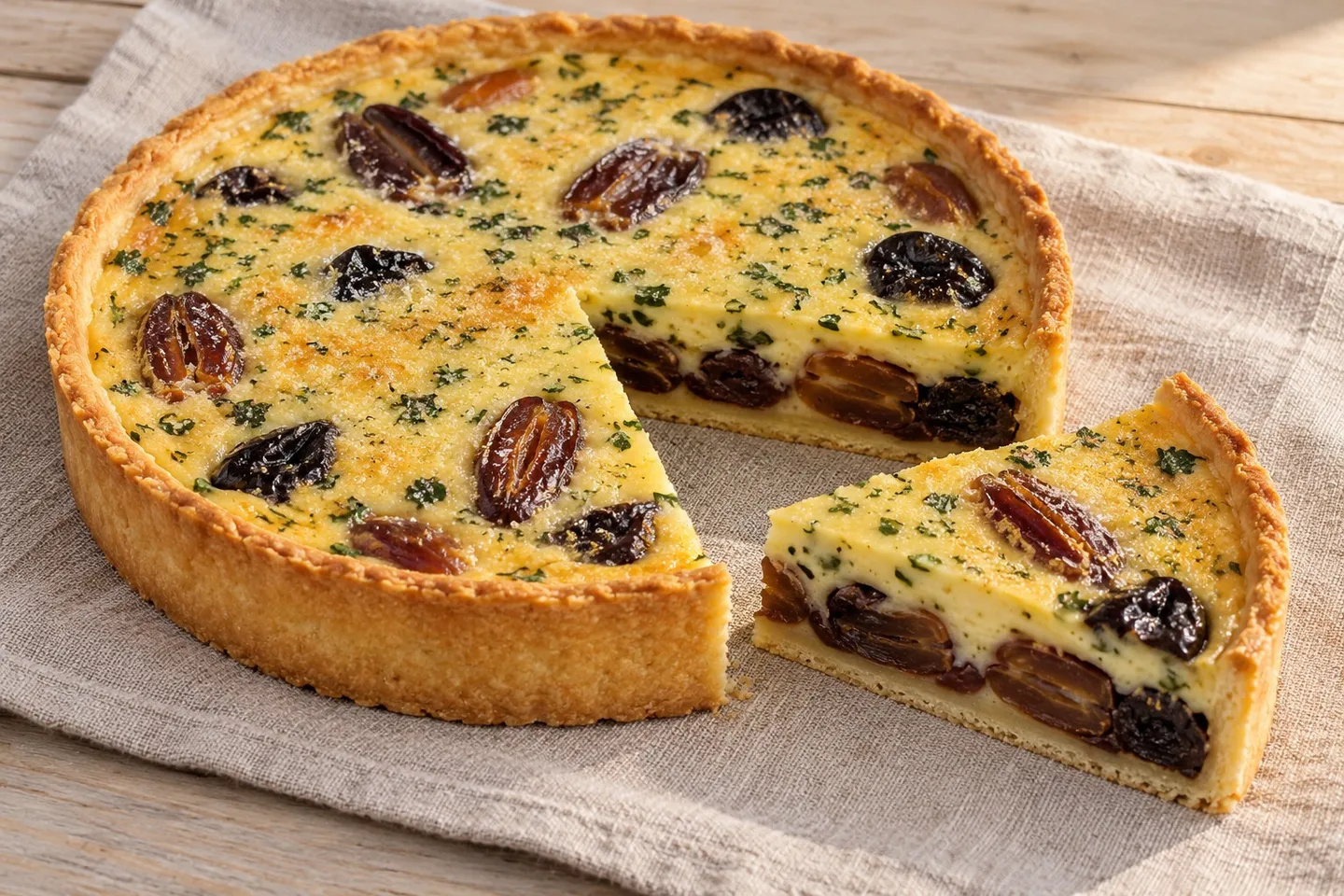
Crustade Lumbard, Custard Tart (1430)
Reader ratingsCrustade lumbard, a custard tart from Henry IV’s first course: dates, prunes and beef marrow in a part-baked pastry case under a custard of cream, eggs and parsley.
- Recipe makes
- One 23 cm tart, 8 servings
- Prep
- Cook
- Total
Chill the pastry for 30 minutes before rolling, and let the baked tart cool for 30 minutes before cutting.
Crustade Lumbard, a custard tart over dates, prunes and marrow.
The story behind the recipe
Twelve years before Henry IV’s coronation, a feast for Richard II and Henry’s father, the Duke of Lancaster, in 1387 had “Crustade lumbard in paste” on its first course. In 1399 the tart was back on the first course, after the heron and before the sturgeon. The manuscript that holds the coronation bill gives the recipe: a pastry case filled with marrow, dates cut in two or three, and prunes, baked until it is a little hard, then filled with cream and eggs strained with parsley, sprinkled with sugar and salt, and baked again until done. In Lent, it says, leave out the eggs and the marrow.
What was a crustade?
A crustade is a dish baked in a crust, an open pie, and lumbard means Lombard, from northern Italy. Thomas Austin, who edited the manuscript in 1888, links this tart in his glossary to the “Custard lumbarde” of the companion manuscript and a “Custad lombard” in another. Marrow, the soft fat inside beef bones, went into sweet and savory dishes alike; Austin noted that it “was then much more used than at present.”
Austin dated the manuscript to about 1430 or 1440, so this is the tart as a cookery book gave it a generation after the feast.
Read more about this recipe
Making it today
Ask a butcher for marrow bones cut in short lengths, and push the marrow out with a thumb; chilled, it slices cleanly. If you can’t get it, cold butter cut in small pieces is the nearest stand-in. The recipe measures nothing. We use enough custard to fill a 23 cm case, sweet enough to taste, with the parsley as a green fleck. Partly baking the fruit and marrow first, as the manuscript does, keeps the base crisp under the custard.
The almond cream that comes before it on the first course is Viaund Ryal, Rice Cream (1430). Where it came among the forty dishes is told in What Was Served at Henry IV’s Coronation Feast?
Crustade lumbard.—Take gode Creme, & leuys of Percely, & Eyroun, þe ȝolkys & þe whyte, & breke hem þer-to, ...
Recipe makes: One 23 cm tart, 8 servings
Ingredients
For One 23 cm tart, 8 servings. Quantities are shown as written.
Quantities as written here, for One 23 cm tart, 8 servings.
Pastry
- All-purpose flour250 g
- Salt, for the pastry1/4 tsp
- Cold butter, diced125 g
- Cold water4 tbsp
Filling
- Pitted dates120 g
- Pitted prunes120 g
- Beef bone marrow, chilled60 g
- Heavy cream300 ml
- Eggs3
- Finely chopped flat-leaf parsley2 tbsp
- Sugar40 g
- Salt, for the custard1/4 tsp
Measurement notes
Ingredients as written here
- 250 g all-purpose flour
- 1/4 tsp salt, for the pastry
- 125 g cold butter, diced
- 4 tbsp cold water
- 120 g pitted dates
- 120 g pitted prunes
- 60 g beef bone marrow, chilled
- 300 ml heavy cream
- 3 eggs
- 2 tbsp finely chopped flat-leaf parsley
- 40 g sugar
- 1/4 tsp salt, for the custard
Equipment
- 23 cm tart pan with a removable base, about 3 cm deep
- Rolling pin
- Baking parchment and baking beans
- Mixing bowls and whisk
 Fine sieve
 Instant-read thermometer
Instructions
Mix the flour and salt for the pastry in a bowl. Rub in the butter until the mixture looks like crumbs, then stir in the cold water until the dough just comes together. Flatten into a disc, wrap and chill for 30 minutes.
Heat the oven to 375°F (190°C).
Roll the pastry out to about 3 mm and line the tart pan, leaving a little overhang. Prick the base, line with parchment, fill with baking beans and bake for 15 minutes. Remove the paper and beans and bake 5 minutes more, until the base looks dry. Trim the overhang.
Cut the dates and prunes in halves or thirds. Slice the bone marrow into small pieces. Scatter the fruit and marrow over the pastry base and bake for 10 minutes, until the marrow begins to melt.
Meanwhile, whisk the cream, eggs, parsley and salt for the custard together and strain through the sieve, pressing the parsley through.
Turn the oven down to 325°F (160°C). Pour the custard over the fruit, sprinkle the sugar over the top, and bake for 30 to 35 minutes, until the custard is set at the edge and just trembles in the center (160°F/71°C on the thermometer).
Cool for 30 minutes on a rack and serve warm or at room temperature.
Nutrition
540calories per serving
- Recipe makes
- One 23 cm tart, 8 servings
- Servings
- 8
Estimated per serving from USDA FoodData Central values for flour, butter, dates, prunes, beef marrow, heavy cream, eggs and sugar.
Recipe notes
When adjusting quantities
One tart. For two, double everything and use two pans.
Notes
Quantities mentioned in these notes don’t change when you adjust the servings.
Keeps 2 days, covered, in the refrigerator. Contains wheat (gluten), milk and egg.
Scaling changes the ingredients only; pan sizes and cooking times need their own judgment. To adapt this recipe further, try the recipe tool at TuneMyRecipe (opens in a new tab), our sister site.
Sources and attribution
After Harleian MS. 279, Crustade lumbard, as printed in Two Fifteenth-Century Cookery-Books, ed. Thomas Austin (London: Early English Text Society, 1888)
Recipe details
- Course
- Dessert
- Dish family
- Desserts & Sweets
- Region
- British
- Era
- Medieval
- Main ingredient
- Fruit
- Difficulty
- Intermediate
- Occasion
- State banquet