The coronation feast of Henry IV · Westminster Hall, London
What Was Served at Henry IV’s Coronation Feast?
Henry IV’s coronation feast of 1399: boar’s head, peacocks, cranes, a custard tart of dates and marrow, rice cream and quinces, in three courses.
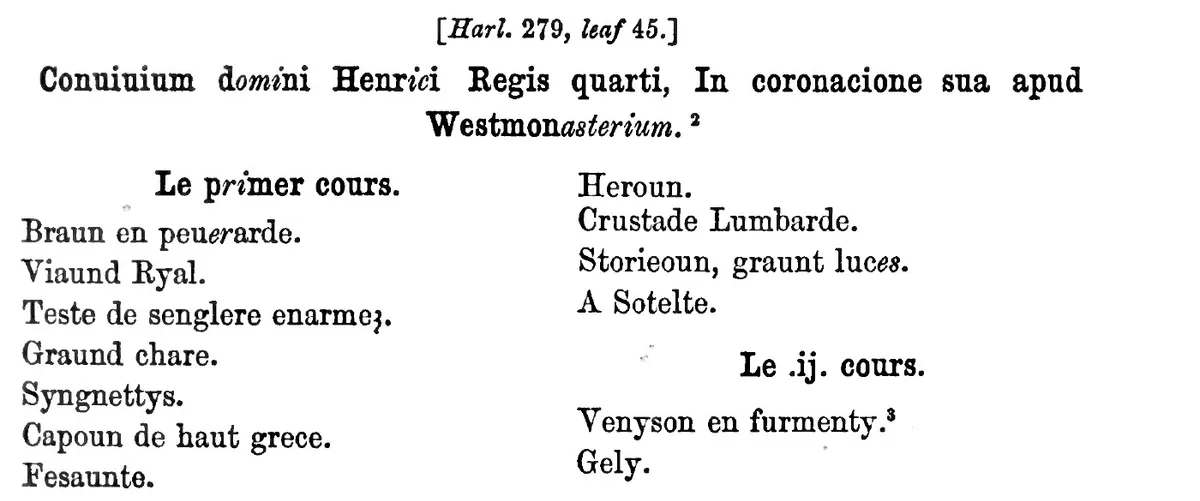
Three courses of meat, game and birds, with sweet dishes among them. The bill of fare for Henry IV’s coronation feast, held in Westminster Hall on October 13, 1399, opens with brawn in a pepper sauce, a rice cream called Viaund Ryal, a boar’s head with its tusks, a heron, a custard tart of dates and marrow, and sturgeon and great pike. The second course brings venison with frumenty, peacocks, cranes and bitterns, and slices of a spiced date paste. The third ends the meal with an almond and chicken pottage, quinces in comfit, curlews, quails, fritters and doucets. Each course closes with a “sotelte,” a showpiece in sugar or paste.
A new king at Westminster
Henry of Bolingbroke took the crown from his cousin Richard II in the autumn of 1399. Thomas Austin, who edited two of these cookery manuscripts for the Early English Text Society in 1888, summarizes the chroniclers: at a Parliament in Westminster Hall, after Richard’s resignation was read out, a vote was taken and “the whole assembly was in Henry’s favour,” with Richard not having four votes. Austin adds that the chronicler John Stow thought Henry had the throne “more by force than by lawful succession or election.”
Henry left the Tower on Sunday, October 12, after making forty-six new Knights of the Bath. On Monday the 13th, St. Edward’s day, he heard three Masses and was led to the Abbey in procession, under a canopy carried, by Holinshed’s account, by the Barons of the Cinque Ports. He was anointed, girded with the Sword of Justice and crowned with the crown of St. Edward. When Mass was over, he went back across to Westminster Hall for the banquet.
Who sat where in Westminster Hall
The king sat at the first table, with the two archbishops and seventeen bishops. His eldest son, the future Henry V, whom Austin calls the Prince of Wales (he was given the title two days later), served him carrying the Sword of Mercy, and the Constable stood on the other side with the Sword of Justice. The great peers had the second table, the leading citizens of London the third, and the Barons of the Cinque Ports, the new knights and the knights and squires of honor had tables of their own.
Each office at the feast went to a named man, and each came with a fee. Sir Thomas Erpingham, as Lord Chamberlain, brought water for the king’s hands before and after the meal and kept the basin and ewer as his fee. The Earl of Somerset carved. Sir William Argentine served the king’s first cup of drink at dinner, by the tenure of his manor in Hertfordshire, and took the silver-gilt cup home. Another man had “the honour of making wafers for the king.”
Three courses and three subtleties
The bill of fare survives in a cookery book now in the British Library, Harleian MS. 279. It is headed in Latin, Conuiuium domini Henrici Regis quarti, In coronacione sua apud Westmonasterium: the feast of the lord King Henry the Fourth at his coronation at Westminster.
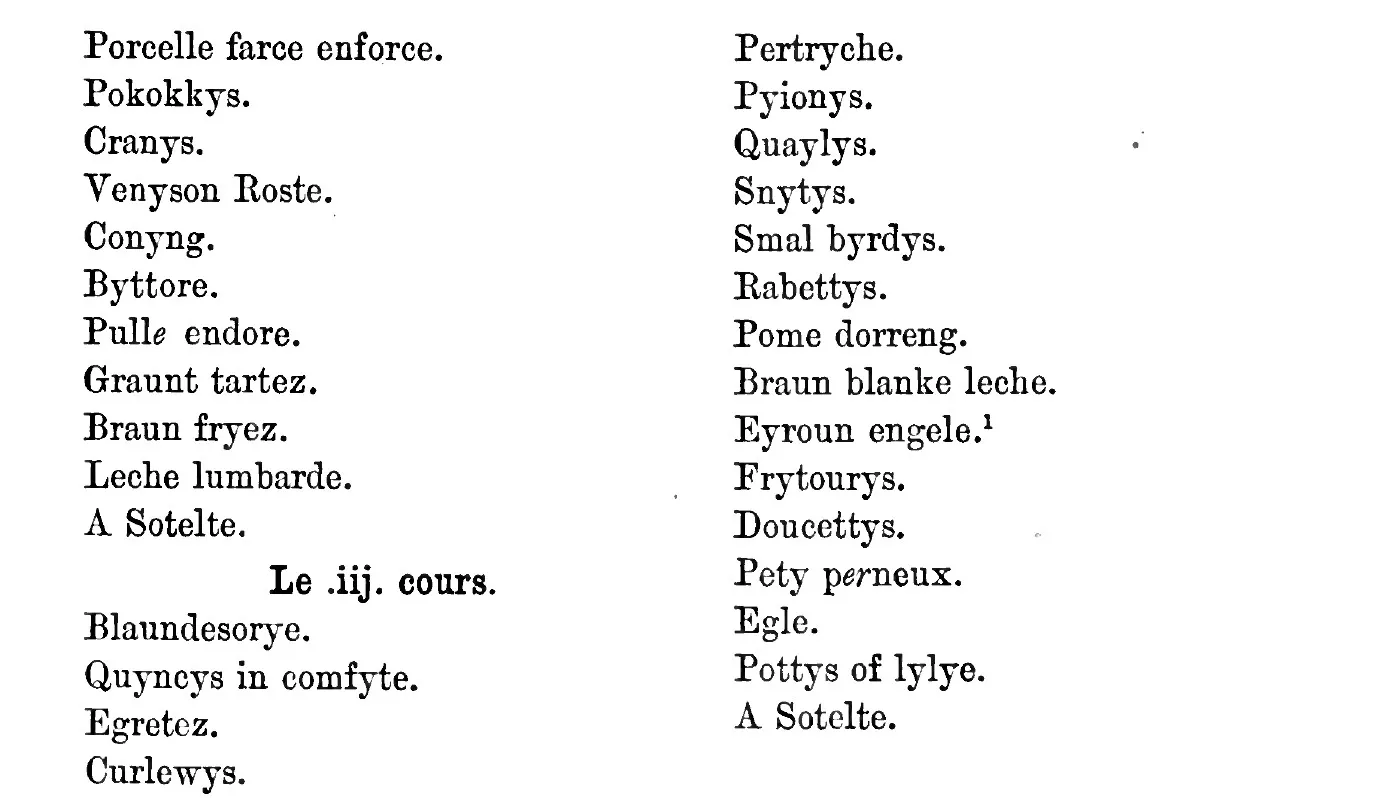 The rest of the second course and the third, from Harleian MS. 279 as printed by Austin (1888), p. 58.
The first course has ten dishes and a subtlety, the second twelve and a subtlety, the third eighteen and a subtlety. Most of the names are French in English spelling. “Graund chare” is great flesh, from the French chair; “Teste de senglere enarmez” is a boar’s head “and tusks,” in Austin’s glossary. The birds run from peacocks, cranes, herons and bitterns to egrets, curlews, partridges, pigeons, quails, snipe and “smal byrdys.” Austin’s footnote reads “Eyroun engele” as iced eggs.
The subtleties came between the courses. Austin describes them as “devices in sugar and paste, and apparently in jelly,” sometimes made to be eaten, and notes that the first of a course was called a warner, because it warned the hall that a new service was coming in. The coronation bill names three, but not what they showed. Sugar showpieces outlasted the Middle Ages by centuries: at Abraham Lincoln’s inaugural ball in 1865, a model of the Capitol in sugar stood at the center of the table, as told in What Was on the Sweets Table at Lincoln’s Inaugural Ball?
The champion rides in
Halfway through the meal, the king’s Champion, Sir Thomas Dymock, rode into the hall in full armor on a horse in crimson trappings, carrying a drawn sword. He handed the king a paper declaring himself ready to fight any knight or gentleman who denied that Henry was the lawful king. Heralds cried the challenge in six places in the hall and the city, and no one answered it. His fee was one of the best horses in the royal stable and one of the best suits of armor.
When Henry had dined, he took “wine and spices” and withdrew to his own rooms. The Lord Mayor followed him with a gold cup of wine, and kept it as his fee, with a second cup that had held water to mix with the wine.
Dates, marrow and almond milk
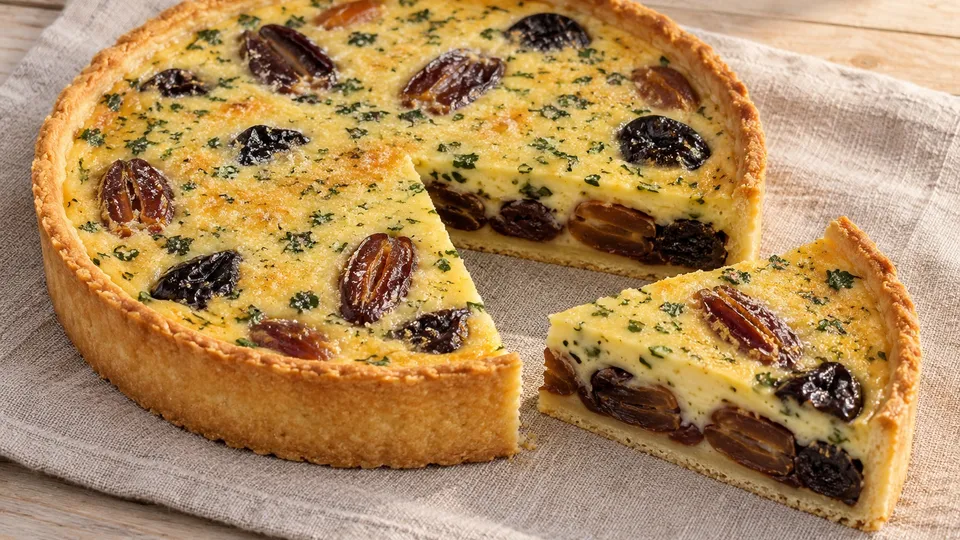
Among the roasts, the bill sets a run of rich, sweet dishes, and the same manuscript gives recipes for four of them. The Crustade Lumbarde is an open tart of dates, prunes and beef marrow under a custard of cream and eggs with parsley. Viaund Ryal, royal food, is almond milk thickened with rice flour until it can be sliced, then strewn with aniseed comfits. Leche lumbarde is a paste of dates boiled in sweet wine and kneaded with ginger and cinnamon, cut in slices and served with a spiced wine syrup. Blaundesorye is almond milk, rice flour and the flesh of capons or hens, spiced with ginger and strewn with mace and cubebs. Harleian MS. 279 bakes its quinces whole in pastry and names a “charde quynce” only in passing; for quinces preserved, the nearest recipe is in its companion manuscript, Harleian MS. 4016, a quince paste made with honey and pepper that “is comfortable for a mannys body, And namely fore the Stomak.”
Marrow was then a common ingredient. Austin, writing in 1888, notes that it “was then much more used than at present.” The companion manuscript, Harleian MS. 4016, keeps a provision list for Richard II and the Duke of Lancaster, Henry’s father, in 1387: fourteen salted oxen, twelve boars, a hundred and forty pigs, three hundred marrowbones and eleven thousand eggs.
The recipes
The recipes are from Harleian MS. 279, which Austin dates to about 1430 or 1440, and one from Harleian MS. 4016, about 1450. They are a generation or two later than the feast, and they are how an English cookery book of that time wrote the dishes on the bill. The modern versions, amounts and temperatures are ours.
- Viaund Ryal, Rice Cream (1430): almond milk set firm with rice flour and sugar, sliced and strewn with aniseed comfits.
- Crustade Lumbard, Custard Tart (1430): dates, prunes and marrow in a pastry case, under cream and eggs with parsley.
- Leche Lumbard, Spiced Date Slices (1430): dates cooked in sweet wine, kneaded with ginger and cinnamon, sliced, with a spiced wine syrup.
- Blaundesorye, Almond Chicken Pottage (1430): chicken breast in almond milk thickened with rice flour, with ginger, mace and cubebs.
- Quince Paste with Honey (1450): quinces cooked soft, pounded, and boiled down with honey, pepper, ginger, galingale and cinnamon.
Cooking it
The quince paste needs a day to set, so it comes first. The Viaund Ryal and the date slices are made the day before too, since both have to set firm before they slice. The custard tart and the almond chicken pottage are the day’s cooking, and both are served warm, the tart cut in wedges, the pottage in bowls with the mace and cubebs strewn on top.
For a coronation table at home, start with the Crustade Lumbard, Custard Tart (1430): it came on the first course with the boar’s head and the heron, and it is the one a modern cook will find most familiar. The tart and the rest of the feast are among our medieval recipes, with the Ménagier’s Paris dishes and the food of the Viking Age. Henry ended his dinner with wine and spices; for what the rest of medieval England drank day to day, Forgotten Drink, our sister site, asks whether medieval people really drank beer instead of water (opens in a new tab).
 Cook it todayCrustade Lumbard, Custard Tart (1430)
Sources
- Two Fifteenth-Century Cookery-Books: Harleian MS. 279 (ab. 1430), & Harl. MS. 4016 (ab. 1450), ed. Thomas Austin (London: Early English Text Society, 1888), pp. vii–xiii, 21, 32, 35, 51, 57–58, 67 and 106–107, and the glossary. Digitized by the Internet Archive.