Braised Beef (1896)
Reader ratingsFannie Farmer’s braised beef of 1896: round of beef browned in salt-pork fat, then four hours covered in a very slow oven over diced vegetables.
- Recipe makes
- 6 servings
- Prep
- Cook
- Total
About 25 minutes rendering the pork and browning the beef, then 3½ to 4 hours covered in a 300°F (150°C) oven, and 10 minutes for the sauce while the beef rests.
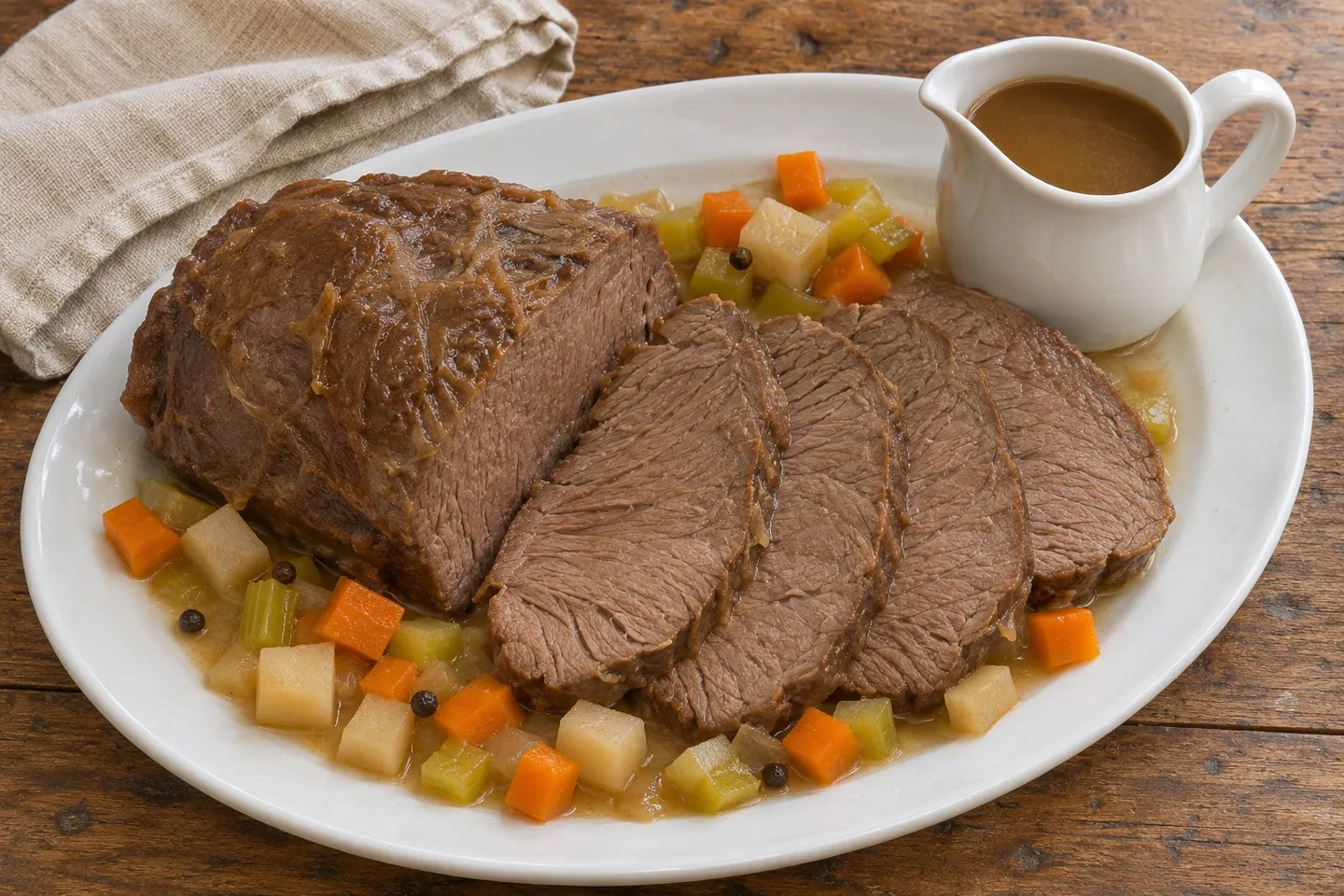
Slices of braised beef with diced braised vegetables and a jug of brown pan sauce.
The story behind the recipe
Fannie Farmer’s braised beef is a cheap joint given four hours under a lid. She asks for beef “from lower part of round or face of rump,” browned in fat from salt pork, set among diced carrot, turnip, onion and celery with three cups of boiling water, and baked in a very slow oven. It was printed in The Boston Cooking-School Cook Book in 1896, some thirty-three centuries after meat was packed into wooden boxes for the tomb of Yuya and Thuya, and it is paired with that tomb food for the contrast: every step of Farmer’s braise is on the page.
Fat you can account for
The chemists who sampled a rib package from that tomb found animal fat in wrappings that had never touched the meat, and could only infer that someone put it there. Farmer leaves no such question. The fat is salt pork, it is named in her list, and it browns the beef before the long cooking starts. The beef is meant for that day’s dinner table. Nothing in the book links it to Egypt; the pairing is ours, made for the contrast.
Read more about this recipe
Braising in the baking table
Farmer files braising with baking. Her time table on page 34 lists “Braised Beef” at 3½ to 4½ hours among the loaves, cakes and puddings, and only baked beans, at 6 to 8 hours, stay in the oven longer. The recipe itself settles on four hours and adds a condition: the liquid is to stay below the boil from start to finish.
Making it today
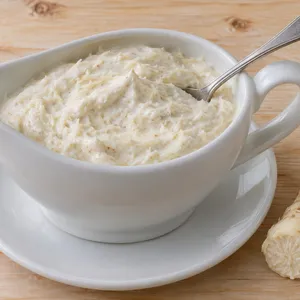
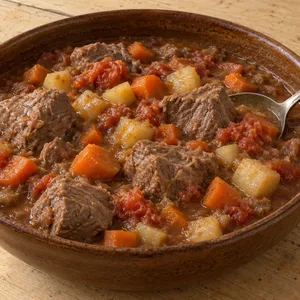
Bottom round is our modern reading of her “lower part of round.” The most consequential choice is the heat. Farmer’s “very slow oven” becomes 300°F (150°C) here, our setting, and the beef rests on its bed of vegetables in place of her trivet. She offers horseradish sauce or a brown sauce from the pan. The brown sauce is given here, thickened with a little flour, and her cold Horseradish Sauce (1896) has its own page; one of her dinner menus serves the two together. The story of the boxed meat, and what its wrappings held, is told in Why Were Egyptian Meat Offerings Wrapped Like Mummies?. The War Department’s Fresh Beef Stew (1896), from the same year, also puts the cheaper parts of beef to slow use.
3 lbs. beef from lower part of round or face of rump. 2 thin slices fat salt pork. ½ teaspoon peppercorns. Carrot, Turnip, Onion, Celery, ¼ cup each, cut in dice. Salt and pepper.
Try out pork and remove scraps. Wipe meat, sprinkle with salt and pepper, dredge with flour, and brown entire surface in pork fat. When turning meat, avoid piercing with fork or skewer, which allows the inner juices to escape. Place on trivet in deep granite pan or in earthen pudding-dish, and surround with vegetables, peppercorns, and three cups boiling water; cover closely, and bake four hours in very slow oven, basting every half-hour, and turn after second hour. Throughout the cooking, the liquid should be kept below the boiling point Serve with Horseradish Sauce or with brown sauce made from liquor in pan.
Recipe makes: 6 servings
Ingredients
For 6 servings. Quantities are shown as written.
Quantities as written here, for 6 servings.
- Fat salt pork, in two thin slices2 oz
- Beef bottom round or rump roast, in one piece3 lb
- Salt1 tsp
- Ground black pepper1/4 tsp
- All-purpose flour for dredging2 tbsp
- Carrot, diced1/4 cup
- Turnip, diced1/4 cup
- Onion, diced1/4 cup
- Celery, diced1/4 cup
- Black peppercorns1/2 tsp
- Boiling water3 cups
- Hot water for topping up, if needed1/2 cup
- All-purpose flour for the sauce1 tbsp
- Cold water for the sauce2 tbsp
Measurement notes
Ingredients as written here
- 2 oz fat salt pork, in two thin slices
- 3 lb beef bottom round or rump roast, in one piece
- 1 tsp salt
- ¼ tsp ground black pepper
- 2 tbsp all-purpose flour for dredging
- ¼ cup carrot, diced
- ¼ cup turnip, diced
- ¼ cup onion, diced
- ¼ cup celery, diced
- ½ tsp black peppercorns
- 3 cups boiling water
- ½ cup hot water for topping up, if needed
- 1 tbsp all-purpose flour for the sauce
- 2 tbsp cold water for the sauce
Equipment
 Large heavy pot
 Tongs, board and knife
 Ladle
 Sieve
 Small saucepan
 Whisk
 Instant-read thermometer
Instructions
Heat the oven to 300°F (150°C), with a shelf low enough to take the covered pot.
Put the fat salt pork in the large heavy pot, which must be ovenproof and have a tight lid, and cook it over medium-low heat until the fat runs and the slices are crisp, 8 to 10 minutes. Lift out and discard the scraps.
Pat the beef dry with paper towels, sprinkle it all over with the salt and ground black pepper, and dust it on every side with the flour for dredging. Turn the heat to medium-high and brown the whole surface of the beef in the pork fat, 10 to 12 minutes, turning it with tongs so the meat is never pierced.
Lift the beef out. Spread the carrot, turnip, onion and celery over the bottom of the pot with the black peppercorns, and set the beef on top of them. Pour the boiling water in down the side of the pot, around the beef, and cover the pot tightly.
Bake for 3½ to 4 hours, basting the beef with the pot liquid every 30 minutes and turning it over after 2 hours. The liquid should barely tremble; if it bubbles, turn the oven down to 275°F (135°C). If the pot starts to look dry, add some of the hot water for topping up.
The beef is done when a fork slides in with little resistance; the thickest part will be far above 145°F (63°C) on the thermometer by then. Move it to the board, cover it loosely and let it rest for 10 minutes.
Pour the pot liquid through the sieve into the small saucepan, keeping the vegetables warm to serve, and skim off most of the fat. Bring the liquid to a simmer. Whisk the flour for the sauce into the cold water for the sauce, whisk it into the simmering liquid and cook for 5 minutes, until the sauce lightly coats a spoon. Taste and add salt if it needs it.
Slice the beef across the grain and serve it with the vegetables and the brown sauce.
Nutrition
440calories per serving
- Recipe makes
- 6 servings
- Servings
- 6
Estimated per serving (6) from USDA FoodData Central values for beef bottom round, salt pork fat, flour, carrot, turnip, onion and celery.
Recipe notes
When adjusting quantities
Farmer’s own quantity, for a 3 lb joint. A bigger joint needs a bigger pot and more boiling water, enough to come about a third of the way up the beef; check it for tenderness from 3½ hours.
Notes
Quantities mentioned in these notes don’t change when you adjust the servings.
Farmer bakes the beef “four hours in very slow oven” and gives no temperature; 300°F (150°C) for 3½ to 4 hours is how we read it, and the oven can come down to 275°F (135°C) to keep her below-boiling liquid. She sets the meat on a trivet in a deep granite pan or earthen pudding dish; a heavy lidded pot with the vegetables under the beef stands in for both. We set the amounts of salt, pepper and dredging flour and the weight of the two slices of salt pork. Her brown sauce has no amounts on this page, so the flour and water thickening and its timing are our own; her horseradish sauce is a separate recipe. Patting dry replaces her wiping. Chill leftovers within 2 hours and eat them within 3 to 4 days, reheated until steaming. Contains wheat (flour) and celery.
Scaling changes the ingredients only; pan sizes and cooking times need their own judgment. To adapt this recipe further, try the recipe tool at TuneMyRecipe (opens in a new tab), our sister site.
Sources and attribution
After Fannie Merritt Farmer, The Boston Cooking-School Cook Book (Boston: Little, Brown, and Company, 1896), Braised Beef
See the original pages (scan at Internet Archive) (opens in a new tab)
Recipe details
- Course
- Main course
- Dish family
- Meat & Poultry
- Region
- American
- Era
- 19th century
- Source decade
- 1890s
- Main ingredient
- Beef
- Difficulty
- Easy
- Occasion
- Everyday meal
- Season
- Winter