- Ancient Egypt
- Egyptian
- New Kingdom
Boxes of dried provisions in the tomb of Yuya and Thuya, reign of Amenhotep III · Thebes, Valley of the Kings · c. 1386 BC
Why Were Egyptian Meat Offerings Wrapped Like Mummies?
Meat for the tomb of Yuya and Thuya was dried, wrapped in cloth and boxed, and one rib’s wrappings held fat and Pistacia resin. What all that work was for.
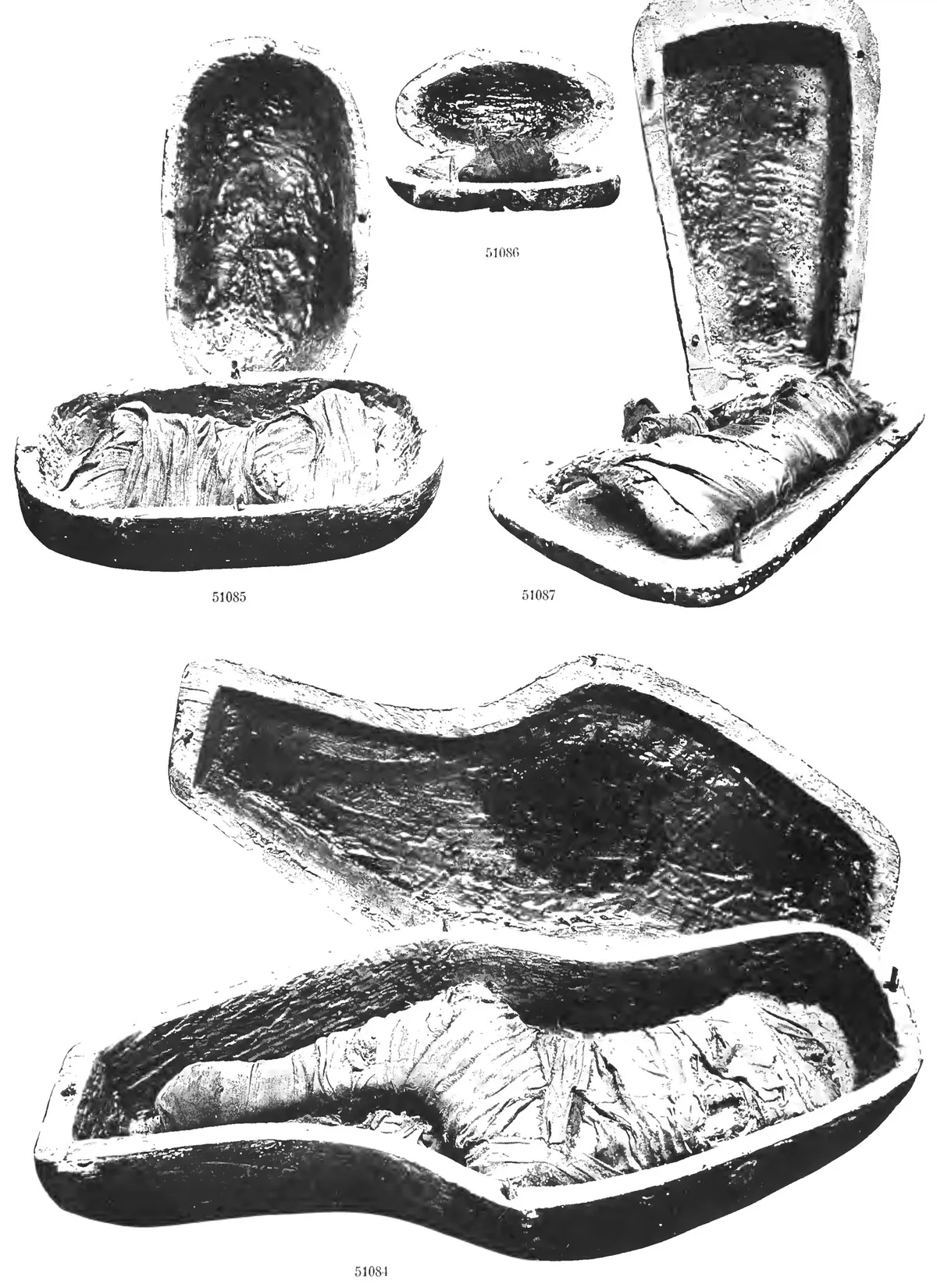
Meat put into an Egyptian tomb was wrapped like a mummy because it had to last as long as the burial. In the tomb of Yuya and Thuya, the parents of Queen Tiye, joints of meat and whole birds were dried, bound in cloth and shut in wooden boxes cut roughly to their shape and coated inside and out. When chemists sampled the wrapping around one package of ribs in 2013, they found animal fat mixed with the resin of a Mediterranean tree. All that labor went into keeping the food, and it leaves out what a cook would most want to know: how the meat was meant to taste at a table.
Eighteen boxes in a small tomb
The tomb was found in February 1905, in a little side valley at Thebes, during excavations paid for by Theodore M. Davis, and its chamber was entered on the morning of the 13th. James Edward Quibell, who took charge of clearing it for the Antiquities Department, wrote it up for the Cairo Museum’s catalogue, printed in 1908. “The tomb is one of the smallest in the valley,” he writes, and he found that “the small size and rough execution of the tomb are in curious contrast with the beauty of its contents.”
Robbers had been there first. They had broken into the outer coffins, upset the lids and piled heavy things on light ones, so that the floor could hardly be crossed without doing damage. The west third of the chamber was cut a meter deeper than the rest, and most of that sunken space held fifty-two large jars of yellow salts. Then comes the food: “In the east and north part of the depression the eighteen boxes of dried provisions were piled.”
Everything was moved fast for fear of theft. On 3 March, Quibell writes, 120 men started carrying the cases down to the river on a very hot day, and 70 of them gave up soon after midday. The boxes reached the museum by train under police guard.
Yuya and Thuya are the spellings most used today; Quibell wrote Yuaa and Thuiu. The 2013 study places the burial in the reign of their son-in-law Amenhotep III, about 1386 to 1349 BC.
A box shaped like its meat
Quibell describes the first box of the series, no. 51084, and lets most of the others refer back to it:
The first of a series of wooden boxes, covered with plaster, then pitched inside and out, and containing some animal or joint of meat, dried and wrapped in cloth. Lid and box are generally of about equal size and pegged together with four pegs. The outline of the boxes follows roughly the shape of their contents.
That first box is 77 centimeters long and appears to hold a leg of veal, with two foot bones wrapped on their own. Its neighbors hold part of another leg of veal, a bird the size of a pigeon, a shoulder of antelope, four detached veal ribs, a complete goose, four more geese and ducks, another bird, an oxfoot and a shoulder of veal. Many of those identifications carry Quibell’s own question marks. “Meat mummy” covers a whole larder of cuts and birds, each with a box made to fit.
The entry that matters most here is one of the shortest:

The 37 centimeters measure the box. Quibell calls its coat pitch, his word for a dark coating; the chemists who later sampled this package took their material from the cloth, so no one in these sources has analyzed what coats the box itself.
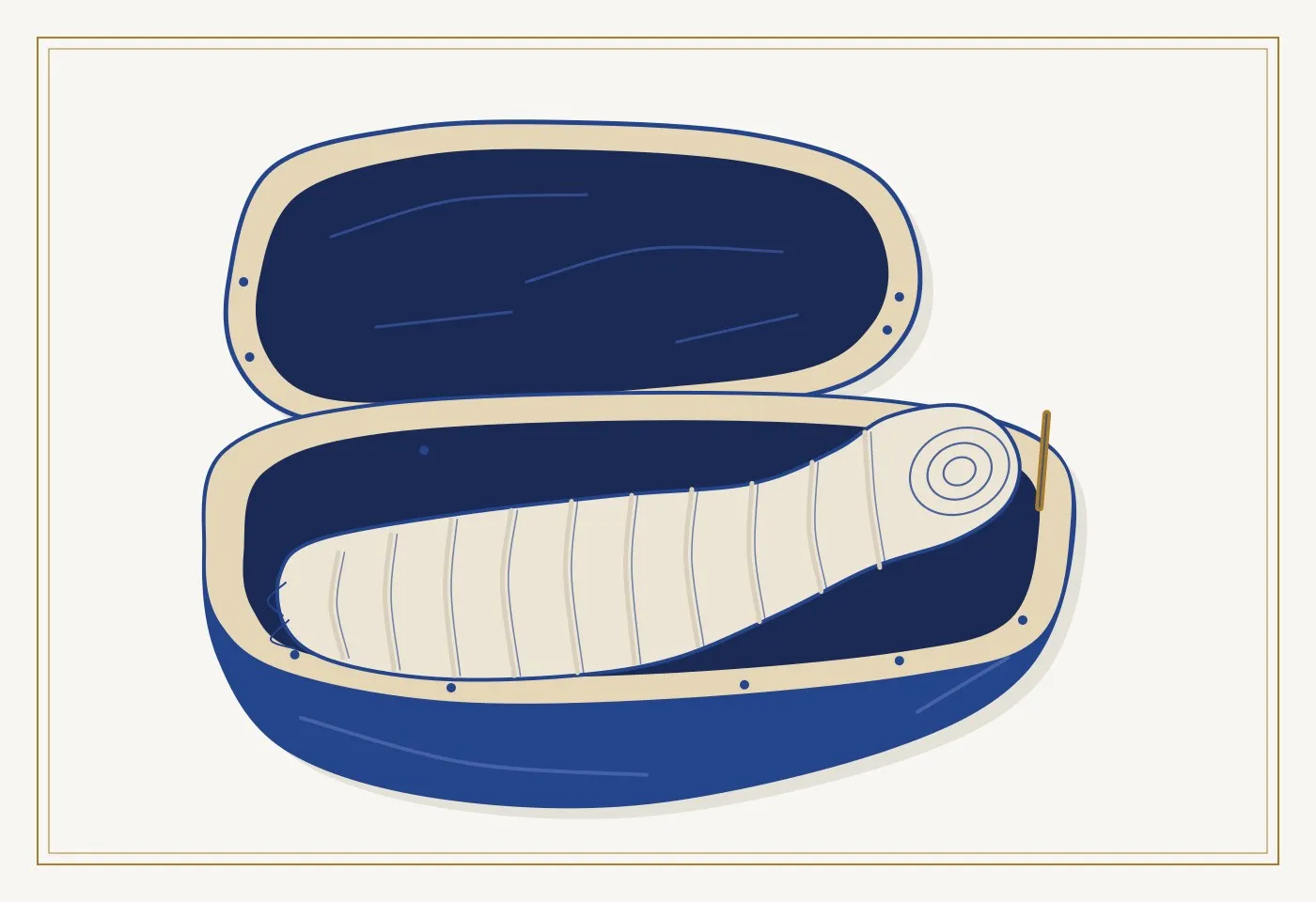
The box and its ribs are in the Egyptian Museum in Cairo. Our drawing, in the site’s own colors, follows the museum photograph printed with the 2013 study: the lid lies open behind the base, the package still sits in its bandages, and one of the pegs that held lid and box together still stands in the rim.
What the wrappings held
A century later, Katherine Clark, Salima Ikram and Richard Evershed asked whether meat for the dead was embalmed the way people were. Hundreds of meat mummies are known, and by their account most are joints of meat or poultry “prepared as if for eating,” then wrapped and boxed; earlier microscope studies had shown that salt and natron dried them. Tutankhamun’s burial alone held 48 carved wooden cases of joints from cattle and poultry. Whether anything was put on the meat besides was the open question.
The Cairo Museum and the British Museum let them sample four mummies, and the results differ from one to the next. The outer bandages of a calf from a burial of about 1070 to 945 BC held animal fat, applied on purpose, since those bandages never touched the meat; there was no wax or resin. A goat leg from the food box of Henutmehyt, about 1290 BC, held fat too, but it could have come from the goat itself. A duck from the same box held no detectable fat at all.
The ribs from Yuya and Thuya’s tomb were another matter. The blackened bandaging, again from layers not touching the meat, held “a mixture of fat/oil and Pistacia resin,” the fat most likely from a ruminant, with traces that may be beeswax. A hump in the chromatogram first suggested petroleum bitumen, but a closer test found none of its markers. The paper names the rib box CG 51098 in its text, the number Quibell gave it, and prints CG 5109 in its table, most likely a dropped digit.
Preserving or flavoring?
The chemistry left open which Pistacia tree gave the resin. Of the Mediterranean species, the authors explain, two yield enough to collect, and their resins are known as mastic gum and Chios turpentine. Egyptians probably called the resin senetjer. It was imported and hard to get, it was burned as incense in temples and at funerals, and it varnished elite coffins. Finding it on food, the authors suggest, reflects the status of a burial so close to the throne.
They also float a second idea: that the resin “might have imparted a special and desirable flavor to the meat,” noting that mastic still flavors seafood, ice cream and desserts in the Mediterranean and the Levant. A balm can do two jobs, and keeping meat and making it taste good need not compete. What the sources don’t give is any sign of which job the makers had in mind. No text names the purpose, no amount survives and nothing shows the resin reached the meat inside.
In 2013 this rib’s resin came some six centuries before any then known from a human mummy, and the authors allowed that later studies might change that.
Kept, never served
The boxes record a sequence of care: a joint cut, dried, wrapped, treated and housed in a coated box shaped to it. They give no seasoning, no cooking, no serving and no amounts, and the resin balm is a tomb treatment with no place in a kitchen. Five centuries earlier, at Asyut, a governor had tried the opposite arrangement. Djefaihapi bound every future senior priest of his city’s temple to give his statue the roast from each bull slaughtered there, a promise that worked only while someone kept delivering, as The Governor Who Made a Contract With Himself tells. The boxes at Thebes needed nobody to come back.
Beef treated for keeping drew a very different response in 1898, when an American general told a commission that refrigerated army beef was what “you might call embalmed beef.” He meant it as an accusation, and the embalmed beef scandal follows the charge through the inquiry. In Thebes, preservation was the whole point.
A Boston dinner, 1896
Eighteen boxes and no meal: the tomb holds provisions but no menu. A dinner written down for the living has to come from somewhere else, and here it comes from Fannie Merritt Farmer’s Boston Cooking-School Cook Book, printed in 1896, about thirty-three centuries after the burial. Farmer has no connection to Egypt. Among the dinner menus at the back of her book is one built on braised beef: tomato soup first, then the beef with horseradish sauce, scalloped potatoes and squash, and a baked Indian pudding to finish. The three recipes below are hers, from the same book, and they come with the details the boxes never record. Her braise names its fat, two thin slices of salt pork, and says what the fat is for, browning a piece of round before four hours under a lid.
The recipes
- Braised Beef (1896): the center of Farmer’s menu, round of beef browned in pork fat and cooked slowly over diced vegetables.
- Horseradish Sauce (1896): the sauce her braise names, grated root and vinegar folded into whipped cream.
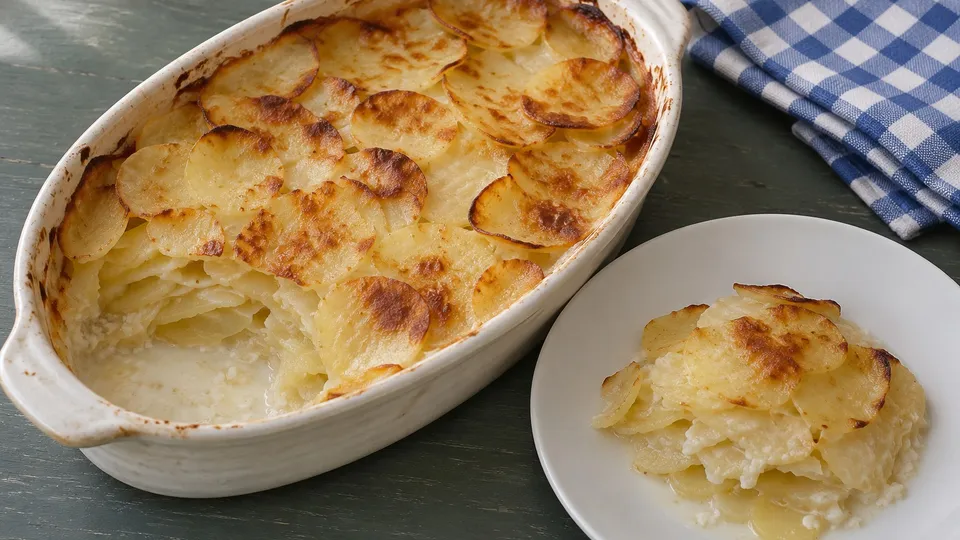
- Escalloped Potatoes (1896): the menu’s scalloped potatoes, sliced and baked in layers with flour, butter and hot milk.
Cooking it
Serve the braised beef the way Farmer’s menu sets it out, with her horseradish sauce and escalloped potatoes: a joint cooked to be eaten that evening, where the ribs in the tomb were wrapped to last. The same tombs show what was poured for the dead and the living, and Forgotten Drink, our sister site, reads one Theban toast in Take, Drink: A Cup of Wine in an Egyptian Tomb (opens in a new tab).
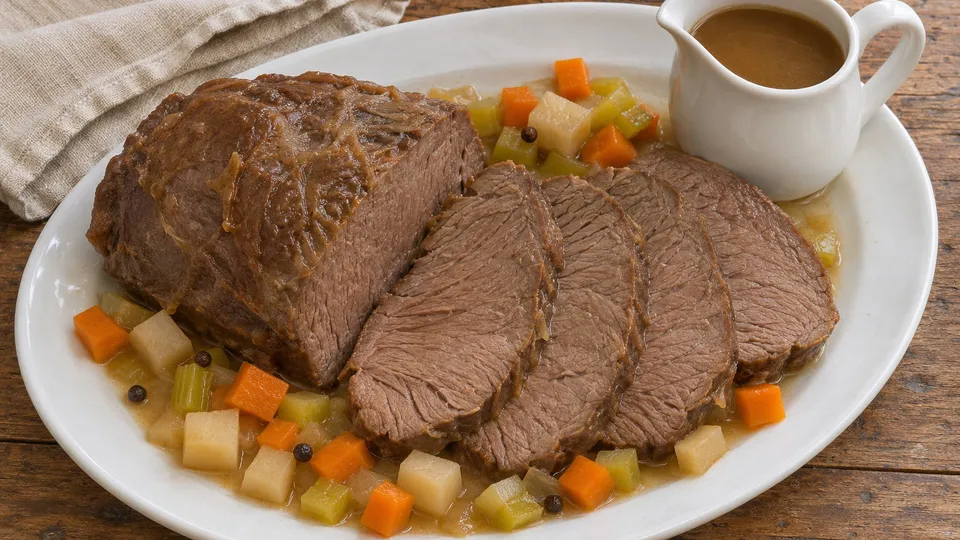 Cook it todayBraised Beef (1896)
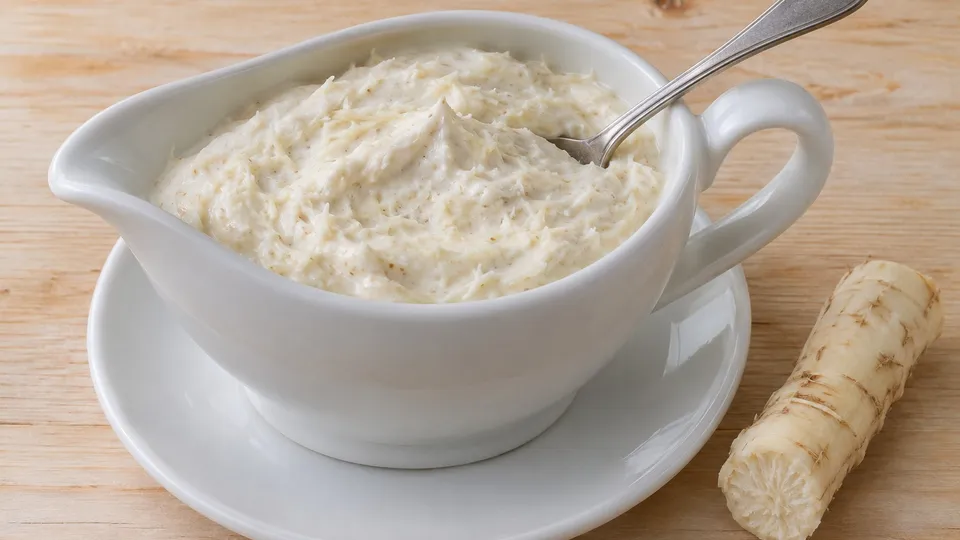 Cook it todayHorseradish Sauce (1896)
 Cook it todayEscalloped Potatoes (1896)
Sources
- J. E. Quibell, Tomb of Yuaa and Thuiu, Catalogue général des antiquités égyptiennes du Musée du Caire, nos. 51001–51191 (Cairo: Imprimerie de l’Institut français d’archéologie orientale, 1908), introduction pp. i–iii, vi; nos. 51084–51101, pp. 46–47; plate XXII. Photographs by E. Brugsch Pasha.
- Katherine A. Clark, Salima Ikram and Richard P. Evershed, “Organic chemistry of balms used in the preparation of pharaonic meat mummies,” Proceedings of the National Academy of Sciences 110, no. 51 (17 December 2013), pp. 20392–20395, doi:10.1073/pnas.1315160110 (opens in a new tab); quoted from pp. 20392–20394, the rest summarized.
- Fannie Merritt Farmer, The Boston Cooking-School Cook Book (Boston: Little, Brown, and Company, 1896): Braised Beef, p. 181; Horseradish Sauce I, p. 246; Escalloped Potatoes, p. 278; dinner menus, p. 518; time table for baking, p. 34. Harvard copy, digitized by the Internet Archive (opens in a new tab).