- Ancient Egypt
- Egyptian
- Middle Kingdom
The sixth contract of Djefaihapi, governor of Asyut · Asyut (Siut), Middle Egypt · c. 1920 BC
The Governor Who Made a Contract With Himself
Djefaihapi, governor of Asyut, traded two inherited temple-days to the priest’s office he held himself, for a roast and beer owed to his statue after his death.
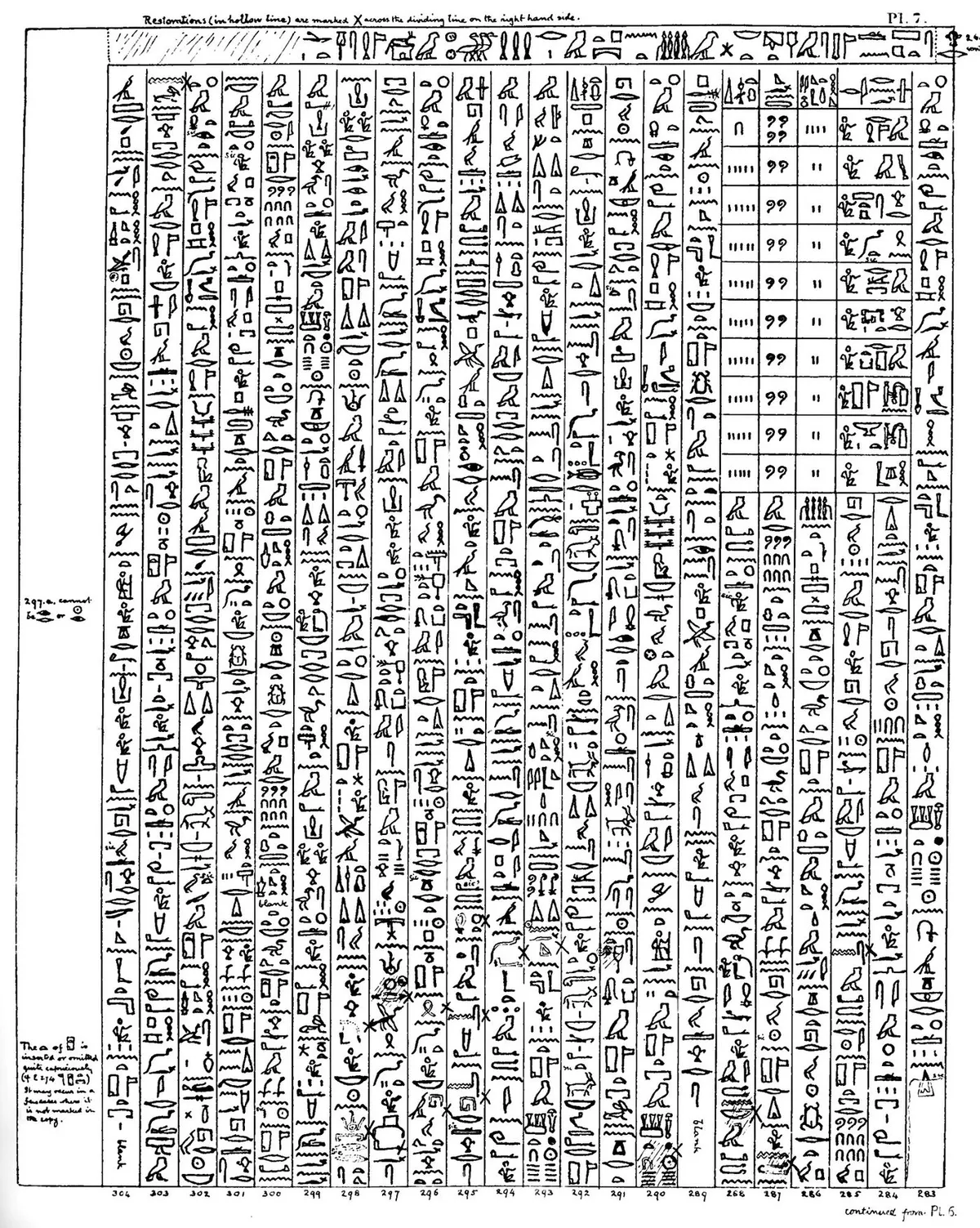
Djefaihapi gained an income for his statue that would outlive him. As governor of Asyut he was also senior priest of the god Wepwawet there, and in the sixth of ten contracts carved in his tomb he makes a deal between those two offices: the governor gives the priest two “temple-days,” a share of the temple’s income that he had inherited from his father, and the priest owes the governor’s statue the roast of meat from every bull slaughtered in the temple and a jar of beer on every procession day. The payment went to the office, so the roast was owed by every senior priest who came after him. Keeping it coming needed three things to outlast him: the priesthood, the statue and the mortuary priest who looked after it.
Ten contracts on a tomb wall
Djefaihapi governed Asyut, on the Nile in Middle Egypt, in the reign of Senusret I, in the twentieth century BC, and the ten contracts were engraved on the east wall of the great hall of his rock-cut tomb. James Henry Breasted, who translated them in the first volume of his Ancient Records of Egypt in 1906, spells the governor’s name Hepzefi and his god Upwawet, and gives his two titles as “count” and “superior prophet.” Djefai-Hapi and Hepzefi are two spellings of one man.
Breasted’s summary of what the contracts are for is short: they “were made solely to secure to Hepzefi, after his death, certain ceremonies and offerings from the priesthoods of Siut.” Nobles of the same time made similar contracts with the priests of Abydos, and so did kings. Breasted put Djefaihapi’s in his collection because civil legal documents from early Egypt are “so rare,” and these give their clauses and payments one by one.
The copy Breasted worked from was made by F. L. Griffith, who visited the tombs in 1886 and 1887 and published his hand-drawn plates in The Inscriptions of Siût and Dêr Rîfeh in 1889. Breasted called it “a model of care and accuracy.” Griffith was careful about what he could not see: “All signs not in existence in January, 1887, are treated as restorations,” drawn in hollow line on his plates and marked with a cross. The sixth contract takes up the three left-hand columns of his Plate VII.
The sixth contract
In Breasted’s English, the contract is made by “the count, the superior prophet, Hepzefi, triumphant,” with “the superior prophet of Upwawet.” Breasted’s footnote to that line reads, “That is, with himself! In his capacity as count he makes a contract with himself in his capacity as superior prophet of Upwawet.” The footnote is Breasted’s; the Egyptian text names the two offices and leaves the reader to notice.
What Djefaihapi receives comes next:
The roast of meat which is due upon the altar, which is placed upon the oblation-table, for every bull which is slaughtered in the temple.
And one (stꜣ-) jar for (every) (ds-) jar of beer every day of a procession; which shall be due to every future superior prophet.
Then what he pays: “He (the count) hath given him (the superior prophet) for it, 2 temple-days from his property, of his paternal estate, but not from the property of the count’s estate.” The words in brackets are Breasted’s, added to keep the two men who are one man apart.
The last clause says where the food goes. “When this roast of meat and this (stꜣ-) jar of beer come for every day of a procession,” the governor declares, “they are due to my statue, (which is) in charge of my mortuary priest.” It closes as every one of the ten does, with agreement, this time before witnesses: “Lo, he was satisfied therewith, in the presence of the official body of the temple.”
What a temple-day was worth
A temple-day was a unit of the temple’s income. The third contract defines it, and the fifth repeats the definition: “as for a temple-day, it is 1/360 of a year.” When everything that comes into the temple, “consisting of bread, of beer, and of meat for each day,” is divided, one temple-day is the right to 1/360 of it. Two temple-days, by simple arithmetic, are a claim on one part in 180 of the temple’s provisions. The contracts give no total for the temple’s income, so the size of that share in loaves or jars can’t be worked out. The jars themselves are a puzzle too: Breasted leaves the two kinds named in the sixth contract in their Egyptian forms, and nothing in the text gives their size.
Djefaihapi insists, in contract after contract, that these days were his own to give. In the third he tells the temple staff, “Behold, it is my property of my paternal estate, but it is not the property of the count’s estate; for I am a priest’s son, like each one of you.” He speaks as a priest’s son, and keeps what he inherited apart from the lands and dues that came with the governorship.
Why bargain with an office?
Because offices outlast people. A promise from the man Djefaihapi would end with him; a promise from “every future superior prophet” would go on as long as Wepwawet’s temple had one. The sixth contract binds the office, and so, by Djefaihapi’s own reckoning, the strangers who would hold it later. The other side of the bargain needed an heir too. The introduction to the ten contracts is a set of instructions to his mortuary priest, the man paid to make his offerings after death:
Behold, all these things, which I have secured by contract from these priests, are under thy charge. For, behold, it is the mortuary priest of a man, who should maintain his possessions and maintain his offering.
Djefaihapi endowed him “with fields, with people, with cattle, with gardens,” told him to have his son and heir hear “every word of my lists,” and ordered that the whole charge pass to that one favored son ahead of the other children, with no dividing it among his own. The statue was the receiver; the mortuary priest and then his son were the ones who would keep watch over the delivery.
Bread and beer for the Wag feast
The sixth contract makes more sense beside the third and fourth, which concern bread and beer for the Wag feast, on the eighteenth day of the first month of the first season. In the third, the official body of the temple promises Djefaihapi bread and beer on that day, set out in a table. The senior priest gives 4 jars of beer, 400 flat loaves and 10 white loaves; each of the nine other officials, from the announcer to the ritual priest, gives 2 jars, 200 flat loaves and 5 white loaves. That comes to 22 jars, 2,200 flat loaves and 55 white loaves, paid for with 22 temple-days. In the fourth, Djefaihapi hands those 22 jars and 2,200 flat loaves on to the temple’s lay priests, in return for a white loaf from each of them for his statue on the same feast day. Counting the beer and flat loaves in both contracts would double them: they come in through one agreement and go out through the next.
The fourth also shows Djefaihapi thinking about a governor who wasn’t him. Part of what he gives the lay priests is relief from fuel dues they owed the governor’s storehouse. Those dues belonged to the office, so he adds a guarantee: “If this fuel be reckoned against you by a future count; behold, this bread and beer shall not be diminished, which the official body of the temple deliver to me, which I have given to you.” Breasted’s note explains why: the fuel “could not be legally conveyed by the count,” because it belonged to the count’s estate and not his father’s. Djefaihapi expected that a successor might undo part of his arrangement, and wrote the contract so the rest would stand.
What the wall leaves out
None of the ten contracts says how the roast was cooked, how big it was, what cut it came from or who cooked it, and none records who ate the offerings once the statue had received them. Nothing on the wall shows how long the roast and beer kept coming after Djefaihapi’s death. His name lasted longer than any record of delivery. The Egyptologist Jochem Kahl notes that Djefaihapi was deified soon after he died, and that twelve visitors’ painted graffiti in another tomb at Asyut, some 400 years later, mention a temple of Djefaihapi and describe its beauty.
The wall may not be the working document either. Kahl argued in 2022 that the terms were presumably agreed aloud and then written on leather or papyrus, now lost, and that the carved version is an edition shaped for the tomb and for Djefaihapi’s remembrance. That doesn’t empty the clauses of meaning. They still separate his father’s property from the governor’s, name the offices bound by them, and plan for a hostile successor.
Djefaihapi’s roast depended on bulls still being slaughtered in the temple and on priests still keeping the bargain. Some five centuries later, the meat for the tomb of Yuya and Thuya at Thebes was handled the other way, dried, bound in cloth and shut in wooden boxes to last in the tomb itself, as Why Were Egyptian Meat Offerings Wrapped Like Mummies? shows.
A Babylonian text has the opposite gaps. The recipes of the Yale tablet, written two centuries or so later, say how each ingredient is handled and give no amounts, as What Did a Babylonian Cook Need to Know? explains. Djefaihapi’s contracts count jars and loaves with care, and say nothing about the kitchen.
The recipes
No Egyptian recipe survives for the roast or the loaves, so both recipes here come from Fannie Merritt Farmer’s Boston Cooking-School Cook Book, printed in Boston in 1896, some 3,800 years after the contracts. They are American kitchen recipes and show nothing about how the temple cooked. What they do show is what a recipe writes down and a contract leaves to the cooks: the heat, the timing, the basting and the dough.
- Roast Beef (1896): Farmer’s roast, floured, seared hot and basted every ten minutes, standing in for the roast from every bull.
- Water Bread (1896): her plainest white yeast loaf, for the white loaves counted out for the statue at the Wag feast.
Cooking it
Put the roast on the table with a loaf of water bread, and two of the things in Djefaihapi’s bargains sit together: the meat from the altar and the white loaves of the Wag feast. The contract owed beer with the roast; how Victorian drink books imagined Egyptian beer is on our sister site Forgotten Drink, in Ancient Beer in Victorian Drink Books (opens in a new tab).
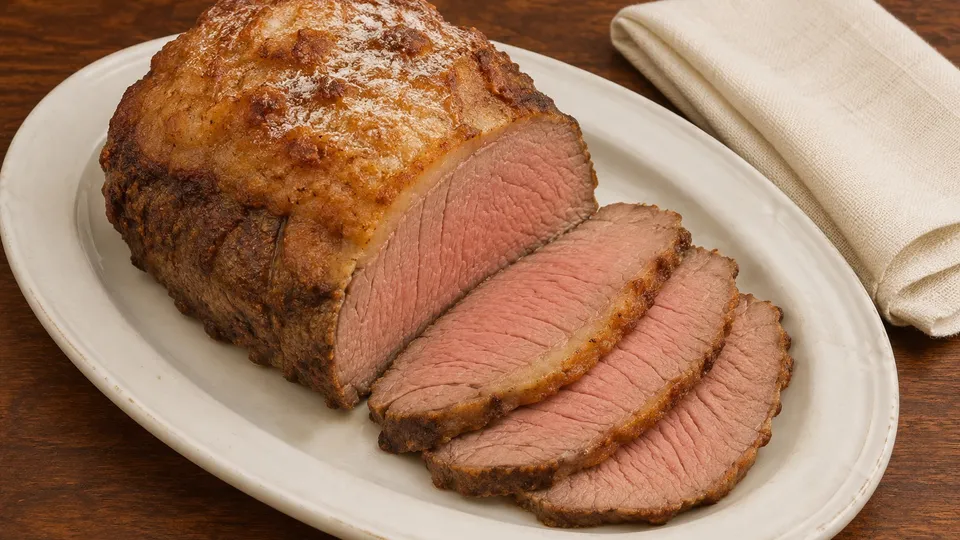 Cook it todayRoast Beef (1896)
 Cook it todayWater Bread (1896)
Sources
- James Henry Breasted, Ancient Records of Egypt, vol. I, The First to the Seventeenth Dynasties (Chicago: University of Chicago Press, 1906), “The Contracts of Hepzefi,” §§535–593, pp. 258–271; the sixth contract §§568–571, pp. 266–267. Brigham Young University copy, digitized by the Internet Archive (opens in a new tab).
- F. L. Griffith, The Inscriptions of Siût and Dêr Rîfeh (London: Trübner and Co., 1889), pp. 8–10 and plates VI–VIII. University of Toronto copy, digitized by the Internet Archive (opens in a new tab).
- Jochem Kahl, “Manuscripts and monuments: the ten contracts of Djefai-Hapi and economies of knowledge,” (opens in a new tab) Manuscript and Text Cultures 1 (2022), pp. 83–111, especially pp. 86–88, CC BY-SA 4.0.
- Fannie Merritt Farmer, The Boston Cooking-School Cook Book (Boston: Little, Brown, and Company, 1896), pp. 34, 54–58 and 179. Harvard copy, digitized by Google.