RMS Titanic, second-class dinner · Second class, North Atlantic
What Was on the Titanic’s Second-Class Dinner Menu?
The Titanic’s second-class dinner of April 14, 1912: haddock, curried chicken, roast turkey and wine jelly, on a card printed as a postcard.
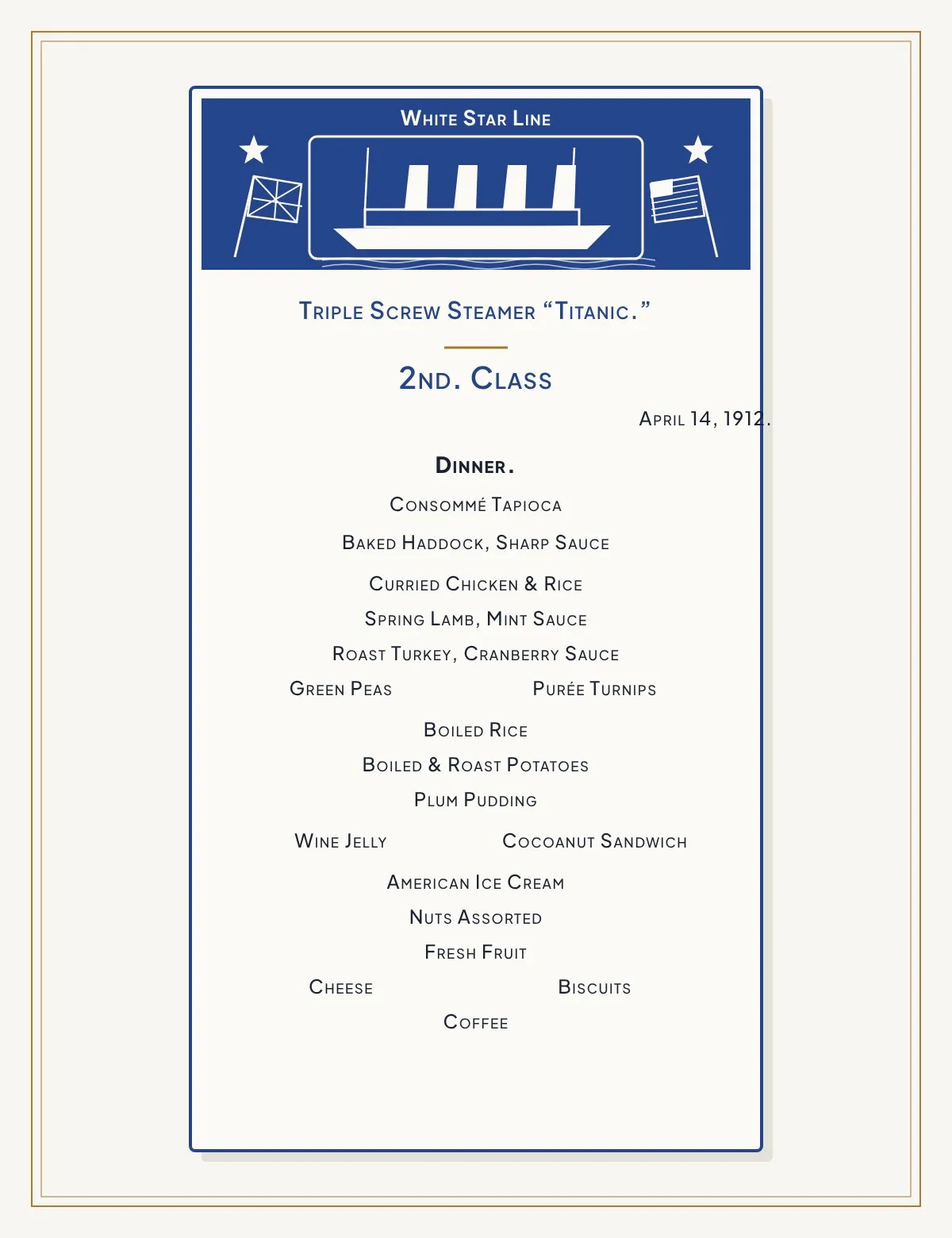
The second-class dinner on the Titanic on Sunday, April 14, 1912, offered consommé tapioca, baked haddock with sharp sauce, curried chicken and rice, spring lamb with mint sauce, and roast turkey with cranberry sauce, with green peas, puréed turnips, boiled rice and boiled and roast potatoes. Plum pudding, wine jelly, coconut sandwich and American ice cream followed, then nuts, fresh fruit, cheese, biscuits and coffee. The card that lists it all was printed as a postcard. On its back are the words “POST CARD,” a ruled space for an address and a box for the stamp.
The card Bertha Watt kept
The copy that survives belongs to the National Maritime Museum in Greenwich, part of Royal Museums Greenwich, as item LMQ/1/12/2. Its catalogue calls it the “Second Class dinner menu from the last night on TITANIC,” kept by survivor Mrs. Bertha J. Marshall, née Watt, and “printed as a postcard,” with an envelope that the museum files separately. The museum shows photographs of both sides on its collection page.
A colored band runs across the top of the front: “White Star Line” over a picture of the ship, a star at either side, the British flag on the left and the American flag on the right. Under it, in blue, come “Triple Screw Steamer ‘Titanic,’” and “2nd Class,” and then, in black capitals, the date and the bill of fare.
What was on the second-class menu?
The card prints the dinner in this order, line by line:
- Consommé Tapioca
- Baked Haddock, Sharp Sauce
- Curried Chicken & Rice
- Spring Lamb, Mint Sauce
- Roast Turkey, Cranberry Sauce
- Green Peas; Purée Turnips
- Boiled Rice
- Boiled & Roast Potatoes
- Plum Pudding
- Wine Jelly; Cocoanut Sandwich
- American Ice Cream
- Nuts Assorted
- Fresh Fruit
- Cheese; Biscuits
- Coffee
After the soup and the fish, three meat dishes take a line each, every one with its sauce. Rice appears twice, once with the curry and again on its own among the vegetables. The card spells the coconut the old way, “cocoanut.” Beyond “consommé” and “purée” it has no French at all, where the first-class card of the same evening ran to filet mignons Lili and punch romaine.
The drinks make the shortest line. Coffee is the only one printed; the wine is in the jelly.
Coffee turned up once more that evening. Lawrence Beesley, a second-class passenger, recalled in his book of 1912 that after dinner a fellow passenger, Mr. Carter, opened the saloon to anyone who cared to come and led about a hundred of them in hymns. “The singing must have gone on until after ten o’clock,” Beesley wrote, “when, seeing the stewards standing about waiting to serve biscuits and coffee before going off duty,” Carter thanked the purser and closed the evening. Beesley talked with the Carters “over a cup of coffee” and was in his cabin by about 10:45.
The back of the card
Turn the card over and it becomes a postcard. The right half reads “POST CARD” in large blue capitals, then “The address to be written on this side,” with a ruled box in the corner for the stamp. On the left, under a rule, a line begins “S.S.” for the name of a steamer, with a second line below it.
Above those lines the card turns into an advertisement. “White Star Line. Royal and United States Mail Steamers,” it begins, then “The Largest Steamers in the World,” and “‘Olympic’ and ‘Titanic,’ each 45,000 tons.” The routes follow: Southampton, Cherbourg, Queenstown and New York; Liverpool to New York and to Boston; Liverpool to Capetown and Australia; London to Capetown and New Zealand, with Shaw, Savill and Albion; New York and Boston to the Mediterranean by way of the Azores; and the White Star–Dominion Canadian Service from Liverpool to Quebec and Montreal. The tonnage is the company’s own figure, printed as publicity.
A passenger could fill in an address, add a stamp and send the dinner home with the line’s map of the world on the back. This copy never made that trip. Its address side carries no address, no stamp and no postmark. The envelope kept with it, a small translucent paper sleeve, shows nothing more in the museum’s photograph of one side than a pencilled “B.” and a reference number.
“To show you how we live”
Another second-class passenger did mean to send a menu home that day. Esther Hart was traveling with her husband and their daughter, Eva, and on April 14 she wrote a letter on board to post home. Its text was reproduced when the letter came up for auction with Henry Aldridge & Son in 2014, and one line is about food: “I am sending you on a menu to show you how we live.”
The letter was never posted. The Associated Press, reporting the sale, said Esther’s husband gave her his coat to keep warm and that she found the letter in its pocket after the rescue. Her husband did not survive.
The letter names no dish, so the menu she meant to send can’t be identified, and nothing ties it to the card in Greenwich. They are two papers from the same day, kept by different families.
The Watt family’s papers carry a caution of their own. Christie’s once catalogued a second-class passenger list as “carried off the ship by Miss Bertha Watt,” then corrected the lot in a sale-room notice to name her mother, Mrs. James Watt. That correction belongs to the list. The museum’s record for the menu still names Bertha, and a story about one paper doesn’t settle the other.
The dishes in a 1906 kitchen
No recipe from the Titanic’s kitchens survives, and no record says which cookbooks its cooks used. The kitchen itself is on record. The Shipbuilder’s 1911 special number on the Olympic and Titanic puts one kitchen between the first- and second-class dining saloons, so both menus came from the same ranges: two of them, with 19 ovens between them, beside a bakery and a confectioner’s room. For an English kitchen of the time, a good guide is Mrs. Beeton’s Book of Household Management in Ward, Lock’s new edition of 1906, six years before the voyage. It has recipes for the haddock, the sharp sauce, the turkey with its sauce and the wine jelly.
Its sharp sauce, no. 277, carries the French name “Sauce Piquante”: shallots reduced in vinegar with a bay leaf and thyme, then gherkins, capers and a brown Espagnole sauce. Its baked haddock is stuffed with forcemeat, trussed “in the shape of the letter S,” and served with anchovy or melted butter sauce. The book calls haddock “Seasonable from August to February,” so by Beeton’s reckoning the April card served it out of season.
The turkey line matches the book almost word for word. Beeton’s cranberry sauce, no. 331, is headed “For Roast Turkey, Fowl, etc.,” and finishes with port and red currant jelly and a turn through a strainer. Her roast turkey fills the crop with sausage meat and lays bacon across the breast, though she sends it to table with bread sauce.
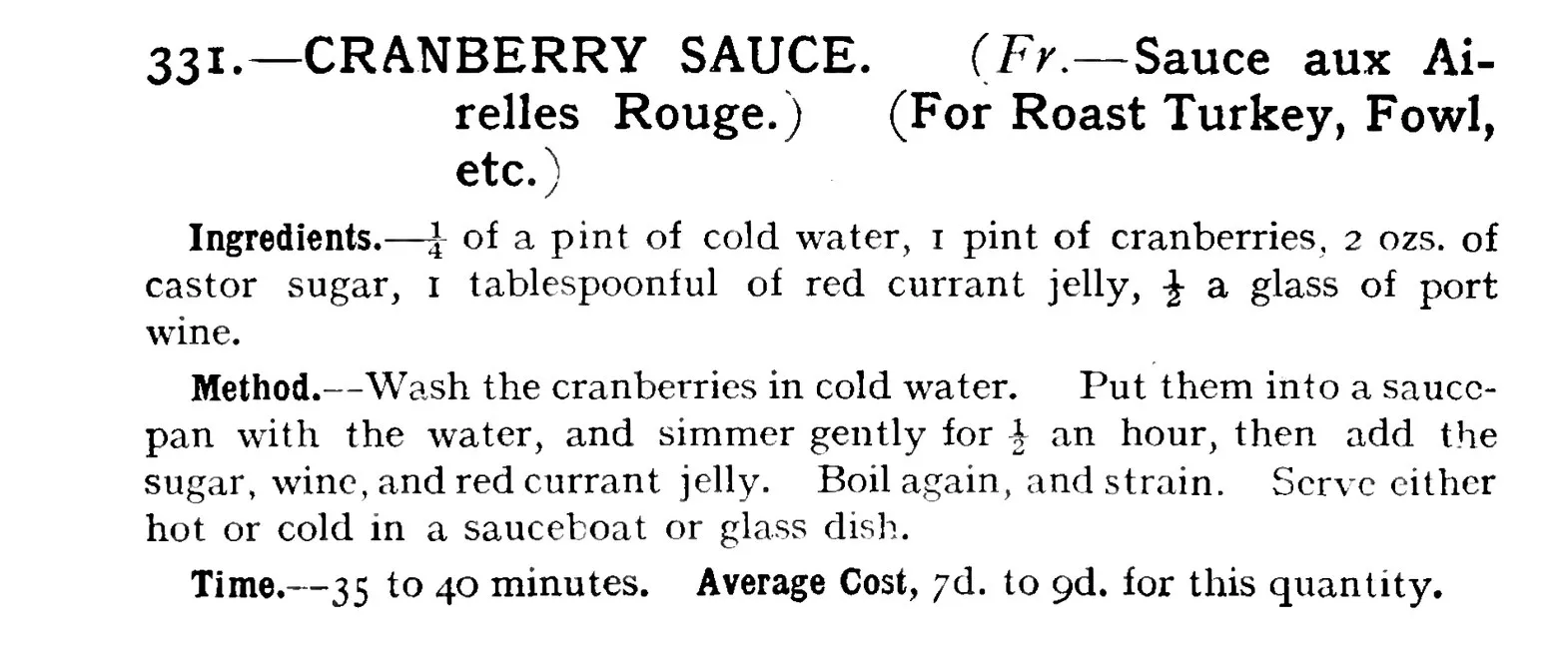 Cranberry Sauce, no. 331, in Mrs. Beeton’s Book of Household Management (London: Ward, Lock, 1906), p. 264.
The wine jelly goes under the card’s own name, no. 2020, with “Gelée au Vin” beside it: a quart of water to a third of a pint of sherry or Marsala, with sugar, gelatine, orange, lemon and coriander seed, cleared by boiling it up with the whites and shells of two eggs and straining it through a hot jelly bag.
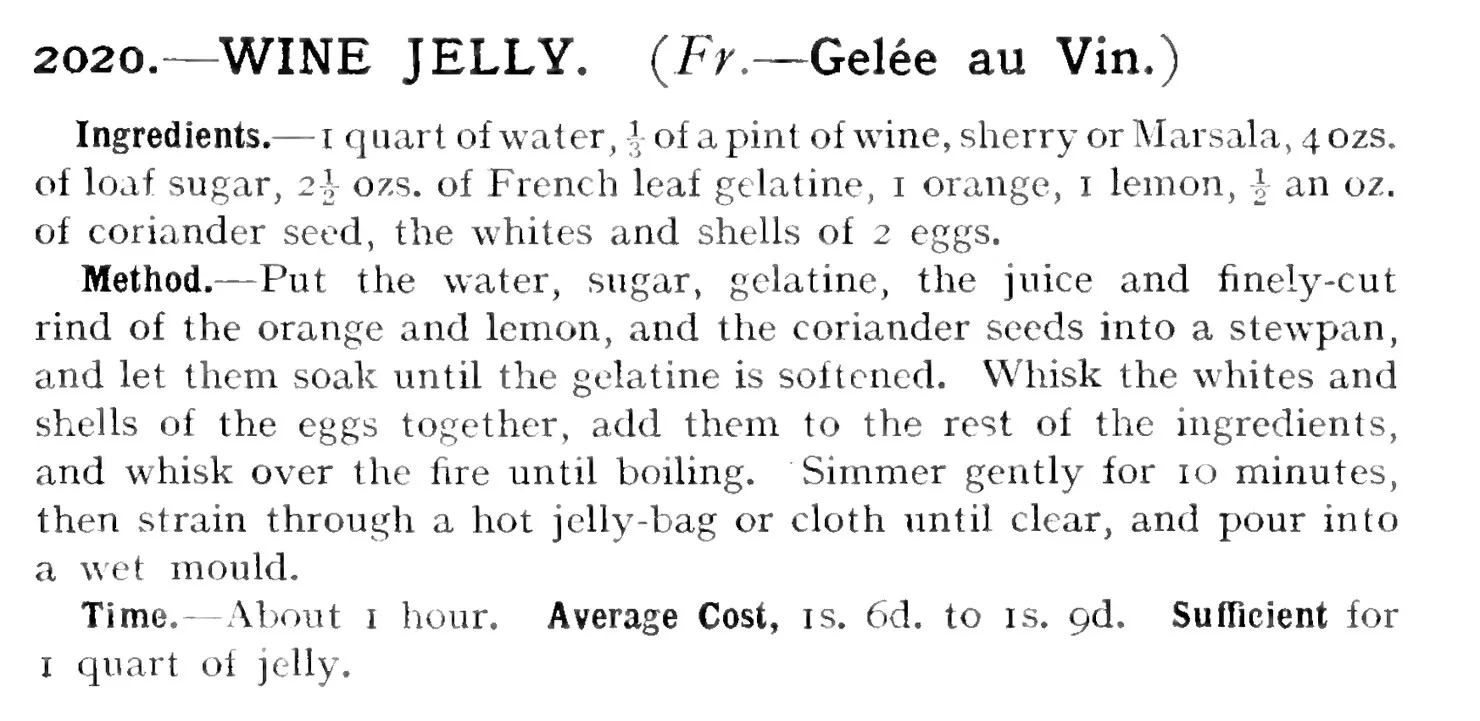 Wine Jelly, no. 2020, in Mrs. Beeton’s Book of Household Management (London: Ward, Lock, 1906), p. 1001.
The curry and the plum pudding already have recipes on TuneMyRecipe, our sister site, in What They Ate on the Titanic: Three Classes, Three Tables (opens in a new tab). Its curry was made for this second-class card, from Beeton’s curried fowl of 1861; its plum pudding was made for the third-class dinner of the same day.
The recipes
Five dishes from the card, in the order it prints them. Three are here, all from the 1906 Beeton, and two link out to TuneMyRecipe.
- Baked Haddock with Sharp Sauce (1906): the fish course, Beeton’s stuffed baked haddock with her sharp sauce, a pairing the card makes and the book doesn’t.
- Curried Chicken and Rice (opens in a new tab), on TuneMyRecipe: the first of the three meat dishes.
- Roast Turkey with Cranberry Sauce (1906): the last of the three, with sausage meat under the neck skin and Beeton’s strained cranberry sauce.
- Plum Pudding with Sweet Sauce (opens in a new tab), on TuneMyRecipe: the first of the sweets.
- Wine Jelly (1906): Beeton’s sherry jelly with orange, lemon and coriander, cleared with egg whites and molded.
The consommé tapioca, the coconut sandwich and the American ice cream are left out. The 1906 Beeton has no coconut sandwich, and the only ice cream it calls American is flavored with tea, which the card doesn’t mention.
A menu meant to leave the ship
The other two cards of that Sunday read differently: the first-class dinner in hotel French, and the third-class bill of fare with four meals and a notice about complaints. The second-class card spoke English to its diners on one side and, on the other, waited for an address ashore, on the same day that a second-class passenger wrote of sending a menu home.
Bring the wine jelly in where the card puts it, after the plum pudding and before the American ice cream. For the coffee that closed this dinner, and the drinks of the other two classes, Forgotten Drink, our sister site, asks What Did People Drink on the Titanic? (opens in a new tab)
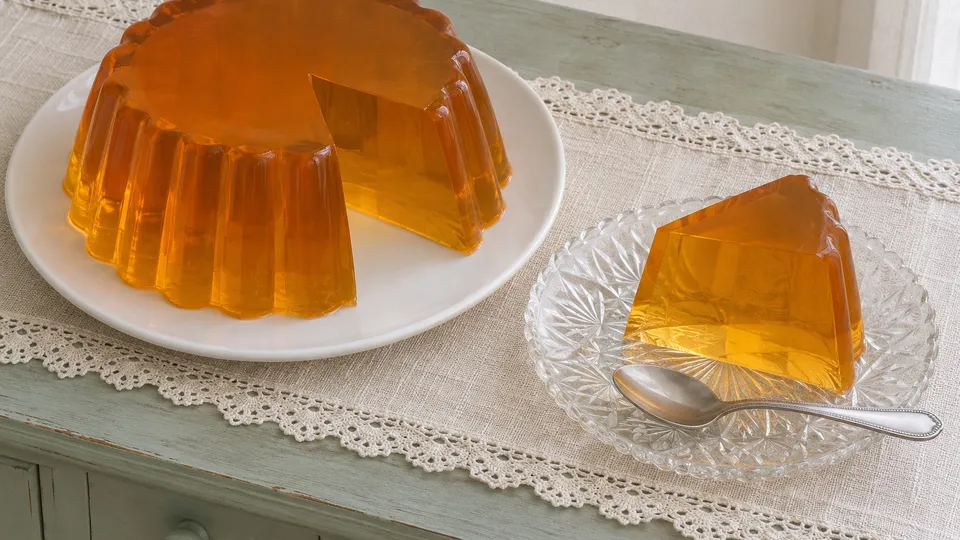 Cook it todayWine Jelly (1906)
Sources
- White Star Line, second-class dinner menu, R.M.S. “Titanic,” April 14, 1912, printed as a postcard: National Maritime Museum, Greenwich, London, LMQ/1/12/2, Royal Museums Greenwich collection record (opens in a new tab), with photographs of both sides.
- Lawrence Beesley, The Loss of the SS. Titanic: Its Story and Its Lessons (Boston and New York: Houghton Mifflin, 1912), pp. 46–49. Internet Archive (opens in a new tab).
- Esther Hart, letter written on board, April 14, 1912, as reproduced for the Henry Aldridge & Son sale, 2014: Encyclopedia Titanica (opens in a new tab).
- Associated Press, report of the Henry Aldridge & Son sale, April 26, 2014, at KPBS (opens in a new tab).
- Christie’s, lot 5093799 (opens in a new tab): a second-class passenger list for the R.M.S. Titanic, with its sale-room notice.
- The Shipbuilder, special number on the White Star liners Olympic and Titanic (Newcastle and London: The Shipbuilder, 1911), pp. 102 and 104. Internet Archive (opens in a new tab).
- Mrs. Beeton’s Book of Household Management, new edition (London: Ward, Lock, 1906), nos. 277, 331, 501, 1272, 2020 and 2214, pp. 250, 264, 333–334, 723, 1001 and 1054, read in the Wellcome Collection copy at the Internet Archive (opens in a new tab).