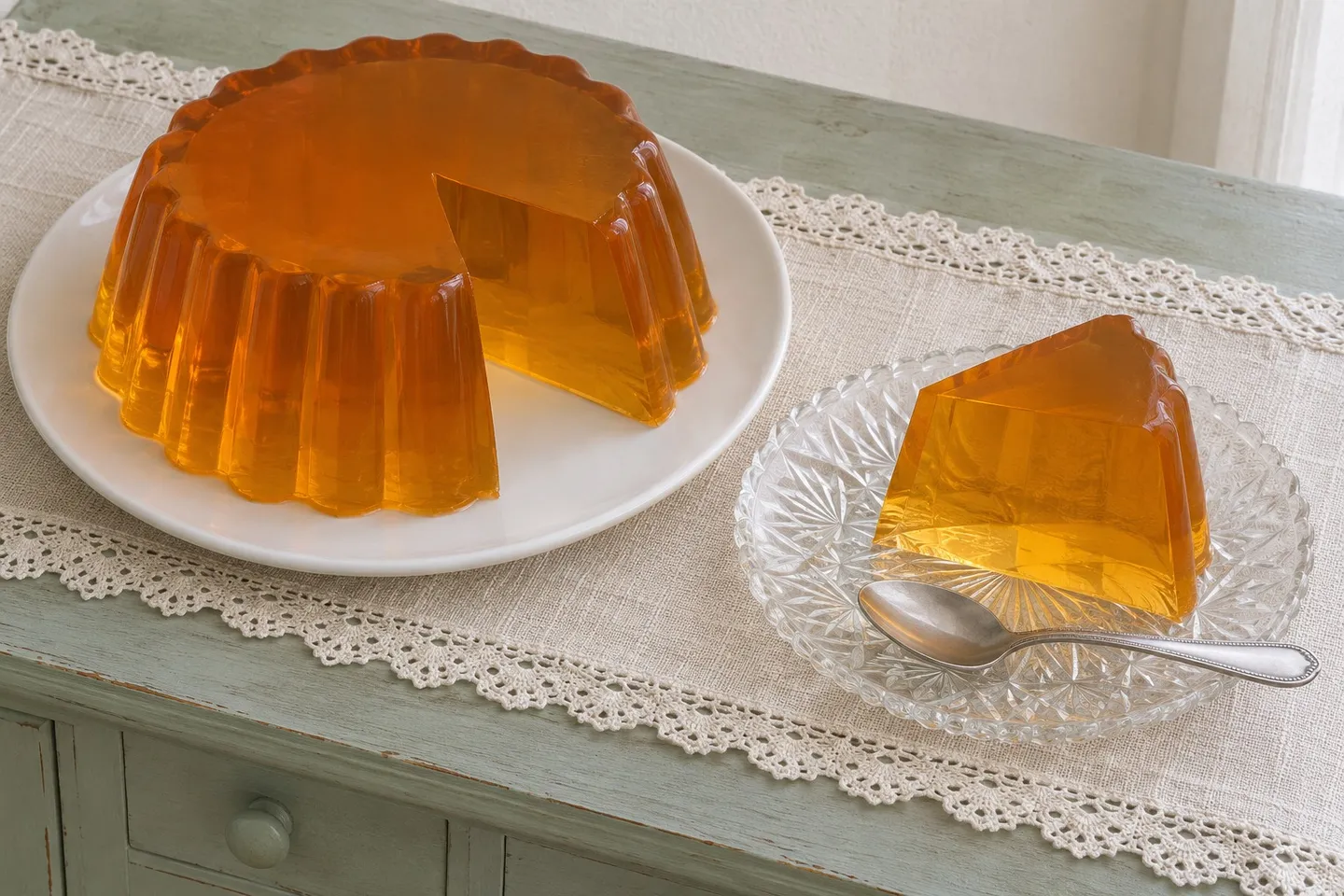
Wine Jelly (1906)
Reader ratingsWine jelly, a sweet on the Titanic’s second-class dinner card of April 14, 1912: Mrs. Beeton’s 1906 sherry jelly with orange, lemon and coriander seed, cleared with egg whites.
- Recipe makes
- about 1 quart (40 fl oz), serving 8
- Prep
- Cook
- Total
About an hour of work, as Beeton says, most of it the slow drip through the jelly bag. Then at least 4 hours in the refrigerator to set; overnight is easier.
Amber sherry jelly turned out of a fluted mold, with one slice served.
The story behind the recipe
The 1906 edition of Mrs. Beeton’s Book of Household Management clears its wine jelly with eggshells. Two egg whites and their shells are whisked into the pan with the water, sugar, gelatine, orange, lemon and coriander seed, brought to the boil and then caught in a hot jelly bag, taking the cloudiness with them. On the Titanic’s second-class dinner card for April 14, 1912, “Wine Jelly” shares a line with coconut sandwich, between the plum pudding and the American ice cream.
A jelly that other sweets are built on
Recipe no. 2020 gives its French name as “Gelée au Vin” and asks for “1 quart of water, ⅓ of a pint of wine, sherry or Marsala.” It also asks for half an ounce of coriander seed, which goes into the pan with the citrus rind and comes out again in the bag. The book prices the whole at 1s. 6d. to 1s. 9d., about £8 to £9 today by UK consumer prices (Bank of England), “Sufficient for 1 quart of jelly.”
Beeton treats this jelly as a starting point as much as a dessert. At least ten of the book’s cold sweets, from grape jelly and jelly with bananas to tapioca cream and pineapple mousse, call for “lemon or wine jelly,” and its note on stock for sweet jellies sends the cook back to no. 2020.
The card names the dish and stops there. This is the wine jelly of a London household book printed six years before the voyage, the same edition behind this menu’s haddock and turkey.
Read more about this recipe
Making it today
Beeton’s 2½ ounces of French leaf gelatine is far more than modern powdered gelatin needs for this much liquid. By Knox’s reckoning of one envelope to 2 cups, about three-quarters of an ounce would set it softly; we use a full ounce so the jelly stands up when turned out. The method never says when the wine goes in, so adding it with everything else, where it clears with the jelly, is also our choice.
The first-class card of the same evening ended with a jelly too, and Peaches in Chartreuse Jelly (1912) is cleared the same way, with whites and shells. How this one sat among the other sweets of the second-class dinner, and on a card printed as a postcard, is told in What Was on the Titanic’s Second-Class Dinner Menu?
2020.—WINE JELLY. (Fr.—Gelée au Vin.)
Ingredients.—1 quart of water, ⅓ of a pint of wine, sherry or Marsala, 4 ozs. of loaf sugar, 2½ ozs. of French leaf gelatine, 1 orange, 1 lemon, ½ an oz. of coriander seed, the whites and shells of 2 eggs. ...
Recipe makes: about 1 quart (40 fl oz), serving 8
Ingredients
For about 1 quart (40 fl oz), serving 8. Quantities are shown as written.
Quantities as written here, for about 1 quart (40 fl oz), serving 8.
- Orange1
- Lemon1
- Cold water40 fl oz
- Powdered gelatin1 oz
- Sugar4 oz
- Coriander seeds0.5 oz
- Egg whites, with their shells2
- Sherry or Marsala6 1/2 fl oz
Measurement notes
Ingredients as written here
- 1 orange
- 1 lemon
- 40 fl oz cold water
- 1 oz powdered gelatin
- 4 oz sugar
- 0.5 oz coriander seeds
- 2 egg whites, with their shells
- 6.5 fl oz sherry or Marsala
Equipment
 Vegetable peeler
 Large saucepan
 Whisk
 Jelly bag, or a sieve lined with a doubled clean cloth
 2-pint (about 1.2 L) jelly mold
Instructions
Pare the rind of the orange and the lemon thinly with the peeler, leaving the white pith behind, and cut it into fine strips. Squeeze both fruits and strain the juice.
Pour the cold water into the large saucepan and sprinkle the powdered gelatin over it. Add the sugar, the rind and juice and the coriander seeds, and leave for 10 minutes, until the gelatin has softened.
Wash the eggs before you crack them, separate them and keep the yolks for another dish. Crush the shells into the egg whites and whisk them together until frothy.
Add the egg whites and shells and the sherry or Marsala to the pan. Set it over a medium heat and whisk steadily until it comes to the boil. Stop whisking as soon as it starts to rise; a gray crust forms on top.
Lower the heat and let it simmer very gently, without stirring, for 10 minutes.
Meanwhile, pour boiling water through the jelly bag or cloth to heat it, wring it out and hang it over a bowl.
Ladle the jelly, crust and all, into the hot bag and let it drip through without squeezing, 15 to 20 minutes. If the first cupful runs cloudy, pour it back through the bag.
Rinse the mold with cold water and shake it out. Pour in the clear jelly, setting any that won’t fit in a glass, let it cool to room temperature, then cover and refrigerate at 40°F (4°C) or below for at least 4 hours, or overnight, until set firm.
To turn it out, dip the mold in warm water for a few seconds, loosen the edge with a fingertip, set a plate on top and turn both over together. Serve chilled.
Nutrition
100calories per serving
- Recipe makes
- about 1 quart (40 fl oz), serving 8
- Servings
- 8
Estimated per serving (8) from USDA FoodData Central values for sugar, gelatin, medium sherry, orange juice and lemon juice; the egg whites, shells, rind and seeds used to clear and flavor the jelly are strained out.
Recipe notes
When adjusting quantities
Beeton’s quantity makes about a quart of jelly for one 2-pint mold. Halve everything for a small mold or four glasses, keeping one egg white and its shell.
Notes
Quantities mentioned in these notes don’t change when you adjust the servings.
Our changes: powdered gelatin in place of French leaf gelatine, at a lower weight; granulated sugar for loaf sugar; the wine added with the other ingredients, which the book leaves unsaid; the soaking time, the refrigerator and the turning out.
Leaf gelatine can replace the powder; follow the maker’s guide for a jelly that turns out, for about 50 fl oz of liquid.
The wine simmers for 10 minutes, so some of its alcohol cooks off and some stays; the jelly isn’t for children. It keeps, covered, in the refrigerator for 2 to 3 days. Leave it out of the refrigerator no more than 2 hours. Contains egg and sulfites (wine). Gelatin is made from animal collagen.
Scaling changes the ingredients only; pan sizes and cooking times need their own judgment. To adapt this recipe further, try the recipe tool at TuneMyRecipe (opens in a new tab), our sister site.
Sources and attribution
After Mrs. Beeton’s Book of Household Management, new edition (London: Ward, Lock, 1906), Wine Jelly, no. 2020, p. 1001; dish as printed on the Titanic’s second-class dinner card of April 14, 1912
See the original pages (scan at Internet Archive) (opens in a new tab)
Recipe details
- Course
- Dessert
- Dish family
- Desserts & Sweets
- Region
- British
- Era
- Edwardian
- Source decade
- 1900s
- Event
- Titanic, 1912
- Main ingredient
- Wine & spiritsFruit
- Difficulty
- Intermediate
- Occasion
- Dinner party