Baked Haddock with Sharp Sauce (1906)
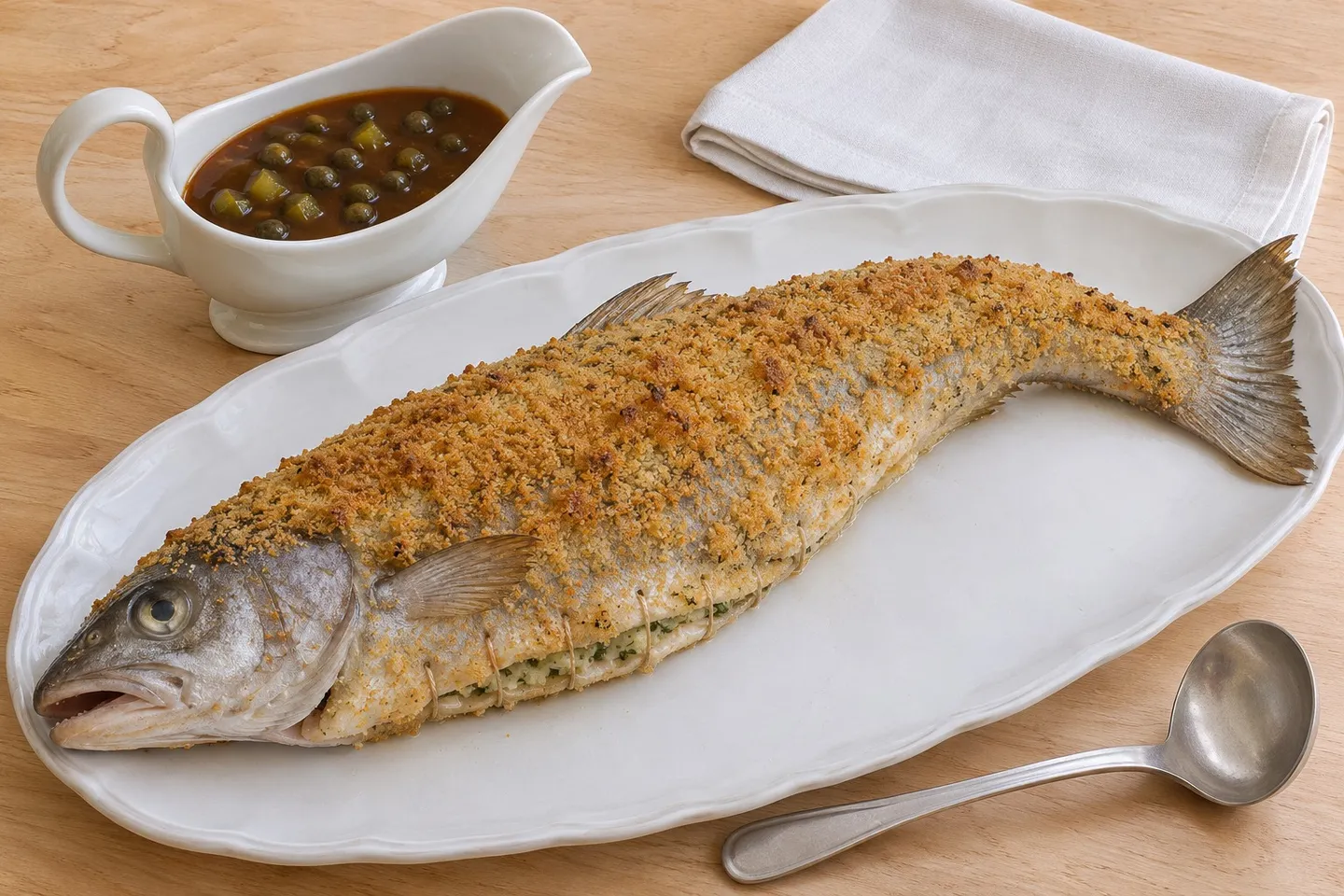
Reader ratingsBaked haddock with sharp sauce, the fish course of the Titanic’s second-class dinner on April 14, 1912: a whole stuffed haddock with Beeton’s 1906 sauce piquante.
- Recipe makes
- 1 haddock, serving 4
- Prep
- Cook
- Total
The Espagnole simmers for about an hour; stuff the fish and bake it during that hour, and reduce the vinegar for the sharp sauce while the fish is in the oven.
Whole stuffed baked haddock with a sauceboat of sharp brown sauce.
The story behind the recipe
A stuffed haddock, baked under brown crumbs and sent to table with a sauce of vinegar, shallots, gherkins and capers: this is the fish course of the Titanic’s second-class dinner on Sunday, April 14, 1912, which came after the consommé and before three meat dishes. The card gives it five words, “Baked Haddock, Sharp Sauce,” and no method.
Two Beeton recipes on one plate
The 1906 Ward, Lock edition of Mrs. Beeton’s Book of Household Management has both halves of the dish, on different pages and never together. Its haddock, no. 501, is filled with forcemeat, sewn up and trussed “in the shape of the letter S” with string tied from head to tail, then brushed with egg, crumbed and baked in a moderate oven, “basting occasionally with hot fat.” Beeton serves it with anchovy or melted butter sauce. The sharp sauce, no. 277, is the book’s “Sauce Piquante,” printed among the brown sauces some eighty pages earlier. Putting the two together is the card’s idea. This page joins them, so it is a reconstruction.
Beeton also prices the fish at 1s. 2d. to 1s. 6d., about £6 to £8 today by UK consumer prices (Bank of England), and calls it “Sufficient for 4 persons.” One line is out of step with the card: haddock, the book says, is “Seasonable from August to February,” and this dinner was served in April.
Read more about this recipe
Making it today
The haddock recipe sends the cook to “veal forcemeat (No. 412),” which turns out to be a pounded veal farce for quenelles. We use the book’s economical veal forcemeat, no. 414, instead: breadcrumbs, suet, parsley, thyme, lemon rind and egg, with no veal in it at all. The sharp sauce wants ¾ pint of Espagnole sauce, so the recipe includes three-quarters of Beeton’s Espagnole, no. 244, which gives about that much. Beeton’s S-shaped truss needs a long tin, so a gentle curve held with string is our choice.
What Was on the Titanic’s Second-Class Dinner Menu? follows the whole card from the soup to the coffee, then turns it over to read the postcard on the back. Of the three meat dishes that came after the fish, the Roast Turkey with Cranberry Sauce (1906) is the one taken from the same book.
501.—HADDOCK, BAKED. (Fr.—Eglefin au Four.)
Ingredients.—1 large fresh haddock, veal forcemeat (No. 412), 1 egg, brown breadcrumbs, fat for basting. ...
Recipe makes: 1 haddock, serving 4
Ingredients
For 1 haddock, serving 4. Quantities are shown as written.
Quantities as written here, for 1 haddock, serving 4.
Espagnole sauce
- Butter for the Espagnole40 g
- Lean smoked bacon20 g
- Carrot60 g
- Onion80 g
- Clove1
- Black peppercorns3
- Bay leaf for the Espagnole1
- Thyme for the Espagnole1 sprig
- Parsley3 stalks
- Button mushrooms2
- Plain flour40 g
- Beef stock850 ml
- Tomato passata50 ml
- Dry sherry50 ml
Forcemeat
- Fresh white breadcrumbs4 tbsp
- Shredded beef suet2 tbsp
- Chopped parsley1 tbsp
- Dried thyme1 tsp
- Grated lemon zest1/4 tsp
- Grated nutmeg1 pinch
- Salt1/4 tsp
- Black pepper1 pinch
- Egg for the forcemeat1
- Milk1 tbsp
Haddock
- Whole haddock, cleaned and scaled1.4 kg
- Egg for brushing1
- Dried brown breadcrumbs4 tbsp
- Butter for basting40 g
Sharp sauce
- Shallots4
- White wine vinegar140 ml
- Bay leaf for the sharp sauce1
- Thyme for the sharp sauce1 sprig
- Small gherkins3
- Capers1 tbsp
Measurement notes
Ingredients as written here
- 40 g butter for the Espagnole
- 20 g lean smoked bacon
- 60 g carrot
- 80 g onion
- 1 whole clove
- 3 black peppercorns
- 1 bay leaf for the Espagnole
- 1 sprig thyme for the Espagnole
- 3 parsley stalks
- 2 button mushrooms
- 40 g plain flour
- 850 ml beef stock
- 50 ml tomato passata
- 50 ml dry sherry
- 4 tbsp fresh white breadcrumbs
- 2 tbsp shredded beef suet
- 1 tbsp chopped parsley
- 1 tsp dried thyme
- 0.25 tsp grated lemon zest
- 1 pinch grated nutmeg
- 0.25 tsp salt
- 1 pinch black pepper
- 1 egg for the forcemeat
- 1 tbsp milk
- 1.4 kg whole haddock, cleaned and scaled
- 1 egg for brushing
- 4 tbsp dried brown breadcrumbs
- 40 g butter for basting
- 4 shallots
- 140 ml white wine vinegar
- 1 bay leaf for the sharp sauce
- 1 sprig thyme for the sharp sauce
- 3 small gherkins
- 1 tbsp capers
Equipment
 Two medium saucepans
 Fine sieve
 Mixing bowl
 Roasting tin or ovenproof dish large enough for the fish
 Trussing needle and kitchen string, or cocktail sticks
 Pastry brush
 Instant-read thermometer
 Sauceboat
Instructions
Start the Espagnole. Melt the butter for the Espagnole in a saucepan, add the lean smoked bacon cut small and fry it for 2 to 3 minutes.
Add the carrot and onion, both sliced, with the whole clove, black peppercorns, bay leaf for the Espagnole, sprig thyme for the Espagnole, parsley stalks and button mushrooms, sliced. Stir over a low heat for about 5 minutes.
Stir in the plain flour and keep stirring over a low heat for 5 to 8 minutes, until it turns an even nut brown without scorching.
Pour in the beef stock, tomato passata and dry sherry, and stir until the sauce boils. Lower the heat and let it bubble slowly, half covered, for about 1 hour, skimming now and then.
Meanwhile, heat the oven to 375°F (190°C), gas mark 5.
Make the forcemeat. Mix the fresh white breadcrumbs, shredded beef suet, chopped parsley, dried thyme, grated lemon zest, grated nutmeg, salt and black pepper in a bowl. Beat the egg for the forcemeat, stir it in, then add just enough of the milk to bind the mixture.
Rinse the whole haddock inside and out and pat it dry. Fill the belly with the forcemeat and sew up the opening with the trussing needle and string, or close it with cocktail sticks.
To truss it as Beeton does, tie a string to the head, bend the fish into a gentle S or a curve and tie the string to the tail. Lay it in the roasting tin.
Beat the egg for brushing and brush it over the fish. Scatter the dried brown breadcrumbs over the top. Melt the butter for basting and spoon a little over the crumbs.
Bake for 35 to 45 minutes, basting two or three times with the rest of the melted butter and the juices in the tin, until the flesh at the thickest part flakes and reads 145°F (63°C), and the center of the forcemeat reads 165°F (74°C).
While the fish bakes, make the sharp sauce. Chop the shallots finely and put them in the second saucepan with the white wine vinegar, bay leaf for the sharp sauce and sprig thyme for the sharp sauce. Cover and simmer until the vinegar has reduced to half, about 10 minutes.
Skim the fat from the Espagnole and strain it through the fine sieve, pressing the vegetables lightly.
Strain the reduced vinegar into the Espagnole and discard the shallots and herbs. Chop the small gherkins and capers and add them. Boil for 2 to 3 minutes and taste for salt.
Lift the haddock onto a hot dish, remove the string or sticks and send the sharp sauce to table in a sauceboat.
Nutrition
520calories per serving
- Recipe makes
- 1 haddock, serving 4
- Servings
- 4
Estimated per serving (4) from USDA FoodData Central values for the edible haddock (about 45% of the whole fish), the forcemeat, egg and crumbs, the basting butter and the whole of the sharp sauce.
Recipe notes
When adjusting quantities
Scales by the fish. Beeton’s one large haddock serves 4; for two fish, double everything and use two tins.
Notes
Quantities mentioned in these notes don’t change when you adjust the servings.
Our changes: forcemeat no. 414 in place of the cross-referenced no. 412; three-quarters of Espagnole no. 244 made for the sauce, with smoked bacon for “raw lean ham or bacon,” passata for “tomato pulp” and beef stock for Beeton’s unnamed stock; white wine vinegar for “vinegar”; butter as the basting fat; the thermometer and the oven setting. Beeton’s sauce for the fish, anchovy or melted butter, is left for the card’s sharp sauce.
A whole haddock this size can be hard to find. Two thick fillets of about 600 g each, skin on, can be sandwiched with the forcemeat and tied, then crumbed and baked the same way to the same temperatures; check them from 25 minutes. Cod or hake can stand in for haddock.
The Espagnole can be made a day ahead and kept covered in the refrigerator; reheat it to a boil before finishing the sauce. Contains fish, egg, milk, wheat and sulfites (sherry, vinegar).
Scaling changes the ingredients only; pan sizes and cooking times need their own judgment. To adapt this recipe further, try the recipe tool at TuneMyRecipe (opens in a new tab), our sister site.
Sources and attribution
After Mrs. Beeton’s Book of Household Management, new edition (London: Ward, Lock, 1906), Haddock, Baked, no. 501, with Veal Forcemeat (Economical), no. 414, Sharp Sauce, no. 277, and Espagnole Sauce, no. 244; dish as printed on the Titanic’s second-class dinner card of April 14, 1912
See the original pages (scan at Internet Archive) (opens in a new tab)
Recipe details
- Course
- Fish course
- Dish family
- Fish & Seafood
- Region
- British
- Era
- Edwardian
- Source decade
- 1900s
- Event
- Titanic, 1912
- Main ingredient
- Fish
- Difficulty
- Advanced
- Occasion
- Dinner party