The Great Central Fair for the U.S. Sanitary Commission, June 7 to 28, 1864 · Logan Square, Philadelphia
What Was in the 1864 Sanitary Fair Cookbook?
A Poetical Cook-Book, dedicated to Philadelphia’s 1864 Sanitary Fair, set verse over oyster loaves, pudding and gingerbread, and gave its stewed duck in rhyme.
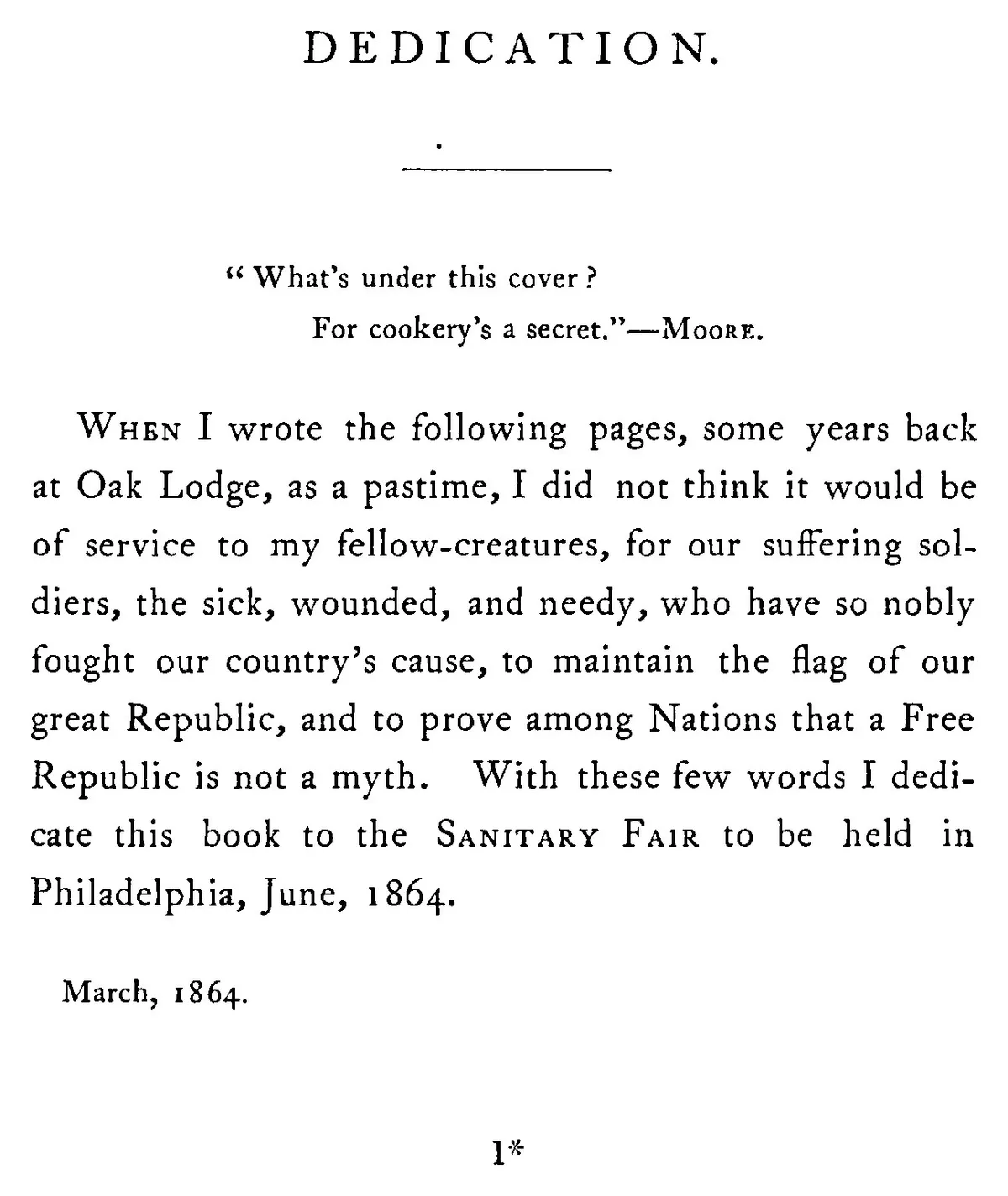
The cookbook Maria J. Moss dedicated to Philadelphia’s 1864 Sanitary Fair put a whole household’s cooking on the table, from turtle soup and oyster loaves to stewed duck, coconut pudding and gingerbread, and most of its receipts came with a few lines of poetry. A Poetical Cook-Book set verses from Moore, Pope, Gay and Burns above its prose directions, and once let the verse do the cooking itself. Moss gave the book in March 1864 to the fair that was to open that June to raise money for sick and wounded Union soldiers.
The fair in Logan Square
The Great Central Fair ran from June 7 to June 28, 1864, in temporary halls built across Logan Square. It raised money for the United States Sanitary Commission, the volunteer organization that gathered money and supplies for the Union army’s sick and wounded. Kerry L. Bryan, writing on the sanitary fairs for the Encyclopedia of Greater Philadelphia, counts close to a hundred departments and booths, from arms and trophies to children’s clothing and homemade fancy articles, and a restaurant department among them. Her total for the three weeks is over a million dollars (about $21 million today, by US consumer prices, Minneapolis Fed), second only to New York among the Northern fairs.
Abraham Lincoln came on June 16. Admission was doubled for the day and the crowds mobbed the halls to see him. He gave forty-eight signed copies of the Emancipation Proclamation to be sold at $10 apiece (about $205 today). At the fair’s banquet that evening, answering a toast, he spoke of the Sanitary and Christian Commissions and of the fairs, first begun at Chicago and then held in Boston, Cincinnati and other cities, as voluntary gifts that proved the nation’s resources were far from exhausted.
A cookbook for the soldiers
Moss’s book came out of a quieter room. Her dedication says she wrote its pages “some years back at Oak Lodge, as a pastime,” never thinking they would be of service “for our suffering soldiers, the sick, wounded, and needy.” It closes: “With these few words I dedicate this book to the Sanitary Fair to be held in Philadelphia, June, 1864.” The title page carries only a monogram under the word “By.” Her name appears in the copyright notice that follows, entered in 1864 “by Maria J. Moss,” and the printer was the Caxton Press of C. Sherman, Son & Co., Philadelphia.
The dedication records what she meant to do with the book. The Library of Congress goes further: its magazine said in 2015 that the book was sold at the Great Central Fair, and called it the first known charity cookbook. No price or sales figure for the book has been found, so the box below keeps both claims open. Half a century later, in 1915, Pittsburgh’s suffragists sold a cookbook of their own for the vote, as What Did the Suffragists Cook? tells.
What the book holds
Inside is a household’s whole round of cooking in 138 small pages. A short essay of “Miscellaneous Observations for the Use of the Mistress of a Family” opens it, with the warning that “nothing is too trifling for her notice, whereby waste may be avoided.” Then the receipts run in the order of a dinner and a larder: turtle soup and chicken broth, fish and oysters, beef, veal, mutton, poultry and game birds, sauces and a mushroom ketchup, vegetables, pickles and sweetmeats, eggs, puddings and creams, yeast, bread, butter and cottage cheese, and a long run of cakes. The last pages turn to drink, with syllabub, beer or ale, a comic poem on the origin of mint juleps, and a punch song translated from Schiller.
Most entries are short. Many give amounts only loosely, or none, and trust the cook to know her fire. What sets the book apart sits above most of them.
Verse over the stove
The poetry starts before the food. On the leaf before the title page, eight lines from Owen Meredith’s Lucile end: “But where is the man who can live without dining?” The title page itself asks the cook to “prepare / To your own taste the bill of fare” and declares a preference for “the cook just now / To Rubens or to Gerard Dow.” Then most receipts get an epigraph, signed Moore, Gay, Pope, Goldsmith, King, Shenstone, Burns or Shakespeare, and the prose underneath gets on with the work.
The verses are picked for wit more often than fit. Over the Oyster Loaves stands a couplet signed Donne:
’Tis no one thing; it is not fruit, nor root,
Nor poorly limited with head or foot.
It says nothing about rolls or oysters. The plain paragraph beneath it carries every step, down to the fried breadcrumbs served in the dish beside them.
Sometimes the poem is all there is. Hasty Pudding gets twenty-six lines of Joel Barlow’s poem in praise of cornmeal mush and no directions at all. A Philadelphia buyer would have reached the couplet “E’en in thy native regions, how I blush / To hear the Pennsylvanians call thee mush!”
The duck that came in rhyme
One receipt turns the arrangement around. Stewed Duck and Peas, on pages 48 and 49, is a poem of four eight-line stanzas with no signature and no prose at all. It opens with an invitation, “I give thee all my kitchen lore, / Though poor the offering be,” and then cooks: the duck trussed, stewed with butter and streaky bacon, a tablespoonful of flour and a quart of water stirred in, twenty onions, parsley, bay and two cloves, then the peas. The pot simmers “till it sings / In a delicious strain.”
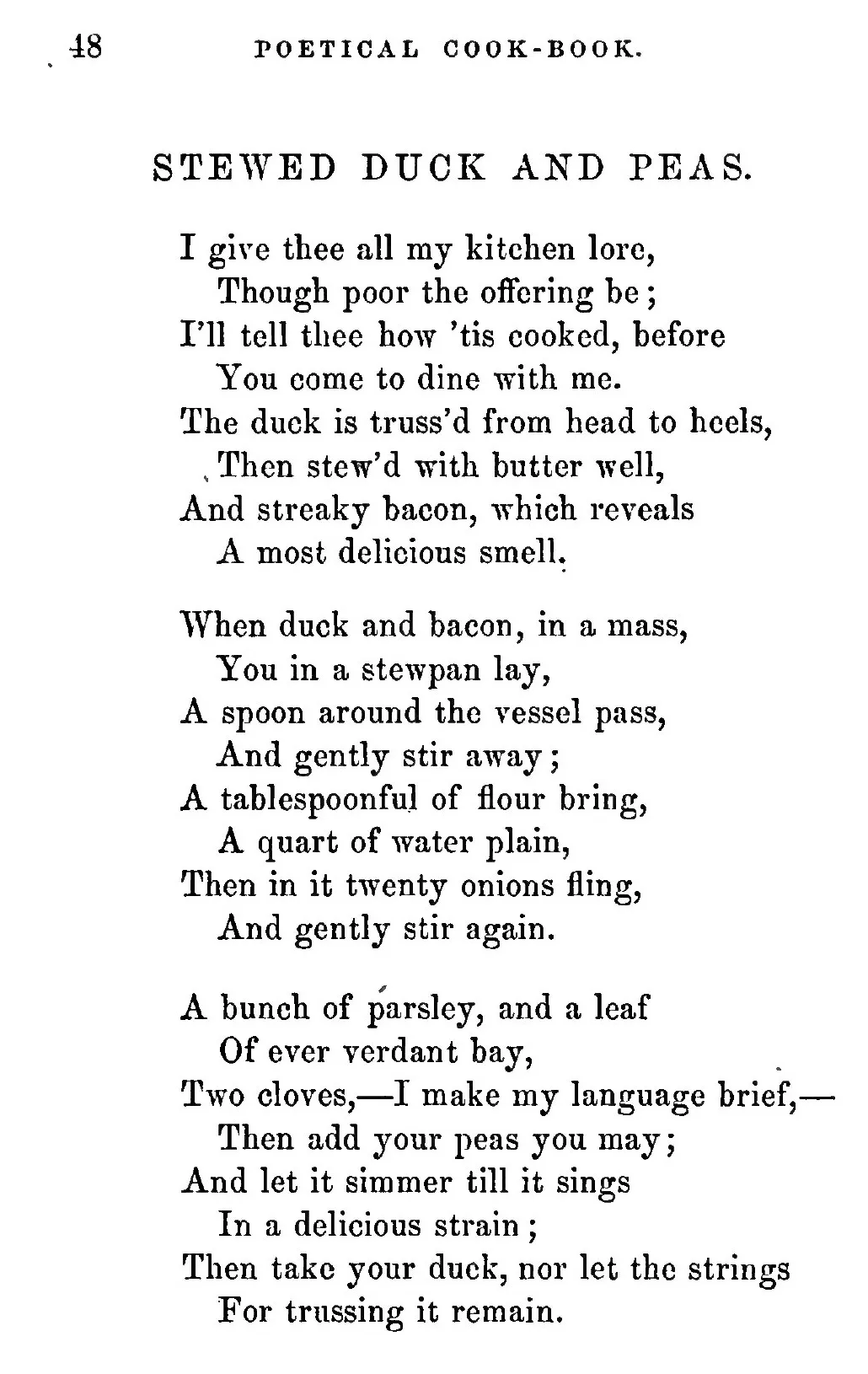
Stewed Duck and Peas, A Poetical Cook-Book (Philadelphia, 1864), p. 48.
The rhyme is exact where it can be: one tablespoonful, one quart, twenty onions, two cloves. It goes quiet on the size of the duck, the measure of peas and the length of the simmer, and the last stanza leaves the sauce to be finished “In the accustom’d way, / With pepper, salt, and other things / I need not here explain.” The poem ends on a promise: “You’ll dine with me again.”
Where the prose came from
Some of the prose receipts had near relatives already in print. Eliza Leslie, the Philadelphia cookery writer, had printed a Cocoa-nut Pudding in her Directions for Cookery (1837) that runs much like Moss’s: the coconut pared, washed and grated, butter and sugar stirred to a cream, wine and rose water, egg whites beaten “till they stand alone,” puff paste at the edge of the dish, half an hour in a moderate oven, sugar grated over when cool. Leslie’s is the larger pudding, with three-quarters of a pound of coconut and the whites of twelve eggs, and it has no brandy.
The same book’s Soft Gingerbread is a cousin of Moss’s Lafayette Gingerbread: a pint of molasses, half a pound of butter, brown sugar, ginger and cloves, eggs and flour stirred in by turns, and the juice and peel of lemon added at the last, “there being no pearl-ash in this gingerbread.” Leslie’s adds milk and nutmeg and leaves out the allspice. Moss’s book does not name Leslie anywhere. A later edition of her Directions supplies the recipes in What Was on the Sweets Table at Lincoln’s Inaugural Ball?
Rhyme in older cookbooks
Recipes told in verse were old by 1864. Two years earlier, Richard Morris had published Liber Cure Cocorum for the Philological Society, a cookery poem in a northern English dialect that he copied from Sloane manuscript 1986 and dated to the fifteenth century. There the rhyme carries every step. Its almond-milk butter is boiled, soured with vinegar or wine, hung in a cloth “a myle way,” laid in cold water and sent to table on a fish day:
Serve hit forthe in þe dysshe,
Þat day þo lorde is servyd with fysshe.
A “myle way” seems to mean the time it takes to walk a mile, and the recipe gives no amounts. Magdalena Bator, comparing 137 of these verse recipes with prose collections of the period in 2017, found the same basic shape of heading, method and serving, and suggests the rhyme may have been aimed at readers outside the professional kitchen. Moss’s duck belongs with those older verses that teach. Most of her book uses poetry the other way, as a frame around a prose page. Nothing ties her book to Morris’s edition.
The recipes
These four receipts from Moss’s book make a dinner of the kind a fair-goer might have planned at home. No record says this meal was served at the fair; the grouping is ours, and the order follows the book’s own, from fish through meats to desserts and cakes.
- Oyster Loaves (1864): small French rolls fried crisp and filled with oysters stewed in wine and gravy, under the Donne couplet.
- Stewed Duck and Peas (1864): the receipt written as a poem, twenty onions and all.
- Cocoanut Pudding (1864): grated fresh coconut and beaten egg whites baked on puff pastry, a smaller cousin of Leslie’s.
- Lafayette Gingerbread (1864): a molasses gingerbread with lemon and whole spices and no raising agent.
Cooking it
The Stewed Duck and Peas (1864) needs nothing harder to find than a whole duck, a piece of streaky bacon and twenty small onions, so save it for a slow Sunday: peel the onions while the bird browns, and by the time the pot has simmered an hour and a half you can test whether the poem keeps its last promise. All four of Moss’s receipts are among our Civil War recipes.
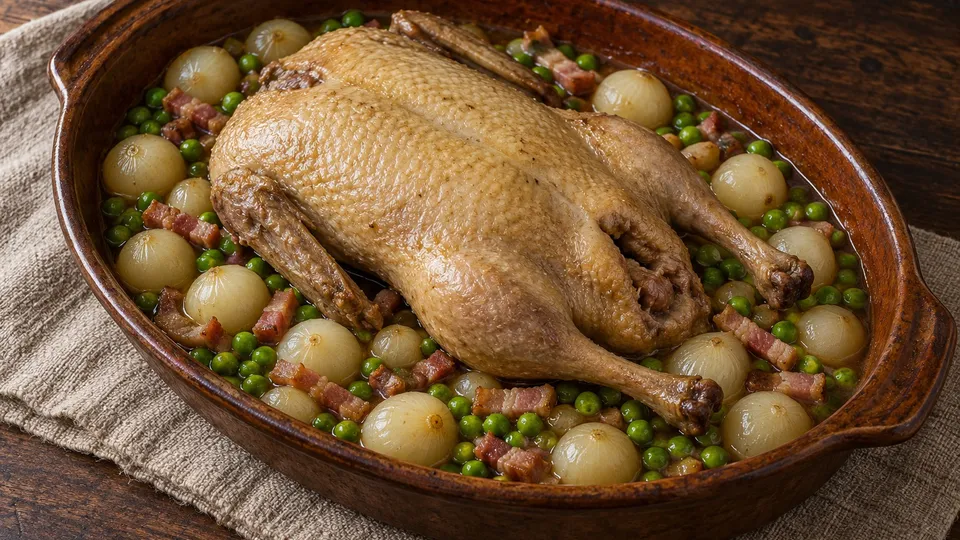 Cook it todayStewed Duck and Peas (1864)
Sources
- [Maria J. Moss], A Poetical Cook-Book (Philadelphia: Caxton Press of C. Sherman, Son & Co., 1864), front matter, dedication, pp. 33, 48–49, 100–102, 121–122. Internet Archive (opens in a new tab).
- Eliza Leslie, Directions for Cookery, Being a System of the Art, in Its Various Branches (Philadelphia: E. L. Carey & A. Hart, 1837), pp. 287, 364.
- Richard Morris, ed., Liber Cure Cocorum: Copied and Edited from the Sloane MS. 1986 (Berlin: A. Asher & Co. for the Philological Society, 1862), p. 15.
- Magdalena Bator, “Rhyming Recipes in Medieval Cookbooks,” Linguistica Silesiana 38 (2017), pp. 95–109. Journal PDF (opens in a new tab).
- Kerry L. Bryan, “Civil War Sanitary Fairs,” The Encyclopedia of Greater Philadelphia. philadelphiaencyclopedia.org (opens in a new tab).
- Alison Kelly, “Food, Glorious Food,” Library of Congress Magazine, November–December 2015, p. 2. loc.gov (opens in a new tab).
- Abraham Lincoln, address at the Sanitary Fair, Philadelphia, June 16, 1864, in The American Presidency Project. presidency.ucsb.edu (opens in a new tab).
- M. Kelly Tillery, “A Right Smart Get Out,” Lincoln Lore, Friends of the Lincoln Collection. friendsofthelincolncollection.org (opens in a new tab).
- Federal Reserve Bank of Minneapolis, “Consumer Price Index, 1800–” (1864 = 47, 2025 = 967.5). minneapolisfed.org (opens in a new tab).