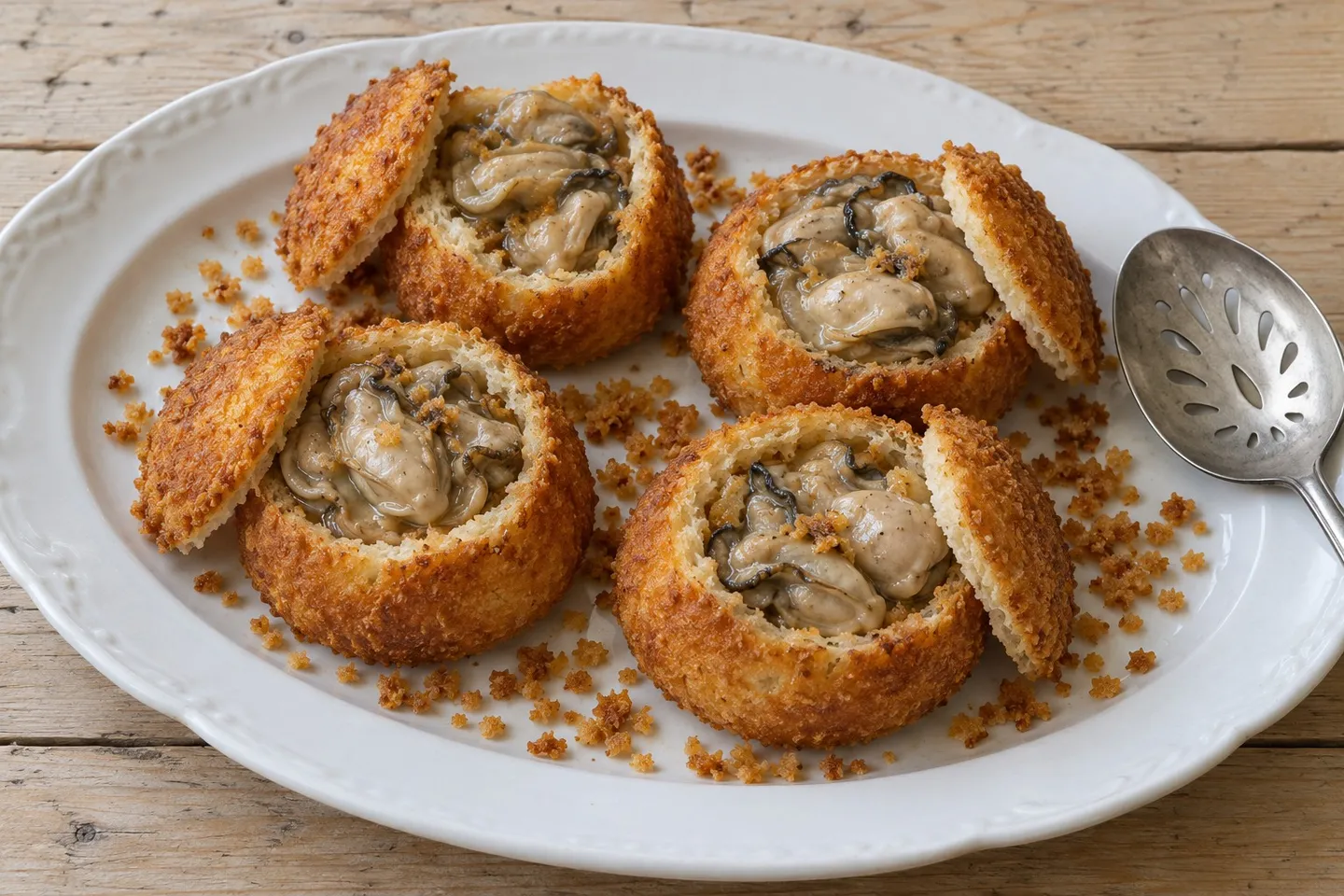
Oyster Loaves (1864)
Reader ratingsOyster loaves of 1864: small French rolls emptied, fried crisp in clarified butter and filled with oysters stewed in their liquor with white wine, gravy, lemon peel and mace.
- Recipe makes
- 4 filled rolls, 4 servings
- Prep
- Cook
- Total
About 20 minutes to hollow the rolls and drain the oysters, then 20 minutes at the stove: the shells and crumbs fry first and wait in a low oven while the oysters stew.
Fried French rolls filled with stewed oysters, with fried breadcrumbs on the dish.
The story behind the recipe
An oyster loaf is a small French roll emptied of its crumb, fried crisp in butter and filled with oysters stewed in their own liquor. A Poetical Cook-Book, the Philadelphia cookbook Maria J. Moss dedicated to the Sanitary Fair of June 1864, prints it among the fish, after fried and stewed oysters, with the stew seasoned by white wine, gravy, grated lemon peel and mace.
How old were oyster loaves in 1864?
Older than the Republic. Hannah Glasse, in The Art of Cookery, Made Plain and Easy (London, 1747), used them as a garnish. For a turkey stewed brown she told the cook to have ready “some little French Loaves about the Bigness of an Egg,” hollowed, fried brown and filled with stewed oysters, and to lay them round the dish. In Moss’s book, more than a century later, the filled rolls are a dish of their own, with breadcrumbs fried separately and heaped beside them.
Her receipt sits under a couplet signed Donne that has nothing to do with oysters, a sign of how freely the book matched verse to food. The paragraph below it gives no amounts at all: “the requisite quantity of oysters,” “a little white wine,” “some gravy.” The cook was trusted to know. Moss’s book and the fair it was written for are the subject of What Was in the 1864 Sanitary Fair Cookbook?
Read more about this recipe
Making it today
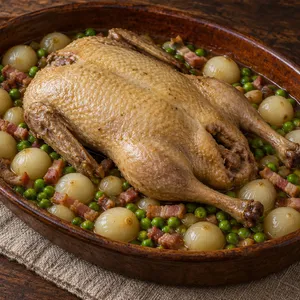
We measured it out ourselves: Glasse’s egg-sized rolls, one per person, and enough oysters to fill them. Shucked oysters sold in tubs with their liquor are the easy choice. Moss’s oysters were “bearded,” the dark frill around the edge trimmed off; this version leaves it on, and the recipe notes say how to trim it as she did. The oysters simmer at least three minutes, as the US Food and Drug Administration advises for shucked oysters. A Stewed Duck and Peas (1864) from the same book follows them well.
Cut off the tops of some small French rolls, take out the crumb, fry them brown and crisp with clarified butter, then fry some breadcrumbs; stew the requisite quantity of oysters, bearded and cut in two, in their liquor, with a little white wine, some gravy, and seasoned with grated lemon-peel, powdered mace, pepper and salt; add a bit of butter, fill the rolls with oysters, and serve them with the fried breadcrumbs in a dish.
Recipe makes: 4 filled rolls, 4 servings
Ingredients
For 4 filled rolls, 4 servings. Quantities are shown as written.
Quantities as written here, for 4 filled rolls, 4 servings.
- Small crusty French rolls4
- Clarified butter, for the rolls3 tbsp
- Clarified butter, for the crumbs2 tbsp
- Fresh breadcrumbs1 cup
- Shucked oysters with their liquor2 cups
- Dry white wine3 tbsp
- Brown gravy or rich beef stock1/4 cup
- Finely grated lemon zest1/2 tsp
- Ground mace1/8 tsp
- Black pepper1/4 tsp
- Salt1/4 tsp
- Cold butter1 tbsp
Measurement notes
Ingredients as written here
- 4 small crusty French rolls
- 3 tbsp clarified butter, for the rolls
- 2 tbsp clarified butter, for the crumbs
- 1 cup fresh breadcrumbs
- 2 cups shucked oysters with their liquor
- 3 tbsp dry white wine
- ¼ cup brown gravy or rich beef stock
- ½ tsp finely grated lemon zest
- ⅛ tsp ground mace
- ¼ tsp black pepper
- ¼ tsp salt
- 1 tbsp cold butter
Equipment
- Heavy skillet
 Small saucepan
- Fine sieve and a bowl
- Slotted spoon
 Instant-read thermometer
- Baking sheet and paper towels
Instructions
Heat the oven to 200°F (95°C) and set a baking sheet lined with paper towels inside to keep things warm.
Cut a thin slice off the top of each French roll and keep the tops. Pull out the soft crumb with your fingers, leaving a crusty shell about ¼ inch thick.
Heat the clarified butter for the rolls in the heavy skillet over medium heat. Fry the shells and their tops, turning them with tongs, until brown and crisp all over, 4 to 5 minutes. Move them to the warm baking sheet.
Add the clarified butter for the crumbs to the skillet and fry the breadcrumbs, stirring, until golden and crisp, 3 to 4 minutes. Spread them on the baking sheet beside the rolls.
Tip the oysters into the sieve set over a bowl to catch their liquor. Pick out any bits of shell and cut each oyster in two.
Pour the oyster liquor into the saucepan, leaving any grit behind in the bowl. Add the white wine, gravy, lemon zest, mace, pepper and salt, and bring to a simmer over medium heat.
Add the oysters and simmer gently for at least 3 minutes, until their edges curl and they are opaque and firm all through, 145°F (63°C) in the thickest one.
Take the pan off the heat and stir in the cold butter. Taste the liquor and add salt if it needs it.
Fill each roll with oysters using the slotted spoon and spoon a little of the liquor over them. Lean the lids against the rolls, set them on a warm dish with the fried crumbs around them, and serve at once.
Nutrition
430calories per serving
- Recipe makes
- 4 filled rolls, 4 servings
- Servings
- 4
Estimated per filled roll (4) from USDA FoodData Central values for French rolls, raw eastern oysters, clarified butter, breadcrumbs, white wine and beef stock.
Recipe notes
When adjusting quantities
One small roll per person as a first course. Double everything for eight; fry the rolls in two batches so they crisp evenly.
Notes
Quantities mentioned in these notes don’t change when you adjust the servings.
All the quantities are our own, from the rolls and oysters to the butter, wine, gravy and seasonings. Serving the fried tops beside the rolls as lids, the warm oven, and the 3-minute simmer with its temperature are our additions. To beard the oysters as Moss did, simmer them in their liquor for a minute, lift them out, trim off the dark frill with scissors, then return them to the seasoned liquor to finish. Clarified butter or ghee keeps the rolls from scorching; plain butter burns at frying heat. The oysters must be cooked through: raw or undercooked oysters can carry Vibrio bacteria, a particular risk for anyone with liver disease or a weakened immune system. Serve at once; leftovers do not keep well. Contains shellfish and gluten.
Scaling changes the ingredients only; pan sizes and cooking times need their own judgment. To adapt this recipe further, try the recipe tool at TuneMyRecipe (opens in a new tab), our sister site.
Sources and attribution
After A Poetical Cook-Book (Philadelphia, 1864), Oyster Loaves
See the original pages (scan at Internet Archive) (opens in a new tab)
Recipe details
- Course
- Fish course
- Dish family
- Fish & Seafood
- Region
- American
- Era
- 19th century
- Source decade
- 1860s
- Main ingredient
- Shellfish
- Difficulty
- Intermediate
- Occasion
- Dinner party