The Suffrage Cook Book is published for the Pennsylvania suffrage campaign · Pittsburgh, Pennsylvania
What Did the Suffragists Cook?
In 1915 Pittsburgh suffragists sold a cookbook for the vote. Its leaders sent bacon and cheese, a caramel custard, a pudding and an accidental quince.
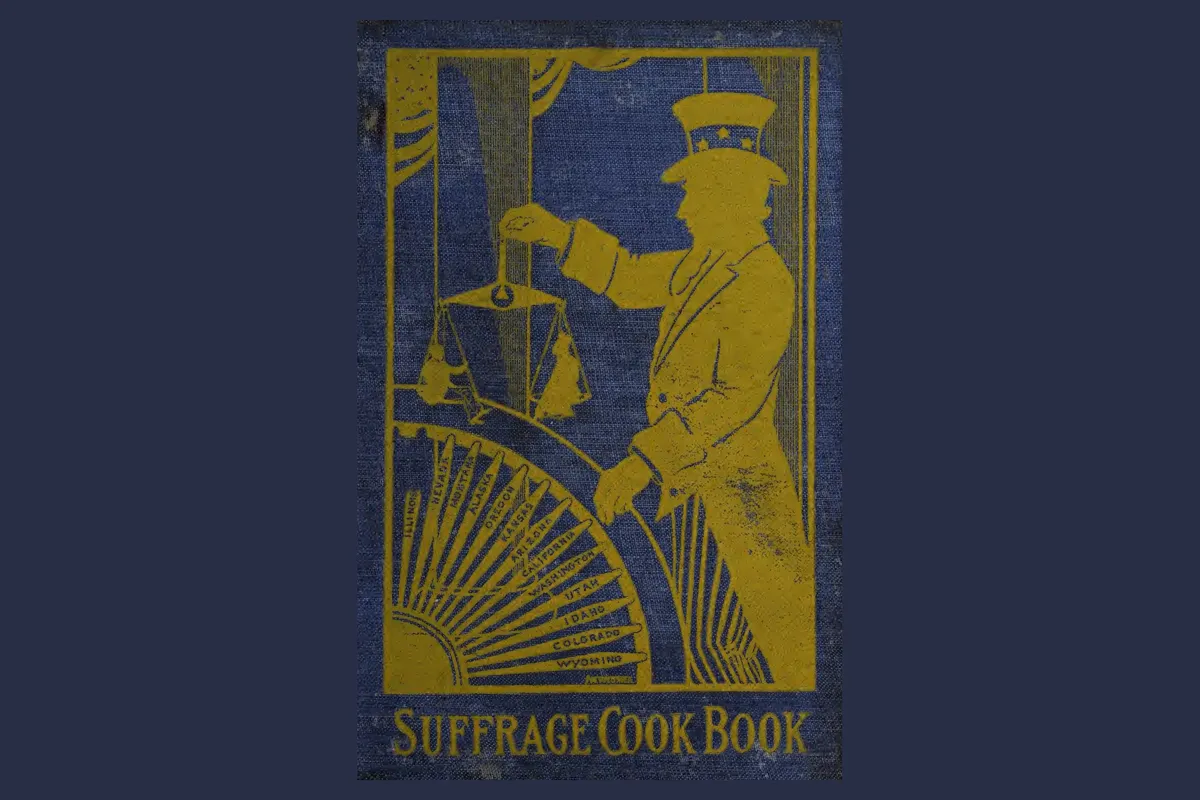
Bacon baked under cheese, a caramel custard and apples stewed in rhubarb juice: that is what three of the best-known suffragists in America sent when a Pittsburgh suffrage society asked them for recipes. The Suffrage Cook Book, compiled by Mrs. L. O. Kleber for the Equal Franchise Federation of Western Pennsylvania, came out in 1915, the year Pennsylvania’s men voted on whether women should vote. Not all of its famous contributors cooked what they sent, and one of them said so.
A cookbook for the campaign
In 1915 four eastern states put woman suffrage to their voters, and the book carries a letter from Jane Addams of Chicago addressed to “the women of Pennsylvania, New York, New Jersey and Massachusetts in this year of 1915.” Illinois women already had a partial vote, and Addams wrote to say that their eyes were on the East.
Cookbooks were a steady fundraiser for the movement. The Library of Congress counts at least six suffrage cookbooks between 1886 and 1920, sold to raise money and win members, and to “dispel fears that enfranchised women would shirk domestic responsibilities.” Suffrage advertising said it more briskly: “The Best Cooks Are Suffragists.”
Kleber gathered recipes from 57 “authoresses,” 30 of them from Western Pennsylvania, by the Heinz History Center’s count, and wrote to the governors of states where women already voted. The cover shows Uncle Sam holding a pair of scales above a wheel of those states, from Illinois and Nevada round to Wyoming. Inside, the governors’ letters sit between the recipes. From Boise, Governor M. Alexander of Idaho reported that suffrage there had “gone beyond the trial stage” and that “Its repeal would not carry a single county in the State.” Kleber added her own guarantee in the preface: “my readers may safely eat everything set down in this book.”
The Quiet Observer
The book opens with an essay by Erasmus Wilson, who signed himself “The Quiet Observer.” Under that name Wilson wrote columns for the Pittsburg Dispatch that told women their place was in the home, and in 1885 the paper printed “What Girls Are Good For.” The furious reply it drew from a young Pittsburgh reader launched the career of the journalist Nellie Bly.
Thirty years on, the Quiet Observer was introducing a suffrage cookbook. Now that women were “coming into their own,” he wrote, it was “entirely proper that they should prescribe the food, balance the ration, and tell how it should be prepared and served.” He kept the old proverb too, calling “The surest way into the affections of a man is through his stomach, also to his pocket” an ancient joke that was “not all a joke.”
What the leaders sent
Anna Howard Shaw, a minister and a physician who led the National American Woman Suffrage Association from 1904 to 1915, sent a letter that is half the fun of the book. The only recipe she had ever given a cookbook, she wrote, was a direction for driving a nail, “as it has always been declared that women do not know how to drive nails.” She had not cooked in thirty years, apart from one clam pie that her friends praised and she could not remember how to make. So she offered a favorite she had “got out of the newspapers”: lean bacon covered thickly with cheese, sprinkled with mustard and paprika, baked half an hour and served with dry toast. “Now that is a particularly tasty dish if it is well done,” she finished. “I never did it, but somebody must be able to do it who could do it well.”
Carrie Chapman Catt, who led the association before Shaw and again after her, sent a French caramel custard, Pain d’Oeufs, with directions that leave little to chance. The sugar for the caramel is melted “using no water,” the water in the baking pan “must not boil,” and the custard is turned out only “When perfectly cold.”
Charlotte Perkins Gilman owned up to an accident, under the heading “Synthetic Quince / An Accidental Discovery.” She had put too much water with her rhubarb, cooked quartered apples in the leftover pink juice with a saucerful of strawberries, and found the dish “looked and tasted exactly like quince, except that the apple was a little softer.” It is a small kitchen joke from a writer who had argued that cooking should not be every wife’s private duty. In Women and Economics, first published in 1898, Gilman wrote that a wife cooks to please her husband partly “because he pays for the dinner,” and that “The selection and preparation of food should be in the hands of trained experts.” She even asked whether the way to a man’s heart through his stomach should “be relinquished for some higher avenue,” the same proverb the Quiet Observer quoted in the book’s opening essay.
From England came a handwritten page. Lady Constance Lytton had been arrested in Liverpool in 1910 under the name Jane Warton and force-fed eight times in Walton Gaol. For the Pittsburgh book she wrote out Hasty Pudding from Homewood, her family’s house at Knebworth: a pint of milk, a spoonful and a half of flour, half a teaspoon of sugar, boiled up once and served at once. Above it she copied four lines from Lucile by Owen Meredith, the pen name of her father, the first Earl of Lytton, ending “But civilized man cannot live without cooks.”
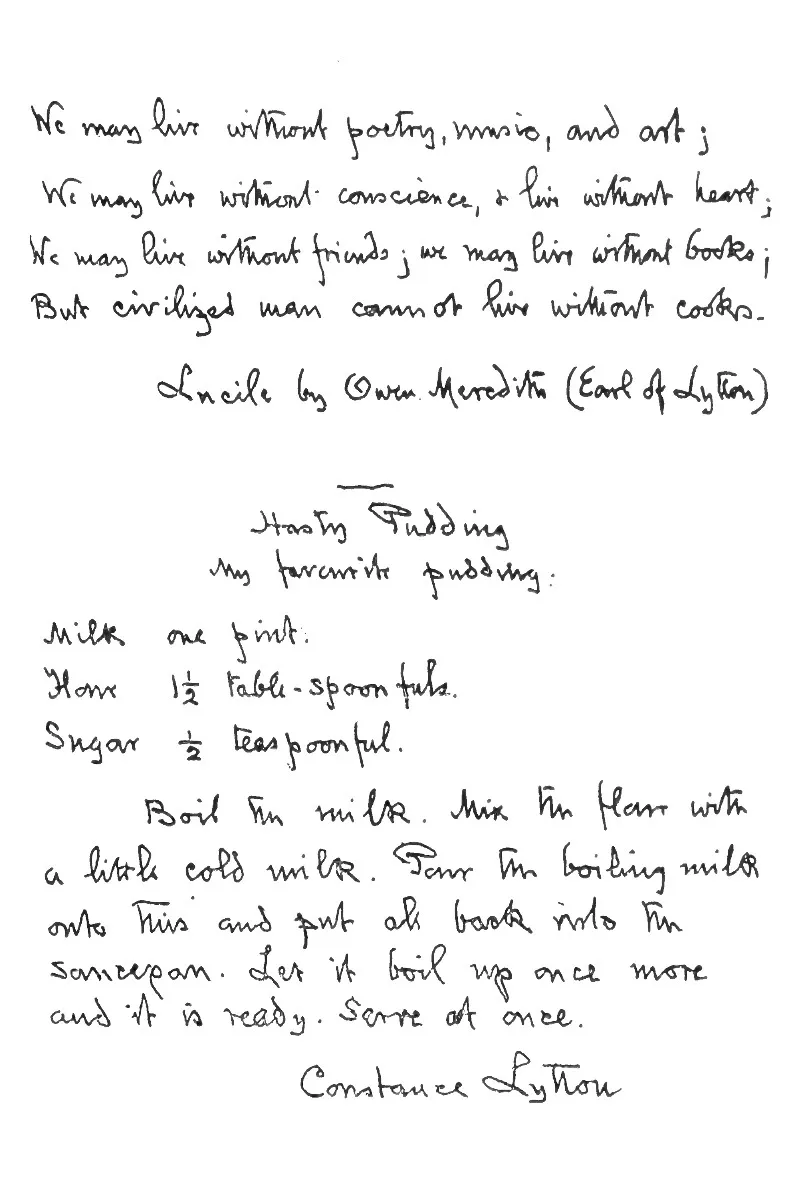 Constance Lytton’s Hasty Pudding, in her own hand, from The Suffrage Cook Book (Pittsburgh, 1915), p. 153.
Jack London wrote from his yacht, the Roamer, on November 5, 1914, apologizing for the delay and offering recipes worked out with Mrs. London that were “especial ‘tried’ favorites of mine.” His wild duck is stuffed with raw celery and roasted 8 to 11 minutes “in a piping oven,” and the carcass is squeezed in a press for the sauce. “The longer the wild duck is roasted,” he warns, “the dryer and tougher it becomes.”
A pie for a doubting husband
Not every page is meant for the stove. Pie for a Suffragist’s Doubting Husband calls for “1 qt. milk human kindness” and “8 reasons,” then lists seven: war, white slavery (the period’s term for forced prostitution), child labor, 8,000,000 working women, bad roads, poisonous water and impure food. The list reads like the reform platform of the day. The crust carries the advice: “Mix the crust with tact and velvet gloves, using no sarcasm, especially with the upper crust.”
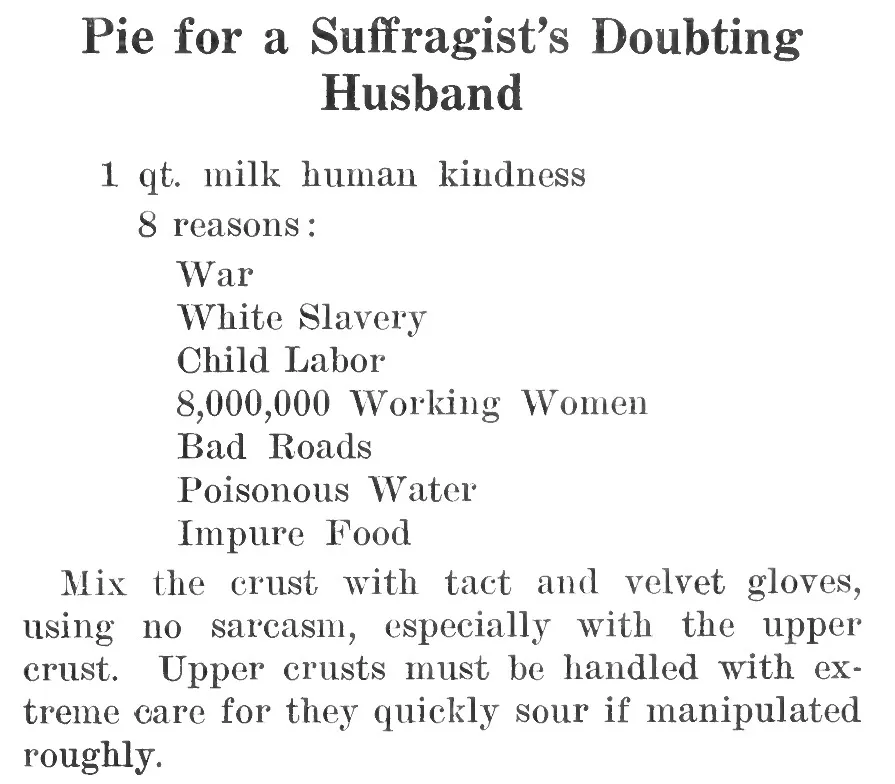 Pie for a Suffragist’s Doubting Husband, from The Suffrage Cook Book (Pittsburgh, 1915), p. 147.
The opponents of suffrage got a recipe too. Anti’s Favorite Hash, reprinted from the Ebensburg Mountaineer Herald, calls for “1 lb. truth thoroughly mangled” and “1 generous handful of injustice,” stirred “with a sharp knife.”
Among the gingerbreads, earlier in the book, comes Parliament Gingerbread, unsigned and printed “With apologies to the English Suffragists.” British women would wait until 1918 for the parliamentary vote, and then only those over 30. The recipe itself is a plain one: flour, treacle, ginger and spice, rolled thin and cut in oblongs.
November 1915
The book did not carry the state. In November 1915 Pennsylvania’s voters, all of them men, turned down the suffrage amendment by 441,034 votes to 385,348. Allegheny County, home of Pittsburgh and of the Equal Franchise Federation, voted yes, 50,557 to 47,539. New Jersey had already said no in October, and New York and Massachusetts said no too. Pennsylvania’s legislature ratified the Nineteenth Amendment on June 24, 1919. Within three years of the vote, American kitchens were being asked to save wheat for the war, as How Did You Feed a Hundred People Without Wheat in 1918? tells.
The recipes
All four come from The Suffrage Cook Book itself, three of them signed by leading names of the movement. Lytton’s pudding and London’s duck stay in the story: the pudding is three lines long, and the duck needs a wild bird and a duck press.
- Bacon and Cheese with Toast (1915): Anna Howard Shaw’s newspaper favorite, bacon baked under cheese with mustard and paprika.
- Pain d’Oeufs (1915): Carrie Chapman Catt’s caramel custard, baked slowly and turned out cold.
- Synthetic Quince (1915): Charlotte Perkins Gilman’s accident, apples and strawberries stewed in rhubarb juice.
- Parliament Gingerbread (1915): thin treacle gingerbread “With apologies to the English Suffragists.”
Cooking it
Catt’s custard has to be “perfectly cold” before it leaves the dish, so bake the Pain d’Oeufs (1915) the evening before and turn it out onto a glass or china dish, the way her recipe ends.
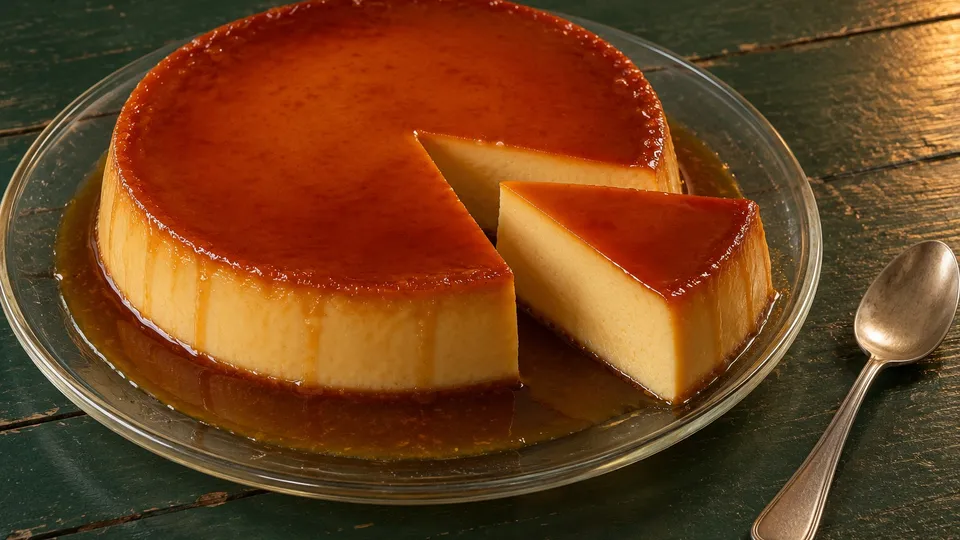 Cook it todayPain d’Oeufs (1915)
Sources
- Mrs. L. O. Kleber, comp., The Suffrage Cook Book (Pittsburgh: The Equal Franchise Federation of Western Pennsylvania, 1915), cover and pp. 6 to 10, 38, 45 to 46, 56, 60, 114, 147, 153, 156, 184, 200.
- Charlotte Perkins Gilman, Women and Economics, 3rd ed. (Boston: Small, Maynard, 1900; first published 1898), pp. 236 to 237.
- Library of Congress, “The Best Cooks Are Suffragists (opens in a new tab),” Shall Not Be Denied: Women Fight for the Vote.
- Sierra Green, “Detre Library & Archives: Cookbooks with a Cause (opens in a new tab),” Heinz History Center, June 24, 2015.
- “Nellie’s Milestones (opens in a new tab),” American Experience, PBS.
- “Nellie Bly (opens in a new tab),” Encyclopaedia Britannica.
- “Pennsylvania Women’s History (opens in a new tab),” National Park Service.
- “1915 Eastern Campaigns (opens in a new tab),” Votes for Delaware Women, University of Delaware Library.
- “New Jersey Women’s Suffrage Referendum of 1915, Vote by Counties (opens in a new tab),” New Jersey Women’s History.
- “Lady Constance Georgiana Lytton (opens in a new tab),” Suffrage Resources, and Tara Morton, “Constance Lytton (Lady) (opens in a new tab),” Mapping Women’s Suffrage, University of Warwick, 2017.
- “Edward Robert Bulwer Lytton, first Earl Lytton (opens in a new tab),” Orlando: Women’s Writing in the British Isles, Cambridge University Press.
- “Anna Howard Shaw (opens in a new tab),” National Park Service, and “Carrie Chapman Catt (opens in a new tab),” National American Woman Suffrage Association Collection, Library of Congress.
- “Representation of the People Act 1918 (opens in a new tab),” Living Heritage, UK Parliament.