Pain d’Oeufs (1915)
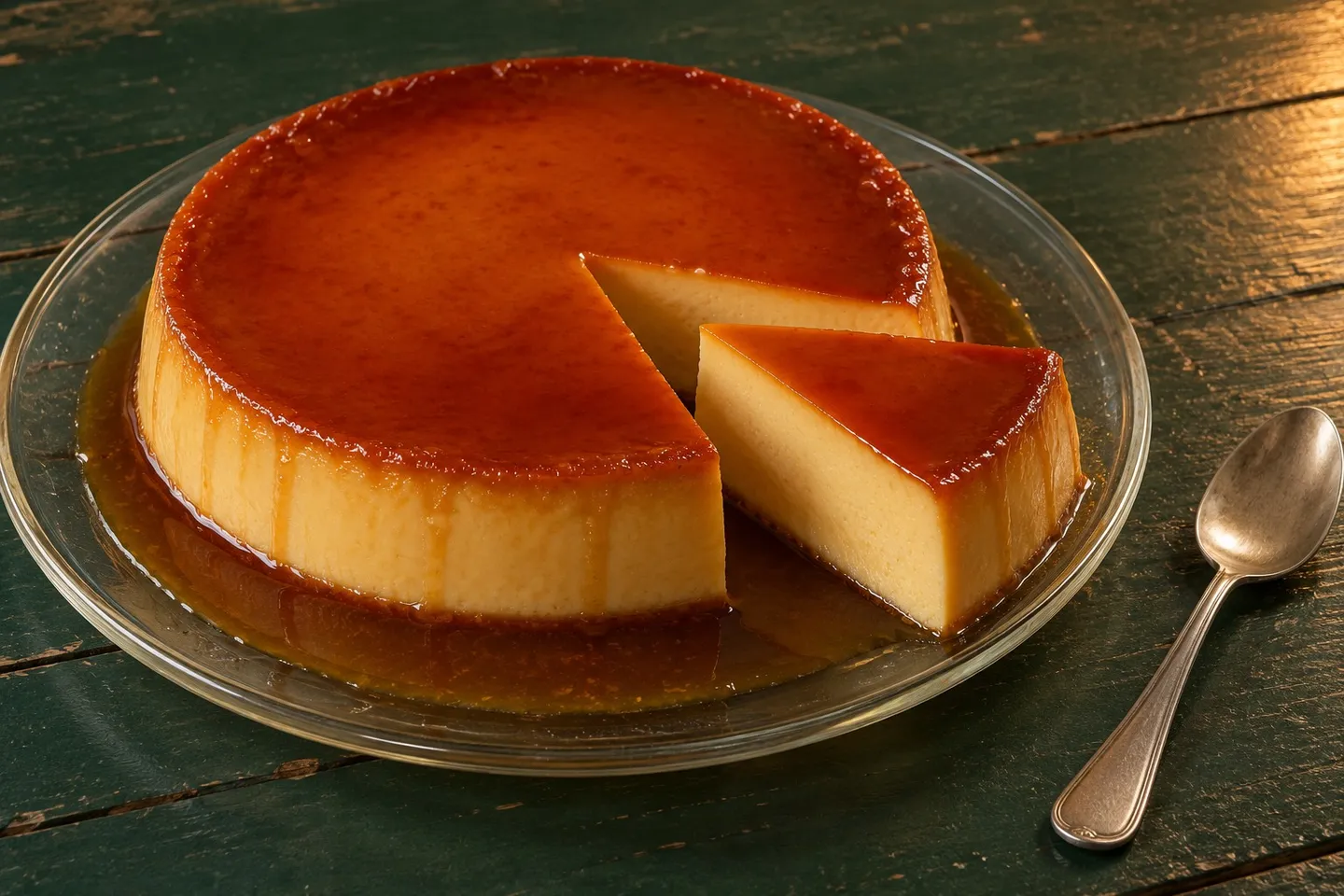
Reader ratingsCarrie Chapman Catt’s pain d’oeufs from 1915: a caramel custard of eggs, sugar, vanilla and scalded milk, baked in a water bath and turned out cold.
- Recipe makes
- 8 servings
- Prep
- Cook
- Total
Making the caramel and custard takes about 20 minutes and the bake 45 to 60. The custard then cools for an hour and chills at least 4 hours, so it is easiest made the day before.
Pain d’oeufs, a baked caramel custard, with one wedge cut.
The story behind the recipe
Pain d’Oeufs, a caramel custard, comes with two warnings from Carrie Chapman Catt, who gave it to The Suffrage Cook Book in 1915: the water around the dish “must not boil,” and the custard stays in its dish until it is completely cold.
From Iowa to the head of the movement
Catt grew up in Iowa, graduated from Iowa Agricultural College in 1880 as the only woman in her class, and in 1885 became superintendent of schools in Mason City. She led the National American Woman Suffrage Association from 1900 to 1904 and took it over again in 1915, the year of this book, after Anna Howard Shaw. The next year she laid out the “Winning Plan” that aimed the movement at a federal amendment, and in February 1920, months before that amendment was ratified, she founded the League of Women Voters.
The name is French and means, word for word, “bread of eggs.” The method is the familiar one: caramel in the bottom of the dish, custard poured over, a slow bake in a pan of water, and a full cooling before the dish is turned upside down and the caramel runs down as sauce. Catt melts the sugar in the baking dish itself, “a granite or aluminum baking dish,” metal that could stand directly on the stove.
Read more about this recipe
Making it today
We make the caramel in a saucepan and pour it into the baking dish, our main change, since glass and ceramic dishes can crack over a burner. Her slow oven becomes our 325°F (165°C), and her knife check stays: the custard is done when a knife slipped in near the center comes out clean. We also strain the custard.
What Did the Suffragists Cook? sets Catt’s custard beside Anna Howard Shaw’s newspaper recipe and Charlotte Perkins Gilman’s accident. Shaw’s own Bacon and Cheese with Toast (1915) makes a supper to serve before it.
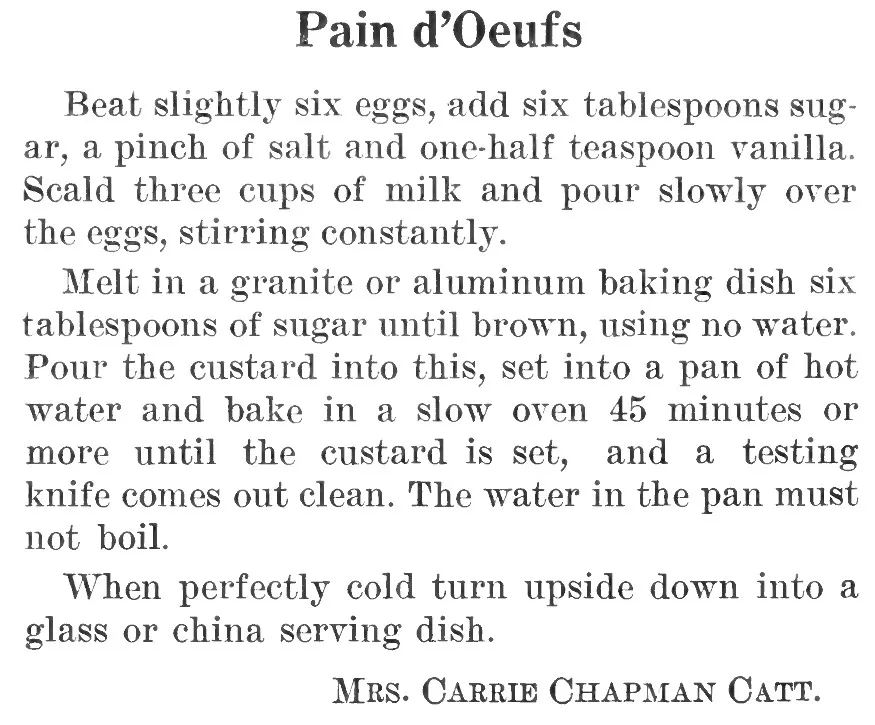
Beat slightly six eggs, add six tablespoons sugar, a pinch of salt and one-half teaspoon vanilla. Scald three cups of milk and pour slowly over the eggs, stirring constantly.
Melt in a granite or aluminum baking dish six tablespoons of sugar until brown, using no water. Pour the custard into this, set into a pan of hot water and bake in a slow oven 45 minutes or more until the custard is set, and a testing knife comes out clean. The water in the pan must not boil.
When perfectly cold turn upside down into a glass or china serving dish.
MRS. CARRIE CHAPMAN CATT.
Recipe makes: 8 servings
Ingredients
For 8 servings. Quantities are shown as written.
Quantities as written here, for 8 servings.
- Sugar, for the caramel6 tbsp
- Large eggs6
- Sugar, for the custard6 tbsp
- Salt1 pinch
- Vanilla extract1/2 tsp
- Whole milk3 cups
Measurement notes
Ingredients as written here
- 6 tbsp sugar, for the caramel
- 6 large eggs
- 6 tbsp sugar, for the custard
- 1 pinch salt
- 1/2 tsp vanilla extract
- 3 cups whole milk
Equipment
 Small heavy saucepan
- Round baking dish, about 8 inches across and 1½ quarts
- Roasting pan large enough to hold the dish
- Medium saucepan
- Mixing bowl and whisk
 Fine sieve
- Serving plate with a rim
Instructions
Heat the oven to 325°F (165°C). Put the baking dish in the roasting pan and bring a kettle of water to a boil.
Put the sugar for the caramel in the small saucepan over medium heat, with no water. Leave it until it starts to melt at the edges, then swirl the pan, without stirring, until all of it has melted to a clear amber-brown, 5 to 8 minutes. Pour it at once into the baking dish and tilt the dish to coat the bottom. It will harden as it cools.
Heat the milk in the medium saucepan until small bubbles appear around the edge and steam rises, without letting it boil.
In the bowl, beat the eggs lightly with the sugar for the custard, the salt and the vanilla, just enough to mix them without making foam.
Pour the hot milk into the eggs in a thin stream, whisking all the time.
Pour the custard through the sieve into the baking dish over the caramel. Set the roasting pan on the oven rack and pour hot water from the kettle into it until it comes halfway up the sides of the dish.
Bake for 45 to 60 minutes, until the edges are firm, the center still trembles a little when the dish is nudged, and a knife slipped in near the center comes out clean. Check the water now and then; if it starts to bubble, lower the oven to 300°F (150°C).
Lift the dish out of the water and let it cool on a rack for about 1 hour, then cover and refrigerate for at least 4 hours or overnight.
To serve, run a thin knife around the edge, set the serving plate upside down on the dish, and turn both over together. Lift off the dish and let the caramel run down over the custard.
Nutrition
180calories per serving
- Recipe makes
- 8 servings
- Servings
- 8
Estimated per serving from USDA FoodData Central values for eggs, whole milk and sugar.
Recipe notes
When adjusting quantities
Halve it in a 3-cup dish and start checking after 30 minutes; a larger dish takes longer to set in the middle.
Notes
Quantities mentioned in these notes don’t change when you adjust the servings.
Some caramel stays stuck in the dish; a few minutes in hot water loosens it. Covered and refrigerated, the custard keeps for up to 3 days. For a caramel custard cooked in small jars, TuneMyRecipe adapts Fannie Farmer’s 1918 recipe in its Sous-Vide Caramel Custard (opens in a new tab).
Scaling changes the ingredients only; pan sizes and cooking times need their own judgment.
Sources and attribution
After Carrie Chapman Catt’s recipe in The Suffrage Cook Book, comp. Mrs. L. O. Kleber (Pittsburgh, 1915)
Recipe details
- Course
- Dessert
- Dish family
- Desserts & Sweets
- Region
- American
- Source decade
- 1910s
- Main ingredient
- EggsMilk & cream
- Difficulty
- Intermediate