Private supper rooms in San Francisco, as B. E. Lloyd described them in 1876 · San Francisco
What Was Served in San Francisco’s Private Supper Rooms?
Oysters, by the signs: the supper rooms of 1870s San Francisco offered eastern oysters in every style, behind a screen and all night. Three oyster recipes.
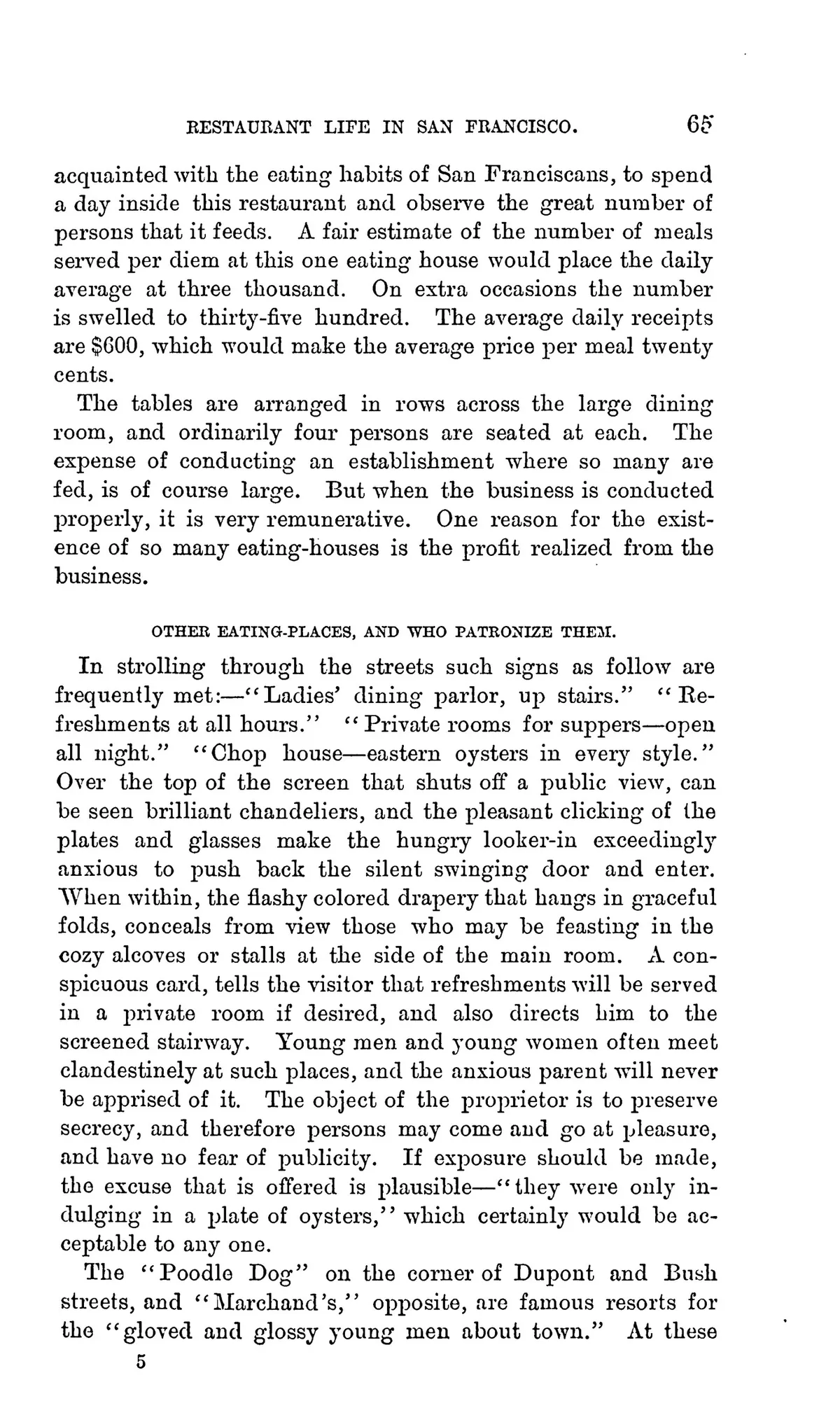
Oysters, if you believe the signs. A walker in 1870s San Francisco passed boards that read “Private rooms for suppers,” “open all night,” and “Chop house,” with “eastern oysters in every style.” Behind a screen there were chandeliers, curtained alcoves and a stairway to rooms upstairs. The oyster was the dish everyone could name, and it doubled as the alibi: anyone found there, the same writer reported, could say they had only stopped in for a plate of them.
That writer was B. E. Lloyd, whose Lights and Shades in San Francisco came out in 1876. The book is a long walk through the city, part guide and part sermon, and Lloyd owns in his preface that “much that this volume contains has been previously offered to the public, in print,” so his street is the city of the early and middle 1870s rather than one particular night. His chapter on restaurants takes the reader past the supper rooms and stops to read their signs.
A city that ate out
Lloyd begins with numbers. Eating houses “abound and seem to thrive,” he writes, so many that a good number of people must take every meal at them. There were chop-houses, coffee-houses, oyster “grottoes” and lunch rooms on every street with a respectable number of businesses, and French, German, Italian, Spanish, Chinese and American places of every grade.
His answer to who ate there is one word: “Everybody.” Clerks, bookkeepers, printer boys, young mechanics and laborers, and “many of the working females,” rented furnished rooms and took their meals out. Small families chose rooms near an eating house to be rid of the kitchen. “The restaurant fosters the lodging-house,” Lloyd sums up, “and the lodging-house in turn furnishes the restaurants many patrons.”
At the top was the Maison Dorée on Kearny Street, where shoppers stopped for lunch and the fashionable took after-theater suppers. Lloyd calls it “the Delmonico of San Francisco,” measuring it against the New York house that gave Charles Dickens his farewell press dinner in 1868. At the other end, the United States Restaurant at Clay and Montgomery Streets charged fifteen cents a dish, or three dishes for twenty-five cents (about $8 today, by US consumer prices, using the Minneapolis Fed and BLS CPI-U tables). Lloyd’s “fair estimate” was three thousand meals a day.
Signs on the street
The supper rooms come next, in a paragraph that reads like a walk down the block. The signs he copies promise a “Ladies’ dining parlor, up stairs,” refreshments “at all hours,” private rooms for suppers open all night, and eastern oysters “in every style.”
From the sidewalk you saw only the top of a screen “that shuts off a public view,” with chandeliers above it and the clicking of plates and glasses. Inside, colored drapery hid the diners in alcoves or stalls along the side of the main room. A card told the visitor that refreshments would be served in a private room if he liked, and pointed him to “the screened stairway.”
Lloyd’s own interest is in what the screens hid, and he says so plainly: young men and young women “often meet clandestinely at such places,” and the anxious parent never hears of it. The proprietor’s business, in his telling, was secrecy.
“Only indulging in a plate of oysters”
Then comes the line that gives this story its dish. If a meeting were found out, Lloyd writes, the excuse was a plausible one: “they were only indulging in a plate of oysters,” which “certainly would be acceptable to any one.” The oyster was the most respectable thing on the premises, and the excuse depended on it.
He moves on to the two best-known rooms in the city, the Poodle Dog on the corner of Dupont and Bush, and Marchand’s across the street, resorts for “the gloved and glossy young men about town.” Here he has nothing but praise for the kitchen. “The pastry is the most delicate, and the wines the finest flavored,” the tables are decorated, the cutlery has “the ‘real’ ring,” and the private rooms are “gorgeously furnished.” Society’s top layer came too: “Upper-ten-dom calls occasionally for a midnight banquet.”
Lloyd adds that “the more favored female denizens of Dupont street,” a street his later chapter lists among those with brothels, were “wined and dined there by their ‘fellows.’” His closing barb is aimed at the customers: a register of everyone who came in after dark “would be a startling disclosure to the social world.”
Quiet rooms in the saloons
The private room had a second life in Lloyd’s book, and even Lloyd, no friend of the saloon, found it orderly. In his chapter on saloons, the first-class bars near the brokers’ boards have plate-glass mirrors, marble counters, cut-glass goblets and fresh flowers. “The private rooms are richly furnished, quiet and retired,” he writes, and the customers are bankers, brokers and leading members of the bar, held to the manners of gentlemen.
The same feature, a closed door with a table behind it, could serve a broker after a good day on the exchange or a couple who wanted not to be seen. Lloyd judged each by who was inside. What both versions of the room had in common was a table to eat at.
What “every style” meant
Lloyd prints no supper room’s bill of fare. The nearest guide to what “every style” could mean in San Francisco comes five years later, from a cook whose pickles and preserves had already won prizes in the city.
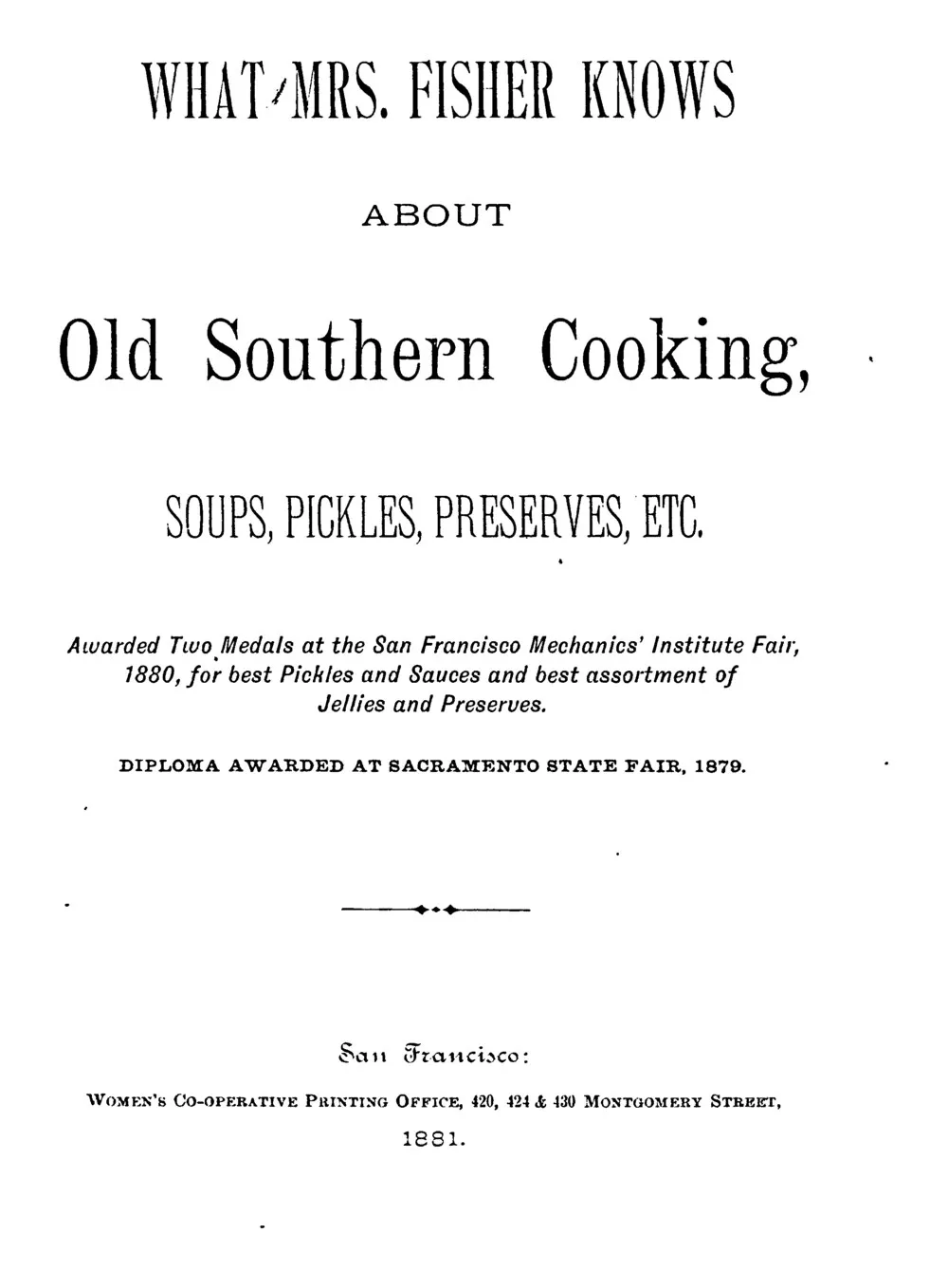 Abby Fisher, What Mrs. Fisher Knows About Old Southern Cooking (San Francisco: Women’s Co-operative Printing Office, 1881), title page.
Abby Fisher’s What Mrs. Fisher Knows About Old Southern Cooking was printed in San Francisco in 1881. Its title page lists two medals from the Mechanics’ Institute Fair of 1880, for pickles and sauces and for jellies and preserves, and a diploma from the State Fair at Sacramento in 1879. In her preface she writes that her “lady friends and patrons in San Francisco and Oakland” had asked for the book, and explains how it was made: “Not being able to read or write myself,” and with a husband who was also “without the advantages of an education,” she gave it by dictation. She signs it “Late of Mobile, Ala.,” and claims more than thirty-five years of experience. The 1880 census of San Francisco lists her as Abby C. Fisher, a cook of 48, with a mother from South Carolina and a father from France. The food historian Karen Hess, who wrote the historical notes for a 1995 facsimile of the book, worked from that entry and concluded from the parentage it records that Fisher had almost certainly been born enslaved. TuneMyRecipe, our sister site, cooks four other dishes from her book in Abby Fisher’s Southern Table (opens in a new tab).
Oysters run all through her book: chopped into croquettes, added to a chicken gumbo, worked into the stuffing of a boiled turkey, and baked in a pie. For the pie they are dropped into their boiling liquor “for four minutes only” and sealed under a crust whose thickness she measures in coins.
The trade’s side of the counter reached print eight years later, in Chicago. Jessup Whitehead, who had learned the business in hotel employment, published The Steward’s Handbook and Guide to Party Catering in 1889 for hotel and restaurant stewards and caterers. His list of oyster entrées “available for supper and breakfast” runs to twenty-two, with fried oysters at the head and stewed next, and steamed, scalloped and broiled, kromeskies, rissoles, fritters and oysters broiled in bacon further down. His rule of quantity is plain: “A dozen is a portion for an oyster supper.” He tells of a supper laid on by a country town in “that far western country” for some two hundred visiting Knights, where the turtle soup went uncalled for, while the oysters “in every style could not be served fast enough.” The caterer had thought oysters too common to make a fine entertainment out there, “for oysters in bulk frozen were plentiful,” and the Knights wanted nothing else.
Between them, the cook and the caterer show what an oyster dish meant in those years, which is as close as the printed record comes to the plate behind the curtain.
The recipes
Two of the recipes come from Fisher’s San Francisco book of 1881, five years after Lloyd’s; the third is Whitehead’s, from Chicago thirteen years after it. The grouping is ours.
- Oyster Pie (1881): Fisher’s pie, the oysters poached in their liquor, the liquor thickened with butter and flour, all sealed in her butter-and-lard pastry.
- Oyster Croquettes (1881): a dozen oysters chopped fine with one hot mashed potato and a single yolk, rolled in cracker crumbs and fried quick.
- Fried Oysters (1889): Whitehead’s double-breaded oysters, in cracker dust, egg and cracker dust again, fried a few at a time in hot lard.
San Francisco’s late suppers went on into the next century: May E. Southworth’s Midnight Feasts, published there in 1914, still suggested “Oysters (in any way)” for a late spread, in What Did a Chafing-Dish Supper Serve?
Cooking it
Fisher reckoned a quart of oysters made a pie for six, so her Oyster Pie (1881) is the one to bake when the whole table is coming. Start with the pastry: it chills for half an hour, just long enough to poach the oysters and thicken their liquor.
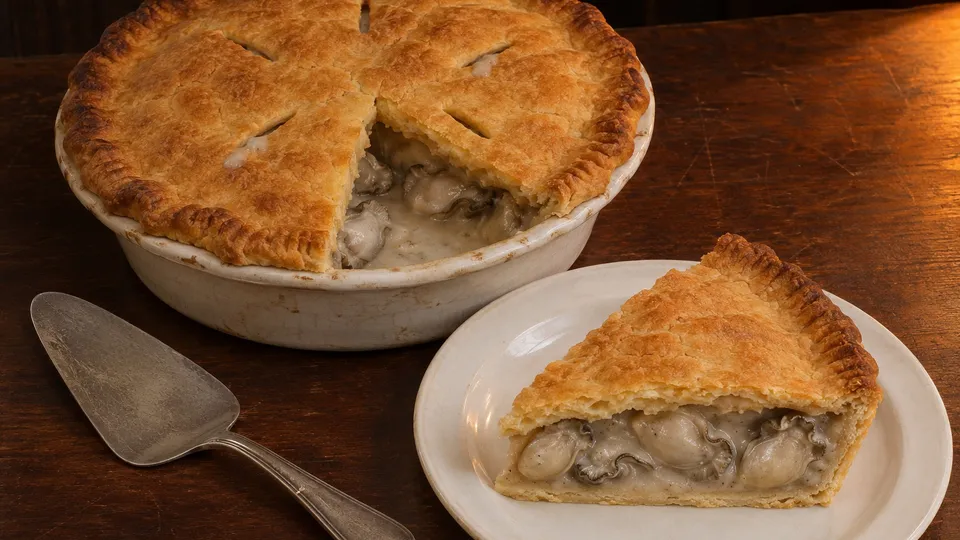 Cook it todayOyster Pie (1881)
Sources
- B. E. Lloyd, Lights and Shades in San Francisco (San Francisco: A. L. Bancroft & Company, 1876), preface, pp. 62–66 and 181–183. Internet Archive (opens in a new tab).
- Abby Fisher, What Mrs. Fisher Knows About Old Southern Cooking, Soups, Pickles, Preserves, Etc. (San Francisco: Women’s Co-operative Printing Office, 1881), title page, preface and pp. 18–19, 22, 24, 54 and 70–71. Internet Archive (opens in a new tab).
- Jessup Whitehead, The Steward’s Handbook and Guide to Party Catering (Chicago: John Anderson & Co., printers, 1889), pp. 76, 103–104 and 106. Internet Archive (opens in a new tab).
- Library of Congress, catalog record for What Mrs. Fisher Knows About Old Southern Cooking. Library of Congress (opens in a new tab).
- Karen Hess, historical notes in Abby Fisher, What Mrs. Fisher Knows About Old Southern Cooking (Bedford, Mass.: Applewood Books, 1995), no online copy; catalogue record: Historical Society of Pennsylvania (opens in a new tab). Her census research and reasoning as reported by Candy Sagon, The Washington Post, reprinted in The Roanoke Times, 7 February 1996: Virginia Tech newspaper archive (opens in a new tab); and in “JHU’s Special Collections Acquires First-Edition Copy of ‘What Mrs. Fisher Knows About Old Southern Cooking’,” Johns Hopkins Magazine, spring 2023: Johns Hopkins University (opens in a new tab).
- Federal Reserve Bank of Minneapolis, “Consumer Price Index, 1800–.” Minneapolis Fed (opens in a new tab).