The New York press dinner for Charles Dickens, Delmonico’s · New York City
What Was Served When Dickens Dined at Delmonico’s in 1868?
Oysters, asparagus cream à la Dumas, timbales à la Dickens and a fish for Queen Victoria: the 1868 press dinner, and why its two witnesses disagree.
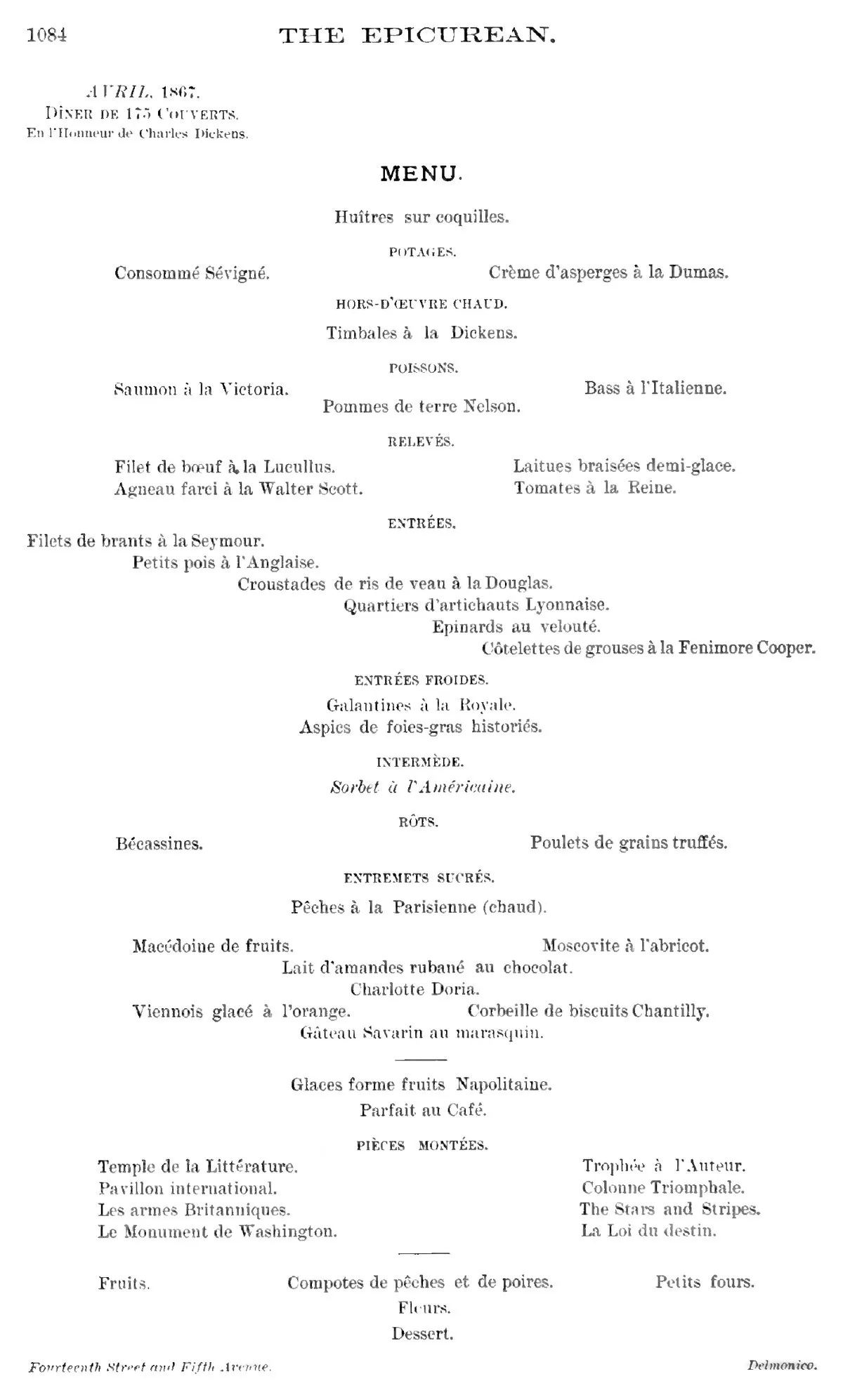
Oysters, a cream of asparagus named for Alexandre Dumas, little timbales named for Dickens himself and a fish dressed in honor of Queen Victoria: those were the first courses the writer James Parton remembered from the dinner the New York press gave Charles Dickens at Delmonico’s on Saturday, April 18, 1868. After them, he wrote, came a fillet of beef in the manner of Lucullus, a stuffed lamb in the style of Sir Walter Scott, cutlets named for Fenimore Cooper “and a dozen other efforts of Mr. Delmonico’s genius.” A longer menu, printed in 1894 by Charles Ranhofer, chef of Delmonico’s, matches most of those names. It also calls the fish salmon where Parton says trout, and it puts the dinner a year too early.
A bill of fare bound like a book
Dickens had landed in Boston near the end of 1867 for a reading tour, his second visit to America after one in 1842. Annie Fields, wife of the Boston publisher James T. Fields, kept a diary of his months in the country, and on the day of the dinner she noted that he had now read 76 times. Her entry for Sunday, April 19, begins: “Last night the great New York Press dinner came off.”
It nearly came off without him. Fields wrote that his foot had become badly swollen the night before, that he could put no weight on it by evening, and that he reached Delmonico’s an hour and a half after the appointed time, “with his foot sewed up in black silk.” She was not in the room, and what she knew of it came to her afterward. Dickens returned with the foot feeling better and repeated his speech to her from memory, word for word, and his tour manager, George Dolby, brought home table talk about Horace Greeley, who had been in the chair.
Parton was in the room, and he used it. His essay “Will the Coming Man Drink Wine?” appeared in the Atlantic Monthly that summer and went into his book Smoking and Drinking the same year. It is an argument against long dinners and the wine that carried them, and the Dickens dinner is his chief exhibit. In place of the usual bill of fare, he wrote, Mr. Delmonico had supplied “the elegantly bound book,” and he watched Dickens “eating and drinking his way through” it, “a task of three hours’ duration.” Watching him, Parton wondered which meal was further from the right thing, this one or the boarding-house dinner in Dickens’s own Martin Chuzzlewit, where the oysters “slid by scores into the mouths of the assembly.” Parton’s own idea of enough was six oysters, a plate of soup and the usual portion of fish, with potatoes and bread. “All the rest of the banquet is excess,” he decided. By the time the fish was cleared, “we had only picked up a few pebbles on the shore of the banquet.”
Two of his names need decoding. His “kettle-drums in the manner of Charles Dickens” are the timbales à la Dickens of the printed menu, put into English: timbale is French for a kettledrum, and the name comes from the drum-shaped mold. His “sighs of Mantalini” borrow a character from Dickens’s Nicholas Nickleby, and no dish by that name appears on Ranhofer’s page.
The menu Ranhofer printed
Ranhofer’s Epicurean, a cookbook of more than a thousand pages, closes with a selection of Delmonico’s bills of fare from 1862 to 1894. One of them, on page 1084, is headed “Dîner de 175 couverts, en l’honneur de Charles Dickens.” It runs:
- Oysters on the shell
- Two soups: consommé Sévigné, and cream of asparagus à la Dumas
- A hot hors d’oeuvre: timbales à la Dickens
- Fish: salmon à la Victoria and bass Italian style, with potatoes Nelson
- Removes: fillet of beef à la Lucullus, stuffed lamb à la Walter Scott, braised lettuce, tomatoes à la Reine
- Six entrées: fillets of brant, petits pois à l’Anglaise (green peas English style), sweetbread croustades, artichokes, spinach and grouse cutlets à la Fenimore Cooper
- Cold entrées of galantines and decorated aspics of foie gras
- A sorbet, then roast snipe and truffled chickens
- Eight sweets, two ices and the pièces montées
Those set pieces were made to be looked at, among them a Temple of Literature, a Trophy to the Author, the British arms, the Stars and Stripes and the Washington Monument. Three years earlier, the sweets table at Lincoln’s second inaugural ball had a Capitol in sugar.
The page carries a date that can’t be right. It reads “Avril, 1867,” months before Dickens sailed. Parton, writing in 1868, calls it the dinner the press gave “last April,” and Fields’s entry sits among her diary pages for the spring of 1868. Yale’s Beinecke Library catalogues an album kept by Henry E. Sweetser with the invitation, admission card, seating chart and Delmonico menu for the press banquet of April 18, 1868. The finding aid lists that menu without transcribing it, so the version most readers will meet is Ranhofer’s page, printed 26 years later.
Salmon or trout?
Most of the names line up. Parton’s Dumas asparagus, Dickens timbales, Lucullus beef, Walter Scott lamb and Fenimore Cooper cutlets are all on Ranhofer’s page, and his “historic pâtés” look like the aspics de foies-gras historiés. The fish doesn’t. Ranhofer prints Saumon à la Victoria; Parton writes of “our trout cooked so as to do honor to Queen Victoria.”
Either could be the slip. Parton was writing a few months after the dinner, with a point to make. Ranhofer printed his page a generation later, and it already has the year wrong. The kitchen may have changed the fish on the night, or the card may have said trout. Until the Yale card or a New York newspaper’s report of the bill of fare settles it, a fish named for the Queen was served and its species is open.
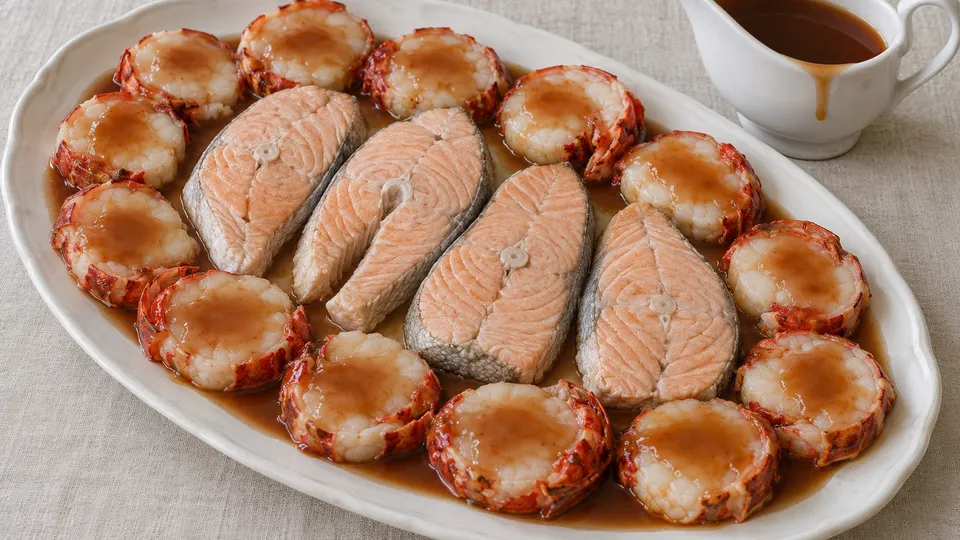
Ranhofer’s own recipe for salmon à la Victoria, in the fish chapter of the same book, shows what the name meant in his kitchen: slices of salmon cooked in a stock of ham, veal and vegetables moistened with red wine, the stock reduced to a sauce with lobster butter, and a garnish of lobster and small anchovy tartlets.
Who was missing
The company was all men. “Hence, not a lady was present!” Parton wrote, and he counted about thirty women who wrote regularly for the periodical press within a day’s journey of New York, along with Fanny Kemble, “who had a treble claim to a seat at that table.” He blamed the English custom of public dinners, with their wine and cigars, and imagined the press giving Dickens a farewell banquet in 1893 with three courses and, “instead of seven kinds of wine and various brands of cigars,” ladies at every table. Dickens had been invited, Parton reported, to come back every 25 years “for the rest of his life.” He died two years later, in June 1870.
The recipes
The three recipes follow the menu’s order, and all three come from Ranhofer’s Epicurean of 1894. They show what Delmonico’s kitchen meant by these names in Ranhofer’s day, a generation after the dinner, and none of them is a record of what was cooked on April 18, 1868.
- Cream of Asparagus Soup (1894): the book has no recipe under the Dumas name, and this is its cream of asparagus, finished with egg yolks and cream, with asparagus tips on top.
- Salmon à la Victoria (1894): the fish exactly as the printed menu names it, in a red-wine sauce with lobster.
- Green Peas, English Style (1894): boiled with mint and buttered, a plain dish among the entrées.
Making the fish course
Make the Salmon à la Victoria (1894) when you want the course the two witnesses argue over: the ham and vegetable stock can be made in the morning, and the fish itself takes ten minutes. Parton’s quarrel was with the seven kinds of wine poured alongside; for the wine card an American hotel set beside a grand dinner in the same decade, Forgotten Drink, our sister site, reads the list at Willard’s Hotel in Washington (opens in a new tab).
 Cook it todaySalmon à la Victoria (1894)
Sources
- James Parton, “Will the Coming Man Drink Wine?,” in Smoking and Drinking (Boston: Ticknor and Fields, 1868), pp. 88–93. University of California copy, Internet Archive.
- M. A. DeWolfe Howe, Memories of a Hostess: A Chronicle of Eminent Friendships Drawn Chiefly from the Diaries of Mrs. James T. Fields (Boston: The Atlantic Monthly Press, 1922), pp. 136–137 and 183–185.
- Charles Ranhofer, The Epicurean (New York: Charles Ranhofer, 1894), pp. 255, 295, 455–456, 827 and 1084. Boston Public Library copy, Internet Archive.
- Yale University, Beinecke Rare Book and Manuscript Library, Manuscripts in the Richard Gimbel Collection of Charles Dickens, GEN MSS 1998, Series III, box 74, folder 812 (H1580), finding aid.