Oyster Croquettes (1881)
Reader ratingsAbby Fisher’s oyster croquettes, San Francisco, 1881: a dozen oysters chopped fine with hot mashed potato and one egg yolk, shaped into oblong cakes, rolled in cracker crumbs and fried.
- Recipe makes
- 8 small croquettes, serving 4 as a first course
- Prep
- Cook
- Total
The potato boils for about 20 minutes, and the mixture chills for 30 minutes so the cakes hold their shape. Frying takes about 4 minutes a batch.
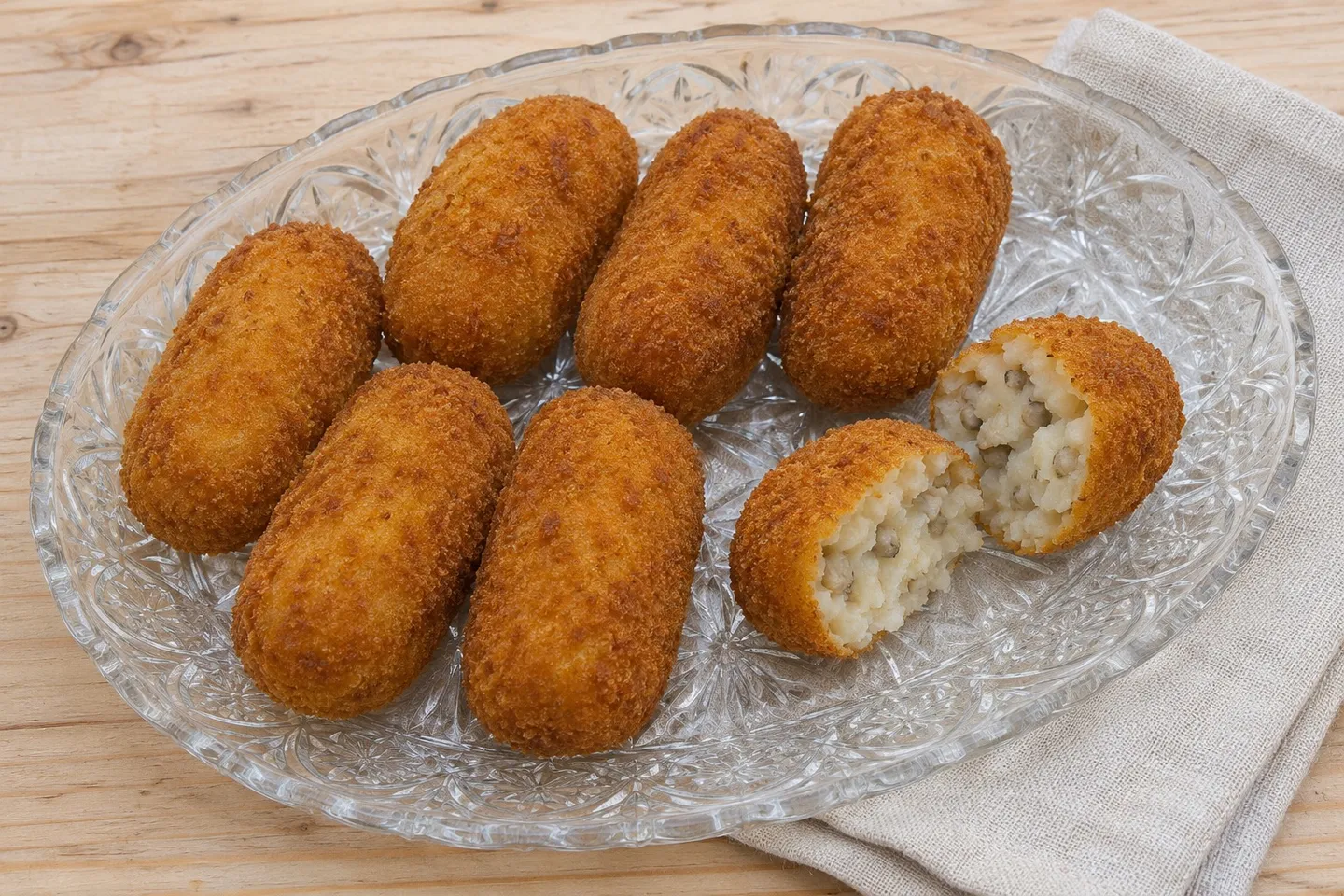
Oyster croquettes, one broken open to show the filling.
The story behind the recipe
Abby Fisher’s oyster croquettes stretch a dozen oysters a long way: chopped very fine, mashed together with one hot boiled potato, bound with a single egg yolk, rolled in cracker crumbs and fried. They come from What Mrs. Fisher Knows About Old Southern Cooking, printed in San Francisco in 1881, and they sit second on our oyster menu for the city’s private supper rooms. Those rooms promised oysters “in every style” and named none; this is one style a cook in the same city put in print five years later.
A run of croquettes
Fisher’s oysters arrive in the middle of a run of croquettes, and her neighbors show what she thought the word meant. Lamb, chicken and crab croquettes come first, each dipped in beaten egg and rolled in powdered crackers; her meat croquettes may be made of any meat, though veal is to be shaped round, “as you would a biscuit.” Her “Veal or Lamb Vigareets,” with calf or lamb brains in them, are seasoned high and made into oblong cakes, and the fish croquettes after the oysters go into dry corn meal. The oysters get the yolk “of one egg only” inside, no egg outside, just the crackers, and a brisk finish: “have your fat very hot, and fry quick and send to table.” She opens the recipe by telling the cook to chop “the quantity of oysters you want for the dinner” and then gives the measure for one dozen, a unit to multiply.
Read more about this recipe
Making it today
A mixture made with hot mashed potato is soft to shape, so it chills for half an hour first. Fisher names no fat and no temperature. We fry at 375°F (190°C), the temperature the FDA gives for frying shucked oysters, for about 4 minutes, until the crust is deep brown and the center is hot right through. Because the oysters and the yolk go in raw, the center should reach 160°F (71°C), the safe temperature for egg dishes. Lard is the period choice, with a neutral oil as the modern alternative.
Fisher’s larger oyster dish is the Oyster Pie (1881). The signs, the screens and the supper rooms are in What Was Served in San Francisco’s Private Supper Rooms?
Chop the quantity of oysters you want for the dinner in the following manner: Chop very fine one dozen oysters, take one boiled potato and mash hot into the fine oysters ...
Recipe makes: 8 small croquettes, serving 4 as a first course
Ingredients
For 8 small croquettes, serving 4 as a first course. Quantities are shown as written.
Quantities as written here, for 8 small croquettes, serving 4 as a first course.
- Shucked oysters, drained12
- Medium russet potato1Author measures: about 8 oz.
- Egg yolk1
- Salt1/4 tsp
- Ground black pepper1/8 tsp
- Plain crackers, finely crushed2 oz
- Lard or neutral oil, about 2 inches deep in the pan, for frying
Measurement notes
Ingredients as written here
- 12 shucked oysters, drained
- 1 medium russet potato (about 8 oz)
- 1 egg yolk
- ¼ tsp salt
- ⅛ tsp ground black pepper
- 2 oz plain crackers, finely crushed
- Lard or neutral oil, about 2 inches deep in the pan, for frying
Equipment
 Small saucepan
 Colander
 Potato masher or ricer
 Chef’s knife and board
 Mixing bowl
 Plate or tray that fits in the fridge
 Heavy deep pot or Dutch oven, at least 4 inches deep
 Deep-fry thermometer
- Instant-read thermometer
 Slotted spoon or spider
 Wire rack set over a tray
Instructions
Peel the russet potato, cut it into chunks and boil in salted water for about 20 minutes, until very tender. Drain well in the colander.
While the potato boils, pick over the shucked oysters for bits of shell, pat them dry and chop them very fine. Keep them in the fridge until the potato is ready.
Mash the hot potato in the mixing bowl until smooth, then mash the chopped oysters into it.
Let the mixture cool for 5 minutes, then beat in the egg yolk, salt and ground black pepper until evenly mixed.
Spread the mixture on the plate, cover and chill for 30 minutes, until firm enough to shape.
Heat the lard or neutral oil in the heavy pot to 375°F (190°C).
Shape the mixture into 8 oblong cakes, about 2½ inches long and ¾ inch thick, and roll each in the plain crackers until coated all over.
Fry 3 or 4 cakes at a time for about 4 minutes, turning once, until deep golden brown and 160°F (71°C) in the center. Let the fat come back to 375°F (190°C) between batches.
Lift them onto the wire rack to drain for a moment, and serve hot.
Nutrition
240calories per serving
- Recipe makes
- 8 small croquettes, serving 4 as a first course
- Servings
- 4
Estimated per serving (4) from USDA FoodData Central values for raw eastern oysters, boiled potato, egg yolk and saltine crackers, with about 2 tablespoons of frying fat absorbed in all.
Recipe notes
When adjusting quantities
Fisher’s dozen oysters to one potato and one yolk. For more, make the mixture in batches of a dozen oysters each so the yolk stays in proportion.
Notes
Quantities mentioned in these notes don’t change when you adjust the servings.
Fisher gives the dozen oysters, one boiled potato, one yolk, pepper and salt, the oblong shape, the powdered crackers and very hot fat. Ours are the potato’s size, the amounts of salt, pepper and crackers, the chilling, the cakes’ size and number, the frying fat, its temperature and the frying time.
Buy shucked oysters in a labeled container from a seller who keeps them on ice or refrigerated, keep them in the fridge until you cook, and use them within two days of buying, as the FDA advises for fresh seafood. Keep the shaped cakes in the fridge until they go into the fat, and don’t leave the cooked croquettes out for more than 2 hours. Raw or undercooked oysters can carry Vibrio bacteria, a particular risk for people with liver disease or weakened immunity, so cook every cake through.
Hot fat is a burn and fire risk: use a deep pan no more than half full, keep the lid nearby, and never leave it on the heat unattended. Contains shellfish, egg and wheat (gluten, in the crackers).
Scaling changes the ingredients only; pan sizes and cooking times need their own judgment. To adapt this recipe further, try the recipe tool at TuneMyRecipe (opens in a new tab), our sister site.
Sources and attribution
After Abby Fisher, What Mrs. Fisher Knows About Old Southern Cooking (San Francisco, 1881), No. 34, Oyster Croquettes
See the original pages (scan at Internet Archive) (opens in a new tab)
Recipe details
- Course
- Starter
- Dish family
- Fish & Seafood
- Region
- American
- Era
- 19th century
- Source decade
- 1880s
- Main ingredient
- Shellfish
- Difficulty
- Intermediate
- Occasion
- Dinner party