Fried Oysters (1889)
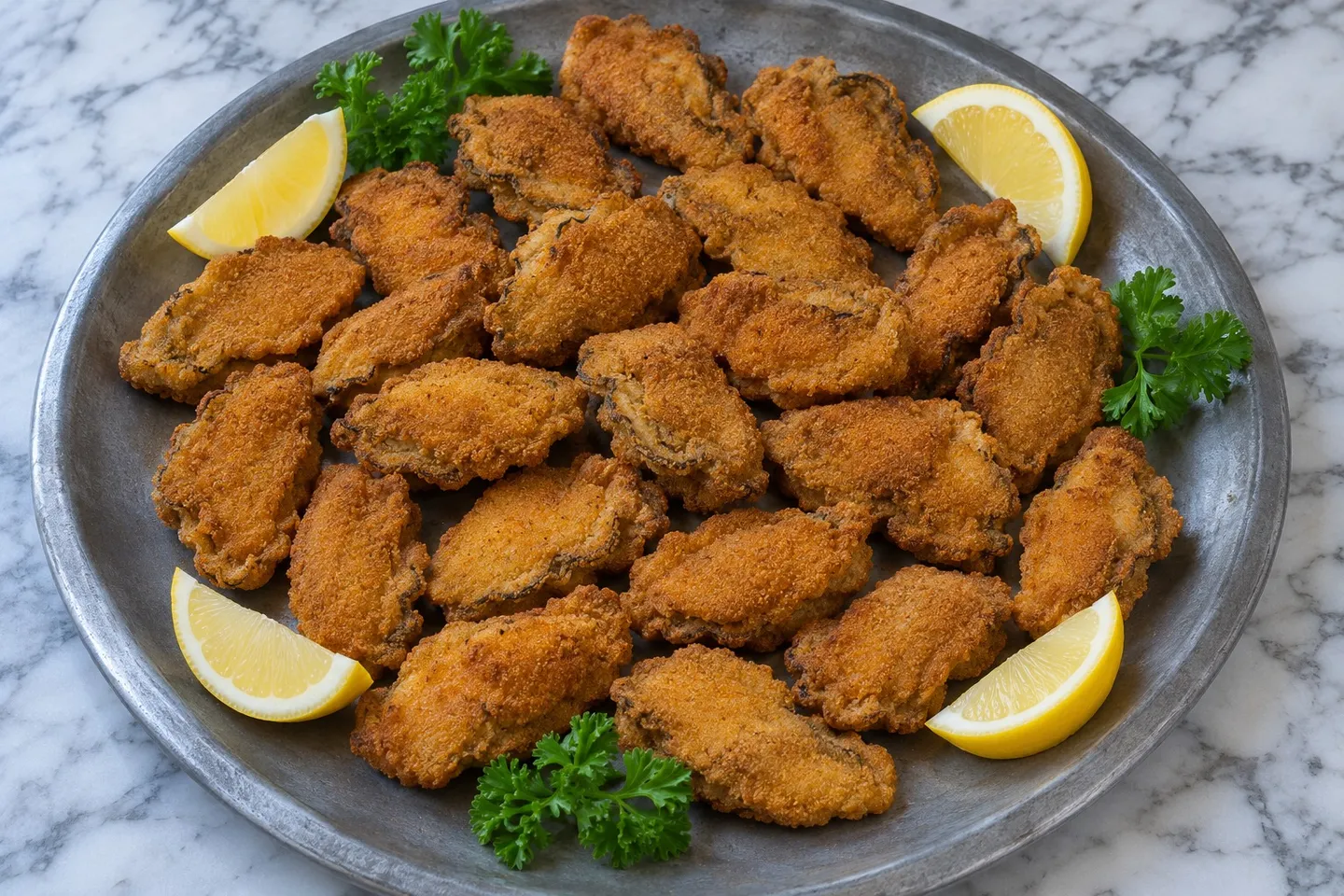
Reader ratingsJessup Whitehead’s fried oysters from his Chicago caterer’s handbook of 1889: large oysters double-breaded in cracker dust, egg and cracker dust again, fried a few at a time in hot lard.
- Recipe makes
- 24 fried oysters, serving 4 as a course or 2 as an oyster supper
- Prep
- Cook
- Total
Heat the fat while you bread the oysters; each batch fries for 4 to 5 minutes.
Crumbed fried oysters with lemon and parsley.
The story behind the recipe
Fried oysters were the caterer’s safe bet, and Jessup Whitehead had a story to prove it. His Steward’s Handbook and Guide to Party Catering, printed in Chicago in 1889, was written for the people who ran hotel dining rooms, restaurants and paid suppers, and it treats the fried oyster as a matter of buying and stock as much as of cooking. They close our oyster menu for San Francisco’s private supper rooms: a trade dish from another city, printed thirteen years after B. E. Lloyd’s account of the rooms.
A dozen to a coffee cup
Large frying oysters, Whitehead advised, were bought “by the hundred.” A dozen, he wrote, “will fill an ordinary coffee cup,” and a dozen made one guest’s portion at an oyster supper, against four to six each when oysters were only one course of a dinner. A banquet he counted among the blunders of his trade made the same point. A country town had hired a caterer to feast its visiting Knights, and the caterer put green turtle soup at the head of the menu. Nobody called for it. What the guests wanted, Whitehead decided, was “a plate of a dozen double-breaded large oysters, properly garnished in Chicago oyster house style.”
His worked example of a ball supper for two hundred shows the scale of the work. Of ten gallons of oysters bought in bulk, four were fried, with twelve pounds of cracker meal for the breading and twenty pounds of lard for the frying and the pastry, and he warned that “oysters frying is most destructive of lard”: the cracker dust soon turned it dark and thick. That supper’s menu set fried oysters beside raw and stewed ones, with celery, pickles and cold slaw.
Read more about this recipe
Making it today
Whitehead’s entry is a single line, and it leaves the heat to the cook. We fry at 375°F (190°C), the temperature the FDA gives for frying shucked oysters, for his own 4 to 5 minutes, which is longer than the FDA’s 3-minute minimum. His plain version is unseasoned; his fried oysters à la Fortress Monroe on the same page are salted after frying and served with lemon and parsley, and these are finished the same way. Lard is the period fat, and a neutral oil can stand in for it.
Abby Fisher fried her oysters chopped and bound with potato in San Francisco eight years earlier, as Oyster Croquettes (1881). Lloyd’s screened rooms and their alibi are the subject of What Was Served in San Francisco’s Private Supper Rooms?
Fried Oysters—Dipped in cracker dust, then in egg, then in cracker dust again, dropped a few at a time in hot lard ...
Recipe makes: 24 fried oysters, serving 4 as a course or 2 as an oyster supper
Ingredients
For 24 fried oysters, serving 4 as a course or 2 as an oyster supper. Quantities are shown as written.
Quantities as written here, for 24 fried oysters, serving 4 as a course or 2 as an oyster supper.
- Large shucked oysters (about 24)1 pint
- Cracker meal or finely crushed plain crackers5 oz
- Large eggs2
- Lard or neutral oil, about 3 inches deep in the pan, for frying
- Salt1/2 tsp
- Lemon, cut in wedges1
- Parsley sprigs, to garnish
Measurement notes
Ingredients as written here
- 1 pint large shucked oysters (about 24)
- 5 oz cracker meal or finely crushed plain crackers
- 2 large eggs
- Lard or neutral oil, about 3 inches deep in the pan, for frying
- ½ tsp salt
- 1 lemon, cut in wedges
- Parsley sprigs, to garnish
Equipment
 Colander
 Clean kitchen towels
 Two plates and a shallow bowl
 Fork
- Large plate
 Heavy deep pot or Dutch oven, at least 6 inches deep
 Deep-fry thermometer
- Instant-read thermometer
 Slotted spoon or spider
 Wire rack set over a tray
- Warm platter
Instructions
Tip the large shucked oysters into the colander and pick each one over for bits of shell. Spread them between clean kitchen towels and pat them dry. Keep them in the fridge until you bread them.
Heat the lard or neutral oil in the heavy pot to 375°F (190°C).
Put half the cracker meal on one plate and the rest on the second. Beat the large eggs in the shallow bowl with the fork.
Roll each oyster in the first plate of cracker meal, dip it in the egg, then roll it in the second plate, pressing the crumbs on. Lay the breaded oysters on the large plate.
Fry 5 or 6 oysters at a time for 4 to 5 minutes, turning once, until deep golden brown all over and 145°F (63°C) in the center of a test oyster. Let the fat come back to 375°F (190°C) between batches.
Lift them onto the wire rack and sprinkle with the salt.
Pile the oysters on the warm platter with the lemon wedges and parsley sprigs, and serve at once.
Nutrition
300calories per serving
- Recipe makes
- 24 fried oysters, serving 4 as a course or 2 as an oyster supper
- Servings
- 4
Estimated per serving (4) from USDA FoodData Central values for raw eastern oysters, saltine crumbs and egg, allowing for crumbs left on the plates, with about 3 tablespoons of frying fat absorbed in all.
Recipe notes
When adjusting quantities
A pint of large oysters, about two dozen. Whitehead’s portion is a dozen a person for an oyster supper and four to six when the oysters are one course of a dinner.
Notes
Quantities mentioned in these notes don’t change when you adjust the servings.
Whitehead gives the order of the breading (cracker dust, egg, cracker dust again), the hot lard, frying a few at a time and the 4 or 5 minutes. The amounts, the frying temperature, the rack, and the salt, lemon and parsley borrowed from his Fortress Monroe oysters are added. Keep the two plates of crumbs apart; the second coat over the egg is what makes them double-breaded.
Buy shucked oysters in a labeled container from a seller who keeps them on ice or refrigerated, keep them in the fridge until you cook, and use them within two days of buying, as the FDA advises for fresh seafood. Raw or undercooked oysters can carry Vibrio bacteria, a particular risk for people with liver disease or weakened immunity; the FDA’s advice for frying shucked oysters is at least 3 minutes at 375°F (190°C). Don’t leave fried oysters out for more than 2 hours.
Hot fat is a burn and fire risk: use a deep pan no more than half full, keep the lid nearby, and never leave it on the heat unattended. Contains shellfish, egg and wheat (gluten, in the crackers).
Scaling changes the ingredients only; pan sizes and cooking times need their own judgment. To adapt this recipe further, try the recipe tool at TuneMyRecipe (opens in a new tab), our sister site.
Sources and attribution
After Jessup Whitehead, The Steward’s Handbook and Guide to Party Catering (Chicago, 1889), Fried Oysters
See the original pages (scan at Internet Archive) (opens in a new tab)
Recipe details
- Course
- Starter
- Dish family
- Fish & Seafood
- Region
- American
- Era
- 19th century
- Source decade
- 1880s
- Main ingredient
- Shellfish
- Difficulty
- Easy
- Occasion
- Dinner party