Oviedo’s Sumario describes the barbacoa · Toledo, Spain
Where Does the Word Barbecue Come From?
From Spanish barbacoa: a raised frame of sticks over a fire, described by Oviedo in 1526 and traced by dictionaries to Taíno. Then came the pork.
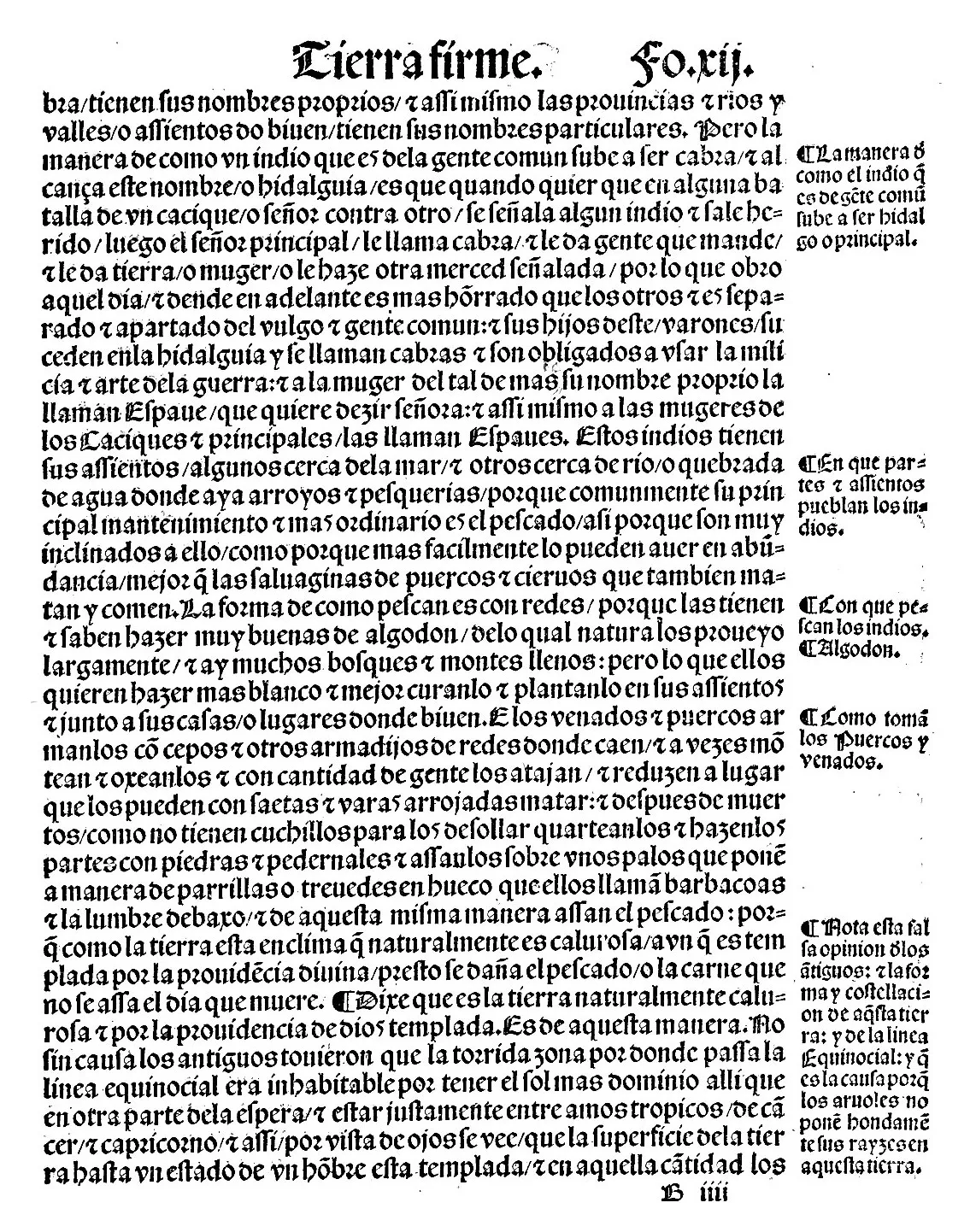
The word reached print in Spanish, as barbacoa, and it first named a frame of sticks. In 1526 Gonzalo Fernández de Oviedo described Indigenous hunters of Tierra Firme, the Spanish name for the Caribbean mainland around the Isthmus of Panama, roasting game and fish on a raised grid of sticks with the fire underneath, “que ellos llamā barbacoas,” which they call barbacoas. Dictionaries trace the Spanish word to Taíno, the language of Hispaniola, though not all of them say so with the same confidence. For well over a century the frame held whatever needed to be off the ground: meat over coals, buccaneers asleep above a rising river, pork drying for a week. By the 1830s American cookbooks used the word for a way of cooking pork, and two of them, in printings a year apart, meant quite different things by it.
Sticks over a fire on Tierra Firme
Oviedo knew the place. The title of his Sumario de la natural y general istoria de las Indias calls him a native of Madrid and a resident and alderman, regidor, of Santa María la Antigua del Darién, “en tierra firme,” on the mainland, and says the book tells the Emperor Charles V of things its author “vido,” saw, in the Indies. He paid for the printing himself. The colophon says Remón de Petras finished it at Toledo on February 15, 1526.
The barbacoa turns up in a passage on how the people of Tierra Firme get their meat. They take deer and what Oviedo calls pigs, puercos, in snares and nets, or drive them with many people to a place where arrows and thrown spears can bring them down. Then, “como no tienen cuchillos para los desollar,” since they have no knives to skin them, they quarter and cut them up with stones and flints, “y assanlos sobre vnos palos que ponē a manera de parrillas o treuedes en hueco que ellos llamā barbacoas y la lumbre debaxo.” In English: and they roast them on sticks they set up like grills or trivets, raised off the ground, which they call barbacoas, with the fire underneath. Fish is roasted the same way. (The translations from Oviedo’s Spanish here are ours.)
He also gives the reason. The land lies in a climate that is hot by nature, he writes, and “presto se daña el pescado o la carne que no se assa el dia que muere”: fish or meat that is not roasted the day it dies soon spoils. Oviedo’s barbacoa is an everyday cooking rack, and its purpose is speed, to get the day’s kill cooked before the heat could spoil it.
Is barbecue a Taíno word?
Probably, though the evidence for it comes from later dictionaries, not from Oviedo. His “they” are the people of Tierra Firme he is describing, and a page earlier he notes that their languages were “muy diuersas y apartadas,” very different and far apart, and that the Spaniards had brought most of the Cueva-speaking province under their rule. The barbacoa sentence records a word in use on the mainland and names no language. Merriam-Webster derives the English noun from American Spanish barbacoa, a “wood framework for supporting cooked or dried meat,” and calls that “probably borrowed from Taino of Hispaniola.” The American Heritage Dictionary is firmer: “of Taíno origin.” If the word was Taíno, it had reached the mainland by the time Oviedo wrote it down there, and his page is the earliest witness in these sources to what it meant: a raised frame and a fire beneath.
A popular story makes barbecue French instead, from barbe à queue, “beard to tail,” for a beast roasted whole on a spit. Neither dictionary gives it, and every early use of the word below is for a frame of sticks, never a spit.
A bed above the floodwater
Merriam-Webster finds the English verb by about 1689, and the earliest English witness in these sources comes from the same isthmus. In the spring of 1681 a party of buccaneers walked back across Darién from the Pacific coast, and William Dampier, who was among them, told the march in A New Voyage Round the World (London, 1697), the book that follows him to Guam with Captain Swan’s starving crew. It was a hungry crossing. On the eleventh, by his count, they marched ten miles, “and built Hutts at night; but went supperless to bed.” The entry before it notes in passing that “our last Slave run away.”
On the twelfth they crossed one deep river on a tree, marched seven miles through low swampy ground and came to a great deep river they could not get over. “We built Hutts upon its Banks and lay there all night, upon our Barbecu’s, or frames of Sticks, raised about 3 foot from the ground.” By morning the river had burst its banks and stood two feet deep in the huts, the guides had slipped away, and the men had eaten nothing since the last settlement except macaw berries, which they ate “though coursly.” Here the barbecue is a bed, and the three feet of clearance is the point of it.
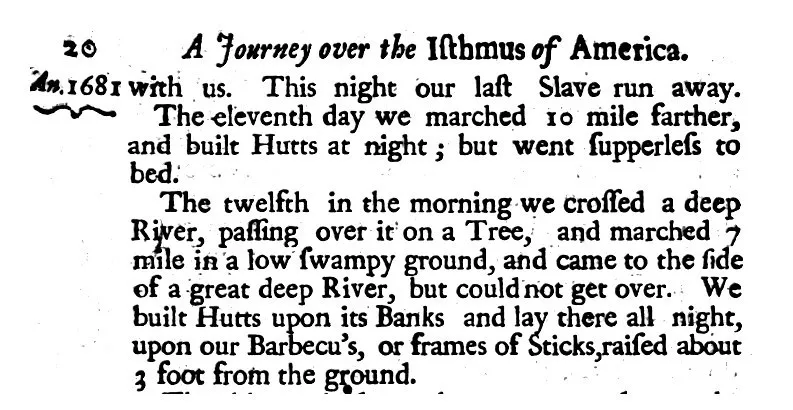 William Dampier, A New Voyage Round the World (London: James Knapton, 1697), p. 20.
As dry as a chip
Lionel Wafer, who had gone to sea “in the Service of the Surgeon” of his ship and was on the same march, saw the frame put to work on food. On May 5, 1681, the fifth day of the journey, a man drying gunpowder in a silver plate let it blow up beside him and scorched Wafer’s knee to the bone, and a few days later he was “left behind among the Wild-Indians, in the Isthmus of Darien,” as he put it. His New Voyage and Description of the Isthmus of America (London, 1699) describes how the Indigenous people he stayed with kept meat.
Hunters carried their kill on sticks over their shoulders to a meeting place where the women waited, then home, “first Barbecuing it that Night.” For a store they built a larger frame. “If they intend to preserve any, having little Salt,” Wafer writes, they set four forked sticks eight or nine feet apart, laid two parallel staves across them a little over a foot from the ground, “and so make a Barbecue.” The pieces of beast or bird went across the staves with a few live coals beneath, and they turned the pieces and renewed the small fire “for three or four Days, or a Week, till the Meat be as dry as a Chip, or like our smoak’d Beef.” When the haul was large, “the Men help the Women to carry home the Venison.” At home another barbecue held the dried pieces over embers to keep them from “growing musty, in that moist Country,” and at great feasts they built “a great Barbecue 10, 12, or 20 Foot long,” spread it with plantain leaves for a tablecloth and ate from it.
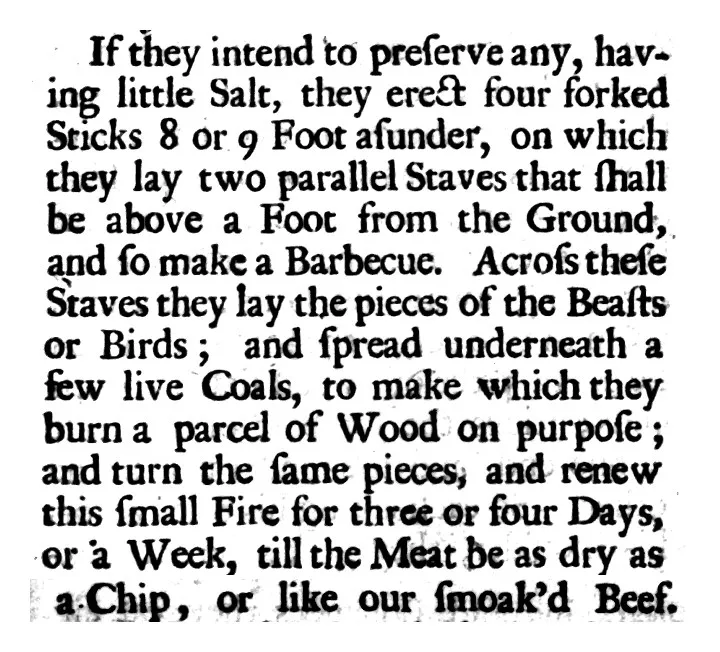 Lionel Wafer, A New Voyage and Description of the Isthmus of America (London: James Knapton, 1699), pp. 174–175.
Oviedo’s frame kept meat from spoiling by cooking it the same day; Wafer’s did it by drying it over days. Both answer the same heat and damp. Wafer’s version, low and slow over a small fire, is the first in these sources that sounds like what many cooks now mean by the word.
Baked in Virginia, grilled in Kentucky
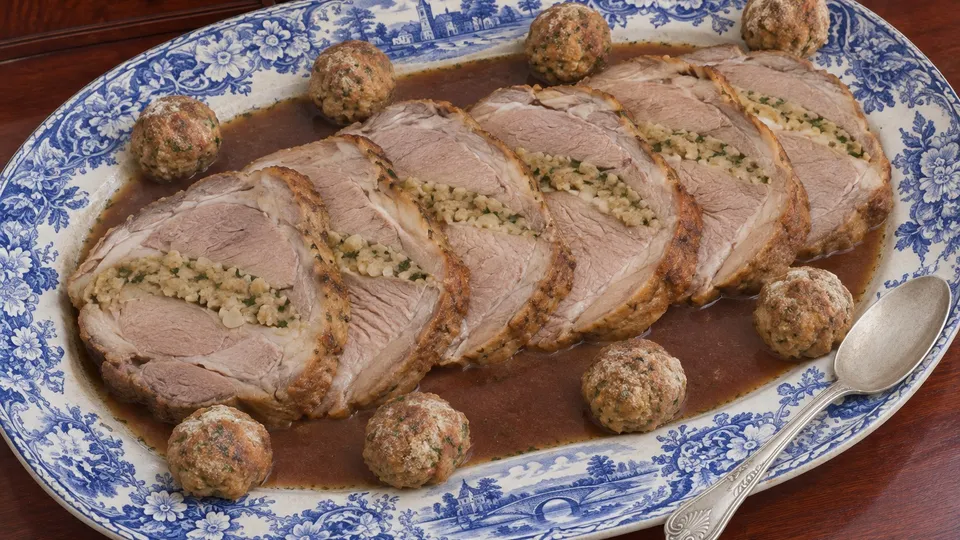
By the 1830s barbecue was a verb in American cookbooks, and they didn’t agree on what it meant. Mary Randolph’s The Virginia Housewife, read here in its Baltimore edition of 1838, which carries a copyright entry of 1828, gives “To Barbecue Shote.” Shote, she explains, “is the name given in the southern states to a fat young hog,” and a footnote says she spelled the provincial word to catch its sound better than the usual shoat. Her barbecue goes in the oven. A forequarter of about six pounds is cut between the ribs and stuffed with “rich forcemeat,” set in a pan with a pint of water, two cloves of garlic, red wine and mushroom catsup, and baked. It comes to the table ribs uppermost, in a gravy thickened with butter and brown flour: “if it be not sufficiently brown, add a little burnt sugar to the gravy, garnish with balls.”
Lettice Bryan’s The Kentucky Housewife, entered for copyright in 1839 and stereotyped in Cincinnati, cooks the same young hog over fire. She rubs a hind or fore quarter with salt, pepper and “a small portion of molasses,” lets it lie a few hours, rinses it clean and wipes it dry, and lays it “on a large gridiron, over a bed of clear coals.” “Do not barbecue it hastily,” she writes, “but let it cook slowly for several hours,” turning it now and then and basting it “with nothing but a little salt-water and pepper.” It is skinned before cooking and served well done, without garnish, with lemon juice squeezed over and melted butter and wine, bread sauce, raw “sallad,” “slaugh” or cucumbers, and stewed fruit beside it. “Beef may be barbecued in the same manner.”
In printings a year apart, though Randolph’s book is the older, one book bakes the pork in wine and the other cooks it slowly over coals, and each calls the result barbecue. Neither says the other is wrong. Bryan’s molasses is no glaze, either: it goes on with the salt and comes off under the rinse, before the meat sees the fire. The books name their authors, not their cooks, and they were written for households that held enslaved people. Randolph’s introduction has the mistress give out “the catsup, spice, wine, whatever may be wanted for each dish, measured to the cook,” because “we have no right to expect slaves or hired servants to be more attentive to our interest than we ourselves are.” Bryan tells her reader to “have established rules for domestics and slaves to be governed by.” The hands that basted Bryan’s pork or set Randolph’s pan in the oven could belong to an enslaved cook, and neither book gives that cook a name. Both show what was advised, not what any household served.
A feast for several hundred
On Monday, September 14, 1931, the Department of Agriculture’s Housekeepers’ Chat, the radio series that gave listeners Aunt Sammy, took up “How to Give an Old-Fashioned Barbecue.” The script, marked “Not for publication,” calls it “a big outdoor feast at which whole animals are roasted outdoors for hours and hours over a great bed of coals,” and says granges, churches, community clubs and even schools had taken it up to feed several hundred people, often to raise money. On the word itself it was frank: “nobody seems to be quite sure where it came from. Some authorities say it came from the Spanish.” In the old days in the South, the script says, the men came the afternoon before to dig the trench and sat up all night over the roasting meat, and the women and children arrived in the morning with bread, vegetables, sauces, cakes and pies.
The instructions are on the scale of a public event. For beef, a trench about 40 inches deep and 3 feet wide, 10 feet long for 400 pounds of meat; for pork, according to “the barbecue expert down in South Carolina,” 15 inches deep, with 4 feet of length for each pig. Hard, dry wood, “oak or hickory preferred,” burned about three hours down to a bed of coals 15 to 18 inches thick. Some cooks laid the carcasses on wire netting or iron bars over the coals and mopped them with vinegar or cider, salt, pepper, butter and sometimes mustard, using a stick wound with cheesecloth; others wrapped 20-pound pieces of beef in cheesecloth and burlap and sealed them in the trench for about ten hours. The Bureau’s menu specialist planned the meal to follow: hot meat slipped into “large, flat, round buns,” potato salad, whole tomatoes, relishes, cake and fruit or pie, and coffee. The recipe of the day was a Cowboy Barbecue Sauce of vinegar, tomatoes, red pepper and bacon drippings, “enough for from 75 to 100 pounds of meat.”
Four hundred years after Oviedo, the frame of sticks had turned into an iron grate over a trench, and the word now named the whole feast.
The recipes
The oldest recipes that call themselves barbecue in these sources are American, printed more than three centuries after Oviedo’s book, so none of them is what the people of Darién cooked. The two pork recipes show the split of the 1830s; the sauce is the USDA script’s own. Amounts, temperatures and the grill set-up are ours.
- Baked Barbecued Pork (1838): Randolph’s stuffed pork, baked in wine and mushroom catsup and garnished with forcemeat balls.
- Barbecued Pork over Coals (1839): Bryan’s pork shoulder, cooked slowly on the grill and basted with salt water.
- Cowboy Barbecue Sauce (1931): the radio script’s boiled sauce of vinegar, tomatoes and red pepper, for basting.
Put Bryan’s pork over coals on the grill in the morning and Randolph’s baked pork in the oven after lunch, and both come to the table at dinner: the 1830s disagreement over one word, smoke and salt water on one plate and wine gravy on the other.
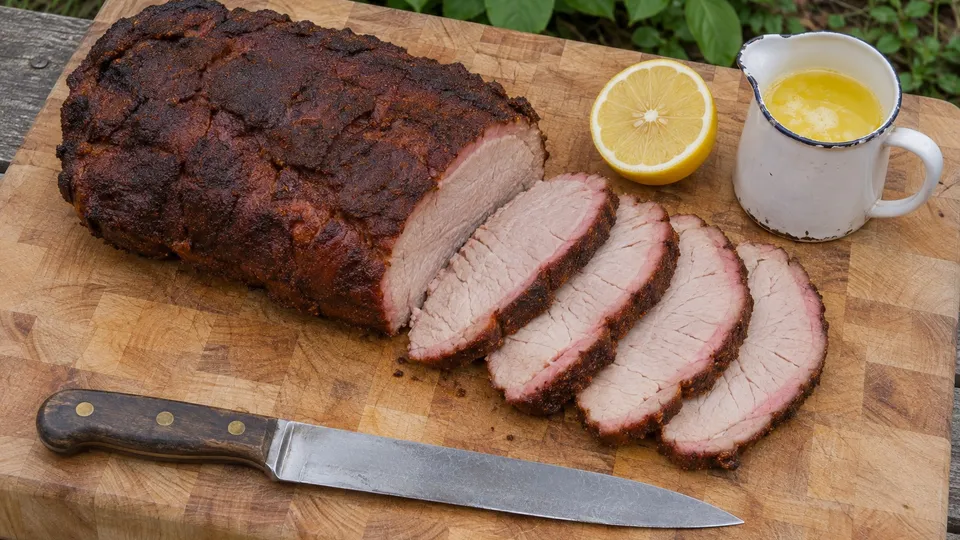 Cook it todayBarbecued Pork over Coals (1839)
 Cook it todayBaked Barbecued Pork (1838)
Sources
- Gonzalo Fernández de Oviedo, Sumario de la natural y general istoria de las Indias (Toledo: Remón de Petras, at the author’s cost, February 15, 1526), fols. 11v and 12r, title leaf and colophon; John Carter Brown Library copy (Internet Archive (opens in a new tab)).
- William Dampier, A New Voyage Round the World (London: James Knapton, 1697), p. 20 (Internet Archive (opens in a new tab)).
- Lionel Wafer, A New Voyage and Description of the Isthmus of America (London: James Knapton, 1699), pp. 3, 5 and 174 to 176 (Internet Archive (opens in a new tab)).
- Mary Randolph, The Virginia Housewife: Or, Methodical Cook, stereotype edition, with amendments and additions (Baltimore: Plaskitt, Fite & Co., 1838), pp. xi to xii and 51 to 52 (Internet Archive (opens in a new tab)).
- Lettice Bryan, The Kentucky Housewife (Cincinnati: stereotyped by Shepard & Stearns; entered 1839), introduction and pp. 95 to 96, read in an undated facsimile reprint by Image Graphics, Paducah, Kentucky (Internet Archive (opens in a new tab)).
- U.S. Department of Agriculture, Radio Service, Housekeepers’ Chat, “How to Give an Old-Fashioned Barbecue,” Monday, September 14, 1931, pp. 1 to 3 (Internet Archive (opens in a new tab)).
- Merriam-Webster, “barbecue (opens in a new tab),” etymology.
- The American Heritage Dictionary of the English Language, “barbecue (opens in a new tab),” etymology.