Barbecued Pork over Coals (1839)
Reader ratingsLettice Bryan’s barbecued shoat from The Kentucky Housewife, 1839: pork rubbed with salt, pepper and molasses, wiped clean, cooked slowly over charcoal with a salt-water baste and served with lemon and butter and wine.
- Recipe makes
- 3 lb pork shoulder, serving 6
- Prep
- Cook
- Total
The rub needs 3 hours in the refrigerator, and the fire is lit in the last half hour of it. The pork then cooks for about 5 hours over the cool side of a covered charcoal grill and rests 15 minutes while the butter and wine are warmed.
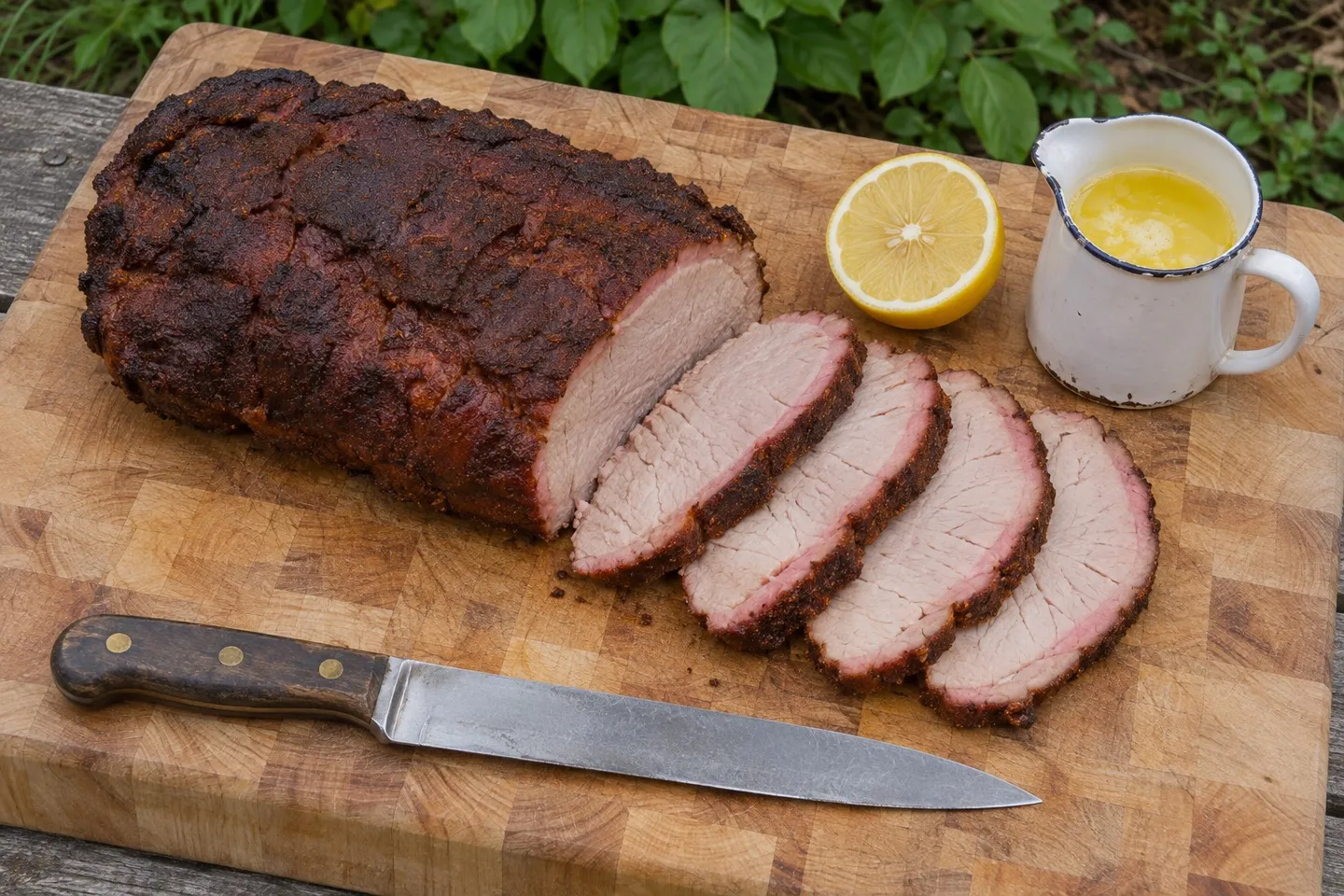
Charcoal-cooked pork shoulder, partly sliced, with a halved lemon and a jug of melted butter and wine.
The story behind the recipe
“Do not barbecue it hastily,” Lettice Bryan wrote in The Kentucky Housewife, entered for copyright in 1839 and stereotyped in Cincinnati. Her barbecued shoat is a quarter of young pork laid on a big gridiron over clear coals and left there for several hours, turned now and then and basted with salt water and pepper, “merely to season and moisten it a little.” It comes off well done, skinned, with lemon squeezed over it and no garnish.
A pig, a shoat and pork
Bryan explains the word just before, in her corned shoat. Shoat “has been given to very small, young hogs, for no other purpose than to distinguish their size, from pigs, or pork of a large size, they being of an intermediate size.” The rub before the fire is salt, pepper and a little molasses, left on for a few hours and then rinsed away, so whatever sweetness it leaves is faint, and the meat goes on the coals plain. On the same page, giving her roast hind quarter, she warns the cook to “be very careful to have shoat, or pork, perfectly done, as the least rawness renders it disgusting.”
She sends it to the table with melted butter and wine, bread sauce, a raw salad, slaw or cucumbers, and stewed fruit, and adds that beef may be barbecued the same way. That is one Kentucky author’s advice of 1839.
Read more about this recipe
Making it today
A boneless pork shoulder, bought with the skin off, stands in for her quarter of young hog, and a covered kettle grill does the work of her gridiron: the coals on one side, the meat on the other, so it cooks slowly in the heat and smoke without the fire under it. We wipe the rub off with damp paper towels where she rinses it, because rinsing raw meat at the sink spreads its bacteria. The amounts, grill temperature, times and thermometer reading are ours.
Randolph’s Virginia version of the same dish goes in the oven: Baked Barbecued Pork (1838). How a frame of sticks on the Isthmus of Panama became this pork is in Where Does the Word Barbecue Come From?
TO BARBECUE SHOAT.
Take either a hind or fore quarter, rub it well with salt, pepper, and a small portion of molasses, and if practicable, let it lie for a few hours; then rinse it clean, and wipe it dry with a cloth, and place it on a large gridiron, over a bed of clear coals. Do not barbecue it hastily, but let it cook slowly for several hours, turning it over occasionally, and basting it with nothing but a little salt-water and pepper, merely to season and moisten it a little. When it is well done, serve it without a garnish, and having the skin taken off, which should be done before it is put down to roast, squeeze over it a little lemon juice, and accompany it with melted butter and wine, bread sauce, raw sallad, slaugh, or cucumbers, and stewed fruit. Beef may be barbecued in the same manner.
Recipe makes: 3 lb pork shoulder, serving 6
Ingredients
For 3 lb pork shoulder, serving 6. Quantities are shown as written.
Quantities as written here, for 3 lb pork shoulder, serving 6.
Rub
- Molasses1 tbsp
- Fine salt, for the rub2 tsp
- Black pepper, for the rub1 tsp
Pork
- Boneless pork shoulder (Boston butt), skin removed3 lb
Baste
- Water1 cup
- Fine salt, for the baste1 tsp
- Black pepper, for the baste1/2 tsp
To serve
- Lemon1/2
- Unsalted butter3 oz
- Dry white wine1/4 cup
Measurement notes
Ingredients as written here
- 1 tbsp molasses
- 2 tsp fine salt, for the rub
- 1 tsp black pepper, for the rub
- 3 lb boneless pork shoulder (Boston butt), skin removed
- 1 cup water
- 1 tsp fine salt, for the baste
- 1/2 tsp black pepper, for the baste
- 1/2 lemon
- 3 oz unsalted butter
- 1/4 cup dry white wine
Equipment
 Small bowls
 Rimmed baking sheet
 Plastic wrap
 Paper towels
 Charcoal grill with a lid, about 22 inches
 Chimney starter
 Heatproof grill gloves
 Grill thermometer
 Long tongs
 Spoon
- Instant-read thermometer
 Carving board and knife
- Aluminum foil
 Small saucepan
 Small jug or sauceboat
 Warm serving platter
Instructions
Stir the molasses, the salt for the rub and the pepper for the rub together in a small bowl.
Set the pork shoulder on the rimmed baking sheet and rub the mixture over every side. Cover with plastic wrap and refrigerate for 3 hours.
Half an hour before the rub’s time is up, set the grill outdoors on level, non-flammable ground, well away from the house, fences and overhanging branches. Fill the chimney starter with charcoal and light it. Wear the gloves whenever you handle the chimney, the grate or the lid.
When the coals are covered with gray ash, after 20 to 25 minutes, pour them onto one side of the grill, leaving the other side empty. Set the grate in place and close the lid with the vents half open. Adjust the vents until the grill thermometer on the cool side holds at 275 to 300°F (135 to 150°C).
Meanwhile, stir the water, the salt for the baste and the pepper for the baste together in a clean small bowl and keep it by the grill.
Wipe the rub off the pork with damp paper towels until the surface is clean, then pat it dry with fresh ones. Throw the towels away and wash your hands.
Lay the pork on the grate over the empty side, not over the coals, and close the lid. Cook for 4½ to 5½ hours, keeping the temperature at 275 to 300°F (135 to 150°C).
Every 45 minutes, turn the pork with the tongs and spoon a little of the baste over the top with a clean spoon. Never put a spoon that has touched the meat back into the bowl.
About once an hour, use the long tongs to add a dozen or so pieces of fresh charcoal to the coals to keep the heat steady.
Start checking after 4 hours. The pork is ready when a fork slides in easily and the thickest part reads at least 190°F (88°C). Lift it onto the carving board, cover it loosely with foil and let it rest for 15 minutes. Throw away any baste that is left.
While it rests, melt the butter in the small saucepan over low heat, add the white wine and let it bubble for 1 minute. Pour it into the jug.
Slice the pork across the grain, lay it on the warm platter, squeeze the lemon over it and serve with the butter and wine.
Close the grill’s lid and vents and leave the coals to burn out inside it. Don’t empty the ashes until they are completely cold.
Nutrition
420calories per serving
- Recipe makes
- 3 lb pork shoulder, serving 6
- Servings
- 6
Estimated per serving (6) from USDA FoodData Central values for roasted pork shoulder, butter and white wine; the molasses rub is wiped off before cooking.
Recipe notes
When adjusting quantities
Written for one 3 lb shoulder. A larger shoulder fits the same grill with the rub increased in step, but takes longer; go by the thermometer and the fork, not the clock.
Notes
Quantities mentioned in these notes don’t change when you adjust the servings.
Our changes from Bryan: a 3 lb boneless pork shoulder, skin off, for her hind or fore quarter of shoat; a covered kettle grill with the coals to one side for her gridiron over a bed of coals; the amounts of rub and baste; 3 hours for her “few hours”; wiping the rub off for rinsing it; 4½ to 5½ hours and a thermometer for her “several hours” and “well done”; and her melted butter and wine read as butter warmed with a little white wine, since she names neither the proportions nor the wine. Her other accompaniments, bread sauce, a raw salad, “slaugh” (slaw, as we read it) or cucumbers, and stewed fruit, are left to the cook. Hardwood lump charcoal or briquettes can be used. Bryan names no wood; a fist-sized chunk of oak or hickory on the coals, the woods the USDA preferred for barbecue fires in 1931, gives more smoke.
Food safety: pork roasts are safe at 145°F (63°C) with a 3-minute rest (FoodSafety.gov, “Safe Minimum Internal Temperatures”); a shoulder needs much more heat before it turns tender. The USDA Food Safety and Inspection Service advises against washing raw pork (“Washing Food: Does It Promote Food Safety?”), keeping a smoker or grill between 225 and 300°F (107 and 150°C), and never part-cooking meat to finish later (“Grilling and Food Safety”). Refrigerate leftovers within 2 hours, or within 1 hour when it is over 90°F (32°C) outdoors, eat them within 3 to 4 days and reheat them to 165°F (74°C) (FSIS, “Leftovers and Food Safety”). Never burn charcoal indoors, in a tent or in a vehicle; it gives off carbon monoxide (U.S. Consumer Product Safety Commission). Contains milk and wine.
Scaling changes the ingredients only; pan sizes and cooking times need their own judgment. To adapt this recipe further, try the recipe tool at TuneMyRecipe (opens in a new tab), our sister site.
Sources and attribution
After Lettice Bryan, The Kentucky Housewife (Cincinnati, 1839), “To Barbecue Shoat”
See the original pages (scan at Internet Archive) (opens in a new tab)
Recipe details
- Course
- Main course
- Dish family
- Meat & Poultry
- Region
- American
- Era
- 19th century
- Source decade
- 1830s
- Main ingredient
- Pork & ham
- Difficulty
- Advanced
- Season
- Summer