Baked Barbecued Pork (1838)
Reader ratingsMary Randolph’s barbecued shote from The Virginia Housewife, 1838: pork shoulder stuffed with veal forcemeat, baked in red wine and mushroom catsup, with a brown-flour gravy and fried forcemeat balls.
- Recipe makes
- 3½ lb pork shoulder with forcemeat, serving 6
- Prep
- Cook
- Total
Prep includes the hour the salted mushrooms stand. The catsup takes about 30 minutes and can be made the day before; the pork bakes for about 3½ hours and rests 20 minutes, while the forcemeat balls fry and the gravy is made.
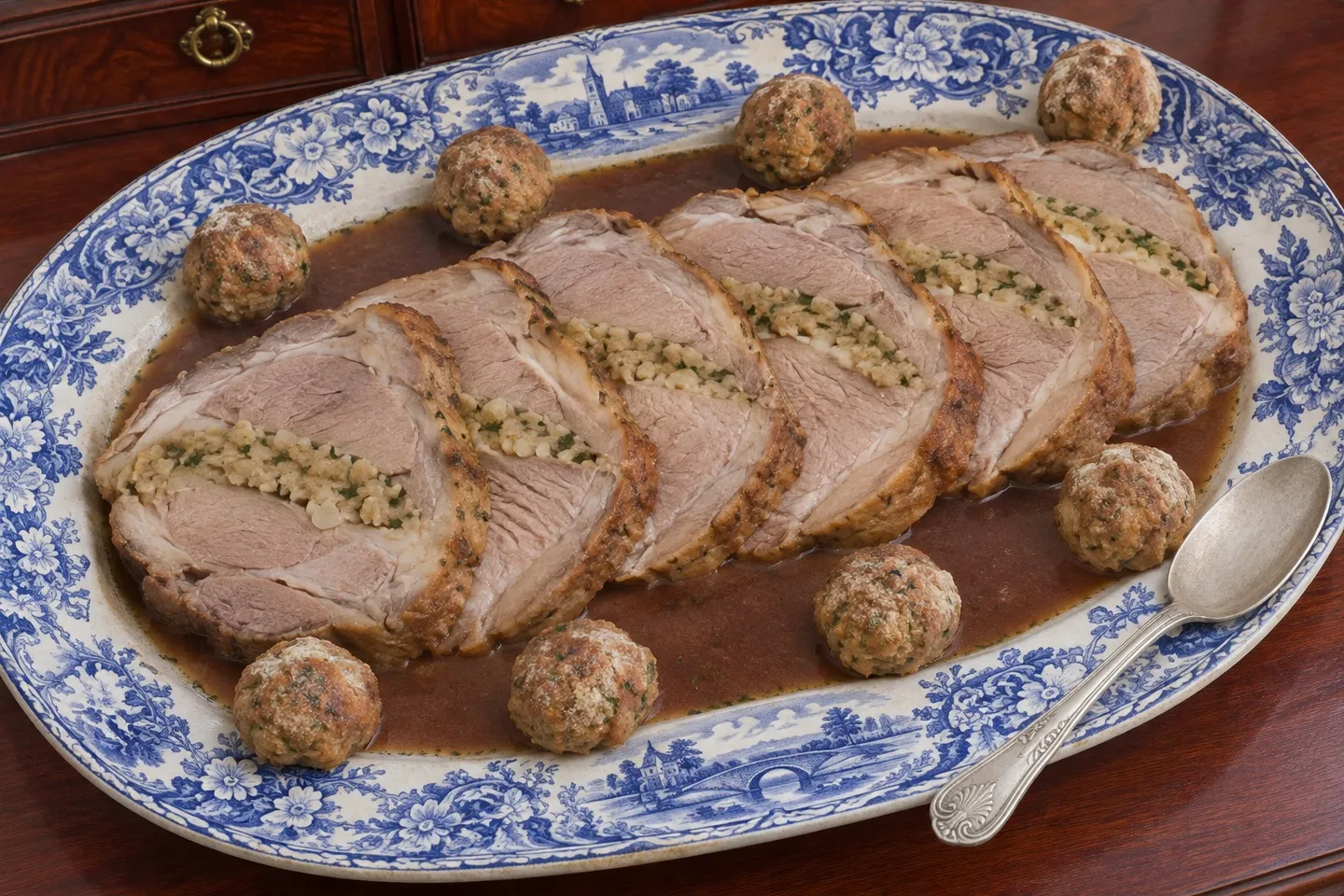
Sliced stuffed pork shoulder in dark wine gravy, ringed with fried forcemeat balls.
The story behind the recipe
Mary Randolph’s barbecue never goes near a fire pit. “To Barbecue Shote,” in the 1838 Baltimore edition of The Virginia Housewife, stuffs a forequarter of young pork with rich forcemeat, sets it in a pan with water, garlic, red wine and mushroom catsup, and bakes it. The gravy is thickened with butter and brown flour, the ribs go uppermost on the dish, and forcemeat balls go around it.
A word she spelled by ear
Shote, Randolph writes, “is the name given in the southern states to a fat young hog,” one whose quarters weigh about six pounds each. A footnote, in the third person, explains the spelling: “Mrs. R. has taken the liberty of spelling it in a way that conveys the sound of the pronunciation more clearly than shoat, the usual manner of spelling it,” since she thought the word provincial. Her catsup is not tomato. Near the back of the book, mushrooms are salted, crushed, boiled and strained, then boiled again with garlic and pounded cloves until reduced by more than half. And the oven is the point: in the Kentucky book of 1839, Lettice Bryan barbecued the same young hog over coals, under the same verb.
The book is older than this 1838 printing, a stereotype edition “with amendments and additions” that carries a copyright entry of 1828. Its introduction has the mistress measure out the catsup, spice and wine for each dish to the cook, among the slaves or hired servants it expects in the house, so the reader Randolph wrote for gave the orders and someone else stood at the oven. The recipe shows what one Virginia cookbook meant by barbecue, not what anyone on the Isthmus of Panama cooked on a frame of sticks.
Read more about this recipe
Making it today
A boneless pork shoulder, a cut from the same forequarter, stands in for Randolph’s young hog, with deep slits in place of the cuts between the ribs, so every slice carries a band of stuffing. She doesn’t say what goes into “rich forcemeat,” so we use her own recipe for forcemeat balls, veal and suet with herbs, mace, nutmeg and lemon, and roll the rest of it into the balls that garnish the dish. The catsup is a small batch of hers, made in a saucepan. The amounts, the oven setting and the times are ours.
Where the word came from, and why it once meant a bed as well as a grill, is told in Where Does the Word Barbecue Come From?. For the version over coals, see Barbecued Pork over Coals (1839).
TO BARBECUE SHOTE.
This is the name given in the southern states to a fat young hog, which, when the head and feet are taken off, and it is cut into four quarters, will weigh six pounds per quarter. Take a fore-quarter, make several incisions between the ribs, and stuff it with rich forcemeat; put it in a pan with a pint of water, two cloves of garlic, pepper, salt, two gills of red wine, and two of mushroom catsup, bake it, and thicken the gravy with butter and brown flour; it must be jointed, and the ribs cut across before it is cooked, or it cannot be carved well; lay it in the dish with the ribs uppermost; if it be not sufficiently brown, add a little burnt sugar to the gravy, garnish with balls.
FORCEMEAT BALLS.
Take half a pound of veal, and half a pound of suet cut fine, and beat in a marble mortar or wooden bowl; add a few sweet herbs shred fine, a little mace pounded fine, a small nutmeg grated, a little lemon peel, some pepper and salt, and the yelks of two eggs; mix them well together, and make them into balls and long pieces—then roll them in flour, and fry them brown. If they are for the use of white sauce, do not fry them, but put them in a sauce-pan of hot water and let them boil a few minutes.
MUSHROOM CATSUP.
Take the flaps of the proper mushrooms from the stems—wash them, add some salt, and crush them; then boil them some time, strain them through a cloth, put them on the fire again with salt to your taste, a few cloves of garlic, and a quarter of an ounce of cloves pounded, to a peck of mushrooms; boil it till reduced to less than half the original quantity—bottle and cork it well.
Recipe makes: 3½ lb pork shoulder with forcemeat, serving 6
Ingredients
For 3½ lb pork shoulder with forcemeat, serving 6. Quantities are shown as written.
Quantities as written here, for 3½ lb pork shoulder with forcemeat, serving 6.
Mushroom catsup
- Cremini mushrooms12 oz
- Fine salt, for the catsup1 tsp
- Water, for the catsup1 1/2 cups
- Garlic, for the catsup1 clove
- Ground cloves1/8 tsp
Forcemeat
- Ground veal8 oz
- Beef suet, finely grated4 oz
- Chopped parsley1 tbsp
- Chopped thyme1 tsp
- Ground mace1/8 tsp
- Grated nutmeg1/4 tsp
- Grated lemon zest1/2 tsp
- Fine salt, for the forcemeat1/2 tsp
- Black pepper, for the forcemeat1/4 tsp
- Large egg yolk1
Pork
- Boneless pork shoulder (Boston butt)3.5 lb
- Fine salt, for the pork1 1/2 tsp
- Black pepper, for the pork1/2 tsp
- Water, for the pan1 1/4 cups
- Dry red wine1/2 cup
- Garlic, for the pan2 cloves
Balls and gravy
- All-purpose flour, for the balls1 tbsp
- Lard, for frying1 tbsp
- All-purpose flour, for the gravy2 tbsp
- Unsalted butter2 tbsp
Measurement notes
Ingredients as written here
- 12 oz cremini mushrooms
- 1 tsp fine salt, for the catsup
- 1 1/2 cups water, for the catsup
- 1 clove garlic, for the catsup
- 1/8 tsp ground cloves
- 8 oz ground veal
- 4 oz beef suet, finely grated
- 1 tbsp chopped parsley
- 1 tsp chopped thyme
- 1/8 tsp ground mace
- 1/4 tsp grated nutmeg
- 1/2 tsp grated lemon zest
- 1/2 tsp fine salt, for the forcemeat
- 1/4 tsp black pepper, for the forcemeat
- 1 large egg yolk
- 3 1/2 lb boneless pork shoulder (Boston butt)
- 1 1/2 tsp fine salt, for the pork
- 1/2 tsp black pepper, for the pork
- 1 1/4 cups water, for the pan
- 1/2 cup dry red wine
- 2 cloves garlic, for the pan
- 1 tbsp all-purpose flour, for the balls
- 1 tbsp lard, for frying
- 2 tbsp all-purpose flour, for the gravy
- 2 tbsp unsalted butter
Equipment
 Cutting board and knife
 Food processor or potato masher
 Medium saucepan
 Fine sieve
 Mixing bowls
 Roasting pan, about 9 by 13 inches
 Kitchen string
 Aluminum foil
 Instant-read thermometer
 Spoon
 Small skillet
- Large skillet
 Slotted spoon
 Heatproof measuring jug
- Small saucepan
 Whisk
- Carving board
 Warm serving platter
Instructions
Trim the stems from the cremini mushrooms, rinse the caps briefly and chop them fine, by hand or in pulses in the food processor. Toss them in a bowl with the salt for the catsup, cover and refrigerate for 1 hour.
Crush the salted mushrooms well with the potato masher, or pulse them to a coarse paste. Scrape them into the medium saucepan with the water for the catsup, bring to a boil and simmer for 15 minutes.
Pour through the sieve set over a bowl, pressing hard on the mushrooms to get out all the liquid. Discard the mushrooms. Return the liquid to the saucepan with the garlic for the catsup, crushed, and the ground cloves, and boil for 10 to 15 minutes, until reduced to about a third. Lift out the garlic and let the catsup cool. Refrigerate it if you aren’t using it within 2 hours.
Heat the oven to 325°F (160°C).
For the forcemeat, mix the ground veal, beef suet, parsley, thyme, mace, nutmeg, lemon zest, salt for the forcemeat, pepper for the forcemeat and egg yolk in a bowl, working them together with your hand or a spoon until evenly blended. Keep it refrigerated until it is used.
Pat the pork shoulder dry. Lay it fat side up and cut six deep slits across it, about 1½ inches apart and two-thirds of the way through. Season it all over, and inside the slits, with the salt for the pork and the pepper for the pork.
Pack about two-thirds of the forcemeat into the slits, pressing it in well. Tie the shoulder around with string between the slits so it holds its shape. Wash your hands and the board. Cover the rest of the forcemeat and return it to the refrigerator.
Set the shoulder in the roasting pan, slits up. Pour the water for the pan, the red wine and the mushroom catsup around it and add the garlic for the pan, peeled and lightly crushed.
Bake for 3 to 3½ hours, spooning the pan liquid over the top every 45 minutes. If the top darkens too early, cover it loosely with foil, and if the pan runs dry, add a little water. It is done when a fork slides in easily, the thickest part of the meat reads about 195°F (91°C) and the forcemeat in the center of a slit reads at least 165°F (74°C).
While the pork bakes, toast the flour for the gravy in the dry small skillet over medium-low heat, stirring all the time, for 4 to 6 minutes, until it is the color of light brown sugar. Tip it onto a plate to stop it cooking.
Lift the pork onto the carving board, cover it loosely with foil and let it rest for 20 minutes.
Meanwhile, roll the rest of the forcemeat into small balls, about the size of a walnut, and roll them in the flour for the balls. Heat the lard in the large skillet over medium heat and fry the balls for 8 to 10 minutes, turning them, until brown all over and 165°F (74°C) in the center. Lift them out with the slotted spoon.
Pour the pan liquid into the measuring jug, let it settle for a few minutes and spoon off as much fat as you can. If there is very little, add a splash of water.
Melt the butter in the small saucepan over medium heat, stir in the browned flour and cook for 1 minute. Whisk in the skimmed pan liquid a little at a time and simmer for 3 to 5 minutes, until lightly thickened. Taste for salt.
Cut away the strings and cut the pork into six thick slices, cutting midway between the slits, so each slice has a band of stuffing through its middle. Lay the slices on the warm platter, pour some of the gravy over, set the forcemeat balls around and serve the rest of the gravy alongside.
Nutrition
750calories per serving
- Recipe makes
- 3½ lb pork shoulder with forcemeat, serving 6
- Servings
- 6
Estimated per serving (6) from USDA FoodData Central values for braised pork shoulder, ground veal, beef suet, egg yolk, mushrooms, red wine, butter, lard and flour; most of the pan fat skimmed off.
Recipe notes
When adjusting quantities
Written for one 3½ lb shoulder. A larger shoulder needs a bigger pan and more time; go by the thermometer and the fork, not the clock.
Notes
Quantities mentioned in these notes don’t change when you adjust the servings.
Our changes from Randolph: a 3½ lb boneless pork shoulder for her six-pound forequarter of young hog, with slits for her cuts between the ribs, so the ribs-uppermost dish becomes a sliced roast; her water and wine scaled to the smaller cut from a pint and two gills, reading the American pint at 2 cups and the gill at half a cup; the forcemeat taken from her forcemeat balls, with her half pound of veal but half her suet, one yolk for her two, and spice and lemon amounts of our choosing; her catsup made in a small batch, with ground cloves for pounded ones, and its whole yield, about half a cup, in place of her two gills scaled to the cut; and the oven setting, times and thermometer readings. We leave out her burnt sugar, which she adds only if the gravy is pale. Cold unsalted butter, grated, can take the place of the suet.
Food safety: pork roasts are safe at 145°F (63°C) with a 3-minute rest, and a stuffing or casserole at 165°F (74°C) (FoodSafety.gov, “Safe Minimum Internal Temperatures”); the shoulder is taken much higher here so it turns tender. Refrigerate leftovers within 2 hours, eat them within 3 to 4 days and reheat them to 165°F (74°C) (USDA FSIS, “Leftovers and Food Safety”). Contains wheat, egg and wine.
Scaling changes the ingredients only; pan sizes and cooking times need their own judgment. To adapt this recipe further, try the recipe tool at TuneMyRecipe (opens in a new tab), our sister site.
Sources and attribution
After Mary Randolph, The Virginia Housewife (Baltimore, 1838), “To Barbecue Shote,” with her “Forcemeat Balls” and “Mushroom Catsup”
See the original pages (scan at Internet Archive) (opens in a new tab)
Recipe details
- Course
- Main course
- Dish family
- Meat & Poultry
- Region
- American
- Era
- 19th century
- Source decade
- 1830s
- Main ingredient
- Pork & ham
- Difficulty
- Advanced
- Occasion
- Dinner party