Eleanor de Montfort’s household at Odiham Castle · Odiham Castle, Hampshire
What Did a Medieval Countess Give the Poor to Eat?
Eleanor de Montfort’s 1265 household roll gives the poor 120 herrings, bread, beer and once beef, while her own kitchen took herrings by the hundred.
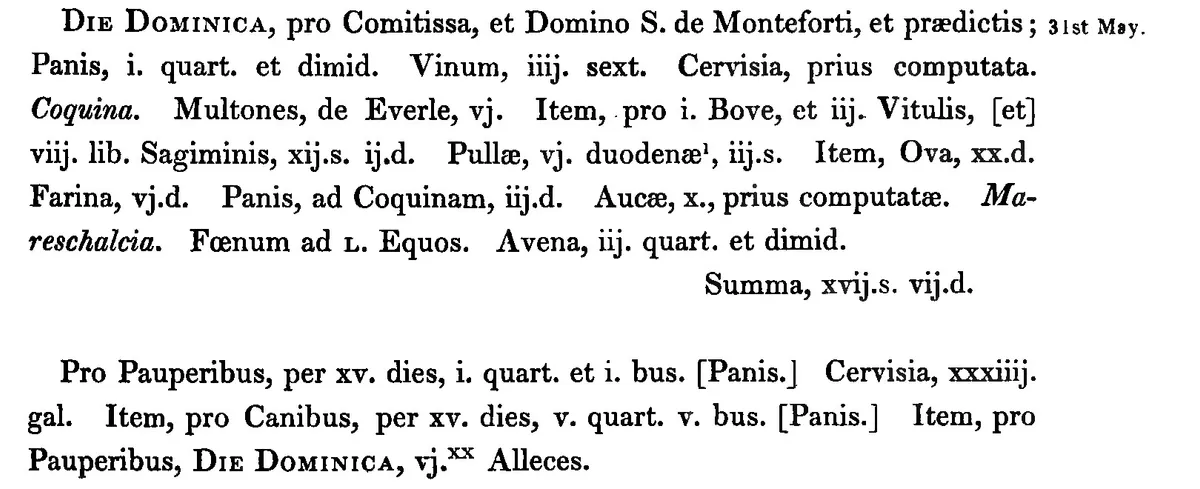
The poor at Odiham Castle in Hampshire got herrings, bread and beer from Eleanor de Montfort, Countess of Leicester, in the spring of 1265, and on at least one day beef. Her household roll records all four going to “the poor” during her stay. On Sunday 31 May her clerk entered six sheep, an ox, three calves, six dozen poultry, eggs and ten geese for her kitchen, and below them, on a line of their own, six score herrings for the poor. That looks like the old picture of meat for the rich and fish for the poor, but the same roll takes the picture apart: six weeks earlier the kitchen sent three quarters of an ox to the hall and the poor together, and on the Friday and Saturday before that Sunday the countess’s own kitchen took herrings by the hundred.
A countess at Odiham in 1265
Eleanor was the sister of Henry III and the wife of Simon de Montfort, Earl of Leicester, who since his victory at Lewes in 1264 had held the king and governed in his name. Her household roll survives in the British Library as Additional MS 8877, thirteen membranes of parchment with their beginning lost, keeping the diet account of her household from February to August of that year. It is read here as printed in 1841, in Manners and Household Expenses of England in the Thirteenth and Fifteenth Centuries, a volume usually credited to the antiquary Thomas Hudson Turner. Its editor dated the roll: a French catalog had given it to 1268, but servants’ wages are reckoned by Henry III’s forty-ninth regnal year, and “the dates of the moveable feasts in 1265 coincide with those given in the roll.”
By the editor’s reckoning, Eleanor reached Odiham Castle on 22 February and “remained until the 1st of June.” It was a household at the center of a civil war. On 17 March her nephew Prince Edward arrived from Wallingford “in the company, or rather custody” of her son Henry de Montfort; the Earl came two days later, and the horses in the castle stables rose from 44 to 334. Edward escaped his captors at Hereford on 28 May, three days before the Sunday on the page above. The Earl was killed at the battle of Evesham that August, and Eleanor left England soon after.
The roll is an account, kept day by day under three heads: the pantry and cellar first (bread, wine, beer), then Coquina, the kitchen, then Mareschalcia, the stables. Each day opens with who was there. The Sunday heading names the countess and “Domino S. de Monteforti,” a Lord S. de Montfort; the family had more than one Simon, and the initial alone does not say which sat down that day.
Sunday, 31 May: the kitchen and the poor
The kitchen line for that Sunday reads, in the printed Latin: “Multones, de Everle, vj. Item, pro i. Bove, et iij. Vitulis, [et] viij. lib. Sagiminis, xij.s. ij.d.” Six muttons from “Everle”; one ox, three calves and eight pounds of fat for 12s. 2d. (about £750 today for the whole bundle, by UK consumer prices on the Bank of England’s measure). Then six dozen poultry for 3s., eggs for 20d., flour for 6d., bread for the kitchen for 3d., and ten geese “prius computatæ,” already counted on an earlier day. Above the kitchen, the day opens with a quarter and a half of bread, four sextaries of wine and beer already reckoned.
None of this is a menu. A clerk wrote down what came out of store or was paid for, for a household and its guests, and no line says how any of it was cooked or who ate which part. The ten geese had been entered on an earlier day, so they carry no price here.
Below the day’s total come three short entries:
Pro Pauperibus, per xv. dies, i. quart. et i. bus. [Panis.] Cervisia, xxxiiij. gal. Item, pro Canibus, per xv. dies, v. quart. v. bus. [Panis.] Item, pro Pauperibus, Die Dominica, vj.xx Alleces.
For the poor, for fifteen days, one quarter and one bushel of bread, and 34 gallons of beer. Also, for the dogs, for fifteen days, five quarters and five bushels of bread. Also, for the poor, on Sunday, six score herrings: 120. The “xx” stands raised above the “vj” on the printed page: the clerk counted in twenties.
What the roll leaves out
Put side by side, the kitchen line and the herring line seem to measure rich against poor. They can’t, and the roll itself shows why.
The two poor entries cover different spans of time. The bread and beer are “per xv. dies,” for fifteen days; the herrings are for the one Sunday. Neither says how many poor people there were, how old they were, what else they ate, or how much each one received. Dividing 120 herrings or 34 gallons by a guessed crowd would only invent a serving.
The bread is not quite bread either. The editor of 1841 warned that “grain or flour was designated by the general term ‘panis,’” and that “the quantity is measured by the quarter or bushel.” A quarter and a bushel of panis is a measure of capacity, of corn or meal, and turning it into loaves or slices would mean guessing the grain, the milling, the baking and the local bushel, none of which the entry gives. The dogs’ line beside it, five quarters and five bushels over the same fortnight, belongs to the kennel and tells us nothing about the poor’s share; it names no number of dogs either.
The prices give no help. The Sunday herrings carry no price, and nor do the poor’s bread and beer, so there is no money ratio to draw between the two channels, any more than a calorie one. What the page does record is a household that fed people through more than one line in its books, and that entered its recipients only as pauperes, the poor, without saying who they were. Calling them peasants, servants or townspeople would put words in the clerk’s mouth.
Beef for the hall and the poor
Six weeks earlier, in April, the poor appear in the kitchen line itself.
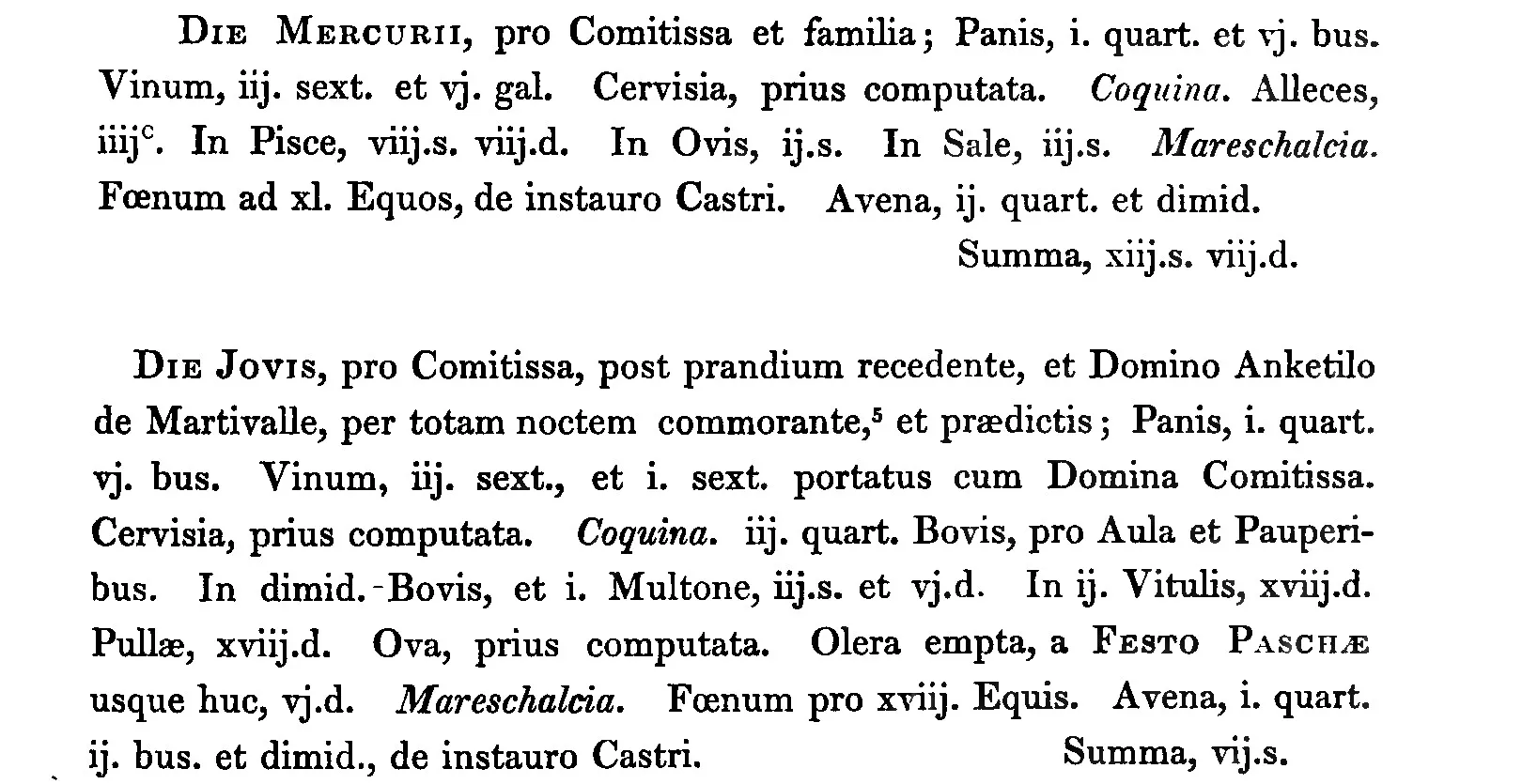 Wednesday 15 and Thursday 16 April 1265, from the countess’s roll as printed in 1841, p. 21.
On Thursday 16 April the kitchen took “iij. quart. Bovis, pro Aula et Pauperibus”: three quarters of an ox, for the hall and the poor. This quarter is a quarter of a carcass, a different thing from the grain quarter of the bread account. The clerk does not split the beef between the two, and no dish is named, but the entry is enough to defeat any rule that the poor in this household never had beef. A shared ingredient does not mean an equal share, the same cut or the same seat at table; it does mean the line between meat and fish was not drawn by rank alone.
Two days before, on Tuesday 14 April, the household dined “cum viij c. Pauperibus,” with 800 poor. Of four quarters and six bushels of bread issued that day, three quarters are entered as the poor’s, and so is a tun of cider. That is the only headcount of the poor at Odiham in the printed roll, and it belongs to that Tuesday; it can’t be carried forward to fill the gap on 31 May. The kitchen that day had oxen, eight bacons and peas from store, but the clerk doesn’t assign them to the 800, so neither can we.
The 1841 editor drew a conclusion from the cider. It was mentioned once, he wrote, “in such a manner as to convey the impression that it was not in very great estimation; the Countess gave one tun among eight hundred paupers.” It is his reading of a gift; the roll gives no price for the cider and no one’s opinion of it. With beef and beer also going to the poor, what they received is no sure guide to what the hall thought of it.
Herring in the household kitchen
The herring line for 31 May looks less like a poor man’s ration once the days around it are read. On the Friday before, the countess’s own kitchen took “Alleces, ccc. et dimid.,” three hundred and a half of herrings, with 8s. 4d. of other fish (about £510 today); on the Saturday, three hundred herrings, fish for 10s. 2d. and two cheeses. There is no meat in the kitchen on either day. On the Wednesday of 15 April, in the scan above, it took four hundred.
The editor of 1841 put it plainly: “The staple article of food during Lent in the household of the Countess, was salted herring; hundreds of which were consumed daily.” His list of the household’s fish runs on through conger, ling, cod, hake, sturgeon, mackerel, salmon, plaice, soles, oysters, crabs, eels and lampreys. Herring was household food as much as alms. What set the poor’s Sunday apart was the day: on a meat day the household’s kitchen line ran to beasts and birds, and the poor’s line was fish.
That is as far as one household roll goes. It shows a great household feeding the poor through its own accounts, sometimes with fish on a meat day, sometimes with beef from the same carcass as the hall, and with bread and beer on a fortnight’s reckoning. It doesn’t show what any poor man, woman or child ate across a week, or what a peasant cooked at home. Modern scholars have taken the roll much further. Louise J. Wilkinson published a critical edition and translation in 2020, and Lars Kjær has written on food and drink in this household as ritual communication. Wilkinson’s edition may correct the 1841 printing in places; the readings here follow 1841. A Paris household of 1393 planned its fish days in writing too, herring and all, in What Did a Paris Household Eat in 1393?
The recipes
Nowhere in the roll does the clerk name a dish, so the recipes come from a later English cookery book: Harleian MS. 279, which its editor Thomas Austin dated to about 1430 or 1440, some 165 years after Odiham. They are not the countess’s kitchen’s recipes and none of them is the poor’s. They show how an English cook a few generations on wrote down three things this roll counts by the beast, the bushel and the gallon: beef, a goose and bread with ale.
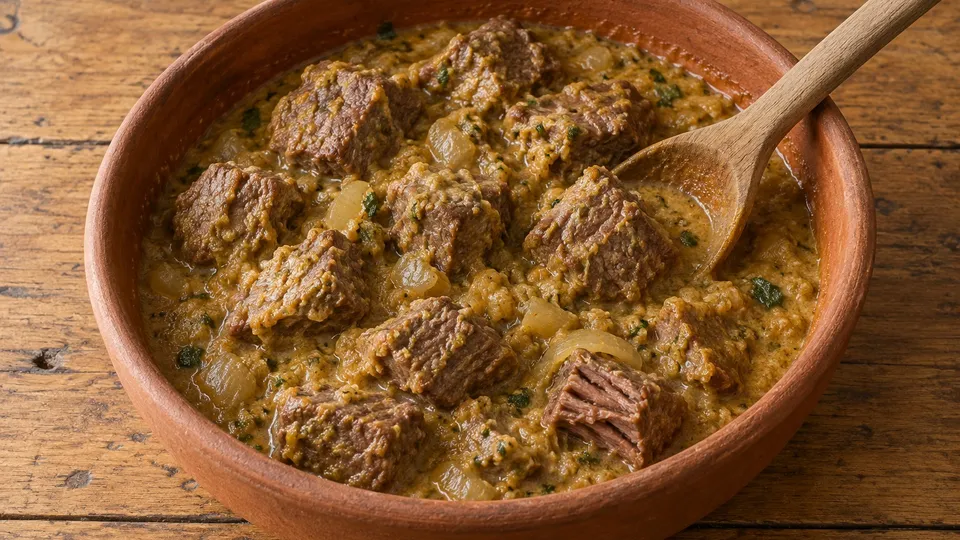
- Beef y-Stywyd, Spiced Beef Stew (1430): beef from the ribs of the forequarter, boiled with cinnamon, cloves, mace, grains of paradise, cubebs, onion, parsley and sage, thickened with bread soaked in broth and vinegar.
- Gos Farced, Stuffed Goose Breast (1430): a stuffing of parsley, fat, hard egg yolks, spices and boiled onions, the manuscript’s choice “for defawte of grapis,” rolled here in goose breast.
- Oyle Soppys, Onions in Ale on Toast (1430): onions boiled, then simmered in ale with a little oil, saffron, pepper and sugar, served hot over toast.
Twenty-four years on, the roll kept for Richard de Swinfield, Bishop of Hereford, shows what a medieval bishop ate at Christmas in 1289, and how much of it went into salt instead.
Cooking it
The one food the roll shares between hall and poor is beef, so start with the Beef y-Stywyd, Spiced Beef Stew (1430): the beef simmers for about two hours, and the bread and vinegar that finish it go in only near the end. The medieval recipes page keeps all three with the rest of our cooking from the Middle Ages. The poor’s 34 gallons were beer; for what everyone else in medieval England drank, Forgotten Drink, our sister site, asks whether medieval people really drank beer instead of water (opens in a new tab).
 Cook it todayBeef y-Stywyd, Spiced Beef Stew (1430)
Sources
- Manners and Household Expenses of England in the Thirteenth and Fifteenth Centuries, Illustrated by Original Records (London: William Nicol, Shakspeare Press, 1841), the household roll of Eleanor, Countess of Leicester, pp. 19–21 and 41–42, and the introduction, pp. xxvii, xxxvi, xl, xliv and lv. Digitized by the Internet Archive from a Cornell University Library copy. The English renderings of the Latin are ours.
- British Library, Additional MS 8877, catalog description.
- Constance H. Berman, review of Louise J. Wilkinson, ed., The Household Roll of Eleanor de Montfort, Countess of Leicester and Pembroke, 1265: British Library Additional MS 8877 (Pipe Roll Society, 2020), The Medieval Review (2021).
- Lars Kjær, “Food, drink and ritualised communication in the household of Eleanor de Montfort, February to August 1265,” Journal of Medieval History 37 (2011), 75–89; abstract.
- Two Fifteenth-Century Cookery-Books: Harleian MS. 279 (ab. 1430), & Harl. MS. 4016 (ab. 1450), ed. Thomas Austin (London: Early English Text Society, 1888), pp. vii, 6, 12 and 41.