Bishop Richard de Swinfield’s Christmas at Prestbury · Prestbury, Gloucestershire
What Did a Medieval Bishop Eat at Christmas?
Bishop Swinfield’s Christmas of 1289: herring, eels and salmon on the Eve, then beef, pork, a boar, partridges, geese and venison, with some meat kept back.
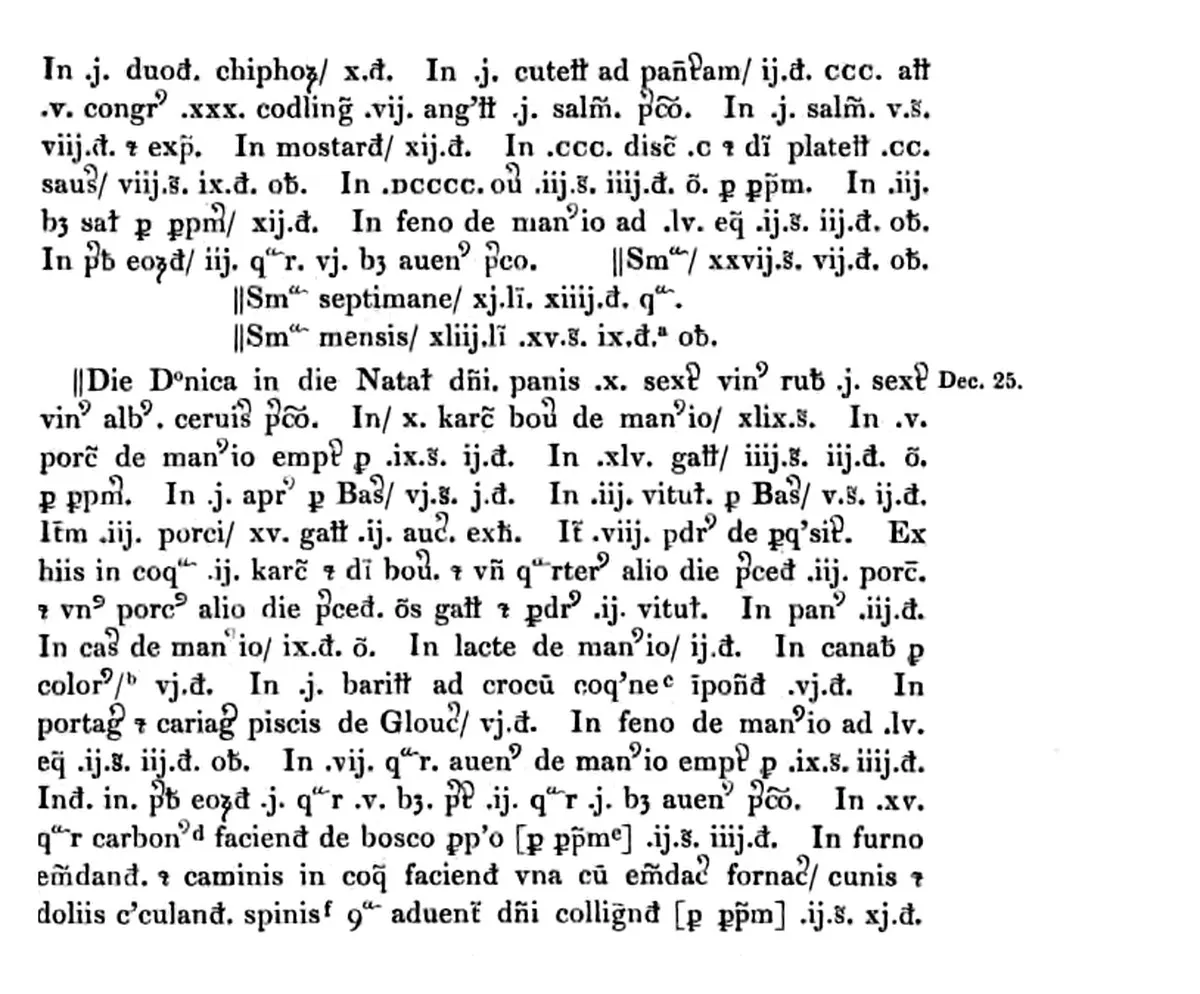
Fish on Christmas Eve, then meat by the carcass on Christmas Day. When Richard de Swinfield, Bishop of Hereford, kept Christmas 1289 at his manor of Prestbury in Gloucestershire, his household’s expense roll entered herring, conger eels, codling, eels and two salmon for the Eve, then for Christmas Day ten carcasses of beef, eight pigs, a boar, three calves, sixty hens, eight partridges, two geese and thirteen fat does, with bread, cheese, ten sextaries of red wine, one of white, and beer. But the roll is an account of supplies, and it keeps two lists. One says what came in. The other, a few lines further down, says what went to the kitchen, and the venison it did not cook was salted for store.
Why Christmas at Prestbury
The roll was kept in Latin, day by day, by the bishop’s chaplain, and it survives for part of the years 1289 and 1290. John Webb printed it for the Camden Society in 1853, with English footnotes, and two years later published a long commentary on it, his Abstract and Illustrations. Webb explains why the household spent Christmas where it did. “Christmas must be passed somewhere,” he wrote. The king had summoned his nobles and bishops to a parliament, the archbishop had called his bishops together, and Prestbury lay on the road to London. It was a stone manor house, moated round, and “the adjoining park was stocked with deer.”
The bailiff, Gerard de Eugina, had been busy. Webb credits him with repairs to the kitchen and the oven before the household arrived, and the Christmas Day entry pays for mending the oven and making fireplaces in the kitchen. The stable shows the house filling up: on Christmas Eve the number of horses rose from forty-one to fifty-five, which Webb took as a sign of guests. The roll gives no count of the people at table.
Herring, eels and a costly salmon
Christmas Eve, a Saturday in 1289, was a vigil, and Webb calls it “a day of abstinence, a fit prelude for what was to follow.” No meat appears in its entry. The roll counts out three hundred herring, five conger eels, thirty codling, seven eels and a salmon, then buys a second salmon for 5s. 8d., about £380 today by UK consumer prices (Bank of England). Webb was dry about it in 1855: “that could not have been a salmon of mean proportions or rarity that cost the exorbitant sum of 5s. 8d.” Mustard cost 12d.
The same day’s entry buys a dozen cups, and Webb reads the next item as 300 dishes, 150 plates and 200 saucers, with a question mark of his own against the saucers. That is tableware bought for the days ahead; it counts neither guests nor courses. The day closes with the week’s and the month’s totals, and only then, halfway down page 33 of Webb’s edition, does the Nativity begin.
What came in on Christmas Day
Christmas Day fell on a Sunday. Its entry opens with bread, ten sextaries of red wine and one of white, and beer; by Webb’s reckoning of four gallons to the sextary, the red wine alone came to forty of the period’s gallons. Then the meat. Ten carcasses of beef came from the manor, entered at 49s., about £3,300 today. Five pigs from the manor came to 9s. 2d. and forty-five hens to 4s. 3½d.; the bailiff provided a boar for 6s. 1d. and three calves for 5s. 2d. Three more pigs, fifteen hens and two geese were brought in, and eight partridges were acquired.
Not all of this was cash spent at a market. Much of it is the manor’s own produce, valued in the account, and the roll gives no price at all for the partridges. Cheese came from the manor too, at 9½d., with milk for 2d. The kitchen got new canvas for its strainers and, for 6d., a tub to hold the saffron used in cooking; Webb’s footnote adds that the kitchen spices had their own box and were given out from the storeroom as they were needed.
Of these, in the kitchen
Then comes the clause that turns a list of supplies into something closer to a meal. It begins Ex hiis in coquina: of these, in the kitchen. The kitchen took two and a half carcasses of beef and a quarter left from the day before, three pigs and one more from the day before, all the hens and the partridges, and two calves. The kitchen’s share is smaller than the supply, and some of it was not new that day. The geese and the boar are not named in the clause at all.
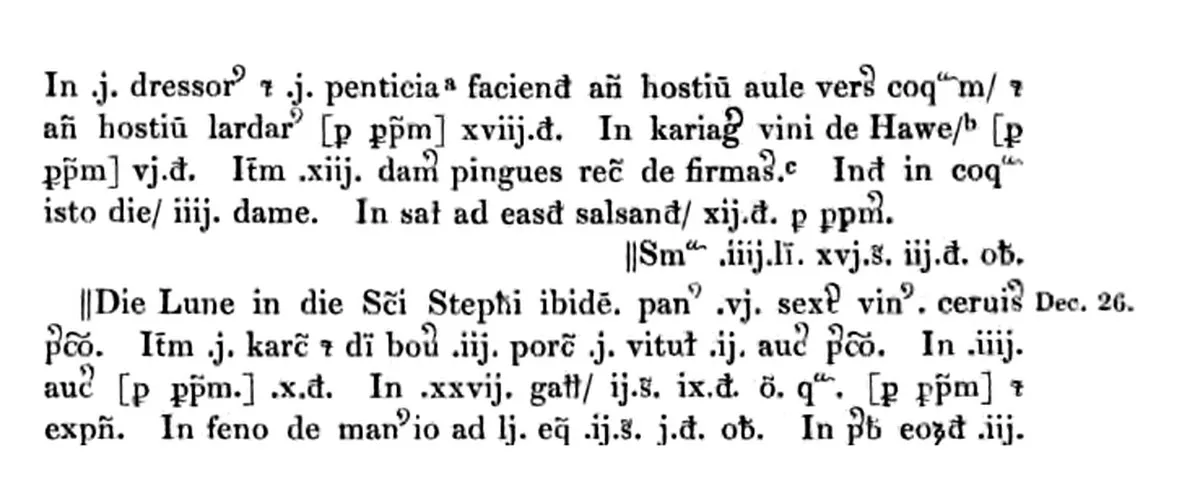 The end of the Christmas Day entry and the start of St. Stephen’s Day, from Swinfield’s roll as printed by Webb (1853), p. 34.
The venison follows on the next page. Thirteen fat does were received, pingues in the Latin, and four of them went to the kitchen that day. Then: “For salt for salting the same, 12d.” Webb’s commentary of 1855 counts nine does salted for store, which is what thirteen less four leaves. His footnote of 1853 says fourteen, does “in prime condition” from the place where they had been put to fatten, and adds that “some were appropriated to the feast of this day, others put into the salting-vat.”
Webb added up the kitchen’s side of the account himself. Over “the three meals” of the day, he wrote, the household was served two and three-quarter carcasses of beef, two calves, four does, four pigs, about sixty fowls, eight partridges and two geese, with bread and cheese “in proportion,” ten sextaries of red wine, one of white, and “an unscored quantity of beer.” Then he made the point the roll makes in its layout: “A much larger quantity of meat appears in the account.”
From kitchen to hall
The household’s cook was not at his post. Webb found that William, “chief in command in the kitchen,” had been left behind ill at Ledbury, so his lieutenant Adam and “little William” did the work. The roll also pays 18d., about £100 today, for a dresser and a penthouse, a roofed shelter, to be made before the hall door toward the kitchen and before the larder door. Webb explains it in a footnote: a shelter along the wall from the larder to the kitchen door and on to the hall, “to shelter the viands; particularly in the latter case, when the dishes were brought from the kitchen and set down on the dresser so protected, preparatory to their being brought into the hall.” In a winter Webb describes as one of “unceasing wet,” the Christmas dishes reached the hall door under cover.
Webb could not believe the household ate what he had totaled. Unless many more farm servants and neighbors came, “it seems impossible for any human powers in so short a time to have achieved an entire demolition of what we find was expended.” So he guessed: “We are therefore willingly led to believe that a liberal residue was distributed to the poor.” In a footnote he owned that he had indulged “in what might have been,” and left it to the reader. The roll records no gift of food. Guests, leftovers and salted stores could all have had their share; the account doesn’t divide the rest among them.
St. Stephen’s Day and after
Christmas did not end on the 25th. A separate entry for Monday, St. Stephen’s Day, opens with bread, six sextaries of wine and beer, then a carcass and a half of beef, three pigs, a calf and two geese, with four more geese bought for 10d. and twenty-seven hens. The 27th, the feast of St. John, has its own beef, pork and fifty-five hens. On the 28th the household was at Colne St. Aylwin, near Fairford, on its way to London, and on the 30th it reached Wantage, where, Webb notes, beer had to be bought by the gallon.
Rolls like this one survive from other great households of the century. A generation earlier, the clerk of Eleanor de Montfort, Countess of Leicester, kept one at Odiham Castle, and it records what a medieval countess gave the poor to eat: herrings, bread, beer and, on at least one day, beef.
The recipes
The roll names foods and costs, and no recipes. The three recipes here come from English cookery manuscripts of about 1430 and 1450, printed by Thomas Austin for the Early English Text Society in 1888, a century and a half after Swinfield’s Christmas. They show how English cooks of that later time wrote down dishes of three of the meats on the bishop’s list, and the modern versions add the amounts and temperatures. The same edition prints the bill of fare for a royal feast between the two dates, told in What Was Served at Henry IV’s Coronation Feast?
- Pertrich Stewyde, Stewed Partridge (1430): partridges stuffed with whole pepper and marrow and simmered in beef broth and wine with cloves and mace, finished with ginger and saffron, for the roll’s eight partridges.
- A Goos in Hogepotte, Goose Stewed with Ale (1430): goose cut in pieces and stewed, thickened with burnt bread ground with ginger, galingale and cumin and worked into ale, with fried onions and wine, for the two Christmas geese.
- Venysoun Rosted, Parboiled Roast Venison (1450): venison fillets boiled briefly, then roasted and sauced with vinegar and salt, for the four does the kitchen cooked.
Cooking it
For a Christmas table, make the goose in hogepotte: the roll names geese on Christmas Day and again on St. Stephen’s, and the stew asks for little more than a slice of dark toast, a glass of ale, four spices and an afternoon at the back of the stove. It joins our other medieval recipes, several of them from the same 1888 edition. For the hot spiced ale that later became the Christmas bowl, Forgotten Drink, our sister site, traces wassail (opens in a new tab) from a greeting to a drink.
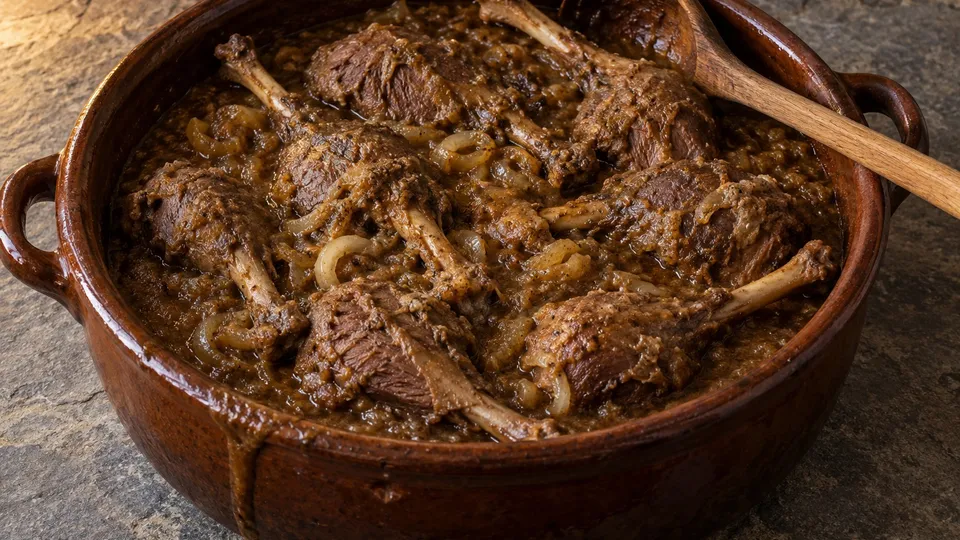 Cook it todayA Goos in Hogepotte, Goose Stewed with Ale (1430)
Sources
- A Roll of the Household Expenses of Richard de Swinfield, Bishop of Hereford, during part of the years 1289 and 1290, ed. John Webb (London: Camden Society, 1853), pp. 32–34. Digitized by Google.
- John Webb, Abstract, Illustrations, Glossary, and Index to the same roll (London: Camden Society, 1855), pp. xlv and cxx–cxxii. Digitized by Google; copy on Wikimedia Commons.
- Two Fifteenth-Century Cookery-Books: Harleian MS. 279 (ab. 1430), & Harl. MS. 4016 (ab. 1450), ed. Thomas Austin (London: Early English Text Society, 1888), pp. vii, 9, 18 and 81. Digitized by the Internet Archive.
- Present-day equivalents: Bank of England inflation calculator basis, which runs back to 1209.