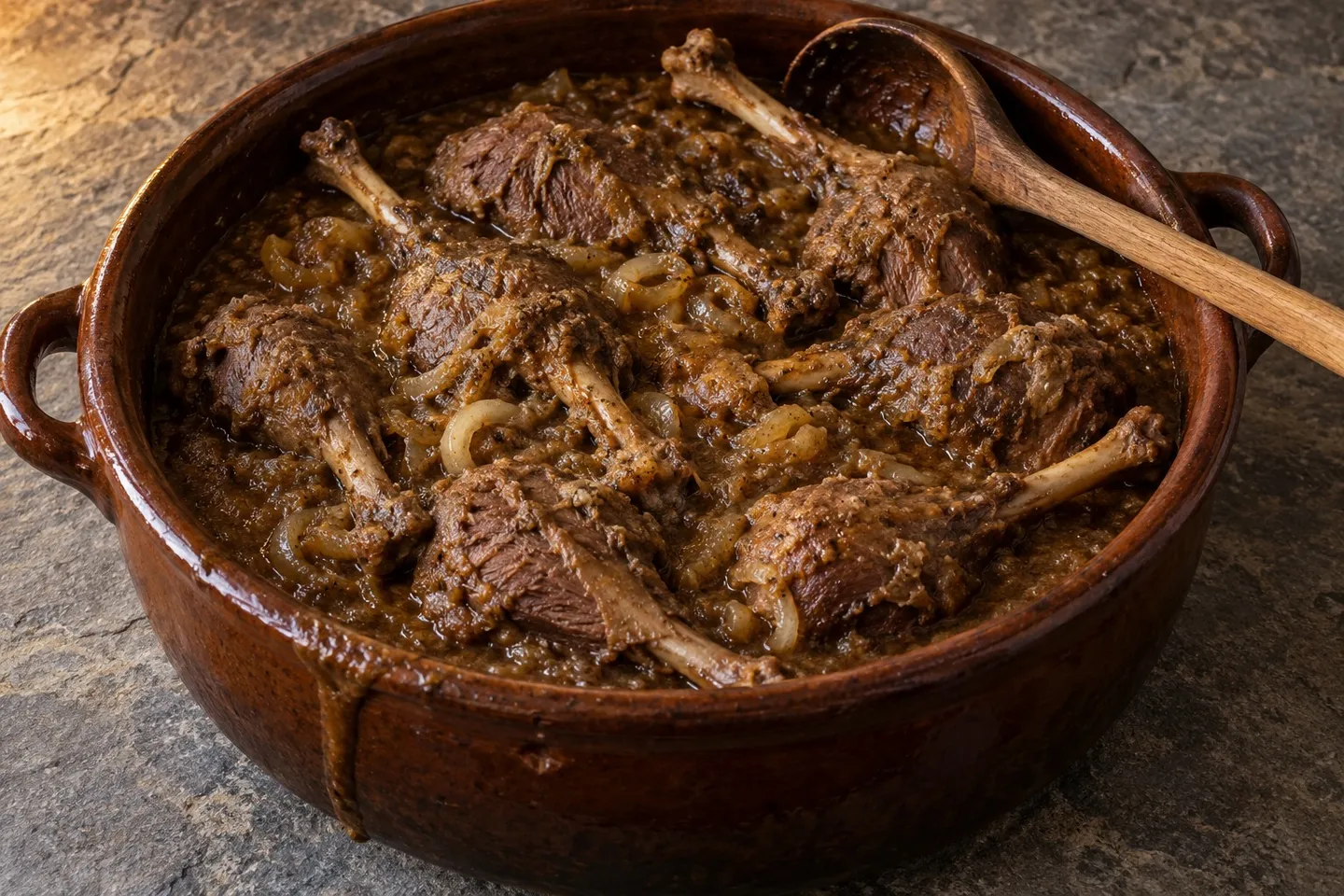
A Goos in Hogepotte, Goose Stewed with Ale (1430)
Reader ratingsMedieval goose stew, a goos in hogepotte: goose simmered in pieces, thickened with dark toast, spices and ale, finished with fried onions and red wine.
- Recipe makes
- 4 servings
- Prep
- Cook
- Total
The goose simmers for about 2 hours, until tender. The bread and onions are made while it cooks, and the finished stew simmers for 20 to 25 minutes more. It can be made a day ahead and reheated to a simmer.
Goose legs stewed in pieces in a dark bread-thickened gravy with onions.
The story behind the recipe
Burnt bread does the thickening in A goos in hogepotte: bread taken dark, ground with pepper, ginger, galingale and cumin and worked into ale, then stirred into a goose hacked into pieces and stewed, with onions fried apart and a little wine to finish. The recipe is English, from about 1430. Bishop Swinfield’s roll records two geese coming in on Christmas Day 1289 and four more bought the next day, St. Stephen’s, and gives no recipe for any of them.
What is a hogepotte?
A stew of meat cut in pieces, a word English took from the French hochepot, from hocher, to shake, and the pot it was shaken in. The recipe in Harleian MS. 279 is one sentence long. The goose is cut into “gobettys,” pieces, and seethed in water. Pepper and “Brennyd brede, or Blode y-boylyd,” burnt bread or boiled blood, are ground together with ginger, galingale and cumin and tempered with ale. Onions are minced and fried “in freysshe grece,” and a portion of wine goes in at the end.
Bread ground into the pot is how many of this manuscript’s pottages are thickened, and burnt bread darkens the stew as well; blood is the alternative the recipe gives. Galingale is the root of a relation of ginger from Southeast Asia, and these manuscripts call for it again and again. The manuscript is about 140 years later than Swinfield’s roll, so it shows how a goose could be stewed in an English kitchen of the 1430s; how his own cooks did it is not recorded.
Read more about this recipe
Making it today
Goose legs, sold at Christmas by butchers and online, stand in for a whole bird; cutting each one through the joint gives the “gobettys.” We take the bread from the manuscript’s two thickeners and toast it very dark, which is our reading of “burnt.” Pulling the skin off before stewing, and skimming the pot, is our choice too, to keep the stew from turning greasy. Ground galangal is sold in Asian groceries.
Another pottage in the same manuscript is thickened with almonds where this one uses bread: Blaundesorye, Almond Chicken Pottage (1430), a dish named on the bill of fare for Henry IV’s coronation. The rest of the bishop’s Christmas, from the Eve’s herring to the salted venison, is in What Did a Medieval Bishop Eat at Christmas?
.lxj. A goos in hogepotte.—Take a Goos, & make hure clene, & hacke hyre to gobettys, & put yn a potte, & Water to, & sethe to-gederys; ...
Recipe makes: 4 servings
Ingredients
For 4 servings. Quantities are shown as written.
Quantities as written here, for 4 servings.
- Goose legs4Author measures: about 1.4 kg.
- Water1.5 l
- Day-old white bread60 g
- Ground black pepper1 tsp
- Ground ginger1 tsp
- Ground galangal1/2 tsp
- Ground cumin1/2 tsp
- Ale250 ml
- Onions2Author measures: about 300 g.
- Lard30 g
- Dry red wine125 ml
- Salt1 1/2 tsp
Measurement notes
Ingredients as written here
- 4 goose legs (about 1.4 kg)
- 1.5 l water
- 60 g day-old white bread
- 1 tsp ground black pepper
- 1 tsp ground ginger
- 0.5 tsp ground galangal
- 0.5 tsp ground cumin
- 250 ml ale
- 2 onions (about 300 g)
- 30 g lard
- 125 ml dry red wine
- 1.5 tsp salt
Equipment
- Large heavy pot with a lid
- Heavy cleaver, or ask the butcher to cut the legs
- Ladle or large spoon for skimming
- Spice grinder, blender or mortar and pestle
 Frying pan
 Instant-read thermometer
Instructions
Pull the skin off the goose legs and trim away the loose fat. Cut each leg in two through the joint, or have the butcher do it.
Put the goose in the large pot with the water, bring to a boil and skim off the foam. Lower the heat, cover and simmer gently for about 2 hours, until the meat is tender and pulls easily from the bone, and the thickest piece reads at least 165°F (74°C).
While the goose simmers, toast the day-old white bread until it is dark brown all over but not black. Break it up and grind it fine with the ground black pepper, ground ginger, ground galangal and ground cumin.
Stir the ale into the bread and spices, a little at a time, to make a smooth, thick paste.
Skim as much fat as you can from the goose broth. If more broth than will just cover the meat remains, ladle out the extra and keep it for another dish. Stir the bread paste into the pot and simmer gently, stirring often so it doesn’t catch, for 10 minutes.
Meanwhile, chop the onions fine and fry them in the lard over medium-low heat for about 10 minutes, until soft and golden, without letting them blacken.
Add the onions, the red wine and the salt to the pot. Simmer uncovered for 10 to 15 minutes, stirring, until the gravy is thick enough to coat a spoon. Loosen it with a little of the kept broth if it grows too thick, and serve hot.
Nutrition
600calories per serving
- Recipe makes
- 4 servings
- Servings
- 4
Estimated per serving from USDA FoodData Central values for goose meat without skin, lard, white bread, beer, red wine and onions, counting a little goose fat left after skimming.
Recipe notes
When adjusting quantities
Allow about 350 g of goose leg per person. Keep about 15 g of toasted bread and 60 ml of ale to each serving for the thickening.
Notes
Quantities mentioned in these notes don’t change when you adjust the servings.
Any goose cut works; breast meat dries out with long stewing, so add breast pieces for the last 30 minutes only, and take them to 165°F (74°C). Cooled quickly and kept covered in the refrigerator, the stew keeps 3 days; reheat it to a simmer. The wine and ale are simmered briefly, so the stew keeps some of their alcohol. Contains gluten (bread, ale).
Scaling changes the ingredients only; pan sizes and cooking times need their own judgment. To adapt this recipe further, try the recipe tool at TuneMyRecipe (opens in a new tab), our sister site.
Sources and attribution
After Harleian MS. 279, A goos in hogepotte, as printed in Two Fifteenth-Century Cookery-Books, ed. Thomas Austin (London: Early English Text Society, 1888)
Recipe details
- Course
- Main course
- Dish family
- Meat & Poultry
- Region
- British
- Era
- Medieval
- Main ingredient
- Poultry & game birdsSpices
- Difficulty
- Intermediate
- Occasion
- Christmas
- Season
- Winter