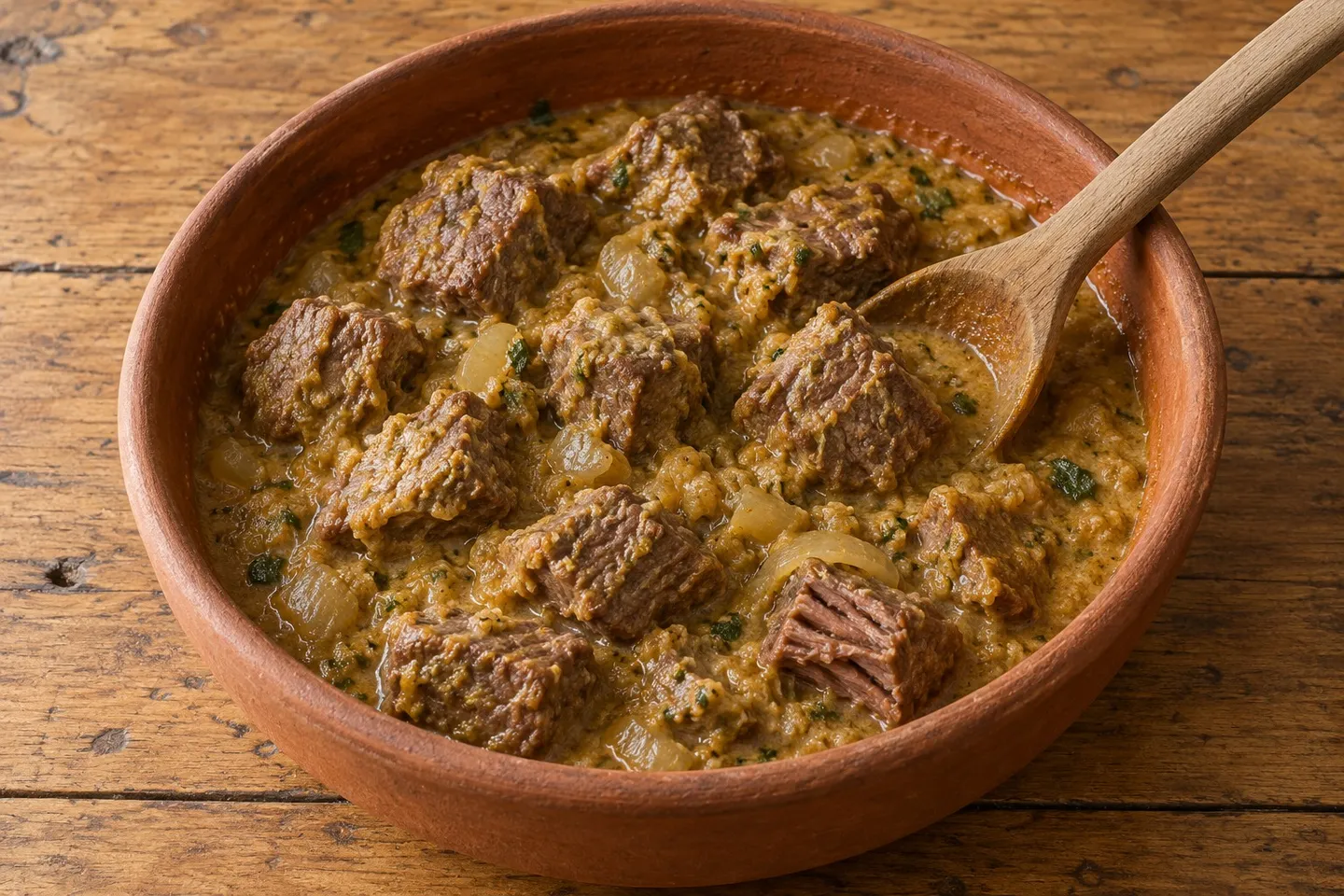
Beef y-Stywyd, Spiced Beef Stew (1430)
Reader ratingsBeef y-Stywyd, a medieval spiced beef stew of about 1430: beef simmered in strained broth with cloves, mace, onion and sage, thickened with bread and vinegar.
- Recipe makes
- 4 servings
- Prep
- Cook
- Total
The beef simmers for about 2 hours. Soak the bread in the last 15 minutes, while the beef finishes.
Spiced beef stew in a bread-thickened sauce with onion and herbs, in a terracotta bowl.
The story behind the recipe
The last instruction is the one that matters: “loke þat it be poynaunt y-now,” see that it is sharp enough. Beef y-Stywyd is stewed beef, cut from the ribs of the forequarter and boiled in its own strained broth with cinnamon, cloves, mace, grains of paradise, cubebs, onion, parsley and sage, then thickened with a loaf soaked in broth and vinegar, colored with saffron and brought to a bite with more salt and vinegar at the end. It comes first here because beef is the one food Eleanor de Montfort’s household roll of 1265 sends to the hall and the poor together.
What was beef y-stywyd?
“Y-stywyd” is Middle English for stewed, the “y-“ marking the past participle as it does in “y-mynced” in the same line. The recipe sits in the first part of Harleian MS. 279, under the running head “Potage dyvers,” sundry pottages: to its cook this was a pottage, a dish of the pot eaten with a spoon. Grains of paradise are the peppery seeds of a West African plant, and cubebs the dried berries of a pepper vine from Java; both came to England by long trade routes. The countess’s own roll shows what such spices cost: bought before Christmas 1264, a pound of cloves came to 14s., about £865 today by UK consumer prices (Bank of England), and a pound of saffron the same.
Its editor, Thomas Austin, put the manuscript at about 1430 or 1440, some 165 years after the Odiham roll, which counts its beef by the carcass and names no dish. This is a later English way with beef. No one can say how the hall’s or the poor’s share was cooked in 1265.
Read more about this recipe
Making it today
Boneless chuck stands in for rib pieces, and we skip washing the raw beef, which food-safety agencies now advise against. The manuscript gives no amounts at all; the spice measures, the 60 g of bread in place of “a lof,” and white wine vinegar for the unnamed “venegre” are our choices. Black pepper can replace the grains of paradise and cubebs if you can’t find them.
The sharp finish has a long life in English cooking: four centuries on, the same idea comes to the table as Boiled Beef with Sauce Piquante (1868). For the beef that went “pro Aula et Pauperibus,” for the hall and the poor, read What Did a Medieval Countess Give the Poor to Eat?
Beef y-Stywyd.—Take fayre beef of þe rybbys of þe fore quarterys, an smyte in fayre pecys, an wasche þe beef in-to a fayre potte; ...
Recipe makes: 4 servings
Ingredients
For 4 servings. Quantities are shown as written.
Quantities as written here, for 4 servings.
- Boneless beef chuck680 g
- Water710 ml
- Onion, chopped200 g
- Flat-leaf parsley, chopped10 g
- Fresh sage, chopped3 g
- Ground cinnamon1/4 tsp
- Ground cloves1/8 tsp
- Ground mace1/8 tsp
- Ground grains of paradise1/4 tsp
- Ground cubebs1/8 tsp
- Hot water for topping up120 ml
- Plain white bread, crust on60 g
- White wine vinegar for the bread15 ml
- Saffron1 pinch
- Salt1/2 tsp
- White wine vinegar to finish15 ml
Measurement notes
Ingredients as written here
- 680 g boneless beef chuck
- 710 ml water
- 200 g onion, chopped
- 10 g flat-leaf parsley, chopped
- 3 g fresh sage, chopped
- 1/4 tsp ground cinnamon
- 1/8 tsp ground cloves
- 1/8 tsp ground mace
- 1/4 tsp ground grains of paradise
- 1/8 tsp ground cubebs
- 120 ml hot water for topping up
- 60 g plain white bread, crust on
- 15 ml white wine vinegar for the bread
- 1 pinch saffron
- 1/2 tsp salt
- 15 ml white wine vinegar to finish
Equipment
- Heavy pot with a lid
- Two bowls
 Fine sieve
 Ladle
 Instant-read thermometer
Instructions
Trim the hard outside fat from the beef and cut it in 4 cm pieces. Put it in the heavy pot with the water, bring to a boil, skim off the gray foam and boil for 5 minutes.
Lift the beef into a bowl and pour the cooking water through the fine sieve into the second bowl. Rinse out the pot and return the beef and the strained broth to it.
Add the onion, parsley, sage, cinnamon, cloves, mace, grains of paradise and cubebs. Bring back to a gentle simmer, partly cover and cook for 1½ to 2 hours, stirring now and then, until the beef is tender when pierced. If the broth sinks below the meat, add some of the hot water for topping up.
About 15 minutes before the beef is ready, ladle enough hot broth from the pot into the empty bowl to cover the bread. Tear in the bread, add the white wine vinegar for the bread and leave it to soak for 10 minutes.
Mash the soaked bread and press it through the sieve with the back of the ladle, scraping the purée from underneath into the bowl. Throw away the little that won’t pass.
Stir the bread purée into the pot a little at a time, stopping while the sauce still pours easily from a spoon. Bring it back to a bubble, add the saffron and salt and simmer gently for 5 minutes. The stew should read at least 165°F (74°C).
Taste, then stir in the white wine vinegar to finish, a little at a time, until the sauce is distinctly sharp. Serve hot in bowls.
Nutrition
370calories per serving
- Recipe makes
- 4 servings
- Servings
- 4
Estimated per serving (4) from USDA SR Legacy values for trimmed raw beef chuck, onion, white bread, vinegar and parsley, counting all fat, bread and broth.
Recipe notes
When adjusting quantities
Keep about 90 g bread and 45 ml vinegar to each kilogram of beef.
Notes
Quantities mentioned in these notes don’t change when you adjust the servings.
The manuscript adds the bread liquor “nowt to moche,” not too much, so stop when the sauce is as thick as you like it. In place of the grains of paradise and cubebs, use 3/8 tsp ground black pepper. Keeps 3 days, covered, in the refrigerator; reheat until it bubbles and reads 165°F (74°C). Contains wheat (bread).
Scaling changes the ingredients only; pan sizes and cooking times need their own judgment. To adapt this recipe further, try the recipe tool at TuneMyRecipe (opens in a new tab), our sister site.
Sources and attribution
After Harleian MS. 279, Beef y-Stywyd, as printed in Two Fifteenth-Century Cookery-Books, ed. Thomas Austin (London: Early English Text Society, 1888)
Recipe details
- Course
- Main course
- Dish family
- Meat & Poultry
- Region
- British
- Era
- Medieval
- Difficulty
- Easy