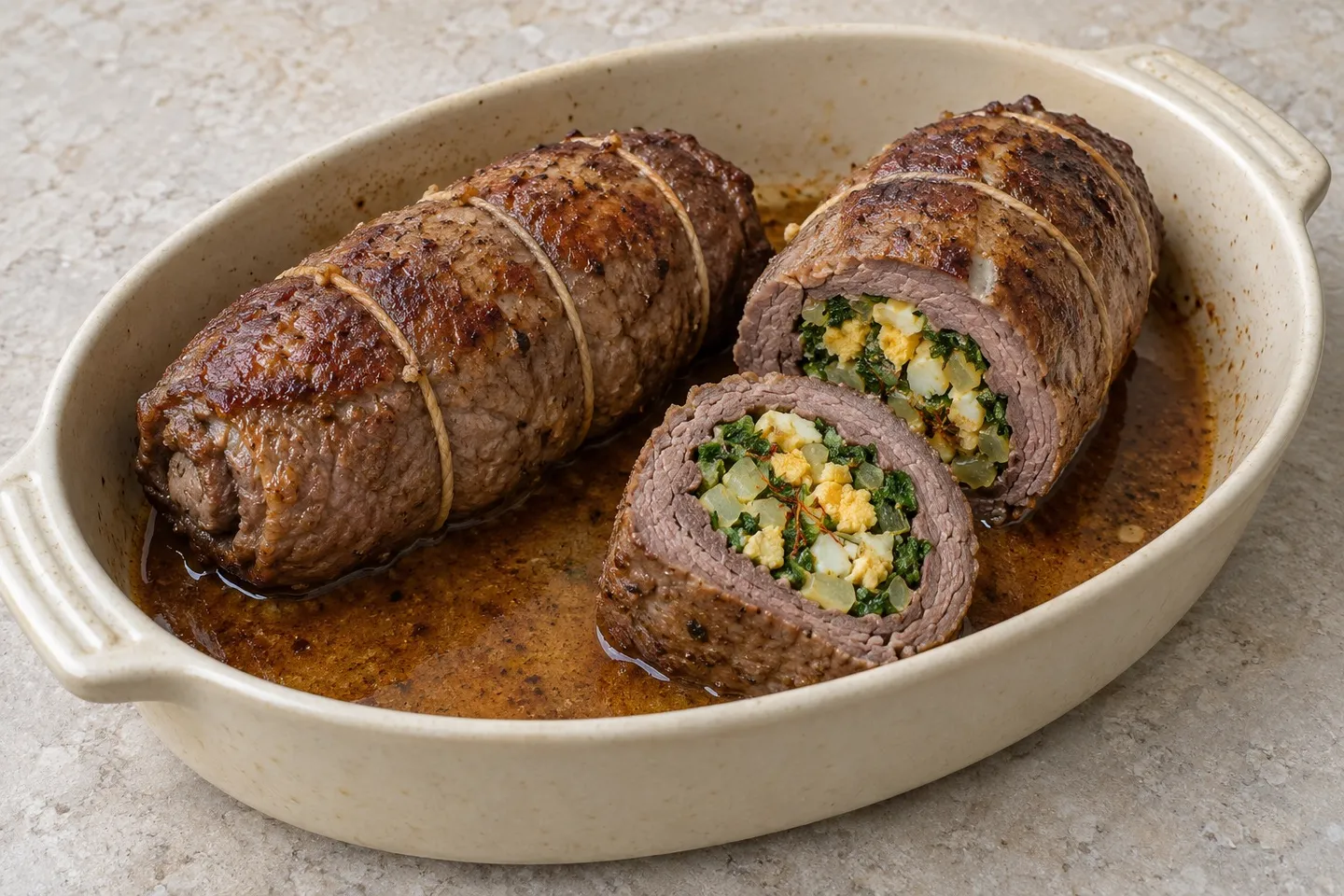
Gos Farced, Stuffed Goose Breast (1430)
Reader ratingsGos farced, a medieval stuffed goose of about 1430, made here as goose breast rolled around parsley, boiled onion, hard egg yolk, ginger, saffron and cloves.
- Recipe makes
- 2 rolls, serving 4
- Prep
- Cook
- Total
Includes a 5-minute rest after roasting. The eggs and onion can be boiled and the filling mixed a day ahead; keep it chilled.
Two roast goose-breast rolls stuffed with parsley, onion and egg yolk, one cut open.
The story behind the recipe
One stuffing, two seasons. The cook of Harleian MS. 279 fills a capon or a goose with parsley parboiled in pork fat or sheep’s suet, chopped hard egg yolks, pepper, ginger, cinnamon, saffron, salt and “clowys y-nowe,” cloves enough, and then grapes “in tyme of yere,” in their season. Out of season there is a second way: “for defawte of grapis, Oynons, fyrst wil y-boylid,” onions boiled well first and then chopped. The goose earns its place here from the ten geese entered in the Odiham kitchen on Sunday 31 May 1265.
What did “farced” mean?
Farced is stuffed, from the French farcir, the root of forcemeat. The recipe closes with a cook’s aside: a little boiled pork chopped in is good, “for it wol be þe better, & namely for þe Capoun,” especially for the capon, so the goose could do without it. The same page shows how standard this filling was. Three recipes on, a kid is skinned, stuffed “ful of suche mete as þou dost a capoun,” roasted on a spit and glazed with egg yolk: the capon’s stuffing was the one other dishes were measured against.
Written down a century and a half and more after the Odiham roll, this is a later English stuffing for a bird the countess’s kitchen had on hand. The roll says nothing of how its geese were cooked.
Read more about this recipe
Making it today
The biggest change is ours: two boneless goose breasts, opened out, spread with the filling, rolled and tied, in place of a whole bird with a stuffed cavity. The rolls cook through in under an hour, but a whole goose’s skin and fat are missing. We follow the onion branch, use lard for the “Swynys grece,” and blanch the parsley in water, apart from the fat. The amounts are ours too; the manuscript gives none. Large duck breasts can stand in for goose; start checking the temperature earlier.
Boiled onion in a goose stuffing turns up again four centuries later, mixed with sage, in Roast Goose with Sage and Onion Stuffing (1861). The countess’s geese, already counted on an earlier day, are in What Did a Medieval Countess Give the Poor to Eat?
Capoun or gos farced.—Take Percely, & Swynys grece, or Sewet of a schepe, & parboyle hem to-gederys til þey ben tendyr; ...
Recipe makes: 2 rolls, serving 4
Ingredients
For 2 rolls, serving 4. Quantities are shown as written.
Quantities as written here, for 2 rolls, serving 4.
Filling
- Large eggs2
- Onion, peeled80 g
- Flat-leaf parsley30 g
- Lard, softened13 g
- Ground ginger1/4 tsp
- Ground cinnamon1/8 tsp
- Ground black pepper1/8 tsp
- Ground cloves1 pinch
- Saffron1 pinch
- Salt1/2 tsp
Goose
- Boneless, skinless goose breasts2Author measures: about 680 g.
- Water for the roasting dish30 ml
Measurement notes
Ingredients as written here
- 2 large eggs
- 80 g onion, peeled
- 30 g flat-leaf parsley
- 13 g lard, softened
- 1/4 tsp ground ginger
- 1/8 tsp ground cinnamon
- 1/8 tsp ground black pepper
- 1 pinch ground cloves
- 1 pinch saffron
- 1/2 tsp salt
- 2 boneless, skinless goose breasts (about 680 g)
- 30 ml water for the roasting dish
Equipment
- Two small saucepans
 Sieve
- Mixing bowl
- Sharp knife and board
- Kitchen string
- Small roasting dish
 Instant-read thermometer
Instructions
Put the eggs in a small saucepan, cover with cold water and bring to a gentle boil. Simmer for 10 to 12 minutes, until the yolks are firm, then cool them in cold water and peel. Keep the yolks for the filling and the whites for another dish.
Boil the onion whole in the second saucepan of water for 10 to 15 minutes, until soft through. Drain, cool and chop it finely.
Drop the parsley into boiling water for 30 seconds, drain it in the sieve, cool under the cold tap and squeeze it dry. Chop it.
In the mixing bowl, mash the lard with the onion, parsley and crumbled yolks, the ginger, cinnamon, pepper, cloves, saffron and salt. Let the filling cool completely before it goes near the raw meat.
Heat the oven to 375°F (190°C).
On a clean board, cut each goose breast horizontally almost through and open it like a book. Flatten any thick parts with the heel of your hand to about 1.3 cm.
Spread half the filling over each opened breast, leaving a border of 2 cm. Roll each one up from a long side, tuck in any filling at the ends and tie with string at 3 cm intervals.
Set the rolls seam side down in the roasting dish and pour the water for the roasting dish around them. Roast for 35 to 55 minutes, checking from 30 minutes, until the thickest part of the meat and the center of the filling both read 165°F (74°C). If the tops brown too fast, cover them loosely with foil.
Rest the rolls for 5 minutes, cut away every piece of string and slice each roll in two. Spoon the dish juices over and serve hot.
Nutrition
345calories per serving
- Recipe makes
- 2 rolls, serving 4
- Servings
- 4
Estimated per serving (4) from USDA SR Legacy values for raw domestic goose meat, lard, egg yolk, onion and parsley, counting all fat and juices.
Recipe notes
When adjusting quantities
One goose breast of about 340 g takes half the filling. Thicker rolls take longer: go by the thermometer.
Notes
Quantities mentioned in these notes don’t change when you adjust the servings.
Goose breast cooked to 165°F (74°C) is firmer than the pink breast of a modern restaurant plate; the stuffing inside it is why it has to reach that temperature. For the grapes of the manuscript’s first way, stir a handful of halved seedless grapes into the cooled filling in place of the onion. Keeps 2 days, covered, in the refrigerator; reheat to 165°F (74°C). Contains egg.
Scaling changes the ingredients only; pan sizes and cooking times need their own judgment. To adapt this recipe further, try the recipe tool at TuneMyRecipe (opens in a new tab), our sister site.
Sources and attribution
After Harleian MS. 279, Capoun or gos farced, as printed in Two Fifteenth-Century Cookery-Books, ed. Thomas Austin (London: Early English Text Society, 1888)
Recipe details
- Course
- Main course
- Dish family
- Meat & Poultry
- Region
- British
- Era
- Medieval
- Main ingredient
- Poultry & game birds
- Difficulty
- Intermediate