Veal frikadellen in an Amsterdam cookbook, 1797 · Amsterdam
Where Did the Frikandel and the Kroket Come From?
No record from the time has turned up naming who invented the frikandel or kroket, but cookbooks of 1705, 1797 and 1873 show the name, the shape and the crumb.
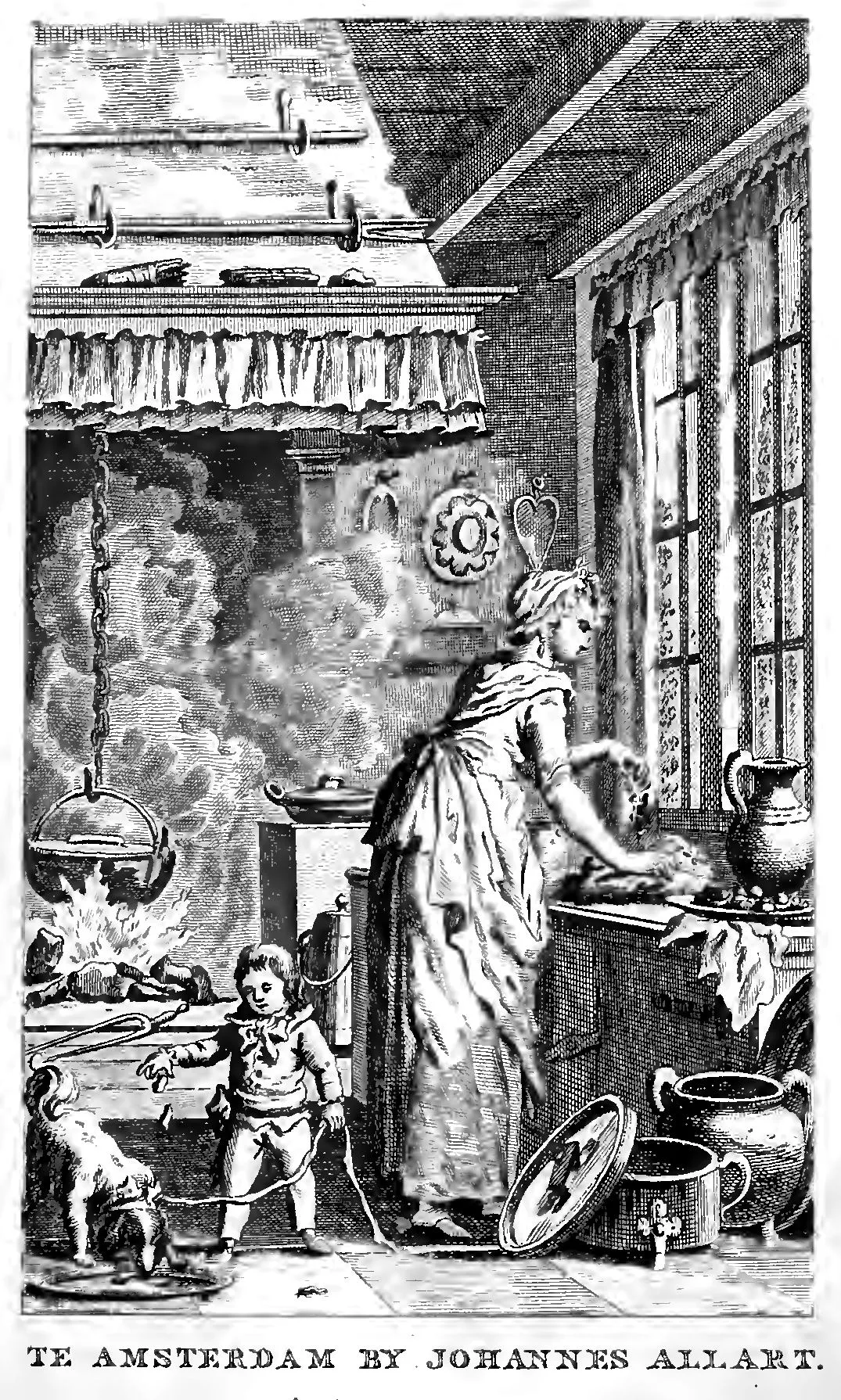
No record made at the time has turned up that names the inventor of the frikandel or the kroket. What the old cookbooks do show is how much of each snack was in Dutch and French kitchens long before the snack bar. An Amsterdam cookbook of 1797 makes veal frikadellen and shapes one batch into a long roll for the spit. A Paris cookbook of 1705 rolls poultry forcemeat into balls, coats them in crumbs and fries them as croquets. A Dutch household book of 1873 binds leftover meat in a thick sauce, cools it, rolls it, crumbs it twice and fries it, which is close to how a kroket is still made. The skinless frikandel arrives in the 1950s, in accounts written long afterward that disagree about who was first.
The anthropologist Irene Stengs, writing about Dutch fast food in 2013, defines the pair as a snack bar sells them. The frikandel is “a deep-fried skinless sausage.” The kroket is “a deep-fried sausage-shaped snack, this time existing of ragout coated with breadcrumbs.” One is minced meat with no coat at all; the other is a soft filling held together by its crumb. They share a counter and a fryer, and their histories run on separate tracks.
An oblong ball in Amsterdam, 1797
The Nieuwe Vaderlandsche Kookkunst, the “new national art of cookery,” was printed in Amsterdam by Johannes Allart in 1797. Its title page names no author, only “twee in dit vak zeer ervarene huishoudsters,” two housekeepers very experienced in the trade, and promises dishes made “op de zuinigste en eenvoudigste wyze,” in the thriftiest and simplest way, and “bevallig op te disschen,” handsomely served. It belongs to the same Amsterdam shelf as the 1769 book that bottled the juices of roast beef and called them Soja, told in How Did a 1769 Dutch Cookbook Make Soy Sauce Without Soy?
In the chapter on veal, after the cutlets, comes “Kalfs-frikadellen.” The cook takes good veal, free of skin and sinew, adds some kidney fat and chops it all very fine. To every three pounds of meat go five beschuiten, the dry Dutch rusks, crushed, or else white breadcrumb soaked in milk and squeezed out, with salt, pepper and nutmeg “naar genoegen,” to taste, and four eggs. Then the book lets the cook decide: make “zo veel frikadellen … als gy goedvindt,” as many frikadellen as you see fit. They are brushed with butter, laid in a pan with a little water, strewn with more crushed rusk and roasted “onder en boven met vuur,” with fire below and above. At the table, their own juices go onto the plate.
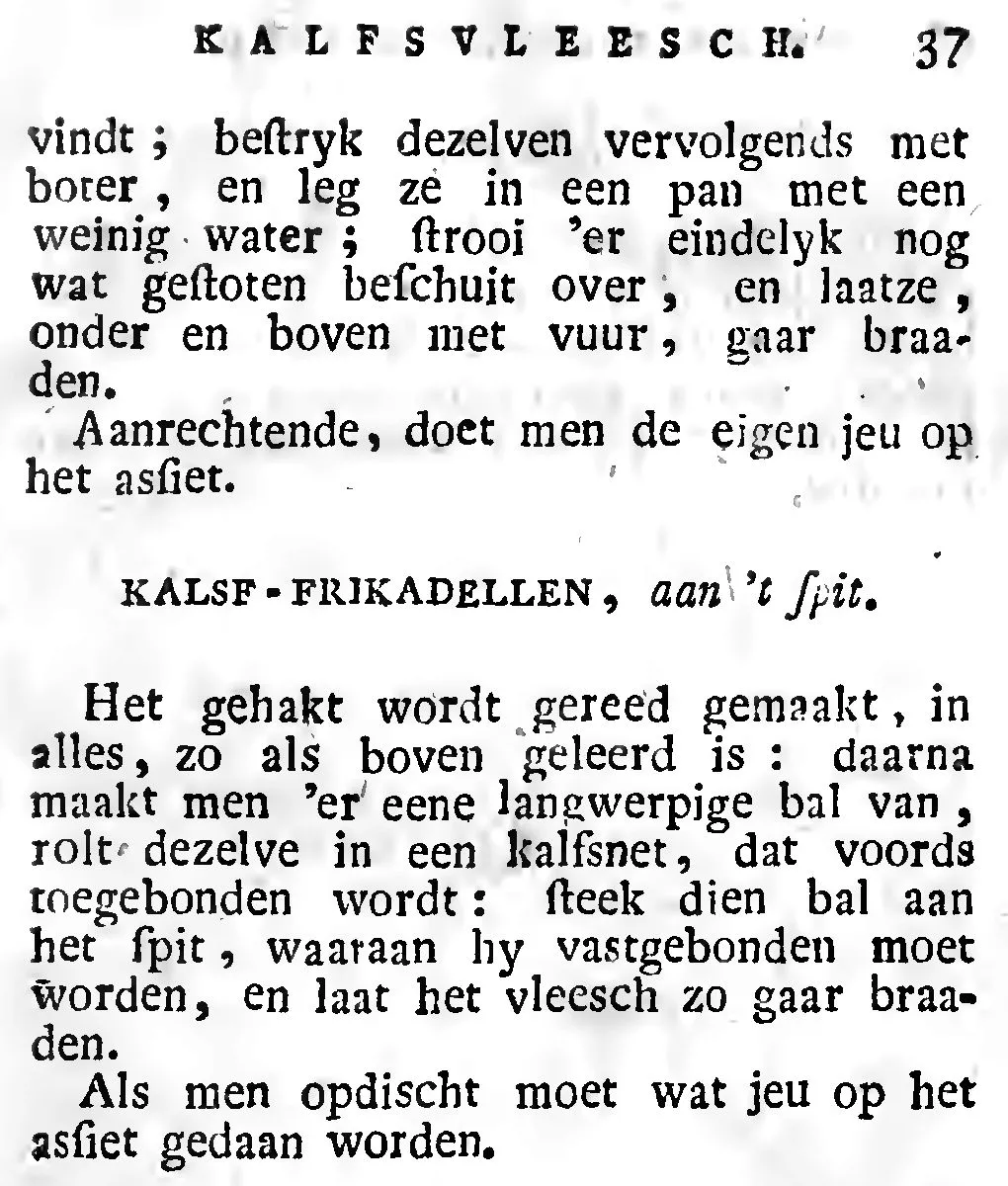
The end of the pan recipe and the spit version, from Nieuwe Vaderlandsche Kookkunst (Amsterdam, 1797), p. 37.
The next recipe, printed with a slipped letter as “Kalsf-frikadellen, aan ’t spit,” uses the same mince for a different job. “Daarna maakt men ’er eene langwerpige bal van”: then make an oblong ball of it. The ball is rolled in a veal caul, the lacy fat that wraps a calf’s stomach, tied up, bound to the spit and roasted, with a little gravy on the plate.
So the old frikadel could already be long. The resemblance only goes so far. Caul and string hold the 1797 roll together while it turns over the fire, and the crushed rusk on the pan version is a scattering over the top, not a coat. Nothing ties the book to any twentieth-century snack maker. What it settles is that the name and an oblong roll of seasoned minced veal were both in a Dutch kitchen by 1797.
What the crumb does
The kroket’s older relatives in print are the ones with a coat. In 1705 a revised edition of François Massialot’s Le cuisinier roïal et bourgeois came out in Paris. Early in the book, after setting out one supper in full, it notes that “Monsieur Langlois” gave a similar one for the Duke of Orléans on 28 March. No year is printed, but the book’s table of meals puts the duke’s Easter dinner in the same March, on Easter Day, the 26th. Easter fell on 26 March only once while he held the title, in 1690, and a supper of roast birds on the 28th had to come after Lent, so that spring is the likely date. For that meal, the book says, hens, chickens and partridges were roasted only “à faire les Farces,” to make the forcemeats, “par exemple, la Farce des Croquets.” The breast and thigh meat went into a forcemeat with blanched pork fat, cooked calf’s udder, sweetbreads, truffles, mushrooms, marrow, bread soaked in milk, herbs, a little cream cheese and cream, bound with four or five yolks and one or two whites.
The same forcemeat served three dishes. The croquets get one sentence of their own: “On forme les Croquets en rond, de la grosseur d’un œuf,” shape them round, the size of an egg, bread them at once, let them rest on a dish, fry them in lard and serve them hot. That is a filling, a crumb coat and hot fat, and it is a feast dish. Nobody in this account is saving scraps.
The thrift comes later in print. In 1873 Erven F. Bohn of Haarlem printed the fifth Dutch edition of Henriette Davidis’s Keukenboek. Its translator, who signed only as “De Vertaalster,” had explained in 1867 that she made “eene gewijzigde vertaling,” a modified translation of Davidis’s German cookbook, “voor het gebruik in de Hollandsche keuken,” for use in the Dutch kitchen. Recipe 24 is “Croquettes,” and its first line is “Van de overblijfsels van allerlei vleesch kan men croquettes maken”: croquettes can be made from the leftovers of all kinds of meat.
Davidis builds a sauce to hold that meat. Flour is fried in butter, a few spoonfuls of broth or gravy go in, then a couple of eggs beaten with water, stirred carefully over the fire. When the sauce is thick, the finely chopped meat goes in with parsley and shallots softened in butter, and the stirring goes on until no liquid shows and it has become “een dik deeg,” a thick dough. It is spread on a dish to cool, shaped into small rolls the size of a hen’s egg, rolled in grated white bread, then beaten egg, then bread again, and fried in a pan in butter or lard. The finer version uses veal cooked to a paste with milk and plenty of nutmeg and is rolled in crushed rusk instead. For the table, the croquettes are stacked into a pyramid with a bouquet of fried parsley on top.
Massialot’s forcemeat holds together with egg; Davidis’s leftovers hold together because they were cooked into a sauce and cooled. That second method, a cooked, chilled filling sealed in a double coat of crumbs, is the one a kroket still uses. Whether any Dutch maker learned it from this book, or from the French, or from a German original, no source here can show. The word had travelled in other directions too: eight years later, Abby Fisher’s San Francisco cookbook rolled chopped oysters and mashed potato in cracker crumbs for its Oyster Croquettes (1881).
Who made the first frikandel?
The skinless frikandel has a story with names in it, all told afterward. The Snack- en Fastfoodmuseum says G. de Vries, a butcher’s assistant, started out in 1952 in a small shop in the center of Dordrecht, and that “de eerste Frikadellen in Nederland,” the first frikadellen in the Netherlands, were made there in 1954. Medelo, the local history society of Meijel, tells a different one. In 1959 Jan Bekkers, a butcher’s son, began making croquettes and sausage for fry shops and snack bars in Deurne. A Mr. Klaassen gave him the idea of making “een worstje zonder vel,” a little sausage without a skin. He first shaped it in a tin meant for sandwich sausage, then with a butcher’s stuffer, and added burnt sugar because the first ones looked too pale. In 1967 he opened a factory in an empty dairy in Meijel.
The two accounts describe different firsts, a shop’s frikadel and a factory’s skinless sausage, and they need not cancel each other out. Neither cites a dated advertisement, price list or production sheet, so the question of who was first stays open. The museum adds a reason for the shape: a change in the rules for meatballs lowered the amount of flour allowed, and a floury meatball became a sausage to get round it. It names no law and no year, and the story stays in the fact-or-legend box until someone finds the regulation.
The wall
Selling changed as much as making. The Amsterdam chain FEBO’s own history says Johan Izaäk de Borst opened a bakery in 1941 whose kroketten sold so well the bakery could not keep up. In 1960 he closed the bakery and carried on as an automatiek, a snack bar selling from a wall of small hatches. Even then, the history says, the croquettes were made by hand, two or three hundred a day, and the stock drawn from the meat in a kettle on the gas stove. A dedicated production kitchen came only in 1970.
Stengs describes what that format became: “de muur,” the wall, “a grid of about a hundred or more rectangular, electrically heated and lighted compartments with glass hatches.” A customer opens one hatch and takes out one hot kroket or one frikandel. The wall is where the two finally meet, side by side in their glass boxes.
Three recipes from before the wall
These are the three dated kitchens behind this story, each cooked from its own words.
- Veal Frikadellen (1797): the Amsterdam pan recipe, fine-chopped veal and kidney fat bound with rusk and egg, brushed with butter, strewn with rusk and roasted in a little water, served on their own juices.
- Poultry Croquets (1705): Massialot’s croquets, roast chicken worked into a forcemeat with pork fat, mushrooms, milk-soaked bread, cream cheese and yolks, shaped the size of an egg, crumbed and fried in lard.
- Meat Croquettes (1873): Davidis’s leftover beef and ham in a thick egg-and-roux sauce, chilled, rolled, crumbed twice and fried in a pan.
The croquettes want a cold filling, so cook Davidis’s sauce and meat in the morning and the Meat Croquettes (1873) can be rolled, crumbed and fried for supper, the way a kroket still starts from a chilled ragout.
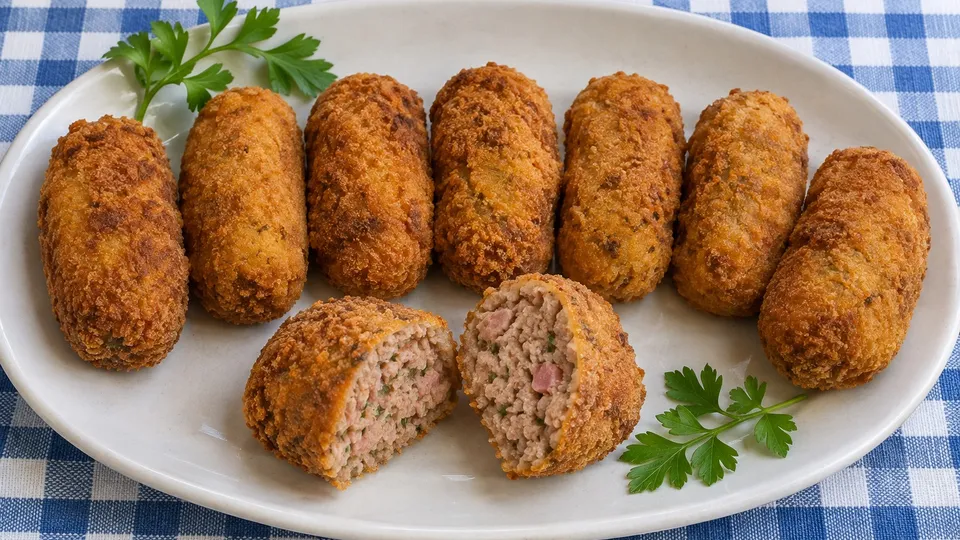 Cook it todayMeat Croquettes (1873)
Sources
- Anonymous (“twee in dit vak zeer ervarene huishoudsters”), Nieuwe Vaderlandsche Kookkunst (Amsterdam: Johannes Allart, 1797), frontispiece, title page and pp. 36–37. University of Leeds Library copy. Internet Archive (opens in a new tab); Wellcome Collection record (opens in a new tab).
- François Massialot, Le cuisinier roïal et bourgeois, new edition, revised and enlarged (Paris: Claude Prudhomme, 1705), p. 8. Gallica (opens in a new tab).
- H. Davidis, Keukenboek, translated from the German, fifth edition (Haarlem: Erven F. Bohn, 1873), translator’s preface of 1867 and pp. 57–58, no. 24. Google Books (opens in a new tab).
- Irene Stengs, “Dutch Treats: Summer Markets and the Festive Everydayness of Dutch Fast Food,” Etnofoor 25, no. 2 (2013): 145–158. Meertens Institute repository (opens in a new tab).
- Snack- en Fastfoodmuseum, “Eerste frikadellen van De Vries Snacks” (2024) and “Viva voor de frikandel” (2020). First frikadellen (opens in a new tab); Viva voor de frikandel (opens in a new tab).
- Medelo, heemkundevereniging Meijel, “Van boter naar frikandel.” Medelo (PDF) (opens in a new tab).
- FEBO, company history for school talks (“Spreekbeurt”), pp. 1–3. FEBO (PDF) (opens in a new tab).