Meat Croquettes (1873)
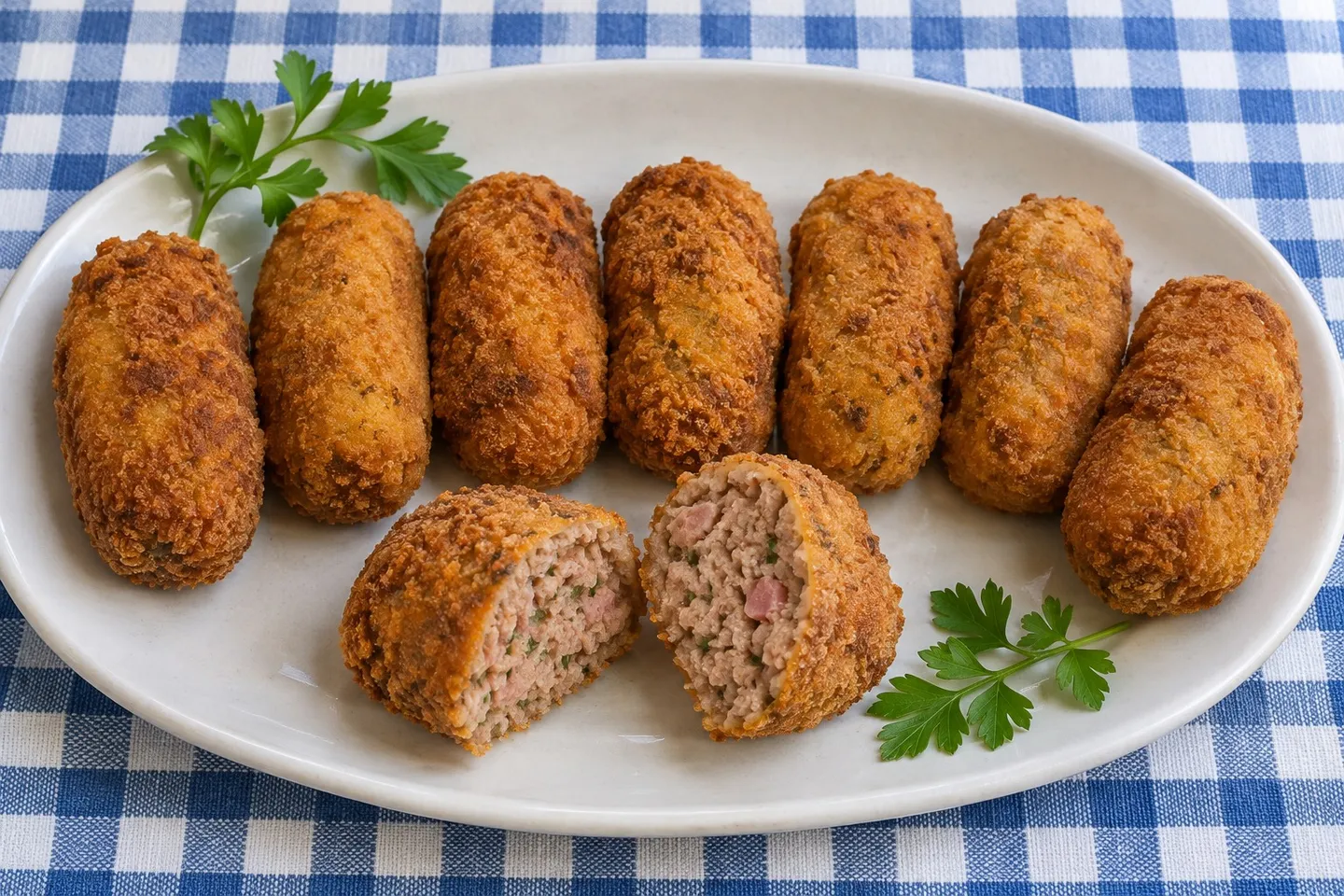
Reader ratingsDavidis’s Dutch croquettes of 1873: leftover beef and ham stirred into a thick sauce of butter, flour, broth and egg, cooled, rolled egg-size, coated in bread, egg and bread again and fried in a pan.
- Recipe makes
- 8 croquettes, serving 4
- Prep
- Cook
- Total
About 30 minutes to make the filling, then at least 2 hours in the refrigerator until it is firm enough to roll; the prep time includes that and 15 minutes to shape and coat. Frying takes 6 to 8 minutes a batch.
Short crumbed meat croquettes on an oval platter, one cut open.
The story behind the recipe
Croquettes in Henriette Davidis’s Dutch Keukenboek were a way to serve leftover meat a second time: chopped fine, stirred into a thick sauce of butter, flour, broth and egg, cooled, rolled, coated twice and fried in a pan. Recipe 24 was printed in Haarlem in 1873, in the fifth Dutch edition of a book translated from Davidis’s German, and it is the most familiar of our three recipes from before the snack wall. A kroket still starts from a cooked filling set firm and sealed in crumbs.
Ham, a pyramid and one minute of parsley
Any meat will do, Davidis says, and then she makes a suggestion: “zelfs is het lekker,” it’s even good, to mix beef or veal with ham. Her finer version is plain veal cooked to a paste with milk and plenty of nutmeg and rolled in crushed rusk, the same dry rusk that binds the Veal Frikadellen (1797). The croquettes go to the table stacked in a pyramid with a bouquet of fried parsley on top, or in a row with the parsley around the edge. The only timing in the recipe belongs to that parsley. Squeezed dry in a cloth and thrown into boiling butter, it stays green and crisp if it comes out after “ééne minuut,” one minute, and drains on gray paper. How these croquettes sit beside the French croquets of 1705 and the frikandel is told in Where Did the Frikandel and the Kroket Come From?
Read more about this recipe
Making it today
Davidis gives no amounts, so every quantity is ours, sized for eight rolls the size of a hen’s egg. Her “few spoonfuls” of broth becomes a measured amount of beef stock. The biggest change is the cooling. She spreads the hot filling on a dish to cool; we spread it thin and put it in the refrigerator at once, both for safety and because the filling needs to be cold and firm to roll. She fries in a pan, in butter or lard, and so do we, in lard about a centimeter deep, turning the rolls so every side browns. Her fried parsley is left as an option in the notes. Her German original, in its 1858 edition, is the source of our Lübeck Marzipan (1858).
24. Croquettes. Van de overblijfsels van allerlei vleesch kan men croquettes maken; zelfs is het lekker om rund- of kalfsvleesch met ham door elkander te gebruiken. Men hakt daarvoor het vleesch zeer fijn en laat wat meel in boter fruiten, waarbij men eenige lepels bouillon of jus voegt, en waar men een paar met water geklutste eijeren op het vuur voorzigtig doorroert. Als deze saus goed dik is geworden, doet men het vleesch er in, benevens fijngehakte pieterselie en in boter gesmoorde chalotten, met zout naar den smaak. Dan roert men het op het vuur nog zoolang, tot er geen nat meer op zigtbaar is en alles tot een dik deeg is geworden, dat men op een schotel uitgespreid, bekoelen laat, en waarvan men dan kleine rolletjes, als een kippenei, vormt. Men rolt die daarop ieder afzonderlijk in geraspt wittebrood, vervolgens in geklutste eijeren, eindelijk nogmaals in wittebrood en bakt ze in de pan in boter of reuzel. — Een zeer fijn recept is enkel gehakt kalfsvleesch en dit tot pap gekookt, met zout, meel, melk en veel notemuskaat, overigens behandeld als hierboven gezegd is, maar in gestampte beschuit, in plaats van brood gerold. — Bij het opdoen stapelt men de croquetten op, als een pyramide en zet op den top een bouquet gebakken pieterselie; of men legt ze naast elkaâr op den schotel, met de pieterselie langs den rand. De pieterselie moet om mooi groen te blijven en toch knapperig te zijn, na het wasschen, tusschen een doek zoo droog mogelijk worden uitgedrukt en dan in eens in de kokende boter geworpen; het is lang genoeg als men ze daarin ééne minuut laat blijven, en dan worde zij er met den schuimspaan uitgeschept. Men laat haar, op graauw papier uitgespreid, een oogenblik liggen, opdat er zoo min mogelijk boter aan blijve hangen, en garneert dan den schotel met de takjes, die men reeds bij het wasschen van de dikke stelen ontdaan heeft.
In our translation: “24. Croquettes. Croquettes can be made from the leftovers of all kinds of meat; it is even good to use beef or veal and ham mixed together. For them, chop the meat very fine and fry a little flour in butter, adding a few spoonfuls of broth or gravy, and into this carefully stir, over the fire, a couple of eggs beaten with water. When this sauce has become good and thick, put in the meat, with finely chopped parsley and shallots softened in butter, and salt to taste. Then keep stirring it over the fire until no more liquid can be seen and it has all become a thick dough, which is spread out on a dish and left to cool, and from which small rolls are then formed, like a hen’s egg. Roll each of these separately in grated white bread, then in beaten eggs, finally once more in white bread, and fry them in the pan in butter or lard. A very fine recipe is chopped veal alone, cooked to a paste with salt, flour, milk and plenty of nutmeg, otherwise treated as said above, but rolled in crushed rusk instead of bread. When dishing up, stack the croquettes like a pyramid and set a bouquet of fried parsley on top; or lay them side by side on the dish with the parsley around the edge. To stay a nice green and still be crisp, the parsley, after washing, must be squeezed as dry as possible in a cloth and then thrown all at once into the boiling butter; it is long enough if it stays in it one minute, and then it is lifted out with the skimmer. Let it lie a moment, spread on gray paper, so that as little butter as possible stays on it, and then garnish the dish with the sprigs, whose thick stalks were already removed when washing.”
Recipe makes: 8 croquettes, serving 4
Ingredients
For 8 croquettes, serving 4. Quantities are shown as written.
Quantities as written here, for 8 croquettes, serving 4.
- Cooked beef or veal200 g
- Cooked ham50 g
- Shallots30 g
- Unsalted butter40 g
- Plain flour35 g
- Beef stock120 ml
- Large eggs3
- Water30 ml
- Chopped fresh parsley1 tbsp
- Fine salt1/4 tsp
- Stale white bread, crusts removed80 g
- Lard, about 1 cm deep in the pan, for frying
Measurement notes
Ingredients as written here
- 200 g cooked beef or veal
- 50 g cooked ham
- 30 g shallots
- 40 g unsalted butter
- 35 g plain flour
- 120 ml beef stock
- 3 large eggs
- 30 ml water
- 1 tbsp chopped fresh parsley
- ¼ tsp fine salt
- 80 g stale white bread, crusts removed
- Lard, about 1 cm deep in the pan, for frying
Equipment
 Knife and board
 Box grater
 Small frying pan
 Small heavy saucepan
 Whisk
 Wooden spoon
 Shallow container
 Plate
 Shallow bowl
- Heavy frying pan, about 24 cm across
 Instant-read thermometer
 Slotted spoon
 Wire rack
Instructions
Chop the cooked beef or veal and the cooked ham very fine with the knife.
Chop the shallots fine and soften them in a quarter of the unsalted butter in the small frying pan over low heat, without browning, about 5 minutes. Set aside.
Melt the rest of the butter in the saucepan over medium-low heat, whisk in the plain flour and cook, stirring, for 2 minutes without letting it color.
Whisk in the beef stock a little at a time until smooth. It will be very thick.
Beat two of the large eggs with half the water. Take the saucepan off the heat and whisk in the eggs a little at a time.
Return the pan to low heat and stir with the wooden spoon for 2 to 3 minutes, until the sauce is thick and the egg has set. Keep it below a boil.
Stir in the chopped meat and ham, the shallots with their butter, the parsley and the fine salt. Taste the mixture and add more salt only if the ham and stock need it.
Keep stirring over low heat for 3 to 4 minutes, until no liquid shows and the filling is a thick paste that leaves the sides of the pan.
Spread the filling no more than 2 cm deep in the shallow container, cover it and refrigerate it right away for at least 2 hours, until cold and firm.
Grate the stale white bread into fine crumbs and spread them on a plate. Beat the last egg with the rest of the water in the shallow bowl.
Divide the cold filling into eight equal pieces and roll each into a thick roll about 6 cm long, the size of a hen’s egg.
Roll each in the crumbs, then in the beaten egg, then in the crumbs again, pressing them on. Keep the coated croquettes in the refrigerator while the fat heats.
Heat the lard in the heavy frying pan to 350°F (175°C).
Fry four croquettes at a time for 6 to 8 minutes, turning them every minute or two, until deep golden on all sides and the center of one reads 165°F (74°C) on the thermometer. Lower the heat if the crust browns before the center is hot.
Drain on the wire rack and serve at once.
Nutrition
440calories per serving
- Recipe makes
- 8 croquettes, serving 4
- Servings
- 4
Estimated per serving (4) from USDA FoodData Central values for roast beef, cooked ham, shallots, butter, flour, beef stock, whole egg and white bread, with about 30 g of frying fat absorbed in all.
Recipe notes
When adjusting quantities
Davidis gives no amounts; these are ours. A double batch needs a wider saucepan for the sauce and a second round of frying.
Notes
Quantities mentioned in these notes don’t change when you adjust the servings.
Our changes from the book: all the amounts; beef stock for its broth or gravy; the refrigerator, and a thin layer, for its cooling on a dish; rolls of a fixed size and number; lard, one of its two fats, for frying; and the frying temperature and time. For Davidis’s garnish, wash and dry a small bunch of parsley well, strip the thick stalks, and drop the sprigs into very hot butter for one minute, then lift them out with the slotted spoon and drain on paper. Stand back, since wet parsley spits. For her finer version, use cooked veal alone with milk in place of the stock and plenty of nutmeg, and roll it in crushed rusk instead of bread.
The meat is cooked twice, so treat it as leftovers. Use cooked meat that has been refrigerated within 2 hours of cooking, cool the filling in a shallow layer in the refrigerator, and fry the croquettes until the center reaches 165°F (74°C), the safe minimum for leftovers on the US government’s FoodSafety.gov chart. Refrigerate any croquettes left over within 2 hours and reheat them to 165°F (74°C).
Hot fat is a burn and fire risk: use a heavy pan with the fat well below the rim, keep water away from it, and never leave the pan on the heat unattended. Contains egg, milk (in the butter) and wheat (gluten, in the flour and bread); check the stock label for celery and other allergens.
Scaling changes the ingredients only; pan sizes and cooking times need their own judgment. To adapt this recipe further, try the recipe tool at TuneMyRecipe (opens in a new tab), our sister site.


Sources and attribution
Translated and adapted from H. Davidis, Keukenboek, 5th ed. (Haarlem, 1873), no. 24, Croquettes
See the original pages (scan at Google Books) (opens in a new tab)
Recipe details
- Course
- Starter
- Dish family
- Meat & Poultry
- Region
- Dutch
- Era
- 19th century
- Source decade
- 1870s
- Main ingredient
- Beef
- Difficulty
- Intermediate
- Occasion
- Everyday meal