Veal Frikadellen (1797)
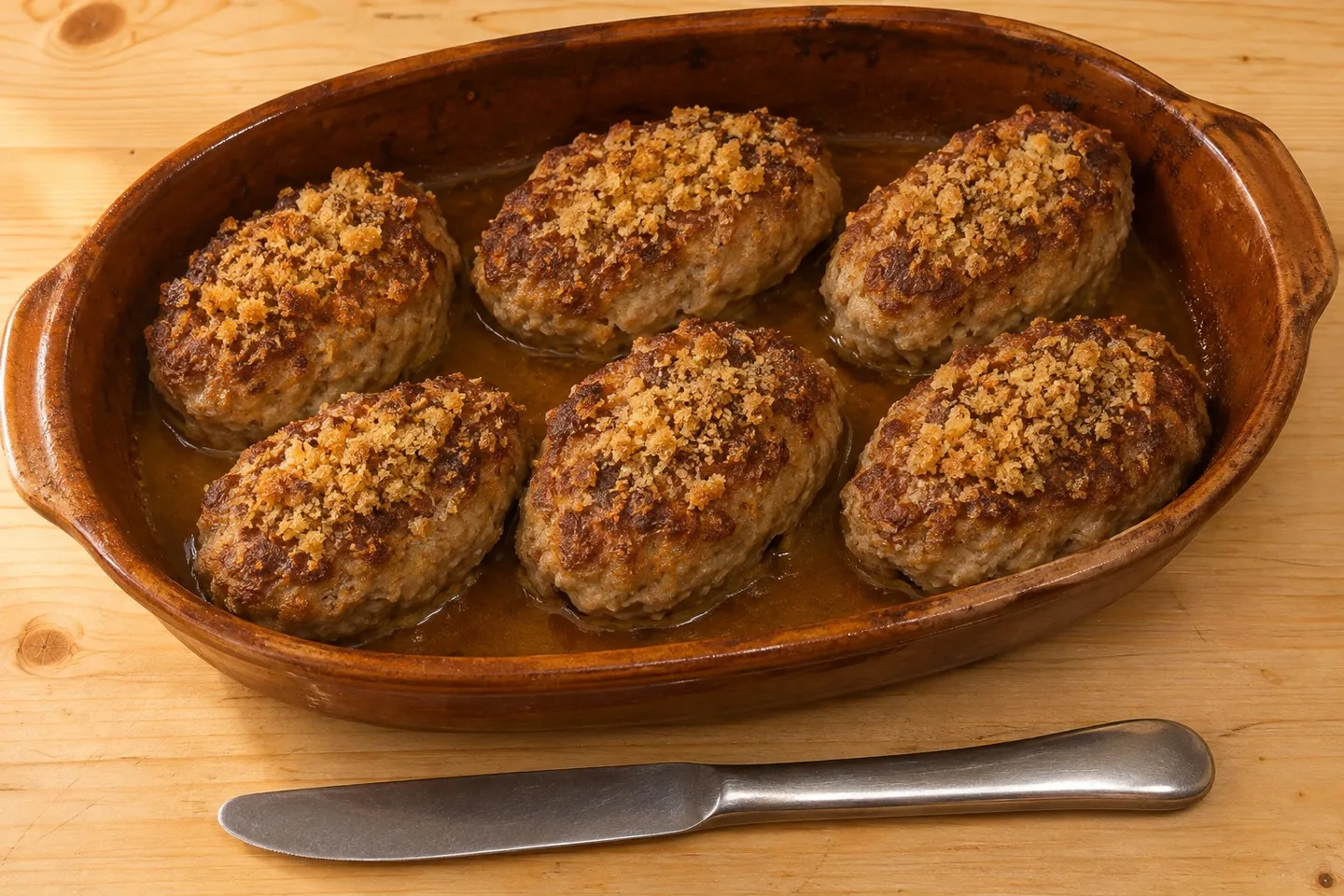
Reader ratingsAn Amsterdam cookbook’s veal frikadellen of 1797: veal and kidney fat chopped fine with crushed rusk, egg and nutmeg, brushed with butter and roasted in a little water under a strewing of rusk.
- Recipe makes
- 6 frikadellen, serving 3
- Prep
- Cook
- Total
Twenty minutes to chop, mix and shape, then about 30 minutes in a hot oven, until the centers reach 160°F (71°C).
Oval veal frikadellen with a crumb top in an earthenware dish.
The story behind the recipe
These are the veal frikadellen an Amsterdam cookbook set down in 1797: finely chopped veal and kidney fat bound with crushed rusk and egg, brushed with butter, strewn with more rusk and roasted in a pan with a little water. They come from the veal chapter of the Nieuwe Vaderlandsche Kookkunst, which Johannes Allart printed as the work of “two very experienced housekeepers,” and they lead our three recipes from before the snack wall.
A recipe that leaves the counting to the cook
The book wants the best of the calf, “zonder vellen of zenuwen,” without skin or sinew, and it works in proportions. Three pounds of meat take five rusks, and a cook with more or less meat is told to adjust the rusk “naar evenredigheid,” in proportion. An Amsterdam pound weighed about 494 grams, so the full batch starts from nearly a kilo and a half of veal and four eggs. How many frikadellen to make, and what shape, the book leaves to the cook. The heat is to come from below and above at once. The very next recipe takes the same mince, rolls it into one long ball in a veal caul and roasts it on the spit, the detail that makes this book a stop in the story told in Where Did the Frikandel and the Kroket Come From?
Read more about this recipe
Making it today
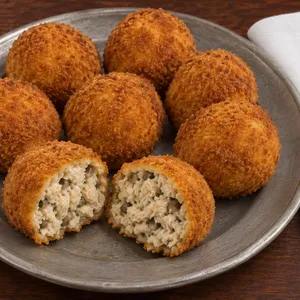
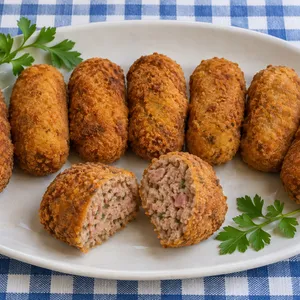
This is a quarter of the book’s batch, with one egg, and butcher’s ground veal in place of hand chopping. Beef suet from around the kidney stands in for the unspecified kidney fat; it is the same kind of fat, firm and white. A hot oven does the work of the fire above and below. Shaping six thick ovals is our choice, since the book names neither the number nor the shape. The book’s other binder, white breadcrumb soaked in milk and squeezed out, can take the rusk’s place. The juices in the dish are the sauce, as the book has it: “doet men de eigen jeu op het assiet,” put their own juice on the plate. For forcemeat with a true crumb coat, almost a century earlier and in Paris, there are the Poultry Croquets (1705).
Kalfs-frikadellen. Neem goed kalfsvleesch, vooral zonder vellen of zenuwen, doe ‘er wat niervet onder, en hak een en ander zeer fyn; doe voords op de 3 pond vleesch 5 beschuiten, (meer of minder vleesch hebbende, beschuit naar evenredigheid; men kan ook kruim van wittebrood neemen, dat in melk geweekt en weder uitgedrukt is,) doe onder de beschuit, of het brood, zout, peper en nootenmuscaat, naar genoegen, benevens vier eiëren, kneed een en ander door het vleesch, en maak ‘er voords zo veel frikadellen van als gy goedvindt; bestryk dezelven vervolgends met boter, en leg ze in een pan met een weinig water; strooi ‘er eindelyk nog wat gestoten beschuit over, en laatze, onder en boven met vuur, gaar braaden. Aanrechtende, doet men de eigen jeu op het assiet.
In our translation: “Veal frikadellen. Take good veal, above all without skin or sinews, put some kidney fat with it, and chop the one and the other very fine; then to the 3 pounds of meat put 5 rusks (having more or less meat, rusk in proportion; one can also take crumb of white bread that has been soaked in milk and squeezed out again), put with the rusk, or the bread, salt, pepper and nutmeg to taste, together with four eggs; knead it all through the meat, and then make as many frikadellen of it as you see fit; next brush them with butter and lay them in a pan with a little water; finally strew a little more crushed rusk over them, and let them roast until done, with fire below and above. When dishing up, put their own juice on the plate.”
Recipe makes: 6 frikadellen, serving 3
Ingredients
For 6 frikadellen, serving 3. Quantities are shown as written.
Quantities as written here, for 6 frikadellen, serving 3.
- Ground veal375 g
- Beef suet (kidney fat)40 g
- Dutch rusks (beschuit) or zwieback25 g
- Fine salt3/4 tsp
- Ground black pepper1/4 tsp
- Grated nutmeg1/4 tsp
- Large egg1
- Unsalted butter15 g
- Water120 ml
Measurement notes
Ingredients as written here
- 375 g ground veal
- 40 g beef suet (kidney fat)
- 25 g Dutch rusks (beschuit) or zwieback
- ¾ tsp fine salt
- ¼ tsp ground black pepper
- ¼ tsp grated nutmeg
- 1 large egg
- 15 g unsalted butter
- 120 ml water
Equipment
 Knife and board
 Rolling pin
 Mixing bowl
 Small saucepan
 Baking dish, about 25 by 20 cm
 Pastry brush
 Instant-read thermometer
Instructions
Heat the oven to 400°F (200°C).
Chop the beef suet very fine on the board, picking out any skin as you go.
Crush the Dutch rusks to fine crumbs with the rolling pin. Set a little under half of the crumbs aside for the tops.
Put the ground veal, the chopped suet and the larger share of the rusk crumbs in the mixing bowl with the fine salt, ground black pepper, grated nutmeg and egg. Knead with your hand until evenly mixed and the mixture holds together.
Divide it into six equal pieces and shape each into a thick oval about 8 cm long. Lay them in the baking dish with a little space between them.
Melt the unsalted butter in the small saucepan and brush it over the tops and sides of the frikadellen.
Pour the water into the dish around them, not over them, and strew the reserved rusk crumbs over the tops.
Roast for 25 to 30 minutes, until browned and the center of the thickest one reads 160°F (71°C) on the thermometer. Start checking at 20 minutes.
Spoon the juices from the dish onto warm plates and set the frikadellen on top.
Nutrition
390calories per serving
- Recipe makes
- 6 frikadellen, serving 3
- Servings
- 3
Estimated per serving (3) from USDA FoodData Central values for raw ground veal, beef suet, zwieback, whole egg and butter.
Recipe notes
When adjusting quantities
A quarter of the book’s batch: one egg to about a quarter of its 3 pounds of veal. Doubled, use a dish large enough to keep the frikadellen in one layer with room between them.
Notes
Quantities mentioned in these notes don’t change when you adjust the servings.
Our changes from the book: a quarter of its batch, with its four eggs reduced to one; 375 grams of ground veal for a quarter of its 3 pounds (an Amsterdam trade pound was about 494 grams, so a quarter of 3 pounds is about 371 grams); beef suet for its unspecified kidney fat, and 40 grams of it, since the book says only “some”; 25 grams of rusk in all for its 1¼ rusks and its extra strewing, which is our figure, since the weight of an 18th-century rusk isn’t recorded; the amounts of salt, pepper, nutmeg, butter and water; the six oval shapes; and a 400°F (200°C) oven for its fire below and above. Zwieback is the nearest dry rusk outside the Netherlands.
Ground veal needs to reach 160°F (71°C) in the center, the safe minimum for ground meat on the US government’s FoodSafety.gov chart. Refrigerate leftovers within 2 hours and reheat them to 165°F (74°C). Contains egg, milk (in the butter) and wheat (gluten, in the rusks).
Scaling changes the ingredients only; pan sizes and cooking times need their own judgment. To adapt this recipe further, try the recipe tool at TuneMyRecipe (opens in a new tab), our sister site.
Sources and attribution
Translated and adapted from Nieuwe Vaderlandsche Kookkunst (Amsterdam, 1797), Kalfs-frikadellen
See the original pages (scan at Internet Archive) (opens in a new tab)
Recipe details
- Course
- Main course
- Dish family
- Meat & Poultry
- Region
- Dutch
- Era
- 18th century
- Source decade
- 1790s
- Main ingredient
- Veal
- Difficulty
- Easy
- Occasion
- Everyday meal