The first Burns supper, in the cottage where Burns was born · Alloway, Ayrshire
What Was Served at the First Burns Supper?
No full menu survives from the 1801 Alloway dinner. Later accounts name a haggis and a sheep’s head; cock-a-leekie joins the Burns table by 1859.
No bill of fare survives from the first Burns supper, so its courses can’t be listed. What survives is a guest list and two dishes. In the summer of 1801 nine men dined in the cottage at Alloway, in Ayrshire, where Robert Burns had been born, and later accounts of the evening, drawn from a manuscript by one of them, name a haggis and a sheep’s head. The neeps, tatties and cranachan of a modern Burns Night don’t appear in the evidence for that table. The earliest cookbook we found that ties a dish to a Burns celebration came sixty years later, when Isabella Beeton wrote that cock-a-leekie was “largely consumed” at the centenary festival of 1859.
Nine men at Alloway
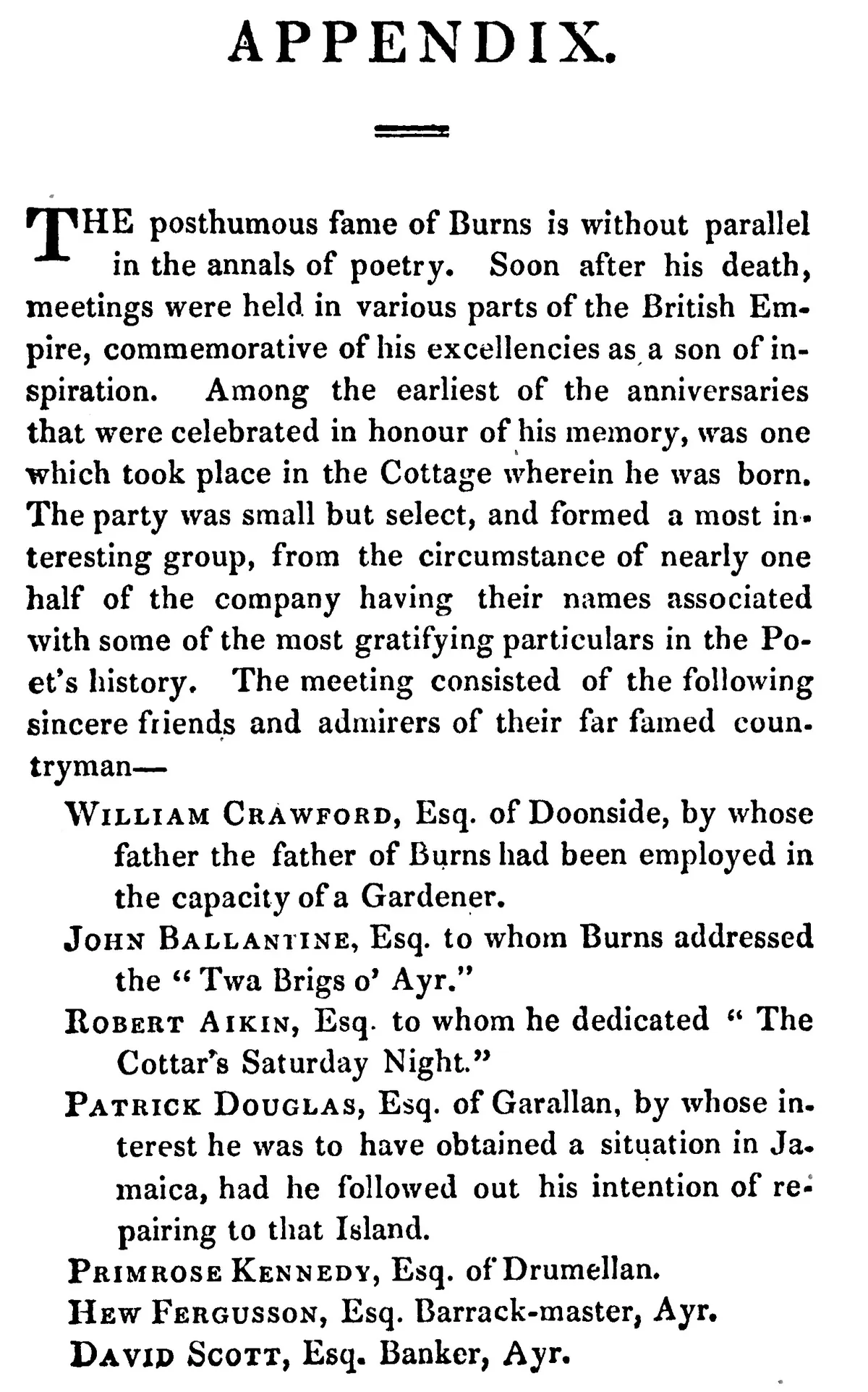
The man who kept the record was Hamilton Paul, who had been asked to write a few verses for the evening. By 1819 he was minister of Broughton, Glenholm and Kilbucho, and that year he published an edition of The Poems & Songs of Robert Burns in Ayr (the title page spells it “Air”), with the dinner in its appendix.
“Among the earliest of the anniversaries that were celebrated in honour of his memory,” he wrote, “was one which took place in the Cottage wherein he was born. The party was small but select.” He named the company. William Crawford of Doonside was the son of the man who had employed Burns’s father as a gardener. John Ballantine was the friend to whom Burns addressed the poem Paul calls the “Twa Brigs o’ Ayr.” Robert Aikin had “The Cottar’s Saturday Night” dedicated to him, and Patrick Douglas of Garallan would have found Burns a post in Jamaica if the poet had sailed. The rest were Primrose Kennedy of Drumellan; Hew Fergusson, the barrack-master at Ayr; David Scott, a banker in the town; Thomas Jackson, professor of natural philosophy at St. Andrews; and Paul himself. “The meeting above mentioned took place in 1801,” he added.
Paul calls it one of the earliest, and claims no more. His manuscript account of the same evening, now in the East Ayrshire collections and shown online by its Future Museum, opens “In the summer of 1801,” and says plainly that its author never saw Burns, though he admired his writings early. The National Trust for Scotland dates the dinner 21 July 1801, the fifth anniversary of Burns’s death.
A haggis and a sheep’s head
The food comes from that manuscript, by way of the people who have quoted it. Later accounts drawn from Paul’s pages say the company ate a haggis and a sheep’s head, and the National Trust for Scotland’s history of the first supper gives the same two dishes. Those later leaves are not shown online, so the dishes are given here as the accounts report them.
A haggis needs little explaining at a Burns dinner. Burns had written “To a Haggis” in 1786, and while a poem is no proof of a menu, it makes the choice easy to understand among men who had known him. The sheep’s head turns up again sixty years later in the same pages as the soup of the centenary: Beeton’s 1861 book prints a leek soup made with one, thickened with oatmeal and enough for ten, directly above her cock-a-leekie.
The rest of the modern standard has no such footing. A 2019 history from the National Trust for Scotland Foundation USA adds neeps, tatties and whisky to the first supper; the Trust’s own 2021 account names only the haggis and the sheep’s head. The University of Glasgow’s research project on the Burns supper treats haggis as central to the meal, with many variations around it, and it leaves the question of cranachan at the first supper open.
From summer to the birthday
Paul’s appendix also shows the supper changing shape. By 1819 he had written “eighteen anniversary Odes, in commemoration of the Birth day of Burns,” and the gathering had outgrown its room: “An additional room was built to the end of the Cottage; but the numbers increased to such a degree, that they could not, without the utmost difficulty, be accommodated.” He knew there were scoffers. “Some weak attempts have been made by narrow minded men to expose to ridicule this Burnomania, as they term it,” he wrote, “but, like self-love converted by the plastic power of the Poet into social affection, it is spreading wider and wider every day.”
Paul doesn’t date the move from a summer memorial to a January birthday; he records only that the odes were read at each anniversary “by different Gentlemen.” The National Trust for Scotland says the next dinner was held on 29 January, on a mistaken birth date, and that 25 January was kept from 1803.
Mrs. Maciver’s haggis
No recipe from the Alloway kitchen survives. The nearest printed haggis we found is one an Edinburgh cookery teacher had published fourteen years before the dinner. William Kitchiner’s The Cook’s Oracle, a London book whose 1822 edition was printed for Constable of Edinburgh, gives “A good Scotch Haggies” and signs it off: “The above we copied verbatim from Mrs. Maciver, a celebrated Caledonian Professor of the Culinary art, who taught and published a book of Cookery at Edinburgh, A.D. 1787.”
It is a recipe of handfuls and plenty. The draught, an old Scots word for the entrails or pluck, is parboiled; the liver is boiled until it will grate; the meal is dried before the fire. Into the bag go the minced draught, about half the liver, grated, “plenty of the suet,” onions, a handful or two of meal and salt and mixed spices, with a quart of stock made from the beef scraps and the water the draught boiled in. A large haggis, Maciver warns, “will take at least two hours boiling.” She never says which animal gives the bag and the draught, and she adds “a pretty large piece of beef.”
Cock-a-leekie at the Crystal Palace
By the hundredth anniversary of his birth, in January 1859, the suppers had spread far past Ayrshire. Ann Rigney, a scholar of cultural memory, has shown how the centenary was staged as a shared event in many places at once, with speeches, letters and telegraph messages tying the gatherings together. South of London, the Crystal Palace at Sydenham held a festival of its own. Five years earlier, at the same Crystal Palace works, Benjamin Waterhouse Hawkins had given a dinner in the mould of his Iguanodon, as What Was Served at the Dinner Inside the Iguanodon? tells.
Two years after the festival, Isabella Beeton put it into a note. Her book, which also supplies the roast goose in What Did the Cratchits Eat for Christmas Dinner?, was published in London in 1861. Her recipe for “Commonly Called Cock-a-Leekie,” number 134 in The Book of Household Management, ends: “Cock-a-leekie was largely consumed at the Burns Centenary Festival at the Crystal Palace, Sydenham, in 1859.”
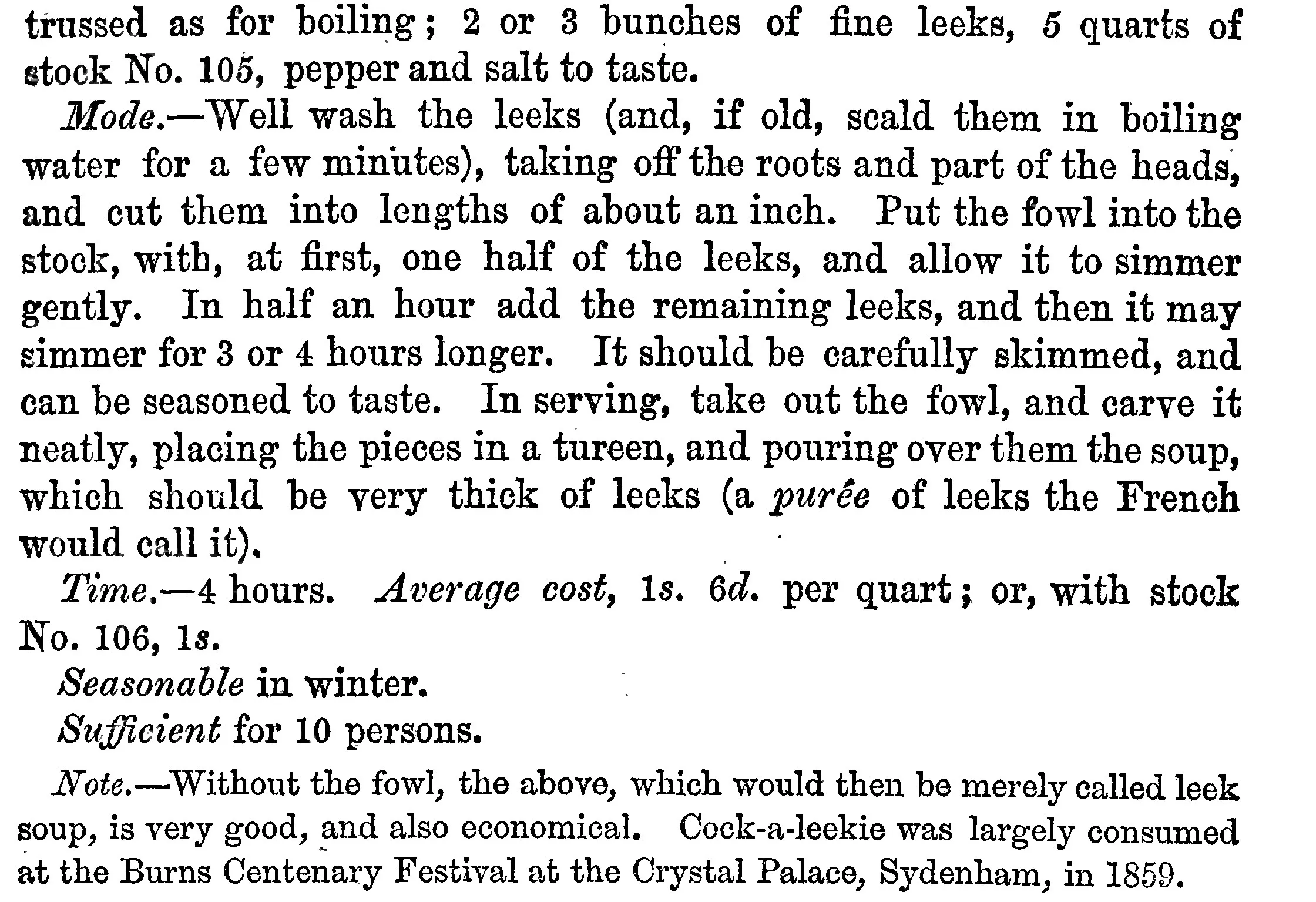
The note tells us the soup was eaten there, and nothing about whose recipe the caterers used. Beeton’s version is a capon or large fowl, “sometimes an old cock, from which the recipe takes its name,” simmered for hours in five quarts of her beef stock with two or three bunches of leeks, carved into a tureen with the soup poured over, “which should be very thick of leeks (a purée of leeks the French would call it).” There are no prunes and no rice in it. She costs it at 1s. 6d. a quart, about £9 today by UK consumer prices (Bank of England), more than four times the 4d. of the sheep’s-head soup above it.
Printed menus for Burns suppers do survive from later in the century. The National Trust for Scotland’s collection lists programmes and menus of the Ayr Burns Club from 1888 to 1899, among them cards for 25 January 1888 and 24 January 1896. The catalogue entries don’t transcribe their dishes, so they can’t yet show when the soup, the haggis, the neeps and the tatties settled into the order a modern supper follows.
The recipes
Neither is a recipe from the Alloway dinner, and no single supper is known to have served both. The pairing is ours, soup before haggis, in the order a Burns supper runs today.
- Cock-a-Leekie (1861): Beeton’s fowl and leek soup, the one dish here with a printed link to a Burns celebration.
- Scotch Haggis Pudding (1822): Mrs. Maciver’s haggis of 1787 as Kitchiner reprinted it, with heart, liver, beef, suet and oatmeal, steamed in a basin.
Cooking it
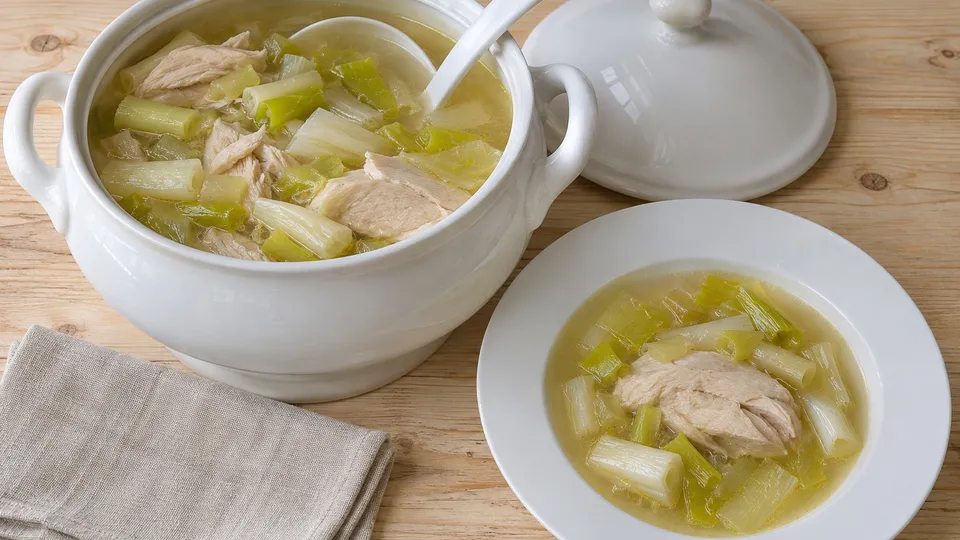
For the one dish here with a printed Burns pedigree, make the Cock-a-Leekie (1861) as Beeton wrote it, with the second half of the leeks going in after half an hour, so the soup comes to the tureen very thick of them.
 Cook it todayCock-a-Leekie (1861)
Sources
- Hamilton Paul, The Poems & Songs of Robert Burns, with a Life of the Author (Air: Wilson, M’Cormick & Carnie, 1819), Appendix, pp. [295]–296. Facsimile via Electric Scotland.
- Hamilton Paul, “Anniversaries of Burns,” manuscript, East Ayrshire Council, EADO172a–d (McKie IX No. 35), first page. Future Museum (opens in a new tab).
- William Kitchiner, The Cook’s Oracle, fourth edition (London: printed for A. Constable & Co., Edinburgh, and Hurst, Robinson & Co., 1822), No. 488*, A good Scotch Haggies, pp. 399–400. Internet Archive (opens in a new tab).
- Isabella Beeton, The Book of Household Management (London: S. O. Beeton, 1861), nos. 133–134, pp. 70–71. Internet Archive (opens in a new tab).
- National Trust for Scotland, “The first Burns supper” (2021). nts.org.uk (opens in a new tab).
- National Trust for Scotland Foundation USA, “Burns Supper 101” (2019). ntsusa.org (opens in a new tab).
- University of Glasgow, Centre for Robert Burns Studies, “Burns Supper: Scottish Tradition, Global Reinvention,” culinary practices. gla.ac.uk (opens in a new tab).
- Ann Rigney, “Embodied Communities: Commemorating Robert Burns, 1859,” Representations 115 (2011), pp. 71–76.
- National Trust for Scotland collections, Ayr Burns Club programme and menu, 24 January 1896 (NTS/02/25/BRN/05/01/154). nts.org.uk (opens in a new tab).