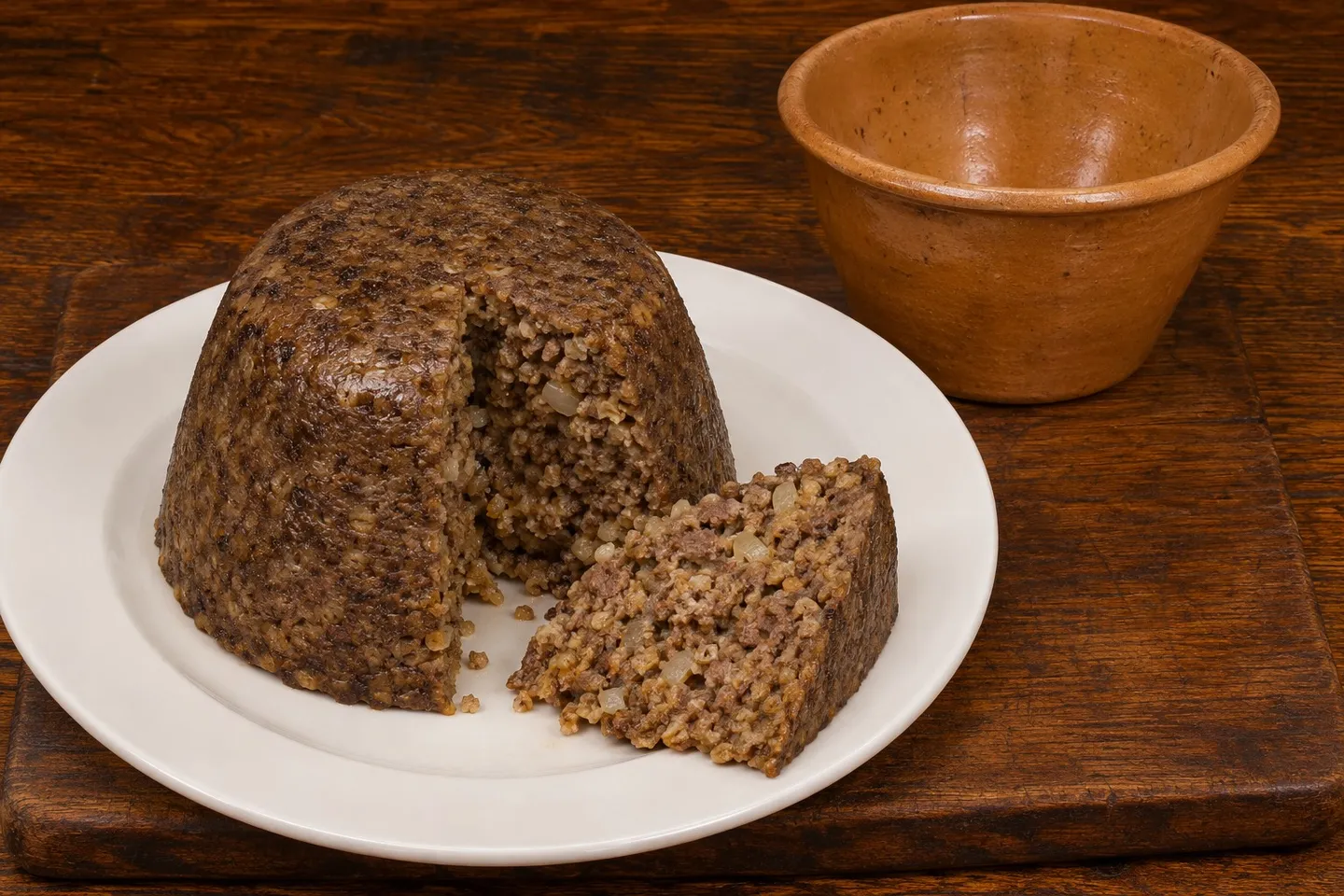
Scotch Haggis Pudding (1822)
Reader ratingsMrs. Maciver’s 1787 haggis as William Kitchiner printed it in 1822: heart, liver, beef, suet, onion and toasted oatmeal with a little stock, steamed in a basin.
- Recipe makes
- One 1.5 litre pudding, 6 servings
- Prep
- Cook
- Total
The heart simmers for 45 minutes, with the liver added for the last 15, and the filled basin steams for about 2 hours, then rests 10 minutes before it is turned out. Maciver allowed a large haggis “at least two hours boiling.”
A steamed haggis pudding turned out of its basin, one wedge cut.
The story behind the recipe
“Make the haggies-bag perfectly clean,” the recipe begins, and after that it gives hardly a measure. This is the haggis Mrs. Maciver, an Edinburgh cookery teacher, published in 1787, fourteen years before the 1801 supper in the cottage where Burns was born, where later accounts put a haggis on the table. Here it follows the soup as the meat course.
Who wrote it down?
William Kitchiner reprinted it in London in the fourth edition of The Cook’s Oracle, in 1822, with a note crediting her by name as its author and dating her book. No recipe from the 1801 dinner survives, so this is the nearest printed haggis to it in date that we found, written in Scotland before the supper and in print in London after it. What Was Served at the First Burns Supper? sets out who sat at that table and what the accounts put on it.
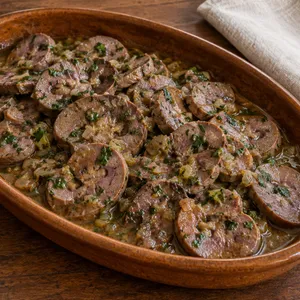
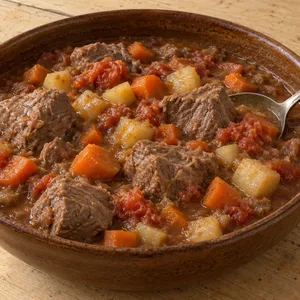
Kitchiner’s neighbors on the page make an odd little Union. Just above the haggis is an Irish stew, “the contribution of Mr. Morrison of the Leinster Hotel, Dublin,” and just below it come minced collops, introduced as “a favourite Scotch dish.”
The recipe is careful in its own way. The quart of stock poured into the bag is made from the beef scraps left from mincing and the water the draught was boiled in, and the recipe glosses its Scots measure: “a choppin (i. e. a quart).” Before the bag is sewn shut, she says, “be sure to put out all the wind,” and “if you think the bag is thin, you may put it in a cloth.”
Read more about this recipe
Making it today
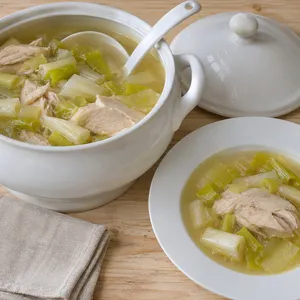
The most consequential choice is ours: a buttered pudding basin replaces the sewn stomach bag, so the haggis is steamed, the way a suet pudding is, without the casing. Heart stands in for the draught, and minced beef for the “pretty large piece of beef” Maciver minced by hand. Every amount is ours, because the recipe has none beyond its handful or two of meal and its choppin of stock. Toasting the oatmeal in a dry pan takes the place of drying it before the fire. Serve it after the Cock-a-Leekie (1861).
Make the haggies-bag perfectly clean; parboil the draught, boil the liver very well, so as it will grate; dry the meal before the fire; mince the draught and a pretty large piece of beef very small; grate about half of the liver; mince plenty of the suet and some onions small; mix all these materials very well together, with a handful or two of the dried meal; spread them on the table, and season them properly with salt and mixed spices; take any of the scraps of beef that is left from mincing, and some of the water that boiled the draught, and make about a choppin (i. e. a quart) of good stock of it; then put all the haggies meat into the bag, and that broth in it; then sew up the bag; but be sure to put out all the wind before you sew it quite close. If you think the bag is thin, you may put it in a cloth. If it is a large haggies, it will take at least two hours boiling.
N.B. The above we copied verbatim from Mrs. Maciver, a celebrated Caledonian Professor of the Culinary art, who taught and published a book of Cookery at Edinburgh, A.D. 1787.
Recipe makes: One 1.5 litre pudding, 6 servings
Ingredients
For One 1.5 litre pudding, 6 servings. Quantities are shown as written.
Quantities as written here, for One 1.5 litre pudding, 6 servings.
- Beef or lamb heart, trimmed250 g
- Water, for simmering the heart and liver1.5 l
- Lamb or beef liver150 g
- Pinhead oatmeal100 g
- Minced beef250 g
- Shredded beef suet100 g
- Onion, finely chopped100 g
- Salt1 tsp
- Ground black pepper1/2 tsp
- Ground allspice1/4 tsp
- Unsalted beef stock250 ml
- Butter, for the basin10 g
Measurement notes
Ingredients as written here
- 250 g beef or lamb heart, trimmed
- 1.5 l water, for simmering the heart and liver
- 150 g lamb or beef liver
- 100 g pinhead oatmeal
- 250 g minced beef
- 100 g shredded beef suet
- 100 g onion, finely chopped
- 1 tsp salt
- 1/2 tsp ground black pepper
- 1/4 tsp ground allspice
- 250 ml unsalted beef stock
- 10 g butter, for the basin
Equipment
 Medium saucepan
 Dry frying pan
 Knife and board, or a meat grinder
 Grater
 Large mixing bowl
 Pudding basin, 1.5 litres
 Parchment, foil and string
 Large pot with a lid and a trivet or folded cloth
 Kettle
 Instant-read thermometer
Instructions
Put the heart in the saucepan with the water for simmering the heart and liver. Bring it to a boil, skim, and simmer gently for 30 minutes.
Add the liver and simmer both for 15 minutes more, until the liver is firm all the way through. Lift both out and let them cool until you can handle them.
While they cool, toast the oatmeal in the dry frying pan over medium heat for 3 to 5 minutes, stirring, until it smells nutty and looks a shade darker. Tip it into the mixing bowl.
Mince the heart very small with a knife or put it through the grinder. Grate the liver and add it to the bowl with the heart.
Add the raw minced beef, the suet, the onion, the salt, the black pepper and the allspice to the bowl and mix everything very well with your hands. Pour in the beef stock and mix again; it will be loose and wet.
Butter the basin well with the butter for the basin. Pack in the mixture, leaving about 2.5 cm (1 inch) of space at the top for the oatmeal to swell. Cover with a pleated round of parchment and then a pleated square of foil, and tie them tightly under the rim with string.
Set the trivet in the large pot and stand the basin on it. Pour in boiling water from the kettle to come halfway up the side of the basin. Cover the pot and keep the water at a steady simmer for 2 hours, topping it up with boiling water every half hour.
Lift out the basin, fold back the covers and push the thermometer into the center. It must read at least 160°F (71°C); if not, cover it again and steam for 15 minutes more before you check again.
Let the pudding stand for 10 minutes, run a knife around the edge and turn it out onto a warm plate. Serve hot, in wedges or spoonfuls.
Nutrition
400calories per serving
- Recipe makes
- One 1.5 litre pudding, 6 servings
- Servings
- 6
Estimated per serving (6) from USDA FoodData Central values for beef heart, lamb liver, ground beef (80% lean), beef suet, oats, onion and beef broth.
Recipe notes
When adjusting quantities
A double batch needs a 3 litre basin or two 1.5 litre basins; a single larger basin steams about an hour longer, so go by the thermometer.
Notes
Quantities mentioned in these notes don’t change when you adjust the servings.
Our changes: the basin in place of the bag and cloth; heart for the draught, with no lungs; minced beef for the hand-minced piece; prepared beef stock for Maciver’s stock of beef scraps and draught water; toasting in a pan for drying the meal before the fire; a set weight of liver standing for her “about half of the liver”; allspice for her unnamed “mixed spices”; every amount; the thermometer check, which follows the USDA’s 160°F (71°C) for ground meat and organ meats. Neeps and tatties often go with a haggis now; they are not part of this recipe. Chill leftovers within 2 hours and eat them within 3 days, reheated until steaming hot, 165°F (74°C). Contains gluten unless your oatmeal is certified gluten-free.
Scaling changes the ingredients only; pan sizes and cooking times need their own judgment. To adapt this recipe further, try the recipe tool at TuneMyRecipe (opens in a new tab), our sister site.
Sources and attribution
After Mrs. Maciver (Edinburgh, 1787), as printed in William Kitchiner, The Cook’s Oracle, fourth edition (London, 1822), A good Scotch Haggies, No. 488*
See the original pages (scan at Internet Archive) (opens in a new tab)
Recipe details
- Course
- Main course
- Dish family
- Pies & Savory Puddings
- Region
- Scottish
- Era
- 19th century
- Source decade
- 1820s
- Main ingredient
- Beef
- Difficulty
- Intermediate
- Occasion
- Dinner party
- Season
- Winter