Cock-a-Leekie (1861)
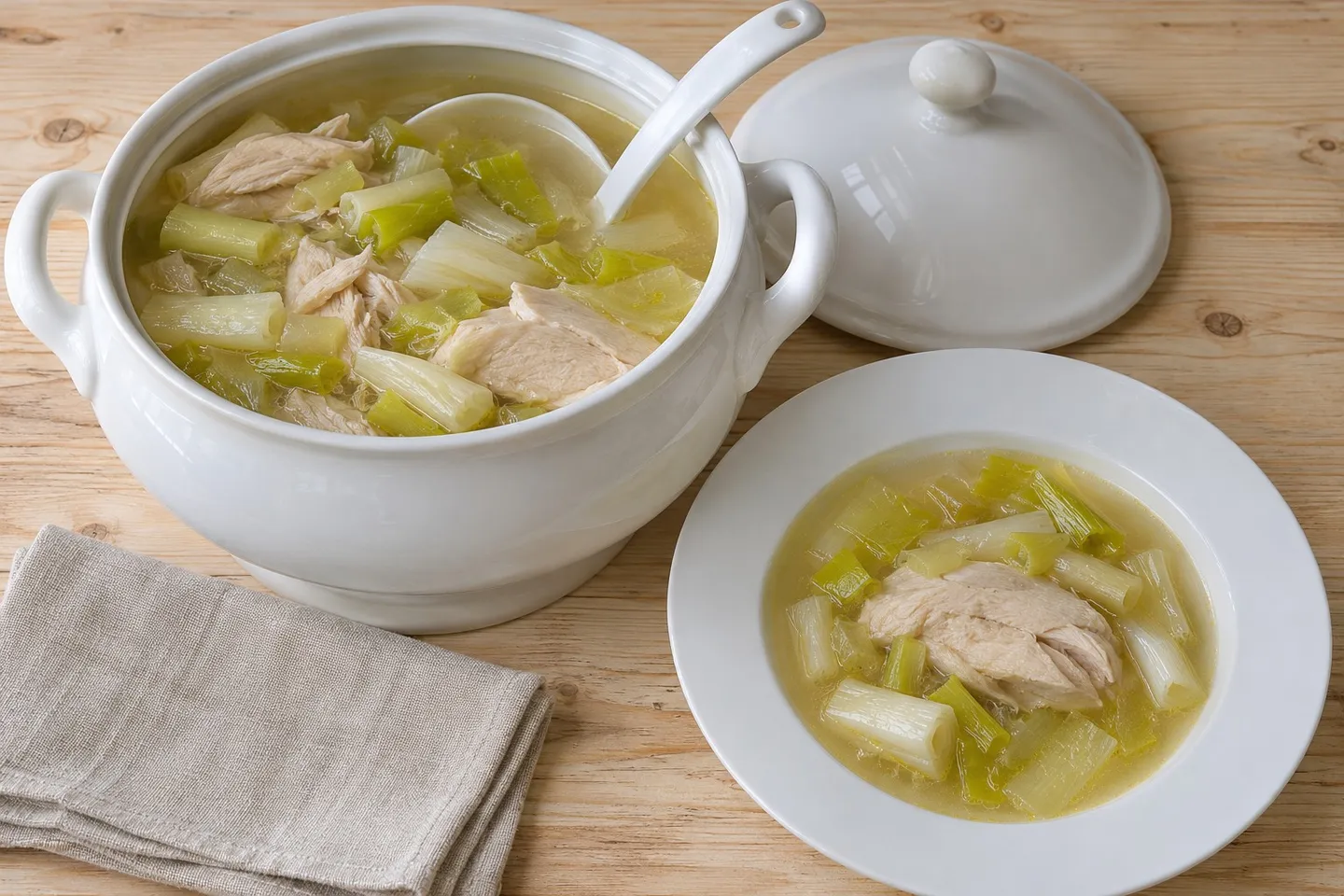
Reader ratingsIsabella Beeton’s 1861 cock-a-leekie: a whole fowl simmered in beef stock with leeks added in two lots, carved into the tureen,, the soup very thick of leeks.
- Recipe makes
- About 2 litres of soup with the chicken, 6 servings
- Prep
- Cook
- Total
Beeton gave an old fowl 3 to 4 hours. A modern roasting chicken is cooked through in about 1¼ hours of gentle simmering; the leeks then get about 20 minutes more on their own while the chicken comes off the bone.
Cock-a-leekie in a tureen, thick with leeks and carved chicken.
The story behind the recipe
The name comes from the bird. Isabella Beeton’s cock-a-leekie of 1861 calls for a capon or large fowl, “sometimes an old cock, from which the recipe takes its name,” simmered for hours with leeks in her beef stock and served in a tureen. It is the soup course of this Burns menu, and the one dish on it with a printed tie to a Burns celebration.
What did Beeton add about 1859?
The accounts of the 1801 supper at Alloway name no soup. Beeton’s recipe, printed in London sixty years later, carries a note at its foot: “Cock-a-leekie was largely consumed at the Burns Centenary Festival at the Crystal Palace, Sydenham, in 1859.” The version given here is her own. The road from the cottage to the centenary is traced in What Was Served at the First Burns Supper?.
The recipe is fowl, leeks, stock, pepper and salt and nothing more, and the leeks go in at two times, half at the start and the rest after half an hour. Take the fowl away, the same note says, and the pot “would then be merely called leek soup,” which she found “very good, and also economical.” Just before it in the book comes her first leek soup, made with a sheep’s head and thickened with oatmeal.
The stock was a production of its own. Her medium stock, no. 105, starts with four pounds of shin of beef or knuckle of veal, lean bacon, onions stuck with cloves, carrots, turnip, celery, mace and herbs, simmered gently for five hours and strained through a fine hair sieve. Made with it, Beeton reckoned the soup at 1s. 6d. a quart, or 1s. with her cheaper stock no. 106; the first is about £9 today by UK consumer prices (Bank of England).
Read more about this recipe
Making it today
Ready-made unsalted beef stock stands in for no. 105; it is our biggest change. A modern roasting chicken replaces the old cock, so the simmer is shorter, and we check the thickest part of the thigh with a thermometer. Six servings come from a smaller batch than Beeton’s ten. The leek course leads on to the meat course of the same menu, the Scotch Haggis Pudding (1822).
COMMONLY CALLED COCK-A-LEEKIE.
134. INGREDIENTS.—A capon or large fowl (sometimes an old cock, from which the recipe takes its name, is used), which should be trussed as for boiling; 2 or 3 bunches of fine leeks, 5 quarts of stock No. 105, pepper and salt to taste.
Mode.—Well wash the leeks (and, if old, scald them in boiling water for a few minutes), taking off the roots and part of the heads, and cut them into lengths of about an inch. Put the fowl into the stock, with, at first, one half of the leeks, and allow it to simmer gently. In half an hour add the remaining leeks, and then it may simmer for 3 or 4 hours longer. It should be carefully skimmed, and can be seasoned to taste. In serving, take out the fowl, and carve it neatly, placing the pieces in a tureen, and pouring over them the soup, which should be very thick of leeks (a purée of leeks the French would call it).
Time.—4 hours. Average cost, 1s. 6d. per quart; or, with stock No. 106, 1s.
Seasonable in winter.
Sufficient for 10 persons.
Note.—Without the fowl, the above, which would then be merely called leek soup, is very good, and also economical. Cock-a-leekie was largely consumed at the Burns Centenary Festival at the Crystal Palace, Sydenham, in 1859.
Recipe makes: About 2 litres of soup with the chicken, 6 servings
Ingredients
For about 2 litres of soup with the chicken, 6 servings. Quantities are shown as written.
Quantities as written here, for about 2 litres of soup with the chicken, 6 servings.
- Whole chicken1.2 kg
- Leeks, trimmed weight800 g
- Unsalted beef stock2.5 l
- Ground black pepper1/2 tsp
- Salt, or to taste1 tsp
Measurement notes
Ingredients as written here
- 1.2 kg whole chicken
- 800 g leeks, trimmed weight
- 2.5 l unsalted beef stock
- 1/2 tsp ground black pepper
- 1 tsp salt, or to taste
Equipment
 Large pot, about 5 litres, with a lid
 Skimmer or large spoon
 Instant-read thermometer
 Tongs, board and knife
 Tureen or warmed soup bowls
Instructions
Trim the roots and the tough dark tops from the leeks, slit them lengthwise and wash out any grit between the layers. Cut them into 2.5 cm (1 inch) lengths and divide them into two equal piles.
Put the chicken, breast up, into the large pot with the beef stock, the black pepper and one pile of leeks. Bring it slowly to a gentle simmer over medium heat, skimming off the foam as it rises, then turn the heat down so the surface barely trembles.
After 30 minutes, add the second pile of leeks. Keep the pot at a gentle simmer, partly covered, skimming now and then, for 45 minutes to 1 hour more, until the thickest part of the thigh reads 165°F (74°C) away from the bone and the juices run clear.
Lift the chicken out onto the board and let it rest for 10 minutes. Meanwhile keep the leeks simmering, uncovered, for about 20 minutes more, until they are very soft and the soup is thick with them.
Carve the chicken or pull the meat from the bones in large pieces, discarding the skin and bones if you like. Taste the soup and add the salt a little at a time.
Put the chicken pieces into the warmed tureen or bowls, pour the hot soup over them and serve.
Nutrition
380calories per serving
- Recipe makes
- About 2 litres of soup with the chicken, 6 servings
- Servings
- 6
Estimated per serving (6) from USDA FoodData Central values for whole roasting chicken (meat and skin), leeks and beef broth.
Recipe notes
When adjusting quantities
Beeton’s quantity, a large fowl in 5 quarts of stock, served ten. A bigger batch needs a pot that holds the bird covered by stock; the simmering time follows the size of the bird.
Notes
Quantities mentioned in these notes don’t change when you adjust the servings.
Beeton’s quantities are a large fowl, two or three bunches of leeks and five quarts of stock, for ten; the chicken weight, the leek weight, the 2.5 litres of stock, the pepper and the starting salt are ours. So are the ready-made stock in place of her no. 105, the shorter simmer for a modern chicken, the 20 minutes of extra simmering for the leeks alone, the rest for the bird and the thermometer reading. If your leeks are old and coarse, Beeton scalds them in boiling water for a few minutes before they go in. Cool leftovers quickly, refrigerate them within 2 hours and eat within 3 days, reheating to a full boil. Contains celery if your stock does.
Scaling changes the ingredients only; pan sizes and cooking times need their own judgment. To adapt this recipe further, try the recipe tool at TuneMyRecipe (opens in a new tab), our sister site.
Sources and attribution
After Isabella Beeton, The Book of Household Management (London: S. O. Beeton, 1861), Commonly Called Cock-a-Leekie, no. 134
See the original pages (scan at Internet Archive) (opens in a new tab)
Recipe details
- Course
- Soup
- Dish family
- Soups & Broths
- Region
- Scottish
- Era
- 19th century
- Source decade
- 1860s
- Main ingredient
- Poultry & game birds
- Difficulty
- Easy
- Occasion
- Dinner party
- Season
- Winter