- Ptolemaic Egypt
- Dinner party
- Antony at Alexandria, c. 41 BC
Antony’s stay with Cleopatra at Alexandria · Alexandria, Egypt · c. 41 BC
Why Were Eight Wild Boars Roasting for Twelve Guests in Alexandria?
Plutarch’s royal cook at Alexandria roasted eight boars for about twelve guests because nobody knew when Antony would want supper. The story and three roasts.
Because nobody in the kitchen knew when Antony would want his supper. In Plutarch’s telling, a young visitor to a royal kitchen at Alexandria saw eight wild boars roasting and asked how many guests were coming. The cook laughed: only about twelve, but every dish had to be at its best, and Antony might call for supper at once and then put it off for a cup of wine or a conversation. So the kitchen kept “not one, but many suppers” going. Plutarch tells the story to show what Antony was doing with his time.
A medical student in the kitchen
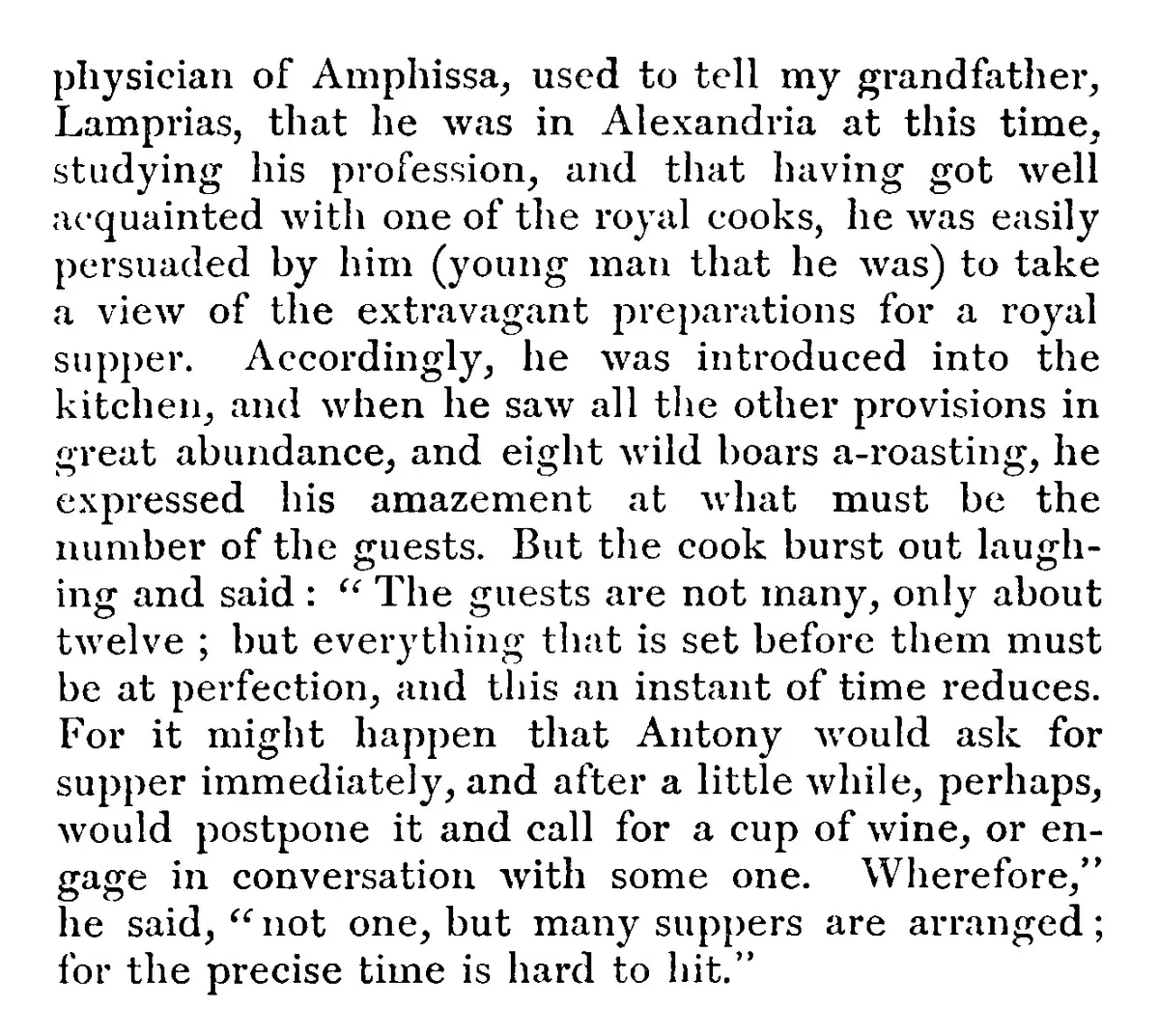
The story comes with its own chain of tellers. In chapter 28 of his Life of Antony, read here in Bernadotte Perrin’s English translation of 1920, Plutarch says that Philotas, a physician of Amphissa, “used to tell my grandfather, Lamprias,” that he had been in Alexandria at the time, studying his profession. He got to know one of the royal cooks, who persuaded him, “young man that he was,” to come and look at the preparations for a royal supper. The page at the top of this article is that passage as Perrin printed it.
So the kitchen reached the page in four steps. A cook explained it to Philotas, Philotas told Lamprias, Lamprias told his grandson, and Plutarch, born about AD 46, wrote it into a Life composed in his later years, well over a century after Antony’s stay. Naming the route is more than many ancient anecdotes offer. It is still a family story, told and retold, and nothing else confirms the visit, the eight boars or the twelve guests.
Eight boars, about twelve guests
What Philotas saw was a kitchen at work: “all the other provisions in great abundance, and eight wild boars a-roasting.” He drew the obvious conclusion and marveled at the size of the party. The cook burst out laughing. In Perrin’s English:
“The guests are not many, only about twelve; but everything that is set before them must be at perfection, and this an instant of time reduces. For it might happen that Antony would ask for supper immediately, and after a little while, perhaps, would postpone it and call for a cup of wine, or engage in conversation with some one.”
“Wherefore,” he went on, “not one, but many suppers are arranged; for the precise time is hard to hit.”
The figure that made Philotas stare is a count of food on the fire at the moment he walked in. It tells nothing about what reached the table. Dividing eight boars among twelve diners sets a kitchen’s stock beside a guest list the cook himself gave only roughly, and the story gives neither weights nor cooking times, and leaves the uneaten boars unaccounted for. Setting roasts going at different times would be one way to have a supper ready at any hour, but the cook never says so. He says only that a roast has a moment of perfection, and that his master keeps moving it.
Time, the costliest outlay
Plutarch puts the story where it does a job. Chapter 28 opens with Antony’s wife Fulvia at war with Octavian at Rome in defense of her husband’s interests and a Parthian army hovering about Mesopotamia, while Cleopatra hurries Antony off to Alexandria. “There, indulging in the sports and diversions of a young man of leisure, he squandered and spent upon pleasures that which Antiphon calls the most costly outlay, namely, time.” Antony and his friends had a club called the Inimitable Livers, and “every day they feasted one another, making their expenditures of incredible profusion.” Philotas and his boars follow, as the example.
Beside that sentence, the cook and the biographer describe the same habit from two ends. Antony spends his hours as he pleases, and the kitchen pays for it by keeping one supper after another ready. The cook’s answer is practical and makes sense of the eight boars; Plutarch’s frame is moral, and the answer serves it. The extravagance is a whole household arranged around a man who keeps no hour.
It is also only one of Plutarch’s Antonys. Earlier in the Life, on the retreat after his defeat at Mutina in 43 BC, Antony faces famine with his army and sets his soldiers an example by “drinking foul water contentedly and eating wild fruits and roots.” The boars belong to a season of leisure. Perrin’s notes date its edges: Antony crossed into Asia in 41 BC, and after leaving Egypt to face the Parthians and the trouble Fulvia had stirred in Italy, he was reconciled with Octavian toward the end of 40 BC.
Where Cleopatra comes in
Cleopatra is all around this story and never in the kitchen. In chapter 26, at their first meeting in Cilicia, she turns down Antony’s invitation to supper and has him come to her instead. He finds “a preparation that beggared description” and is most amazed by the lights, so many of them let down and arranged in rectangles and circles that few sights were as beautiful. The next day Antony returned the feast, “and was ambitious to surpass her splendour and elegance, but in both regards he was left behind,” and he was the first to make fun of how meager and rustic his own arrangements were.
In chapter 29, straight after the kitchen, she plays dice with him, drinks with him, hunts with him and goes along in a serving maid’s clothes on his night rounds of the city, when he stands at the doors and windows of ordinary people and mocks those inside. Plutarch makes her the reason Antony is in Alexandria and the partner of his pleasures. He never shows her giving the cook an order, choosing a dish or eating a slice of boar.
A second story: gold beakers
Philotas had another story, and Plutarch keeps it. As time went on, Philotas became one of the physicians attending Antony’s eldest son by Fulvia and often supped at the young man’s house. One evening he silenced a tiresome doctor with a neat sophism, and the delighted son pointed to a table covered with large beakers and gave him the lot. A slave brought them round in a sack for Philotas to seal, then advised him to exchange them for money, since the boy’s father “might miss some of the vessels, which are of ancient workmanship and highly valued for their art.” Then Plutarch closes the frame he opened: “Such details, then, my grandfather used to tell me, Philotas would recount at every opportunity.”
The beakers are another evening and another host. Set beside the boars, they make a pointed pair: a roast is perfect for an instant and then gone, while old gold plate lasts, and someone notices when it goes missing.
Eight boars at breakfast
Shakespeare kept the numbers and dropped the cook. In Antony and Cleopatra, Maecenas asks Enobarbus whether it is true that eight wild boars were roasted whole at a breakfast for only twelve people, and Enobarbus waves it away as a fly beside an eagle, next to the feasting he could describe. On the stage the boars become a boast about appetite, and the meal moves to the morning. Plutarch’s cook is talking about supper, and the point of his answer is the clock.
The recipes
Plutarch names wild boar and says nothing of how it was cooked, so these two roasts come from later books, and each takes up a different part of the cook’s problem.
- Roast Wild Boar (Apicius): the first boar recipe in the Roman collection known as Apicius, salted with toasted cumin, left until the next day, roasted and dressed with pepper, honey, fish sauce and two grape wines. It was compiled centuries after Antony, and it is still the closest surviving Roman recipe for a roast boar.
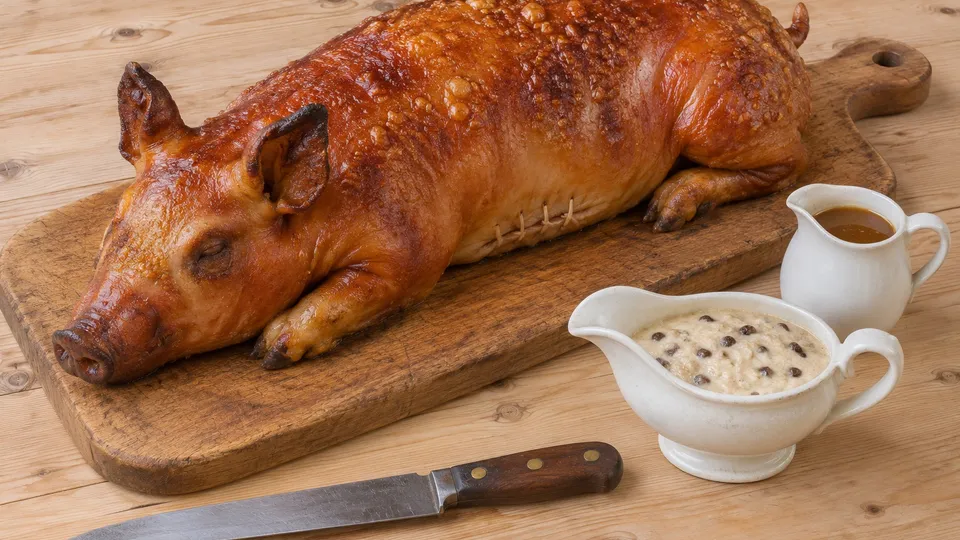
- Roast Sucking Pig (1846): Alexis Soyer’s whole stuffed pig, its paper wrapping taken off ten minutes before the end so the skin browns. A whole animal that is ready at one moment and not long after.
Roman boars could be theater as well as food. At the fictional dinner in Petronius’s novel, a huntsman slashes a boar hung with baskets of dates and live thrushes fly out, as What Was Actually Served at Trimalchio’s Dinner? describes. Soyer, for his part, turns up at the end of What Did a Babylonian Cook Need to Know?, measuring out a stock that older recipes would have left to the cook.
Cooking it
Plutarch’s cook says a roast is at perfection for an instant, and Soyer’s Roast Sucking Pig (1846) puts that instant at the very end, when the skin turns brown and crisp: have the bread sauce warm and the platter ready before the thermometer says the pig is done.
 Cook it todayRoast Sucking Pig (1846)
Sources
- Plutarch, Lives, vol. 9, Demetrius and Antony; Pyrrhus and Caius Marius, trans. Bernadotte Perrin, Loeb Classical Library (London: William Heinemann; Cambridge, Mass.: Harvard University Press, 1920; 1959 reprint), Antony 17, 24 and 26–31, pp. 175, 187, 195–201 and 205. Digitized by the Internet Archive (plutarchslives09plutuoft).
- Apicius, De re coquinaria, ed. Cesare Giarratano and Friedrich Vollmer (Leipzig: Teubner, 1922), 8.1.1, p. 58.
- Alexis Soyer, The Gastronomic Regenerator (London: Simpkin, Marshall & Co.; sold by John Ollivier, 1846), No. 508, p. 204.
- William Shakespeare, Antony and Cleopatra, act 2, scene 2, in Mr. William Shakespeares Comedies, Histories, & Tragedies (London, 1623), the Bodleian First Folio (opens in a new tab).
- “Plutarch,” Encyclopaedia Britannica, britannica.com/biography/Plutarch (opens in a new tab), read 3 November 2026.