Trimalchio’s dinner, in Petronius’s Satyricon · Trimalchio’s house, in an unnamed Italian town · c. AD 60
What Was Actually Served at Trimalchio’s Dinner?
Olives in a bronze donkey’s panniers, sausages on a silver grill, a boar hung with baskets of dates: the food of Petronius’s dinner, and three Roman recipes.
Olives, sausages and dates, dressed up as a show. The first course at Trimalchio’s dinner brought pale green and dark olives in the panniers of a bronze donkey, dormice seasoned with honey and poppy seed, and sausages smoking on a silver grill over plums and pomegranate seeds. Later came eggs made of pastry, a wild boar hung with baskets of dates, a pig that spilled sausages when the cook cut it open, and cakes that squirted saffron water. The dinner is fiction, written about AD 60, but the food on it was Roman food.
A dinner in a novel
The dinner is the best-known part of the Satyricon, a comic novel in Latin by Petronius. Its narrator, Encolpius, and his companions are invited to dine with Trimalchio, a freedman who, in the words of Harry Thurston Peck, “has amassed an enormous fortune and is now enjoying it.” Peck put the dinner into English in 1898. He calls it “one of the great masterpieces of comic literature” and counts it among the best pictures to survive “of the typical life of the Roman bourgeoisie.”
The author is usually taken to be the Petronius whom Tacitus describes at Nero’s court, under the year AD 66. In Peck’s summary he was a man “who turned night into day,” Nero’s arbiter of elegance, who opened his veins when he fell from favor. The identification, Peck writes, “has been almost universally accepted,” because the book belongs to that part of the first century and to that kind of man.
A dog on the wall
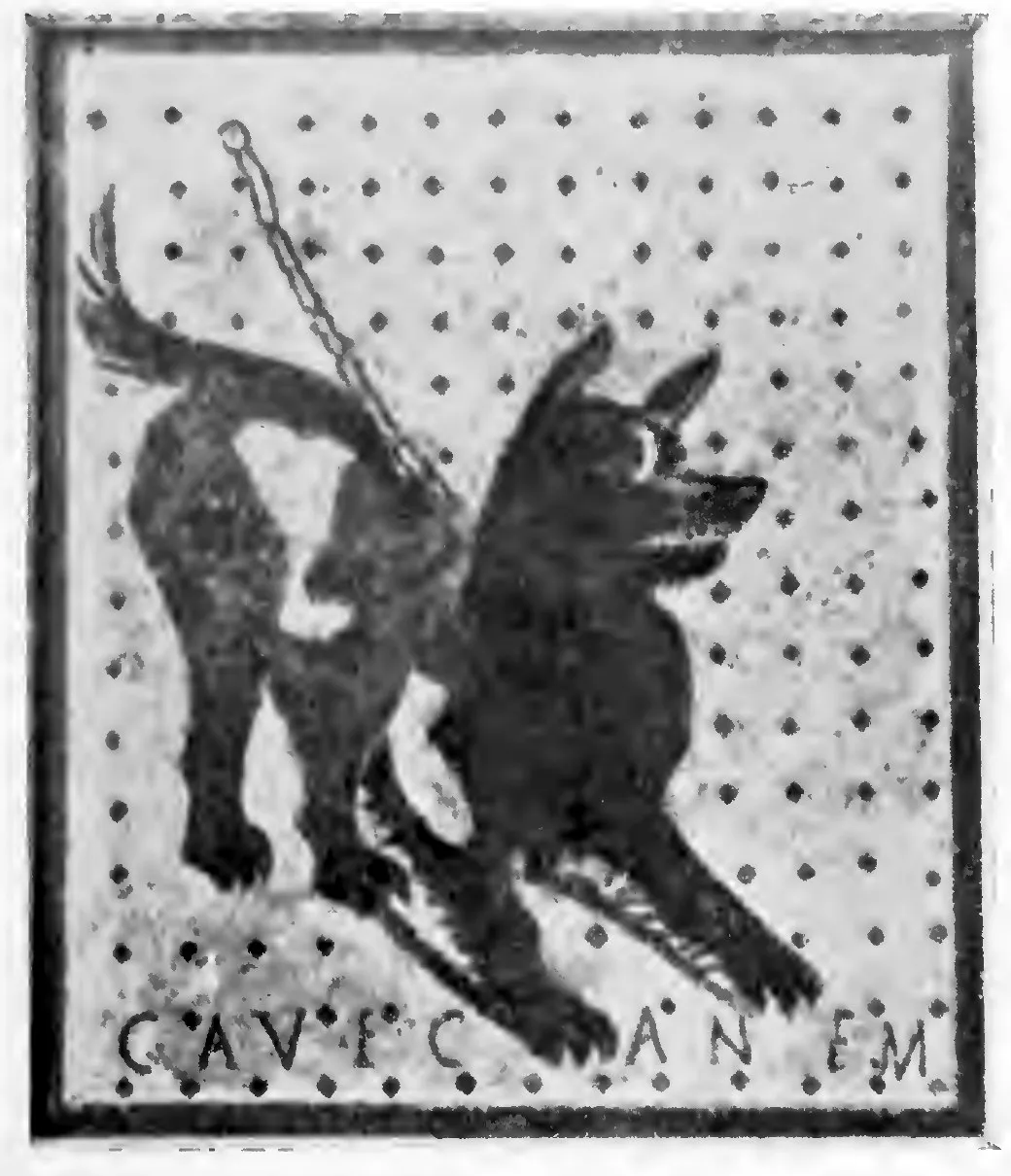
The show starts at the door. Peck’s Encolpius finds the doorkeeper, dressed in green with a cherry-colored belt, “shelling peas into a silver dish,” and a magpie in a golden cage that greets each guest with “How do you do?” On the left, near the porter’s room, he stares up at “a great dog fastened by a chain and painted on the wall,” with “Beware of the Dog!” over it in capitals, and nearly falls over backwards in fright. His friends laugh at him. Peck printed beside the scene a real mosaic dog of the same kind, the chained mosaic dog with CAVE CANEM from Pompeii shown at the top of this page.
Inside, the walls are painted with Trimalchio’s own life: a slave auction, his entry into Rome guided by Minerva, his lessons in arithmetic. The dining room keeps it up. Between courses, two slaves pour wine over the guests’ hands, “for water was not good enough to wash in at that house,” and Trimalchio has given each guest a separate table: “Mars loves a fair field,” he explains, and the slaves won’t overheat everyone by crowding.
Olives, dormice and a silver grill
The guests had taken their places and Trimalchio had not yet arrived when the first dishes came in.
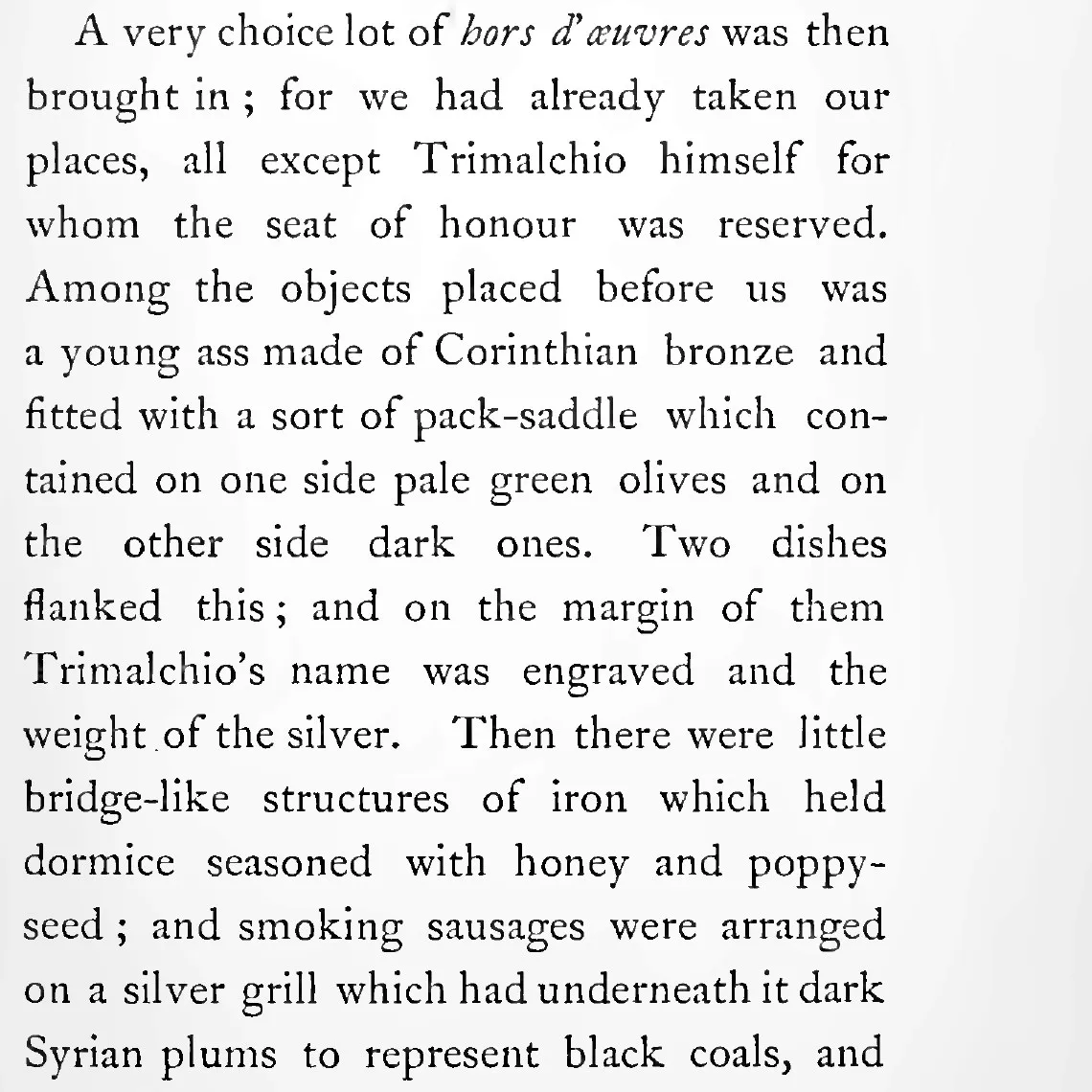 The hors d’oeuvres, in Peck’s translation (1898), p. 81.
Under the grill, Peck goes on, were “dark Syrian plums to represent black coals, and scarlet pomegranate seeds to represent red-hot ones.” Two silver dishes flanked the donkey, each engraved with Trimalchio’s name and the weight of the silver.
The food under the show was familiar. Cicero, writing to a friend a century earlier, recalled how he used to enjoy the friend’s “oleis et lucanicis,” his olives and Lucanian sausages. Dormice had their own recipe in the late Roman collection called Apicius: stuffed, sewn up and baked.
Eggs of pastry
While Trimalchio finished a game of backgammon, played with gold and silver coins for pieces, a wooden hen was carried in on a basket of straw. Two slaves dug out peahens’ eggs and handed them round. The guests broke the shells, “which were made of flour paste,” with spoons that weighed half a pound each. Encolpius almost threw his away, thinking it held a chick, until an old diner-out beside him said there was bound to be something good inside. He found “a plump reed-bird, surrounded by yolk of egg well seasoned with pepper.”
Then came the wine: glass jars sealed with plaster, tagged “Falernian Opimian, one hundred years old.” “Just look; here’s genuine old Opimian,” says Trimalchio, adding that the people he had entertained the day before were socially very much superior to his present guests.
The boar and its baskets of dates
Hunting nets were hung along the couches, Spartan hounds ran round the table, and the main dish arrived.
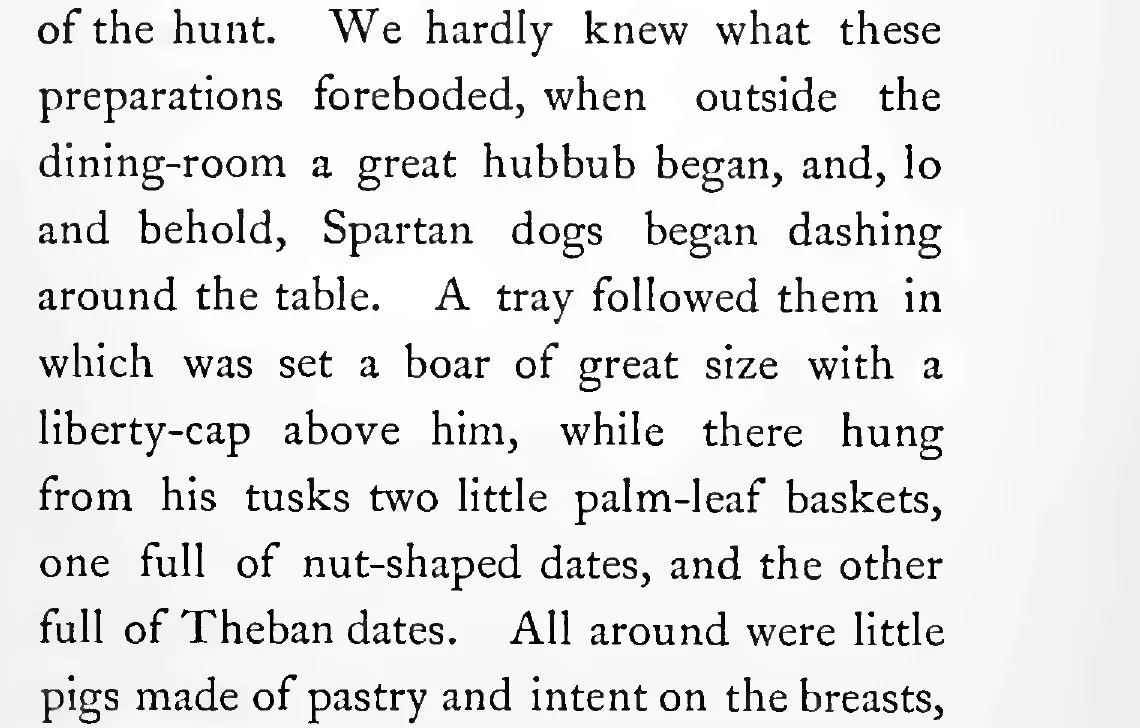 The boar course, in Peck’s translation (1898), p. 97.
A bearded huntsman slashed its side with a hunting knife, “till out of the gash live thrushes flew forth,” to be caught by bird-catchers with long rods. Then the slaves took the baskets from the tusks and gave out the dates to music. The pastry piglets were keepsakes for the guests to take home.
Later a whole pig came in, and Trimalchio declared it had not been gutted. He had the cook stripped for a flogging, let the guests beg him off, then had him draw the pig at the table. The cook cut into it “this way and that way with a careful hand,” and “sausages of various kinds came tumbling out.” Near the end came a tray of cakes around a confectionery Priapus; every cake and apple, pressed, “squirted forth saffron-water into our faces.”
What a late guest had eaten
The plainest food at the dinner comes from a late arrival. Habinnas, a stonecutter, walks in “about half seas over,” straight from a funeral dinner at another house that evening, and Trimalchio asks what they had. Pork, cheesecakes and chicken livers, says Habinnas, beets and “graham bread” (Peck’s word for a coarse loaf), tarts in hot honey, a piece of bear, “pot-cheese, and jelly, and snails, and a dish of heart and liver, and eggs and turnips.” There were “also offered to us in a dish pickled olives, of which some one who had no manners took three fistfuls.”
No bronze donkeys and no live thrushes: pork, eggs, cheese, olives and a sweet in honey.
The recipes
The novel names dishes but gives no recipes. These three come from Apicius, the Roman cookbook usually dated to the fourth century AD, in the Latin edition of Cesare Giarratano and Friedrich Vollmer (1922). The translations are ours.
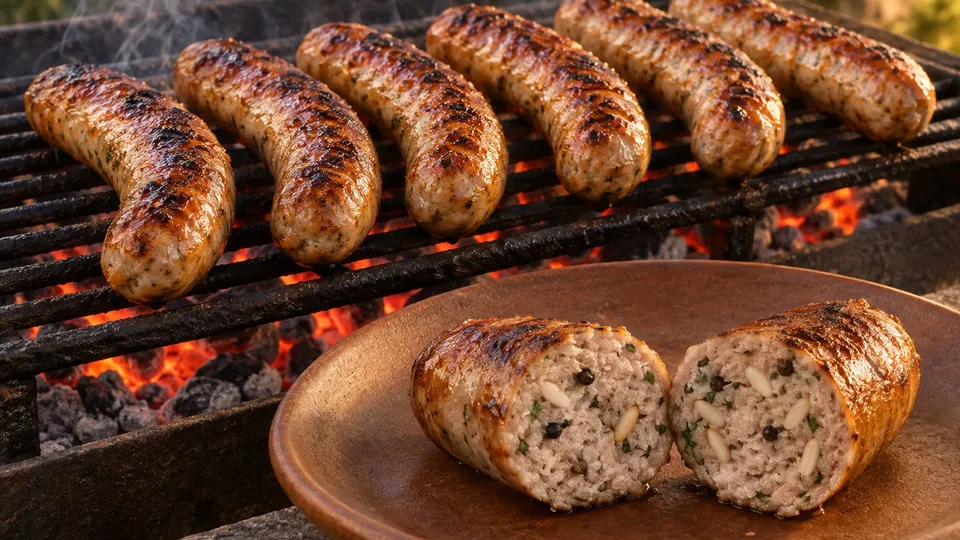
- Lucanian Sausages (Apicius): meat pounded with pepper, cumin, savory, rue, parsley and bay, with fish sauce, whole peppercorns, fat and pine nuts, for the sausages on Trimalchio’s silver grill.
- Honey Sponge Eggs (Apicius): eggs beaten with milk and a little oil, set in a pan, turned out and soaked with honey and pepper, a Roman egg dish peppered like the yolks in Trimalchio’s pastry eggs.
- Stuffed Dates in Honey (Apicius): dates stoned and filled with walnuts, pine nuts or ground pepper, touched with salt and fried in honey, for the baskets on the boar’s tusks.
The olives can be any good mixed olives, or Cato’s chopped relish of green and dark olives, Epityrum, Olive Relish (Cato).
Cooking it
Apicius hangs his sausages in the smoke to cure; we cook them fresh on the grill and bring them to the table on it, as Trimalchio’s were served. The dates keep for a day, so they can be made first, and the sponge eggs go in the pan last and come to the table warm. For bread and beans on the side, the Roman counter food of What Did Pompeii Buy at the Street Counter? belongs to the same century.
Start with the Lucanian Sausages (Apicius) in the morning: they take an hour of work and two hours in the refrigerator before they meet the grill. The sausages, the sponge and the dates are among our Roman recipes. For what went into the cups, Trimalchio’s honeyed wine and his doubtful Opimian, Forgotten Drink, our sister site, asks how Roman wine tasted (opens in a new tab), salted, resinated or thick with age.
 Cook it todayLucanian Sausages (Apicius)
Sources
- Petronius Arbiter, Trimalchio’s Dinner, trans. Harry Thurston Peck (New York: Dodd, Mead, 1898), pp. 45–48, 62–64, 76, 81–86, 97–98, 119–120, 141 and 153–156. Digitized by the Internet Archive (trimalchiosdinne00petr).
- Apicius, De re coquinaria, ed. Cesare Giarratano and Friedrich Vollmer (Leipzig: Teubner, 1922), 2.4, 7.13.1, 7.13.8 and 8.9, pp. 15, 54, 55 and 69.
- Pliny, The Natural History, vol. 3, trans. John Bostock and H. T. Riley (London: Bohn, 1855), book 14, chapter 6, p. 237.
- Cicero, Letters to Friends 9.16, as cited in Charlton T. Lewis and Charles Short, A Latin Dictionary (Oxford, 1879), under lucanica.