Roast Wild Boar (Apicius)
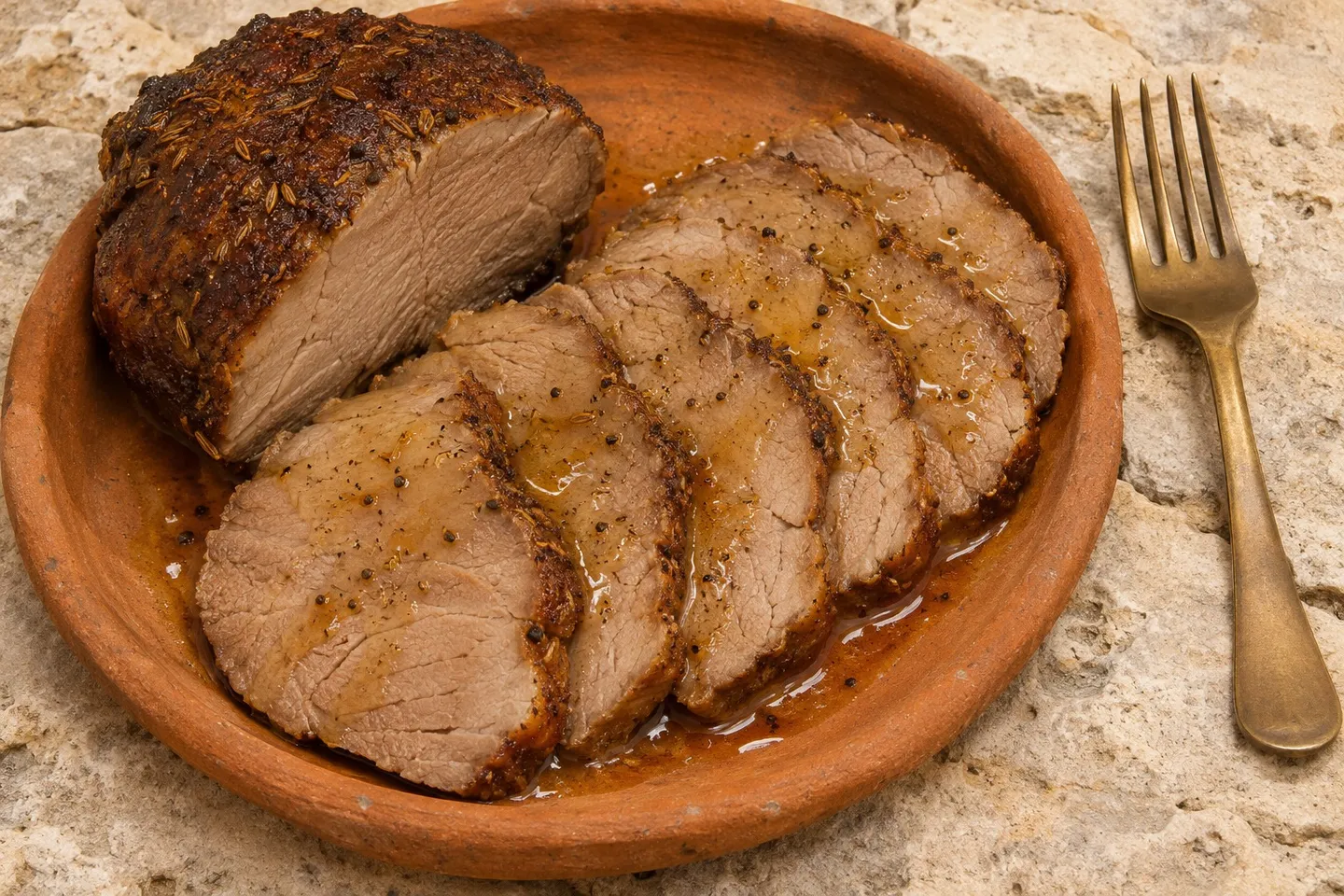
Reader ratingsThe Roman cookbook Apicius’s first boar recipe: a wild boar roast salted with toasted cumin overnight, roasted, then dressed with pepper, honey and grape wines.
- Recipe makes
- 6 servings
- Prep
- Cook
- Total
Includes 12 hours for the salted roast to sit overnight in the refrigerator and a 15-minute rest after roasting. A 1.5 kg boneless leg takes about 1½ to 1¾ hours at 325°F (160°C); the thermometer decides.
Slices of roast wild boar with a cumin crust and a honey and grape dressing.
The story behind the recipe
The Roman cookbook that goes under the name of Apicius opens its chapter on boar with a roast, salted with cumin a day ahead and dressed sweet and peppery once it comes out of the oven. Plutarch’s royal cook at Alexandria had eight boars roasting for about twelve guests and left no word on how he seasoned them. This is how a Roman kitchen book, written down much later, went about it.
What else does Apicius do with a boar?
Book eight of the collection is headed Tetrapus, four-footed animals, and it opens with boar, ahead of venison, roe deer, beef and veal, kid and lamb, sucking pig, hare and dormice. The boar chapter is a run of recipes and sauces. One boils the meat in seawater with sprigs of bay until it is tender, takes off the skin and sends it to table with salt, mustard and vinegar. Another sauce, of pepper, lovage, oregano, myrtle berries, coriander and onion, is poured over boar cooked in the oven, and the cook is told it serves for every kind of game.
The two wines in the first recipe are caroenum, which Lewis and Short’s Latin dictionary defines as a sweet wine boiled down by a third, and passum, wine made from dried grapes. The collection is usually dated to the fourth century AD, some four hundred years after Antony’s stay in Alexandria, so it shows a Roman book’s way with the same animal, not the palace kitchen’s.
Read more about this recipe
Making it today
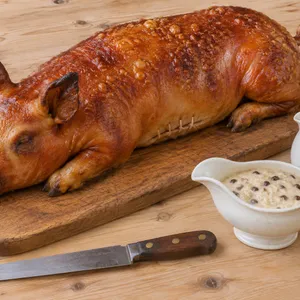
Farmed wild boar is sold as leg and shoulder roasts; we use a boneless leg, rolled and tied, for six. In the 1922 Latin edition of Cesare Giarratano and Friedrich Vollmer the cumin is frictum, toasted, an earlier editor’s correction taken from a later line of the same chapter; the manuscripts read tritum, ground. We toast it and then grind it. Apicius says only that the boar goes into the oven the next day. The oven setting is our choice, and the roast comes out at 160°F (71°C), the temperature the US Department of Agriculture gives for wild pig. Grape saba or molasses stands in for caroenum, and an Italian passito, also made from dried grapes, for passum. Alexis Soyer’s Roast Sucking Pig (1846) is a later whole roast that had to be timed to its moment. Plutarch’s cook and his eight boars open Why Were Eight Wild Boars Roasting for Twelve Guests in Alexandria?
I. IN APRO. 1. Aper ita conditur: Spongiatur, et sic aspergitur ei sal et cuminum frictum, et sic manet. alia die mittitur in furnum. cum coctus fuerit, perfunditur piper tritum, [condimentum aprunum] mel, liquamen, caroenum et passum.
Apicius, De re coquinaria 8.1.1, in the 1922 edition of Cesare Giarratano and Friedrich Vollmer; the editors bracket the words condimentum aprunum, “boar seasoning,” as a note that slipped into the text from the margin. In our translation: “Boar is seasoned like this. It is wiped with a sponge, then sprinkled with salt and toasted cumin, and left so. The next day it goes into the oven. When it is cooked, it is dressed with ground pepper, honey, fish sauce, caroenum and passum.”
Recipe makes: 6 servings
Ingredients
For 6 servings. Quantities are shown as written.
Quantities as written here, for 6 servings.
Boar
- Boneless wild boar leg roast, rolled and tied1.5 kg
- Cumin seed2 tsp
- Fine sea salt2 1/2 tsp
- Water, for the roasting pan120 ml
Dressing
- Black peppercorns1/2 tsp
- Honey2 tbsp
- Fish sauce1 tbsp
- Grape saba or grape molasses2 tbsp
- Passito or other sweet raisin wine60 ml
Measurement notes
Ingredients as written here
- 1.5 kg boneless wild boar leg roast, rolled and tied
- 2 tsp cumin seed
- 2.5 tsp fine sea salt
- 120 ml water, for the roasting pan
- 0.5 tsp black peppercorns
- 2 tbsp honey
- 1 tbsp fish sauce
- 2 tbsp grape saba or grape molasses
- 60 ml passito or other sweet raisin wine
Equipment
 Small dry skillet
 Mortar and pestle or spice grinder
 Roasting pan with a rack
 Kitchen string
 Probe or instant-read thermometer
 Small saucepan
Instructions
The evening before, toast the cumin seed in the dry skillet over medium heat for 1 to 2 minutes, shaking the pan, until it smells warm and darkens a shade. Let it cool, then grind it in the mortar.
Pat the wild boar leg roast dry all over with paper towels, in place of Apicius’s sponge. Mix the ground cumin with the fine sea salt and rub it evenly over every side of the roast. Set it on a plate, cover it loosely and refrigerate it overnight, about 12 hours.
The next day, heat the oven to 325°F (160°C). Set the roast on the rack in the roasting pan and pour the water into the pan.
Roast for 1½ to 1¾ hours, checking from 1¼ hours, until a thermometer pushed into the center of the thickest part reads 160°F (71°C). If the pan runs dry, add a little more water so the juices don’t burn.
Lift the roast onto a board, cover it loosely with foil and let it rest for 15 minutes.
Meanwhile, grind the black peppercorns coarsely. Skim the fat from the pan juices, pour the juices into the small saucepan and add the honey, fish sauce, grape saba and passito. Warm them over low heat for 2 minutes, stirring, until the honey has melted into the dressing and it just begins to bubble.
Remove the string, slice the boar thickly, scatter the ground pepper over the slices and pour the warm dressing over them. Serve at once.
Nutrition
370calories per serving
- Recipe makes
- 6 servings
- Servings
- 6
Estimated per serving (6) from USDA FoodData Central values for raw wild boar, cumin seed, honey, fish sauce, grape molasses and sweet dessert wine, before cooking.
Recipe notes
When adjusting quantities
For a larger roast, keep the salt at about 1% of the meat’s weight and roast by the thermometer; a thicker roast takes longer.
Notes
Quantities mentioned in these notes don’t change when you adjust the servings.
Our changes from Apicius: a boneless leg roast in place of a whole boar or joint, a measured salt and cumin rub, water in the pan, an oven setting and the thermometer, the pan juices added to the dressing, and the dressing warmed. Apicius gives no amounts for the dressing; ours are a choice. For a dressing without alcohol, use the same amount of unsweetened red grape juice in place of the passito; warming it for 2 minutes does not drive off the alcohol in the wine version. Cook wild boar to 160°F (71°C), as the US Department of Agriculture advises for wild pig. Refrigerate leftovers within 2 hours and eat them within 3 or 4 days. Contains fish (fish sauce).
Scaling changes the ingredients only; pan sizes and cooking times need their own judgment. To adapt this recipe further, try the recipe tool at TuneMyRecipe (opens in a new tab), our sister site.
Sources and attribution
After Apicius, De re coquinaria, book 8, In apro; Latin text ed. Cesare Giarratano and Friedrich Vollmer (Leipzig: Teubner, 1922); our translation
See the original pages (scan at Internet Archive) (opens in a new tab)
Recipe details
- Course
- Main course
- Dish family
- Meat & Poultry
- Era
- Ancient Rome
- Difficulty
- Intermediate
- Occasion
- Dinner party