Roast Sucking Pig (1846)
Reader ratingsAlexis Soyer’s 1846 roast sucking pig: a whole young pig stuffed with sage, onion and egg, browned at the end, with gravy and a bread sauce with currants.
- Recipe makes
- 1 pig, serving 8
- Prep
- Cook
- Total
Includes a 15-minute rest. A 4 kg pig takes roughly 2½ to 4 hours at 350°F (175°C), depending on its shape and your oven; start checking with the thermometer after 2 hours. The onions boil for the stuffing during the preparation.
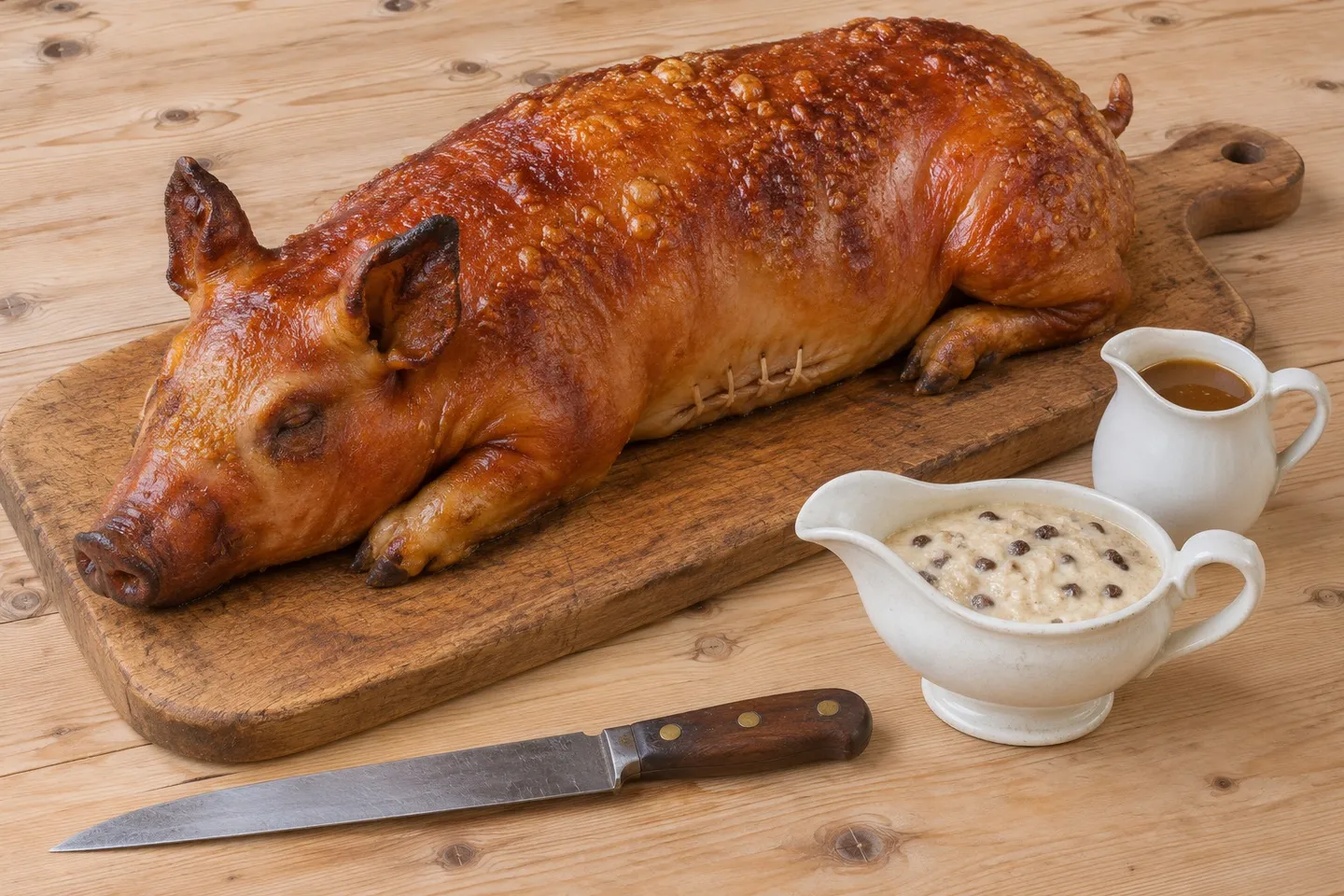
A whole roast suckling pig with gravy and a currant bread sauce.
The story behind the recipe
Soyer roasts his sucking pig in a coat of buttered paper and saves the skin for the last minutes: “ten minutes before it is done take off all the paper to allow it to become brown and crisp.” Before that, the pig is pale and protected; after it, there is a short time when the skin is at its best, the gravy is in the dish and the bread sauce is in its boat, and the head comes off and the pig is split down the back before it goes to table.
A pig from the Kitchen of the Wealthy
The Gastronomic Regenerator, Alexis Soyer’s big book of 1846, is in two parts, the Kitchen of the Wealthy and the Kitchen at Home, and this is No. 508, from the chapter of Removes in the first. Soyer asks for a pig of eight to nine pounds, stuffed “quite full” with boiled onions, sage, thyme, parsley, breadcrumbs and three eggs, sewn up and turned on a spit. He returns to it later in the Kitchen at Home, where a sucking pig is “merely plain roasted (see page 204),” with one warning: before it goes on the spit it must be floured and rubbed very dry, “otherwise the skin would not eat crisp.”
This is a domestic pig, from London, nearly nineteen centuries after Plutarch’s royal cook at Alexandria roasted eight wild boars. It stands in for the cook’s problem only: a whole animal with a moment of perfection, and a kitchen that has to be ready when the diners are.
Read more about this recipe
Making it today
An oven replaces the spit and the moving closer to the fire, and foil rubbed with butter replaces the paper. We fill the pig loosely, where Soyer packs it full, so the heat reaches the center, and any stuffing that won’t fit bakes in a dish beside it. A thermometer decides when the pig is done, since the skin can brown before the stuffing is hot. The amounts for the herbs, salt and butter are ours, as are both sauces: Soyer names plain gravy and bread sauce with currants and gives no measures for either. Have the butcher check that the pig fits your oven before you buy; if none will, the rolled leg of Roast Wild Boar (Apicius) is a far smaller roast. The royal kitchen that brings this pig here, with its eight boars on the fire, is the subject of Why Were Eight Wild Boars Roasting for Twelve Guests in Alexandria?
No. 508. Roast Sucking Pig. Procure a sucking pig of from eight to nine pounds, wash the inside and wipe it well with a dry cloth, prepare the stuffing thus: boil four large onions until quite tender, chop them very fine, with six leaves of sage, a little thyme and parsley, season with a little cayenne pepper and salt, add three tablespoonfuls of bread-crumbs, and mix it with three eggs, stuff the pig quite full, sew up the belly, put it on the spit, place it at a distance from a moderate fire (folded in buttered paper) for half an hour, then put it closer, allowing it two hours to roast, but ten minutes before it is done take off all the paper to allow it to become brown and crisp; serve plain gravy in the dish, and bread sauce with currants in it in a boat; before sending it to table take off the head and cut the pig in halves down the back.
Recipe makes: 1 pig, serving 8
Ingredients
For 1 pig, serving 8. Quantities are shown as written.
Quantities as written here, for 1 pig, serving 8.
Pig
- Oven-ready suckling pig, with its head4 kg
- Fine salt, for the skin6 g
- Unsalted butter, for the skin15 g
- Unsalted butter, for the foil10 g
Sage and onion stuffing
- Onions, peeled (about 4 large)600 g
- Fresh sage leaves6
- Chopped fresh thyme1 tsp
- Chopped fresh parsley2 tbsp
- Cayenne pepper1/4 tsp
- Fine salt, for the stuffing4 g
- Fine fresh breadcrumbs, for the stuffing15 g
- Large eggs3
Gravy
- Unsalted pork or chicken stock240 ml
Bread sauce with currants
- Whole milk240 ml
- Fresh breadcrumbs, for the sauce30 g
- Dried currants20 g
- Unsalted butter, for the sauce15 g
- Fine salt, for the sauce1/8 tsp
Measurement notes
Ingredients as written here
- 4 kg oven-ready suckling pig, with its head
- 6 g fine salt, for the skin
- 15 g unsalted butter, for the skin
- 10 g unsalted butter, for the foil
- 600 g onions, peeled (about 4 large)
- 6 fresh sage leaves
- 1 tsp chopped fresh thyme
- 2 tbsp chopped fresh parsley
- 0.25 tsp cayenne pepper
- 4 g fine salt, for the stuffing
- 15 g fine fresh breadcrumbs, for the stuffing
- 3 large eggs
- 240 ml unsalted pork or chicken stock
- 240 ml whole milk
- 30 g fresh breadcrumbs, for the sauce
- 20 g dried currants
- 15 g unsalted butter, for the sauce
- 0.125 tsp fine salt, for the sauce
Equipment
 Roasting pan with a rack, large enough for the whole pig
 Trussing needle and kitchen string, or skewers
 Aluminum foil
 Two probe thermometers
 Two saucepans
 Small ovenproof dish for any extra stuffing
 Large carving board and carving knife
Instructions
Heat the oven to 350°F (175°C). Pat the suckling pig dry inside and out with paper towels; don’t rinse it. Keep raw-meat boards and knives apart from everything else.
Boil the onions whole in a saucepan of water for 20 to 30 minutes, until quite tender. Drain them well, let them cool enough to handle and chop them very fine.
Chop the sage leaves and mix them with the onions, thyme, parsley, cayenne pepper, the salt for the stuffing and the breadcrumbs for the stuffing. Beat the eggs and stir them in just before the pig goes into the oven.
Rub the skin of the pig with the salt for the skin and then the butter for the skin. Spoon the stuffing loosely into the belly, without packing it, and sew or skewer the opening closed. Put any stuffing that doesn’t fit into the small ovenproof dish, greased with a little of the butter for the foil.
Set the pig on the rack in the roasting pan. Rub a sheet of foil with the butter for the foil and lay it loosely over the pig, buttered side down. Roast for 30 minutes, then take off the foil, keeping small pieces over the ears and snout if they darken fast. Put the dish of extra stuffing in the oven now.
Roast until the center of the stuffing reads 165°F (74°C) and the thickest part of both the shoulder and the leg reads at least 145°F (63°C), away from the bone, about 2½ to 4 hours in all. Take the dish of extra stuffing out when its center reaches 165°F (74°C). If the skin is still pale when the inside is nearly done, raise the oven to 425°F (220°C) for the last 10 to 15 minutes and watch it closely; if it browns too early, cover the dark parts with foil and carry on at 350°F (175°C).
Meanwhile, put the milk, breadcrumbs for the sauce, currants, butter for the sauce and salt for the sauce into the second saucepan and simmer gently for 5 to 8 minutes, stirring, until the crumbs soften into a loose sauce. Keep it warm.
Lift the pig onto the carving board and let it rest for 15 minutes. Skim the fat from the roasting pan, add the stock, scrape up the browned juices and boil for 2 minutes for the gravy.
Remove the string or skewers and spoon the stuffing into a warm dish. Take off the head and cut the pig in half down the back, as Soyer does, or carve it into portions. Pour the gravy into the platter under the pig, as Soyer does, or serve it in a warm jug, with the bread sauce in a sauceboat.
Nutrition
740calories per serving
- Recipe makes
- 1 pig, serving 8
- Servings
- 8
Estimated per serving (8) from USDA FoodData Central values for raw fresh pork with its fat, onion, egg, breadcrumbs, butter, whole milk and currants, counting the edible meat and skin of a 4 kg pig at about half its weight.
Recipe notes
When adjusting quantities
Made for one pig of about 4 kg. A larger pig needs a larger oven and more time; scale the stuffing with it and cook by the thermometer.
Notes
Quantities mentioned in these notes don’t change when you adjust the servings.
Our changes from Soyer: an oven-ready pig of about 4 kg (his eight to nine pounds is 3.6 to 4.1 kg); no washing of the inside; amounts for the onions, herbs, salt, cayenne and butter; the eggs and breadcrumbs as large eggs and 15 g; loose stuffing with any extra baked apart; foil in an oven for buttered paper on a spit; the thermometer and a hot finish if needed for the skin; our own gravy and bread sauce; and carving in portions allowed. Don’t stuff the pig ahead and keep it for later: stuff it just before it goes into the oven. Refrigerate leftovers, stuffing apart from the meat, within 2 hours and eat them within 3 or 4 days. Contains eggs, milk (butter, milk) and wheat (breadcrumbs).
Scaling changes the ingredients only; pan sizes and cooking times need their own judgment. To adapt this recipe further, try the recipe tool at TuneMyRecipe (opens in a new tab), our sister site.
Sources and attribution
After Alexis Soyer, The Gastronomic Regenerator (London, 1846), No. 508, Roast Sucking Pig
See the original pages (scan at Internet Archive) (opens in a new tab)
Recipe details
- Course
- Main course
- Dish family
- Meat & Poultry
- Region
- British
- Era
- 19th century
- Source decade
- 1840s
- Main ingredient
- Pork & ham
- Difficulty
- Advanced
- Occasion
- Dinner party