The first Nobel Prize banquet, Grand Hôtel · Stockholm, Sweden
What Was Served at the First Nobel Dinner in 1901?
The first Nobel Prize dinner, Stockholm 1901: brill in the Norman style, fillet of beef, roast hazel grouse with an Estrée salad, and a Grand Hôtel pastry.
Hors d’oeuvre, then brill in the Norman style, a fillet of beef in the imperial style, roast hazel grouse with an Estrée salad, and a pastry named for the hotel, the Succès Grand Hôtel. Those were the five entries on the menu of the first Nobel Prize banquet, held at the Grand Hôtel in Stockholm on the evening of December 10, 1901, after the first prizes were handed out. The Nobel Foundation keeps the list, with its wines: a Niersteiner of 1897, a Château Abbé Gorsse of 1881, a Champagne in sweet and extra-dry versions, and sherry. What the list doesn’t keep is how any of it was made.
The menu as printed
The Foundation’s transcription of the menu reads:
- Hors d´œuvre
- Suprême de barbue à la normande
- Filet de bœuf à l´impériale
- Gelinottes rôties, salade d´Estrée
- Succès Grand Hôtel, pâtisserie
Every line is in French, in Stockholm. Ulrica Söderlind, the economic historian who wrote a history of the Nobel banquets, has described the early Grand Hôtel menus as extensive and French-inspired, and says they changed character after each of the world wars.
The list gives each course a name and nothing more. Hors d’oeuvre covers whatever small dishes opened the meal, and none is named. Barbue is brill, a flatfish of the turbot family, and a suprême is a choice fillet. À l’impériale names a style of garnish for the beef without saying which. Gelinottes are hazel grouse, small forest birds of northern and eastern Europe, Sweden included, served roast with a salad. The succès closing the meal carries the hotel’s own name, and no description of it has come down with the menu.
Prize day in Stockholm
The first prizes were given on the fifth anniversary of Alfred Nobel’s death, which fell on December 10, 1896, in San Remo. Four of them were presented in Stockholm, in the great hall of the Royal Swedish Academy of Music. The peace prize had its own ceremony in Christiania, now Oslo.
Folke Henschen, then a student and one of the marshals at the ceremony, set down his memories of the day more than seventy years later, first on Swedish radio in 1975 and then in print in 1976. He remembered Crown Prince Gustaf handing out the prizes in place of King Oscar, who had gone to Christiania. Wilhelm Conrad Röntgen came for physics, Jacobus van ’t Hoff for chemistry and Emil von Behring for medicine. The poet Sully Prudhomme was ill, and a French minister received the literature prize for him.
From the hall the company went on to the Grand Hôtel, where the banquet was ready and even the student marshals had places. Henschen recalled many toasts and, in the small hours, two marshals carrying van ’t Hoff around the room in a gold chair. The Foundation places the dinner in the hotel’s Hall of Mirrors and gives the number of guests as 113. By 2016 the banquet, held in Stockholm City Hall, was served to about 1,350 guests. Less certain are the exact count, the fate of the printed card, and a price of 15 kronor a head (about 1,100 kronor today, by Statistics Sweden’s consumer price index), a figure from a Swedish magazine of 2018 that no bill from 1901 has yet confirmed.
The wines
The wines are listed separately, below the food. Niersteiner is a white wine from Nierstein on the Rhine; the 1897 was four years old. Château Abbé Gorsse of 1881 was the oldest vintage on the list. The Champagne, Crème de Bouzy, carries the name of Bouzy, a Champagne village, and came in two versions, doux, or sweet, and extra dry. Xerez is sherry. The list doesn’t say which wine went with which course, or how much anyone drank.
Reading the dishes
No recipe from the Grand Hôtel’s kitchen for any of these dishes has been found. What can be done is to read the names with the cookbooks of the same years, which show what a cook trained in French cooking would have understood by them.
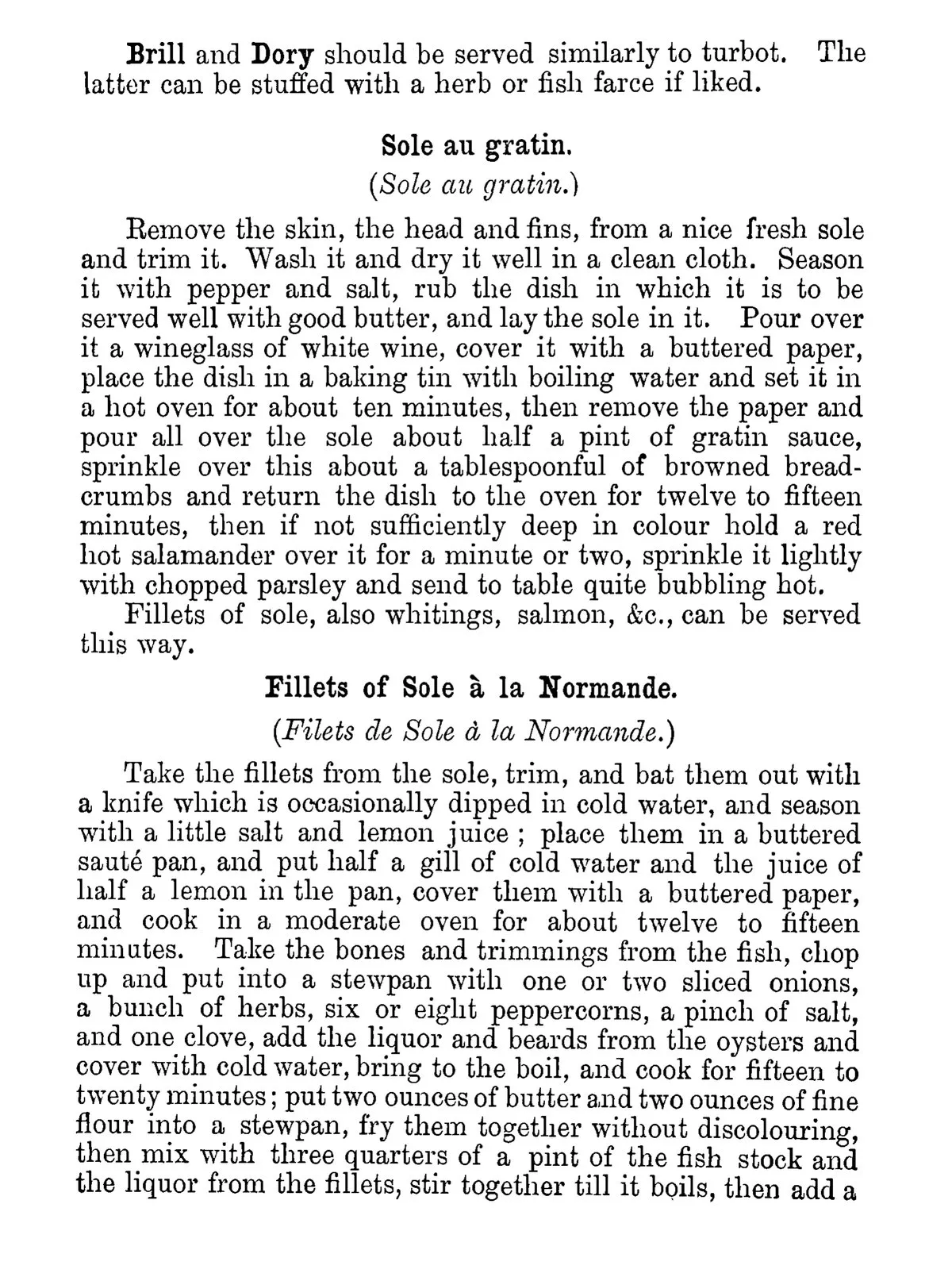
Agnes B. Marshall, who ran a cookery school in London, printed a Norman-style fish for fillets of sole in her Cookery Book, in a copy of about 1894. The fillets are cooked under buttered paper, the sauce is made from a stock of the bones with onion, herbs and the liquor of oysters, and the dish is garnished with oysters, button mushrooms, truffle and lobster. On the same page she notes that brill should be served like turbot, so in her kitchen brill took the same dressings as the larger fish.
Auguste Escoffier’s Le Guide culinaire, published in Paris in 1903, two years after the dinner, covers the game course. His entry for roast hazel grouse runs to one line: the bird must be used fresh, well covered with fat, or barded, and roasted for 15 to 18 minutes. On a page of cold salads he gives a salade d’Estrées of “equal parts of curled white celery and raw truffles,” cut in julienne and dressed with a mustard mayonnaise sharpened with cayenne. The menu spells the name Estrée, Escoffier Estrées. Nothing shows that the Grand Hôtel’s dish matched his, and the hotel’s salad may have been made quite differently. His book does show that a salad by that name could be half truffle.
The beef and the pastry are left out of the recipes here. No beef garnish à l’impériale appears in Escoffier’s 1903 Guide, and the menu doesn’t say what the beef was served with. The Succès Grand Hôtel was the hotel’s own, and nothing in the record says whether it was a cake, a tart or a meringue. Eleven years later, the Titanic’s last first-class dinner ran through a similar sequence, from hors d’oeuvre and fish to a roast bird and a cold salad.
The recipes
The three recipes follow the menu’s order. Each is a cookbook recipe for a dish of the same name and style, from London in the 1890s or Paris in 1903, and none is the Grand Hôtel’s own.
- Fillets of Sole à la Normande (1894): Marshall’s fish in cream sauce with oysters, mushrooms, lobster and truffle, the nearest printed recipe to the menu’s brill.
- Roast Hazel Grouse (1903): Escoffier’s barded and quickly roasted bird, made with Cornish game hens.
- Estrées Salad (1903): celery and black truffle in equal weight, with mustard mayonnaise.
Making the game course
Make the Roast Hazel Grouse (1903) and the Estrées Salad (1903) together, as the menu paired them: cut the celery and set it to curl in iced water before the birds go in, and the salad is ready to dress when they come out to rest. Both are in our Edwardian recipes. The Stockholm list included sherry and Champagne; for how an English household of the same years poured those two at dinner, from sherry with the soup to Champagne until the dessert, Forgotten Drink, our sister site, reads the manuals of the Edwardian country house (opens in a new tab).
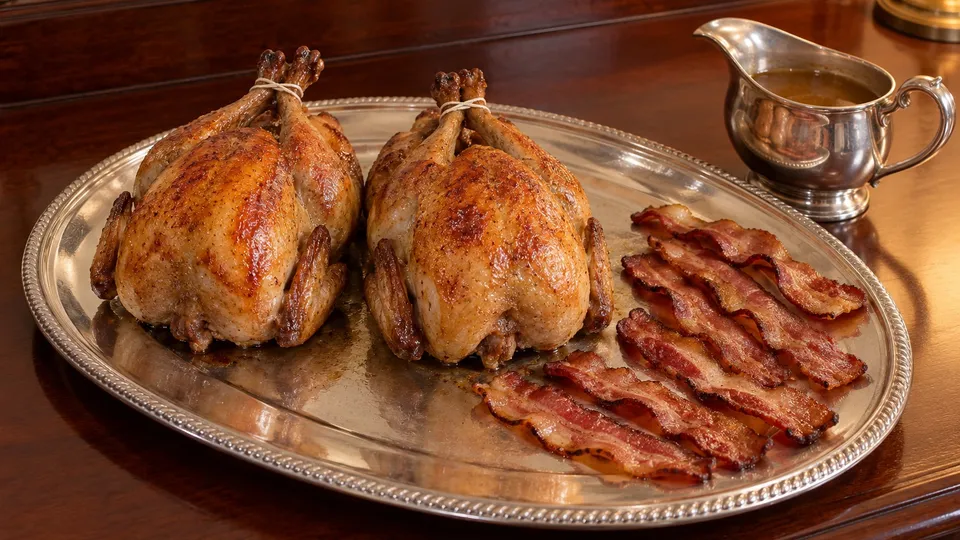 Cook it todayRoast Hazel Grouse (1903)
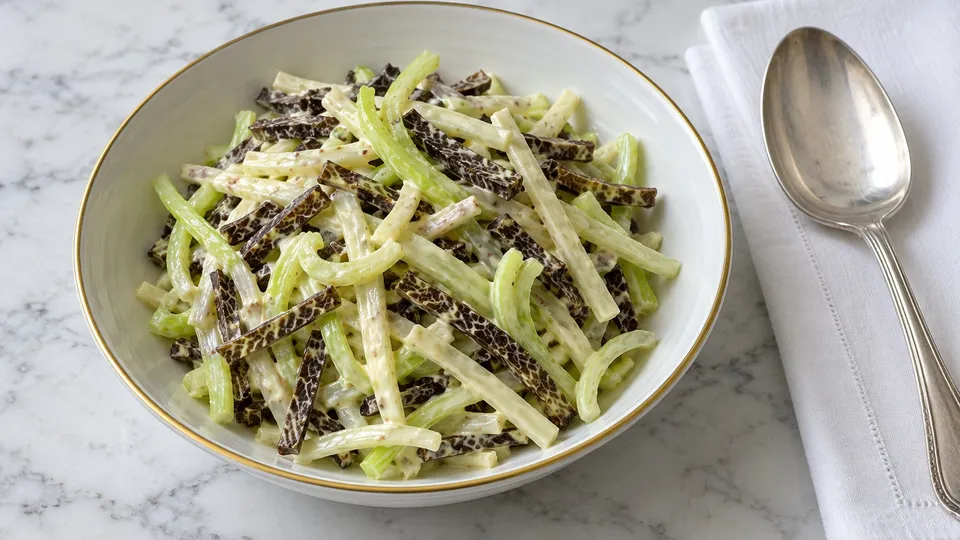 Cook it todayEstrées Salad (1903)
Sources
- Nobel Foundation, “Nobel Banquet Menu 1901,” nobelprize.org.
- Nobel Foundation, Nobel Week 2016: Information for the Media, p. 10.
- Folke Henschen, “From the First Nobel Prize Award Ceremony 1901,” trans. Robert E. Savage, from Recip Reflex 1 (1976), nobelprize.org.
- Stockholm University, “Nobelmiddagen genom tiderna i ny bok på engelska,” press release, 2010.
- Elin Andersson, interview with Ulrica Söderlind, Umeå University, 2022.
- Almar Latour, The Wall Street Journal, December 7, 2000.
- Svensk Damtidning, “Menyerna under årens Nobel,” December 9, 2018.
- Mrs. A. B. Marshall’s Cookery Book, Twenty-fifth Thousand (London: Simpkin, Marshall, Hamilton, Kent & Co., undated, catalogued 1894), pp. 86–87.
- A. Escoffier, Le Guide culinaire (Paris: L’Art Culinaire, 1903), pp. 550, 625–626 and 638–639.
- Statistics Sweden, “Levnadskostnadsindex/KPI (juli 1914=100), historiska tal, 1830–.”