Tamales de Dulce (1893)
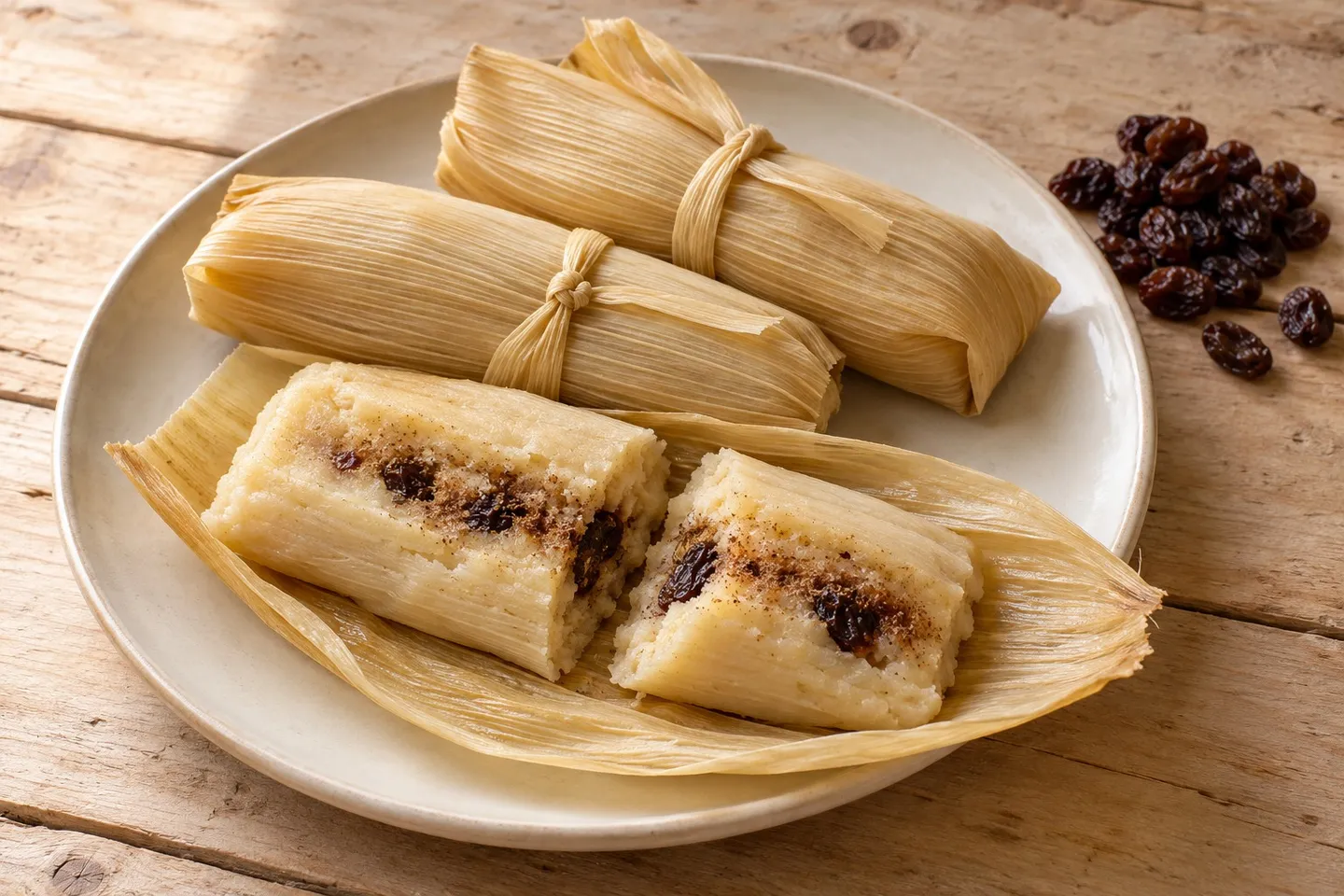
Reader ratingsTamales de dulce, sweet corn tamales from New Mexico: masa beaten until it floats, enriched with lard and sugar, filled with ground cinnamon and raisins, tied in husks and steamed, from Vicenta Labadie de Chaves’s recipe of 1893.
- Recipe makes
- About 16 tamales
- Prep
- Cook
- Total
Soak the husks for at least 30 minutes while you mix and beat the masa. The tamales steam for about 1¼ hours and rest for 10 minutes before unwrapping.
Sweet tamales, one cut open to show raisins and cinnamon in the dough.
The story behind the recipe
These are the sweet tamales of New Mexico as one cook wrote them down in 1893: corn ground into masa, beaten light, sweetened, filled with cinnamon and raisins and steamed in the husk. Vicenta Labadie de Chaves sent the recipe, in Spanish, to Favorite Dishes, the cookbook of the Lady Managers of the World’s Columbian Exposition in Chicago, where it was printed among the desserts under her late husband’s name, “Señora Don Manuel Chaves.”
The whole method
Hers is the only tamale method in the book, and her one-line chile tamales, as we read them, borrow it. It runs in one breath: nixtamal from good white corn, ground “muy remolido,” very fine, then beaten in a bowl and dropped in water until it rises. Only then do lard and sugar go in. The cinnamon and raisins go in the middle of each tamale, and each is wrapped in corn husk, tied, and steamed. She measures nothing and times nothing.
Read more about this recipe
Making it today
We use masa harina made for tamales in place of home-ground nixtamal and choose the amounts ourselves. Her book says “una poca,” a little, for both lard and sugar, and we keep them modest: half a cup of lard to two cups of masa harina is a little leaner than the proportion in the 1903 Landmarks Club Cook Book, and there is no salt, as she wrote it. Her float test comes before the lard. Modern recipes made with masa harina beat the fat in first and test after, the order the Landmarks Club book also used, and we follow them. The sugar goes in after the test, as she has it.
Her savory version, on the same masa, is the Tamales de Chile (1893). What Did the Southwest’s Tamales Look Like in Print? shows where the two recipes sit in the book, 118 pages apart.
Para hacer tamales de dulce se descojo buen mais blanco y se hace nistamal. ...
Recipe makes: About 16 tamales
Ingredients
For about 16 tamales. Quantities are shown as written.
Quantities as written here, for about 16 tamales.
- Dried corn husks20
- Masa harina for tamales2 cups
- Warm water, or as needed2 cups
- Lard, at room temperature1/2 cup
- Sugar1/3 cup
- Raisins1/2 cup
- Ground cinnamon1/2 tsp
Measurement notes
Ingredients as written here
- 20 dried corn husks
- 2 cups masa harina for tamales
- 2 cups warm water, or as needed
- ½ cup lard, at room temperature
- ⅓ cup sugar
- ½ cup raisins
- ½ tsp ground cinnamon
Equipment
- Large bowl for soaking the husks
- Stand mixer or large bowl and wooden spoon
- Cup of cold water for the float test
- Large pot with a steamer insert and a lid
- Kitchen string, if the husk strips tear
Instructions
Soak the corn husks in very hot water in the large bowl, held under with a plate, for 30 minutes or more, until they bend without cracking.
Stir two-thirds of the warm water into the masa harina and knead briefly to a soft, cohesive dough. Let it rest, covered, for 15 minutes.
Whip the lard with a mixer for about a minute, until pale and airy. Add the rested dough in handfuls, then trickle in the remaining water, and go on beating for 5 minutes or so: the masa should turn light and spread as easily as soft frosting. A stiff dough needs another spoonful of water.
Use her float test: a small ball dropped into the cup of cold water should rise to the top. When it sinks, beat for another 2 minutes and test again. Stop at about 10 minutes of beating whatever the test says; a masa that never floats only makes slightly heavier tamales.
Beat in the sugar until it disappears into the dough.
Mix the raisins with the cinnamon. Tear 2 of the husks into thin strips for ties.
For each tamale, set a husk smooth side up with its broad end nearest you. Spread a generous spoonful of masa across the broad half, about 4 inches long and 3 wide, keeping it clear of the edges. Line a few cinnamon raisins along the center, bring the long sides of the husk together so the dough wraps the raisins, turn up the pointed end and tie it with a strip of husk.
Fill the pot with water up to the bottom of the steamer basket. Stand the tamales in the basket on their folded ends, close together so they stay upright, lay the leftover husks over them, cover and bring the water to a boil.
Keep them steaming over medium heat for 60 to 75 minutes, topping up with boiling water as it boils away. They are done when the husk comes off the masa without sticking.
Let them stand off the heat for 10 minutes to set, then peel off the husks and eat the tamales warm.
Nutrition
280calories per serving
- Recipe makes
- About 16 tamales
- Servings
- 8
Estimated per serving of 2 tamales from USDA FoodData Central values for the listed ingredients.
Recipe notes
When adjusting quantities
About 3 tablespoons of masa to each tamale; the husks and the steamer set the practical limit.
Notes
Quantities mentioned in these notes don’t change when you adjust the servings.
Masa harina varies by brand, so go by feel: the mixed dough should be soft and hold together, like modeling clay. If the tamales stick to the husk at the end of steaming, give them 15 minutes more. They keep for 3 days in the refrigerator, or 3 months in the freezer; resteam them in their husks for 15 to 20 minutes, until hot all the way through. Contains no wheat, milk or egg.
Scaling changes the ingredients only; pan sizes and cooking times need their own judgment. To adapt this recipe further, try the recipe tool at TuneMyRecipe (opens in a new tab), our sister site.
Sources and attribution
After Vicenta Labadie de Chaves, in Carrie V. Shuman, comp., Favorite Dishes (Chicago, 1893), Tamales de Dulce
Recipe details
- Course
- Dessert
- Dish family
- Desserts & Sweets
- Region
- American
- Era
- 19th century
- Source decade
- 1890s
- Main ingredient
- Fruit
- Difficulty
- Intermediate