Favorite Dishes, the Lady Managers’ cookbook of the World’s Columbian Exposition · Chicago, Illinois
What Did the Southwest’s Tamales Look Like in Print?
In 1893 Vicenta Labadie de Chaves of New Mexico sent her tamales, in Spanish, to the Chicago World’s Fair cookbook, and half the method landed 118 pages away.
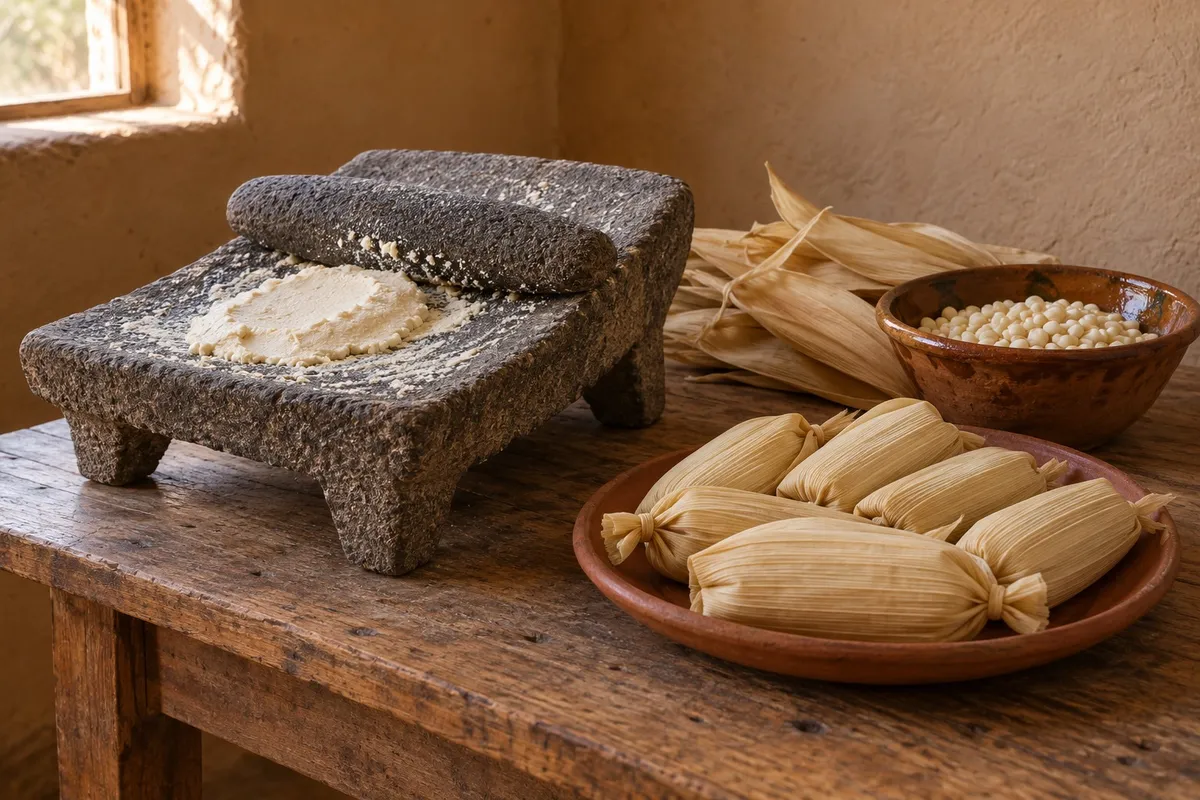
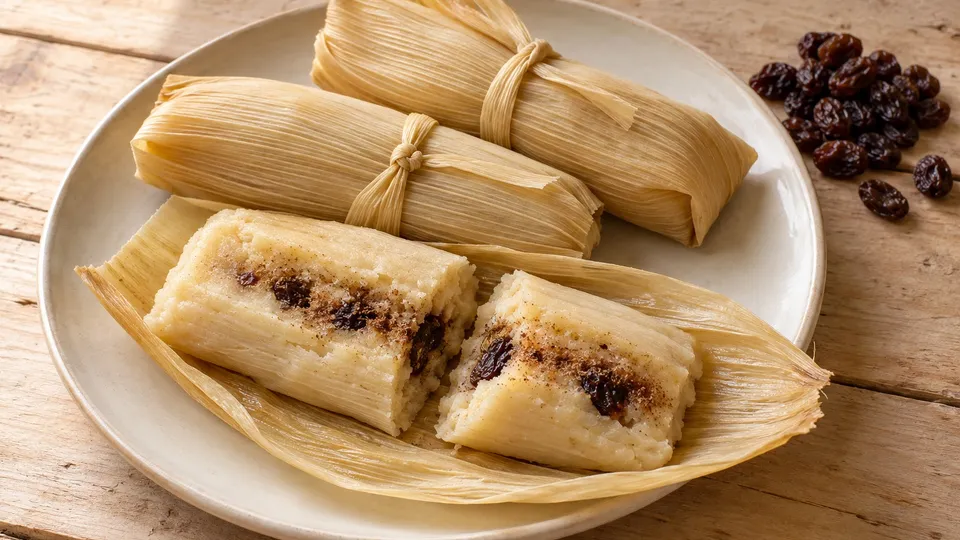
In Spanish, in a few lines, with no amounts and no times. Some of the first New Mexican tamales in print appeared in 1893 in Favorite Dishes, the cookbook of the women who ran the women’s side of the World’s Columbian Exposition in Chicago. They came from Vicenta Labadie de Chaves of New Mexico: white corn made into nixtamal, ground fine on a metate, beaten until a bit of it floated, then wrapped in corn husks and steamed, sweet with sugar, cinnamon and raisins, or savory with meat and chile.
The Lady Managers’ cookbook
The fair opened on May 1, 1893, on the shore of Lake Michigan. Each state and territory chose its own Lady Managers to serve on a national board for the women’s exhibits, and New Mexico, still a territory, sent two. The same year a Chicago woman, Carrie V. Shuman, compiled Favorite Dishes, “A Columbian Autograph Souvenir Cookery Book” of more than three hundred recipes “contributed specially by the Board of Lady Managers.” Under each recipe the book printed a facsimile of its sender’s signature.
Its opening page gives the reason for the book. The Lady Managers had sent their recipes so that the compiler could open “an additional avenue for women to provide the necessary funds to pay the expenses of a visit to the Exposition.” Whether it raised that money, nobody now can say.
Shuman asked the Lady Managers and their friends for recipes, and several New Mexican women answered. Most of the book is in English; one New Mexican contributor wrote hers in Spanish.
Señora Don Manuel Chaves
The four Spanish recipes are headed “From Señora Don Manuel Chaves, of New Mexico.” The name is her husband’s. Manuel Antonio Chaves was a soldier of the territory who made his name fighting the Apache, and he is best remembered for guiding Union troops to the Confederate supply train at Glorieta Pass in 1862; he ended his life ranching in the San Mateo Mountains. He died in 1889, so the heading carries the name of a man four years dead. Under the recipes the book prints a facsimile of her signature, which the historian Cheryl Foote reads as Vicenta Labadie de Chaves.
Her recipes were Pollo con Arroz, chicken with rice; Pollo con Tomates, the same with tomatoes; Tamales de Dulce, sweet tamales; and Tamales de Chile. They are written the way a cook writes for another cook. Nothing is weighed and nothing is timed, and the printed Spanish keeps spellings such as asucar for azúcar and ojas for hojas, though page 72 prints azucar.
Not every newcomer took to her kind of cooking. The journalist Charles Lummis described his first spoonful of chile colorado, which he had taken for stewed tomatoes, and how he ran outside to bite the snow. He came around to it. After eating at the Chaves house he remembered the food on Vicenta’s table as “abundant and very good,” as Foote quotes him.
Foote counts her four recipes among the first New Mexican recipes in print, and among the first published by Hispanic women anywhere in the country. Three years later, in 1896, the War Department’s Manual for Army Cooks printed its own tamales, with the note that the metate “can be purchased at any Mexican store.” It is the same manual that shows army cooks stewing hard bread with salt pork, a generation after the post bakery at Fort Larned on the Santa Fe Trail.
The same, except
The chicken and rice comes first, on page 72, and it is short: boil the chicken until done, fry a little onion with the rice in lard, add whole pepper and the strained broth the chicken cooked in, then the chicken in small pieces, and salt. Pollo con Tomates follows in one line, “Lomismo,” the same, but with tomatoes in place of the rice.
The next line is the chile tamales, and it begins the same way: “Lomismo, con la excepcion que en lugar de echarles azucar, canela y pasas se les echa en el medio carne con chile y sal.” The same, except that instead of sugar, cinnamon and raisins, meat with chile and salt goes in the middle.
Read on the page, that makes no sense. Neither chicken dish has sugar, cinnamon or raisins in it. The recipe the line depends on is the sweet tamales, printed 118 pages later among the desserts, between an orange-basket dessert and a custard, under the same name. The recipe gives no page reference. The contents at the back of the book list both under her name, but apart: the chile tamales among the poultry, with her two chicken dishes, and the sweet ones among the desserts. A reader who knew tamales would fill in the rest; one who didn’t would have to go looking. Put side by side, the two entries make one method with two fillings, and that is how we have read them.
Until the masa floats
The sweet tamale is the whole lesson, and it starts with corn. Choose good white corn and make nixtamal, the corn cooked with lime, cal, that softens the hulls and lets the corn grind into a dough. Wash it until no lime is left and grind it on the metate, the sloping grinding stone, muy remolido, very fine.
Then beat the masa well in a cajete, a bowl, and try a little in water. “Cuando la masa se sube sobre el agua ya esta de punto”: when the masa comes up on the water, it is ready. Only then do a little lard and sugar go in. Ground cinnamon and raisins go inside each tamale, the tamales are wrapped in corn husks and tied, “y ya estan listos para ser cosidos con vapor”: and they are ready to be steamed.
That is all of it. It says nothing about how much corn or lime, how long to cook the nixtamal, how many tamales, or how long to steam them. New Mexican cooks of her day, Foote writes, learned by watching and working beside their mothers, grandmothers and neighbors, with no written recipes to follow.
Ten years later, in Los Angeles
Lummis put together a cookbook of his own. The Landmarks Club Cook Book, published in Los Angeles in 1903 to raise money for saving California’s old missions, opens with a chapter of Spanish-American cookery. Its Mexican tamales follow the same steps with numbers attached: for nine pounds of prepared corn, a pint of warm water, an ounce of salt and two pounds of melted lard, beaten until a little ball of the dough floats, then steamed “for about four hours.” It gives a reason for leaving the corn out overnight, “a good cook prides herself on the whiteness of her tamales,” and an honest verdict: “They are difficult to make well, but are extremely delicate and delicious.”
The order is different from Chaves’s. In the 1903 book the lard goes in before the float test; in hers, after. Its sweet tamales are a one-sentence reference too, the other way around from hers: they “are made in precisely the same way, only that the salt is omitted,” with sugar, raisins, almonds and anise seed worked into the dough. Nothing suggests one was copied from the other.
The same chapter has a dish from the vegetable garden, signed by Miss H. Knickerbocker: Calabacitos con Chile Verde, little squashes with green chile, fried with salt pork and onion, cooked down “very dry,” and finished with a little cream. It isn’t one of hers, and no source puts it beside her tamales, but we serve it with them.
The recipes
Three recipes are Vicenta Labadie de Chaves’s from Favorite Dishes, 1893; the fourth comes from the 1903 Landmarks Club book. The English readings of her Spanish are our own.
- Tamales de Dulce (1893): the sweet tamales that hold the method, with sugar in the masa and cinnamon and raisins inside.
- Tamales de Chile (1893): the same tamale with red chile pork in the middle.
- Pollo con Arroz (1893): boiled chicken folded into rice fried in lard and cooked in the chicken’s broth.
- Calabacitos con Chile Verde (1903): summer squash, corn and green chile with salt pork and a little cream.
Cooking it
Make one batch of masa and split it, so that one dough serves both entries, as we read them. Use masa harina made for tamales in place of homemade nixtamal, beat in the lard until a pinch floats in a cup of water, then sweeten half for the Tamales de Dulce (1893) and fill the rest with chile and meat. Both tamales and the pollo con arroz are among our 19th-century recipes.
 Cook it todayTamales de Dulce (1893)
Sources
- Carrie V. Shuman, comp., Favorite Dishes: A Columbian Autograph Souvenir Cookery Book (Chicago, 1893), title page, preface, pp. 72, 190 to 191, and contents, pp. 214, 220.
- The Landmarks Club, The Landmarks Club Cook Book (Los Angeles: Out West Company, 1903), pp. 3 to 4, 14.
- War Department, Manual for Army Cooks (Washington: Government Printing Office, 1896), pp. 189 to 190.
- Cheryl Foote, “Chiles, Frijoles and Bizcochitos: Recording, Preserving and Promoting New Mexico’s Culinary Heritage,” Tradición (September 2013), pp. 98 to 99 (PDF (opens in a new tab)).
- New Mexico Legislature, House Memorial 110 (opens in a new tab), 2018, on Lt. Col. Manuel Antonio Chaves, and “Chaves, Manuel Antonio, 1818–1889,” Library of Congress Name Authority File, no2002064926.
- “When the World Came to Chicago (opens in a new tab),” Chicago Public Library, April 30, 2018.