Salmon with Scallop Mousseline (1907)
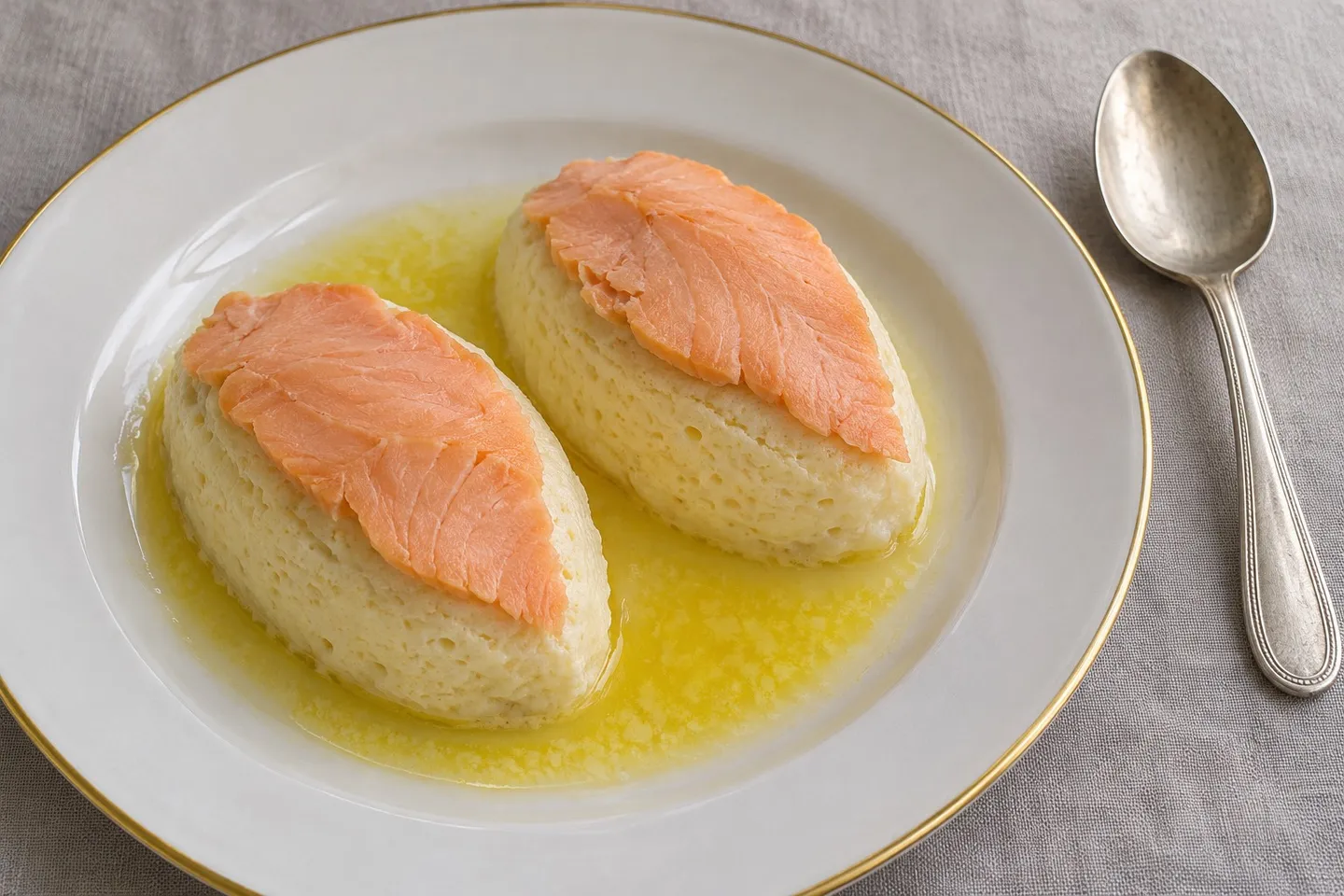
Reader ratingsAfter Escoffier’s 1907 salmon mousselines: spoonfuls of light scallop and cream forcemeat, each topped with a thin slice of salmon and poached in a covered pan.
- Recipe makes
- 16 mousselines, 8 servings
- Prep
- Cook
- Total
Keep the scallops, cream and bowl cold the whole time the forcemeat is being made. The mousselines can be shaped in the pan up to an hour ahead and kept covered in the refrigerator; straight from the refrigerator they may need a few minutes longer in the oven.
Scallop mousselines topped with thin slices of salmon, with melted butter.
The story behind the recipe
Escalope de saumon à la mousse de Saint-Jacques, a “collop of salmon with scallop mousse,” was the fish course on Air France’s Concorde card from Paris to New York in November 1977, second after the foie gras. The card gives no method. This version is put together from Auguste Escoffier’s salmon mousselines in A Guide to Modern Cookery (London, 1907), with scallops in the forcemeat.
Two kinds of mousseline
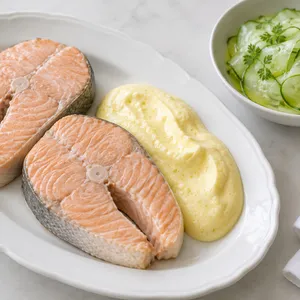
In Escoffier’s kitchen the word did two jobs. A mousseline sauce is hollandaise lightened with whipped cream, the sauce on our Poached Salmon with Mousseline Sauce (1912). A mousseline forcemeat is fish, meat or shellfish pounded to a paste with egg white, rubbed through a sieve and worked on ice with thick cream until it holds its shape. Mousselines made from it, he writes, “are only large quenelles which derive their name from the very light forcemeat of which they are composed,” and they “are always moulded with the ordinary tablespoon.”
His salmon mousselines are topped with “a fine, raw slice” of salmon before poaching. In his Mousseline Alexandra they go into a buttered pan with a thin round of salmon on each and are poached “in a very moderate oven with lid on.” Make the forcemeat of scallops instead, keep the salmon slice on top, and the plate comes close to what the card’s English describes.
Shellfish were no stretch for him. He thought the forcemeat particularly suited to them, and counted it the most adaptable of all his forcemeats, able to stand in for every other kind while none could replace it.
Read more about this recipe
Making it today
A food processor does the work of his mortar, and a sieve is optional. The scallop forcemeat is our choice, following his rule that mousseline forcemeat can be made from shellfish “according to the principles and quantities given above.” His salt, a full ounce to the pound, is far heavier than modern taste; we use much less. Escoffier glazes his Alexandra under Mornay sauce; plain melted butter with lemon, which he lists among the sauces for boiled salmon, keeps the dish lighter. What Did Air France Serve on Concorde to New York in November 1977? reads the whole card, foie gras to fruit.
In Part I. I dealt with the preparation of mousseline forcemeat (No. 195), and also the method of poaching spoon-moulded quenelles (No. 205). Now mousselines are only large quenelles which derive their name from the very light forcemeat of which they are composed. ...
Recipe makes: 16 mousselines, 8 servings
Ingredients
For 16 mousselines, 8 servings. Quantities are shown as written.
Quantities as written here, for 16 mousselines, 8 servings.
- Sea scallops, side muscles removed, well chilled8 oz
- Fine salt, for the forcemeat3/4 tsp
- White pepper1 pinch
- Grated nutmeg1 pinch
- Large egg white, cold1
- Heavy cream, well chilled10 fl oz
- Skinless salmon fillet, well chilled8 oz
- Fine salt, for the salmon1/4 tsp
- Soft butter, for the pan1 tbsp
- Boiling water, to come halfway up, for poaching
- Salt, for the poaching water
- Butter, for the sauce4 tbsp
- Lemon juice2 tsp
Measurement notes
Ingredients as written here
- 8 oz sea scallops, side muscles removed, well chilled
- 3/4 tsp fine salt, for the forcemeat
- 1 pinch white pepper
- 1 pinch grated nutmeg
- 1 large egg white, cold
- 10 fl oz heavy cream, well chilled
- 8 oz skinless salmon fillet, well chilled
- 1/4 tsp fine salt, for the salmon
- 1 tbsp soft butter, for the pan
- Boiling water, to come halfway up, for poaching
- Salt, for the poaching water
- 4 tbsp butter, for the sauce
- 2 tsp lemon juice
Equipment
 Small food processor
 Fine sieve
 Large bowl set over a bowl of ice water
 Rubber spatula
 Small saucepan
 Sharp knife
 Large ovenproof sauté pan with a lid, about 12 inches
 Kettle
- Small bowl of hot water and two tablespoons
 Instant-read thermometer
 Thin, wide spatula
Instructions
Heat the oven to 325°F (160°C). Brush the sauté pan with the soft butter for the pan and set it aside to cool.
Pat the scallops dry. Purée them in the food processor with the salt for the forcemeat, the white pepper and the nutmeg for about 30 seconds, scraping down once, until they form a smooth paste.
Add the egg white and process for 15 to 20 seconds more, until the paste is glossy. For the finest texture, press it through the fine sieve with the rubber spatula.
Scrape the paste into the large bowl set over the bowl of ice water. Work in the heavy cream a little at a time with the spatula, letting each addition be absorbed before the next, until the forcemeat is smooth, pale and soft but holds its shape on a spoon. Keep it on the ice.
Cut the salmon on a slant into sixteen thin, wide slices, about 1/8 inch thick and roughly the size of a mousseline, and season them lightly with the salt for the salmon.
Shape the mousselines: take up a heaped tablespoon of forcemeat, smooth the top with the second spoon dipped in the bowl of hot water, and slide it off into the buttered pan as a neat oval. Make sixteen, set a little apart, and lay a slice of salmon on each.
Bring a kettle of water to a boil. Pour the boiling water for poaching gently down the side of the pan, not over the mousselines, until it comes halfway up them, and season the water with the salt for the poaching water. Put on the lid and poach in the oven for 12 to 18 minutes, until the mousselines have swelled slightly and feel springy, the salmon is opaque, and the center of a mousseline reads 160°F (71°C).
Meanwhile, melt the butter for the sauce in the small saucepan over low heat and stir in the lemon juice.
Lift the mousselines out with the thin spatula, let the water run off, and set them on warm plates; spoon the lemon butter around them and serve at once.
Nutrition
270calories per serving
- Recipe makes
- 16 mousselines, 8 servings
- Servings
- 8
Estimated per serving (8) from USDA FoodData Central values for sea scallops, Atlantic salmon, heavy cream, egg white and butter.
Recipe notes
When adjusting quantities
Escoffier’s mousseline forcemeat takes one pound of fish or shellfish, the whites of two eggs and a pint of thick cream; this batch is half of that, with his imperial half pint of cream read as 10 fl oz. Keep the same proportions for a larger batch and allow two mousselines a person.
Notes
Quantities mentioned in these notes don’t change when you adjust the servings.
Escoffier’s forcemeat is made with one pound of meat, two egg whites and a pint of thick cream, kept on ice. Pouring boiling salted water around the shaped mousselines follows his method for spoon-moulded quenelles (no. 205), and the lid follows his Alexandra. Halving the forcemeat, using scallops, the much smaller amount of salt, the oven temperature (our reading of his “very moderate oven”) and the times are our choices. Escoffier’s own salmon mousseline uses salmon in the forcemeat as well; use 8 oz of salmon in place of the scallops for his version. The 160°F (71°C) in the center is the USDA’s safe temperature for dishes made with raw egg; the salmon slices on top are well past the FDA’s 145°F (63°C) for fish by then. Don’t leave the raw forcemeat out of the refrigerator or off the ice for more than 2 hours; chill leftovers within 2 hours. Contains fish, shellfish, milk and egg.
Scaling changes the ingredients only; pan sizes and cooking times need their own judgment. To adapt this recipe further, try the recipe tool at TuneMyRecipe (opens in a new tab), our sister site.
Sources and attribution
After A. Escoffier, A Guide to Modern Cookery (London, 1907), no. 797, Mousseline de Saumon, no. 798, Mousseline Alexandra, no. 195, Mousseline Forcemeat, and no. 205, Quenelles
See the original pages (scan at Internet Archive) (opens in a new tab)
Recipe details
- Course
- Fish course
- Dish family
- Fish & Seafood
- Region
- French
- Era
- Edwardian
- Source decade
- 1900s
- Difficulty
- Intermediate
- Occasion
- Dinner party