Air France Concorde, Paris to New York · Paris to New York
What Did Air France Serve on Concorde to New York in November 1977?
Air France’s Concorde menu from Paris to New York in November 1977: fresh foie gras, salmon with scallop mousse, chateaubriand, cèpes and Opéra cake.
In the first week of Concorde’s service to New York, Air France offered a seven-course lunch, served on a crossing so short that the route’s opening flight landed at breakfast time. A card headed “De Paris a New York,” which the Musée Air France labels as the first regular flight of 24 November 1977, lists a medallion of fresh foie gras, a collop of salmon with scallop mousse, chateaubriand with green peppercorns, fresh string beans in butter, cèpes sautéed the Bordeaux way, an Opéra cake and fruit. The route itself had opened two days earlier, when Concorde left Paris late in the morning and touched down at Kennedy airport at 8:47, New York time.
Two dates for one card
The card is a single printed page, and we know it from an image the Musée Air France at Roissy-Charles de Gaulle sent us. Our thanks go to the museum and to Dominique Lecomte for sharing the Paris to New York menu of November 1977. The page has no cover, no drinks and no flight number. Its layout matches the food panel of a Concorde menu folder from the same autumn (the Paris to Washington card described below), with the route at the top right and the dishes set low on the page, so it is very likely one panel of a folder whose other panels are missing.
The date comes from the museum, not the card. The title the museum gave that image calls it the Concorde “précurseur,” the forerunner, and the “premier vol régulier,” the first regular flight, Paris to New York, 24 November 1977. Air France’s own history marks the start of the route two days earlier. Its Concorde “inaugurated the Paris-New York service” on 22 November 1977, taking off from Roissy at 11:12 and landing at Kennedy at 08:47, both local times, after New York had kept the aircraft out of Kennedy for about eighteen months over its noise until the courts lifted the ban. The two dates sit together without strain: the 22nd opened the route, and the museum counts the 24th as its first regular service. A card printed for the route could also have flown on both.
Lunch, then breakfast time
The opening flight’s times show what kind of meal this was. Paris was one hour ahead of Greenwich that November and New York five hours behind it, so 11:12 in Paris was 5:12 in the morning in New York. Landing at 08:47 New York time makes the crossing three hours and thirty-five minutes, close to the “3 hr 39 minutes” that Air France gives as Concorde’s Atlantic time. On a late-morning departure, seven courses made a lunch by the clock left behind, and that first flight’s passengers stepped off at a quarter to nine in the morning by the clock ahead.
The New York Concorde left from Roissy. Air France’s catering history ties the founding of its own air kitchen subsidiary, Servair, in 1971 to that new hub; whether Servair dressed this chateaubriand, the history leaves out.
The same history recalls an older idea of luxury in the air. At the end of the 1920s, Air Union ran the Golden Ray, a restaurant plane that “offered a real feast in the sky: seven dishes accompanied by the finest wines.” The experiment was short-lived. Half a century later, Concorde’s card also ran to seven lines.
Seven lines in two languages
The card is bilingual, and its English is worth reading as closely as its French:
- Médaillon de foie gras frais, “medallion of fresh foie gras”
- Escalope de saumon à la mousse de Saint-Jacques, “collop of salmon with scallop mousse”
- Chateaubriand au poivre vert, “chateaubriand with green pepper corn”
- Haricots verts frais au beurre, “fresh string beans in butter”
- Cèpes sautés bordelaise, “sauteed cepe mushrooms Bordelaise fashion”
- Gâteau Opéra, “pastry Opera”
- Fruits, “fruit”
(The card prints the French without accents; they are restored here.) Two lines insist on freshness: the foie gras is frais and so are the beans. The translator reached for “collop,” an old English word for a thin slice of meat or fish, where a modern menu would say escalope. The 1907 English translation of Escoffier uses it as a verb, telling the cook to “collop the cèpes” before they go into the oil.
The cake is the newest thing on the list. Dalloyau, the Paris pastry house, says the Opéra was invented there in 1955: a joconde sponge soaked in coffee syrup and layered with coffee cream and chocolate ganache. On Dalloyau’s dating, the cake was twenty-two years old when it flew. No recipe for it is old enough to reprint, so it stays a description here.
The card names no price and never offers a choice with “or.” Seven lines for a crossing of three and a half hours is a long list, and nothing on the page tells a passenger whether to take everything or to choose.
A different card for Washington
One other Air France Concorde card from the same period is on this site: a Paris to Washington menu at SFO Museum in San Francisco, printed with the code 9/77 and tied by the museum to a flight on 11 August 1978. Its story is told in What Did Concorde Serve on the Way to Washington in 1978? That card also runs to seven lines and also ends with fruit. Every dish between is different: Iranian caviar, truffled duck ballottine, lobster with Sauternes, a rice subric, mushrooms with mashed string beans and an apricot Bavarian cream.
So within a year of each other, passengers to New York and to Washington were offered entirely different meals. Air France may have changed its Concorde menus by route, by season or by week; two cards can’t show which, and no schedule of menus has been found.
The Washington card’s drinks list survives, and this one’s doesn’t, so what was poured with the chateaubriand on the way to New York is unknown.
What Escoffier’s Guide says about the names
The chateaubriand, the beans and the cèpes can all be looked up by name in Auguste Escoffier’s A Guide to Modern Cookery, the English edition of his Guide culinaire published in London in 1907, and the salmon has a near relative there. The Washington card’s introduction promised to keep up French gastronomy, and Escoffier’s book, seventy years older than the flight, is the classic statement of it. What it gives is the meaning of the names.
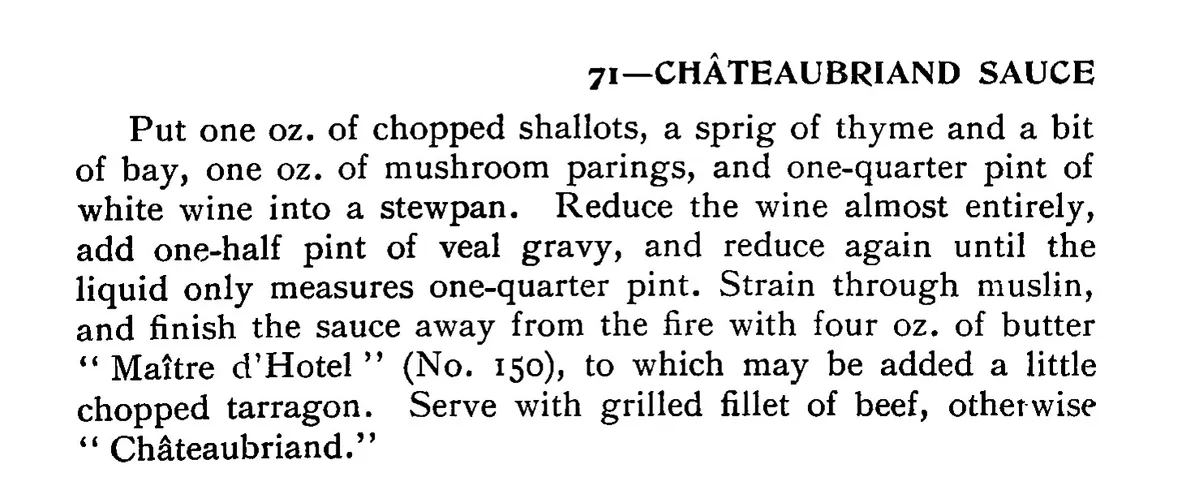
Escoffier’s chateaubriand is cut from the center of the fillet of beef and weighs two or three times as much as an ordinary fillet steak. “As a rule, especially when grilled, it constitutes a special roast for luncheons,” he writes: a lunch dish, as on the card. Its sauce, his no. 71, is shallots, thyme, bay, mushroom parings and white wine reduced almost to nothing, then veal gravy reduced by half and finished off the heat with parsley butter. He singles it out as the sauce for meat garnished with green vegetables. French beans and peas, he says, have “a disintegrating action upon the sauces” served with them, but Chateaubriand sauce “combines admirably with the garnish.” The card set its chateaubriand beside buttered beans.
The green peppercorns are the card’s own. We found none in the 1907 book, only ordinary peppercorns in stocks, marinades and seasonings, so our recipe adds them to his sauce as a labeled change.
His cèpes à la bordelaise are sliced and frizzled in very hot oil, then tossed at the last moment with their chopped stalks, a little shallot and a spoonful of breadcrumbs to drink up the oil, and finished with lemon and parsley. Garlic belongs to a different version, his cèpes à la provençale, two recipes further on.
We found no scallop mousse in the book either, but the method is there. His salmon mousselines are spoonfuls of a forcemeat of pounded fish, egg white and cream, each topped with a thin raw slice of salmon and poached under a lid. Of the forcemeat itself he says it is “particularly suited to preparations with a shell-fish base.”
For the beans, his French beans in butter, cooked until they “seem a little firm to the teeth” and then tossed with fresh butter, are already on this site.
The recipes
Three of the card’s dishes are cooked here from Escoffier’s 1907 text, in the card’s order. The card prints names only, so each recipe says how much of it is his and what we added.
- Salmon with Scallop Mousseline (1907): his salmon mousseline with scallops in the forcemeat, under a thin collop of salmon.
- Chateaubriand with Chateaubriand Sauce (1907): his luncheon roast and its sauce, with the card’s green peppercorns added.
- Cèpes à la Bordelaise (1907): his own recipe for the dish the card names, sautéed cèpes in the Bordeaux style.
The beans in butter are Escoffier’s French Beans (1907), which first appeared on this site with the Sultan of Morocco’s train menu of 1945. The foie gras and the fruit are left as the card gives them.
Cooking it
The Chateaubriand with Chateaubriand Sauce (1907) and Escoffier’s buttered French beans make the card’s center course together, and his own reason for the pairing is the best one: this is the sauce that can meet the beans on the plate without breaking.
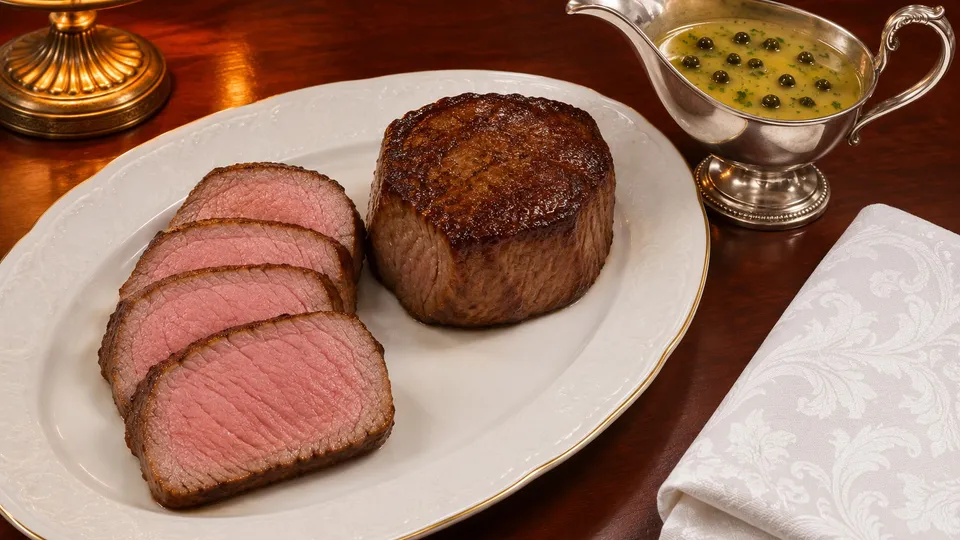 Cook it todayChateaubriand with Chateaubriand Sauce (1907)
Sources
- Menu, Air France, Concorde, “De Paris a New York,” inside page only; Musée Air France, Roissy, labeled by the museum “précurseur” and “premier vol régulier,” Paris to New York, 24 November 1977. Sent to us by Dominique Lecomte by email, 4 November 2026; not reproduced here. No online copy.
- Air France, “The Concorde lands in New York,” corporate history. Air France (opens in a new tab).
- Air France, “Air France, ambassador of the French lifestyle,” corporate history of in-flight catering. Air France (opens in a new tab).
- Menu, Air France, Concorde service, Paris to Washington (printed code 05344, 9/77), SFO Museum, San Francisco, accession 2011.066.058. SFO Museum (opens in a new tab).
- A. Escoffier, A Guide to Modern Cookery (London: William Heinemann, 1907), pp. 35, 56, 79–80, 120–122, 272, 362–364, 633, 650. Internet Archive (opens in a new tab).
- Dalloyau, “The Opéra Cake.” Dalloyau (opens in a new tab).