Air France Concorde, Paris to Washington · Paris to Washington
What Did Concorde Serve on the Way to Washington in 1978?
The Concorde menu from Paris in 1978: caviar, truffled duck, lobster with Sauternes, mushrooms with green beans and apricot Bavarian cream.
An Air France Concorde flying from Paris to Washington offered Iranian caviar, a truffled ballottine of duck, lobster cooked with Sauternes, a rice subric with shredded vegetables, mushrooms with mashed string beans, an apricot Bavarian cream and fruit. The card that lists them belongs to SFO Museum in San Francisco, which ties it to a flight on 11 August 1978. It also makes an unusual offer: to fit the meal to a crossing that, by the Washington airports authority’s count, took under four hours.
A card from the Washington run
Air France and British Airways opened Concorde service in the United States together on 24 May 1976, according to the authority that runs Washington Dulles. The SFO Museum card, accession 2011.066.058, came from the collector G. Robert “Bob” Hamrdla. The museum describes it as paper, ink and string, 11¾ by 8¼ inches, issued for Concorde service on the Paris to Washington route and “dated August 11, 1978.” The same record gives a menu number, 05344, and a printed date, 9/77, which reads as September 1977. That code is not visible in the museum’s two photographs, and a card printed in one year could easily be handed out in the next, so the August 1978 flight is the museum’s attribution and the 9/77 is the printer’s.
The cover looks back to the age of balloons. It reproduces a colored French print of a balloon painted in blue, gold and pink, with a boat-shaped car slung beneath it and pennants flying. The title across the top reads “Projet d’un superbe balon de 120 pieds de diametre qui doit etre enleve a Dijon”: a plan for a superb balloon 120 feet across, to be sent up at Dijon. A key under the picture explains the parts, down to a “Gouvernail de 20 pieds de long en plumes,” a rudder of feathers twenty feet long. The print was sold “chez Basset rue St Jacques” in Paris. It describes a project, and nothing on it says the balloon ever left the ground.
Seven dishes and a cellar
Inside, the right-hand panel is headed “De Paris a Washington” and lists the food, each dish in French capitals with an English line under it:
- Caviar d’Iran, Iranian caviar
- Ballottine de canard truffée, ballotine of duck with truffle
- Homard au Sauternes, lobster with Sauternes wine
- Subric de riz à la julienne de légumes, baked chopped rice and carrots
- Champignons Princesse, mushrooms with mashed string beans
- Bavarois aux abricots, apricot Bavarian cream
- Fruits
There are no prices, and nothing on the card marks the duck and the lobster as either one or the other. The museum’s description calls them “menu choices,” which may well be how the cabin used them, but the page itself sets them down as a single list.
The drinks fill two more panels. Aperitifs and cocktails run from old whisky, gin, vodka, port and bourbon through quinquina, vermouth, an Americano and anise aperitifs to a daiquiri, a white punch, a planter’s punch, a whisky sour, a dry martini, an old fashioned and a Manhattan. Then come Laurent-Perrier’s Cuvée Grand Siècle champagne, a Corton-Charlemagne 1975 as the white, two reds (Château Léoville Las Cases 1973 from Bordeaux and a Clos de la Roche 1969 from Burgundy’s Côte de Nuits), and to finish, Otard X.O. cognac, a J. de Maillac VSOP armagnac, Grand Marnier and a pear eau-de-vie. One wine is missing from the list, and it is the Sauternes. The card puts it in the lobster.
A meal to fit the clock
The left-hand panel speaks in French and English, side by side. Concorde, it says, cuts down time and tiredness, and Air France has tried to keep up French gastronomy while fitting the cabin service to the aircraft and its performance. Then comes the offer: “You may arrange your meal in accordance with your plans at destination and with how rapidly Concorde flies across the time zones.”
Washington’s clocks run six hours behind Paris in August. A westbound flight of under four hours therefore landed, by the clocks on the ground, earlier in the day than it had left.
How the dishes reached the cabin is not on the card. Air France’s own history of its catering says that from 1949 its hot meals were made by the company’s catering department at Orly, carried on board in containers and reheated by the crew in small galleys, and that the jets put an end to long meals: “The age of long feasts was over,” because service time was limited. Neither the museum’s record nor that history gives a loading list, recipe sheet or galley plan for the flight the card is tied to, so how much of the duck, the lobster and the rice was finished in the air is unknown.
Some passengers kept their cards. The Smithsonian’s National Air and Space Museum holds the papers of Virginia D. Martus and Dorothy K. de Silva from an Air France Concorde trip of 28 May 1978, and its finding aid lists menus among the certificates, letters and postcards they brought home.
The names in Escoffier’s book
Almost every dish on the card carries a name from the classic French kitchen, and the English edition of Auguste Escoffier’s Le Guide culinaire, published in London in 1907 as A Guide to Modern Cookery, has most of them. Seventy-one years separate the book from the flight, and nothing says that Air France’s kitchens cooked from it. What the book shows is what the names meant to a trained French cook.
Escoffier’s ballotines of duckling are small parcels: the duck boned, its meat chopped with veal, pork fat, bread panada and egg yolks, enriched with foie gras forcemeat and mushrooms, divided into two-ounce portions, wrapped in pieces of the duck’s own skin, poached in muslin in a stock made from the carcass and glazed. The card’s version added truffle.
He has no lobster “au Sauternes,” though he braises salmon and trout in Sauterne wine and names a Sole au Sauterne and a Sole au Chateau Yquem. His lobster Newburg comes two ways, and he is plain about which suits whom. Lobster cooked beforehand, sliced, warmed in butter, moistened with wine and finished with cream and egg yolks, is “the more correct”; the version from live lobster, which is less trouble, “is more suited to the work of large establishments.”
In Escoffier’s book, a subric is a spoonful of bound spinach dropped into very hot clarified butter and browned on both sides; the sweet one is cooked semolina spread on a tray, cut into rings and browned in butter. The card’s English calls its rice subric “baked.”
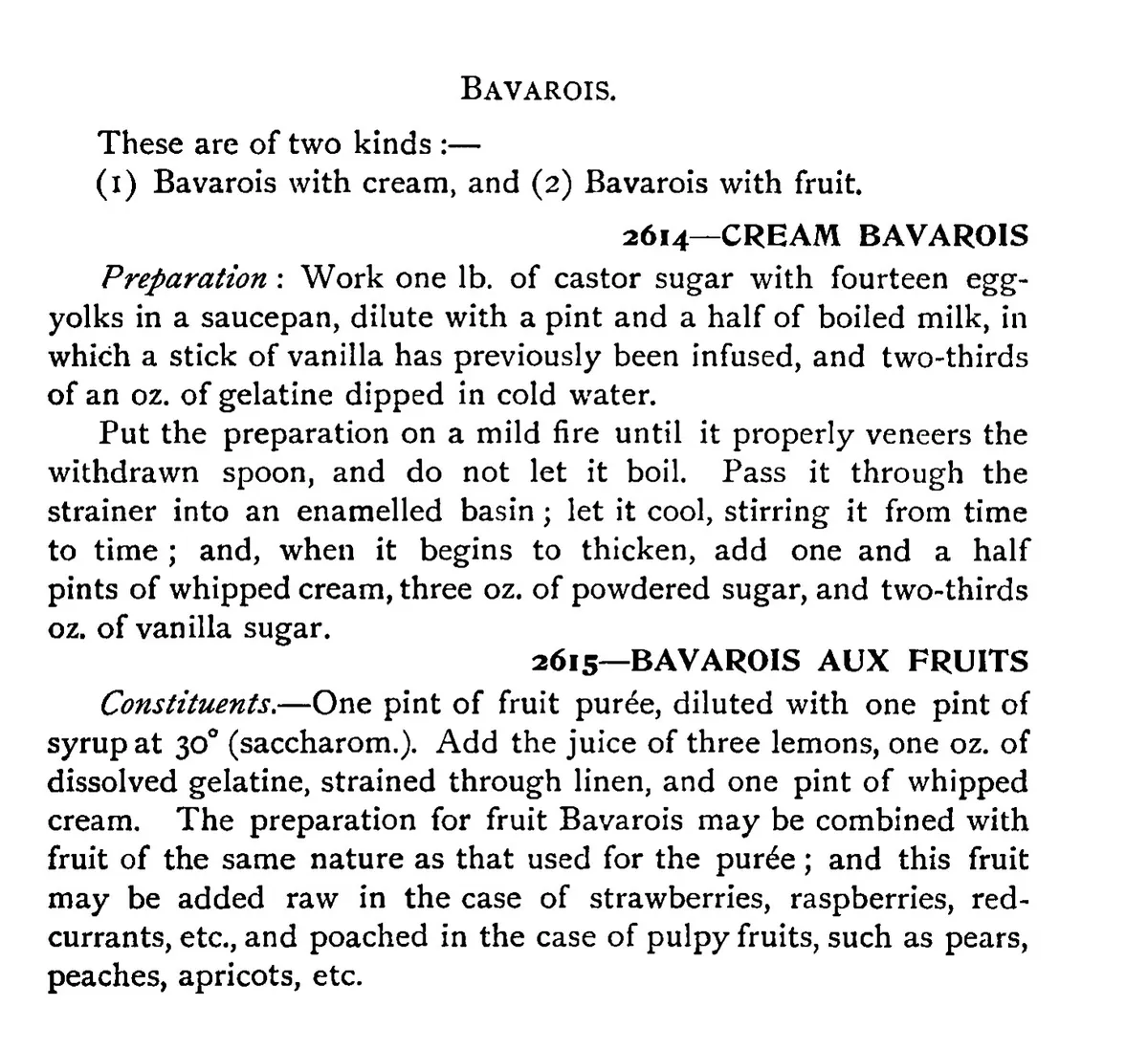
Princesse is the curious one. In Escoffier’s tournedos à la ménagère, the beans to use are “Haricot butter or ‘Princesse,’” which makes Princesse the name of a green bean. That may be why Air France’s mushrooms came with mashed string beans, though the card doesn’t explain itself. For the dessert, his fruit Bavarois names apricots among its fruits, and he allows it to be served in a deep silver dish surrounded with ice: not having to be turned out, “the preparation does not need to be so cohesive, and is therefore much more delicate.”
The recipes
The three recipes follow the order of the card. All three come from Escoffier’s 1907 book; none is Air France’s own, and the first two are put together from his parts.
- Lobster with Sauternes (1907): his Newburg of lobster cooked beforehand, with the card’s Sauternes in place of his Madeira.
- Mushrooms Princesse (1907): his stuffed mushrooms, filled with his purée of French beans and flageolets.
- Apricot Bavarois (1907): his fruit Bavarois made with apricots and set in cups.
The caviar and the fruit need no recipe. The duck is left out because Escoffier’s ballotines need a boned duckling, a panada and a separate foie gras forcemeat before the parcels are even rolled. The subric is left out too: his are fried, the card’s English calls its version baked, and the card gives too little to build on. Escoffier’s book does the same work for the dishes on the Sultan of Morocco’s train menu of 1945, which ended with an apricot ice.
Cooking it
The one detail that makes the Apricot Bavarois (1907) easy at home is Escoffier’s own: set in its cups and never turned out, it can take less gelatin and stay softer, so there is no mold to dip and no moment of doubt over the plate.
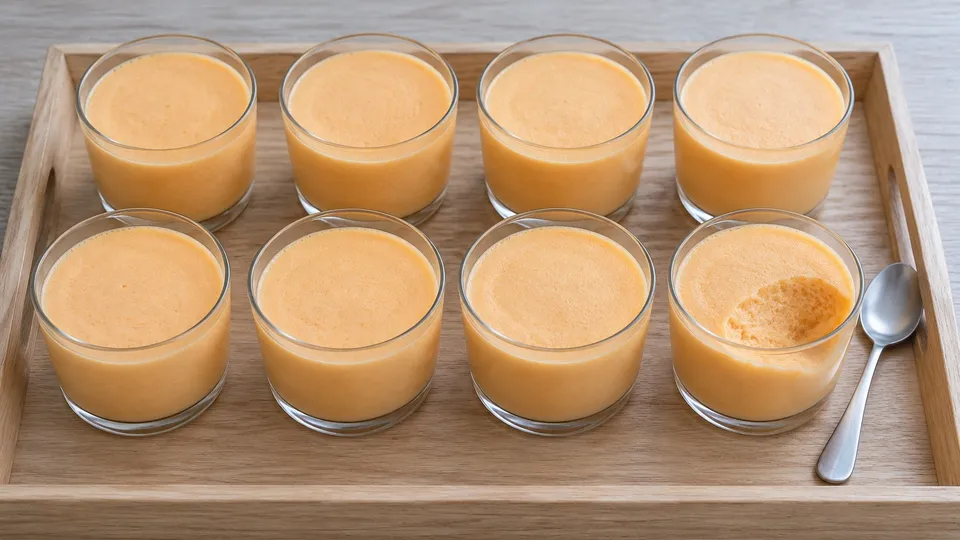 Cook it todayApricot Bavarois (1907)
Sources
- Menu, Air France, Concorde service, Paris to Washington (printed code 05344, 9/77), SFO Museum, San Francisco, accession 2011.066.058, gift of G. Robert “Bob” Hamrdla; catalogue record and museum photographs of the cover and inside spread. SFO Museum (opens in a new tab).
- A. Escoffier, A Guide to Modern Cookery (London: William Heinemann, 1907), pp. 272, 278, 282, 320, 370, 557, 634, 646–647, 650, 741–742, 757–759. Internet Archive (opens in a new tab).
- Air France, “Air France, ambassador of the French lifestyle,” corporate history of in-flight catering. Air France (opens in a new tab).
- Metropolitan Washington Airports Authority, “Air France retires historic aircraft to be housed in new museum” (2003), for the first United States Concorde services and the Paris to Washington flight time. MWAA (opens in a new tab).
- National Air and Space Museum Archives, Air France Concorde Collection (Martus), NASM.2019.0030, finding aid. Smithsonian (opens in a new tab).