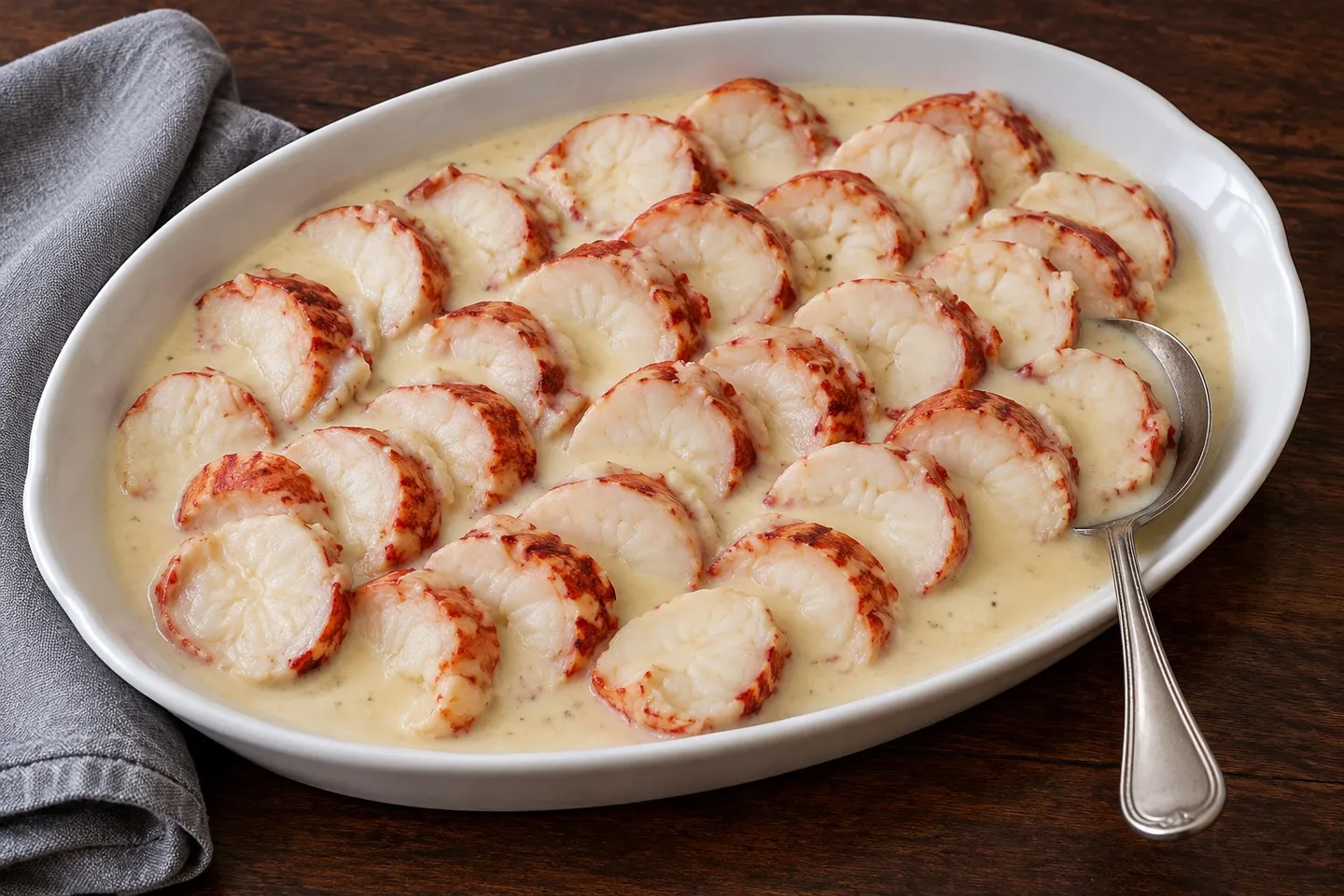
Lobster with Sauternes (1907)
Reader ratingsLobster with Sauternes, after Escoffier’s lobster Newburg of 1907: slices of poached lobster warmed in butter, glazed with the wine and finished in a cream and egg-yolk sauce.
- Recipe makes
- 4 servings
- Prep
- Cook
- Total
Poach and slice the lobster first; the sauce takes about 15 minutes once the slices are in the pan. Serve it at once, since a cream and egg-yolk sauce can’t be reheated hard.
Slices of lobster tail in a pale Sauternes cream sauce.
The story behind the recipe
Auguste Escoffier had a rule for dishes cooked in a fine wine: “the name of the wine may be mentioned, and on the menu may be written Sole au Barsac, Sole au Château-Yquem.” Air France’s Concorde card for Paris to Washington follows it with Homard au Sauternes, lobster with the sweet white wine of Bordeaux, third after the caviar and a truffled duck. The card names the dish and gives no method, so this version is put together from the nearest dish in Escoffier’s A Guide to Modern Cookery (London, 1907), with the card’s wine in it.
What did Escoffier do with lobster and wine?
He gives lobster Newburg two ways. One starts from live lobster cut up and fried in its shell; the other from lobster cooked beforehand in court-bouillon, the tail meat sliced, warmed in plenty of butter until the outer membrane turns red, then moistened with wine almost to cover and boiled until the wine has nearly gone. Cream and two egg yolks go over the slices at the end, stirred by the fire until the yolks thicken it. He calls the second way “the more correct.”
His wine for that Newburg is Madeira. Sauterne turns up elsewhere in the book: he braises a salmon steak and a stuffed trout in it, and lists Sole au Sauterne and a Sole au Chateau Yquem, named for Château d’Yquem in Sauternes, among the variations on sole poached in champagne. Lobster never gets the same treatment in his book, so the pairing here is the card’s.
Read more about this recipe
Making it today
Swapping Sauternes for his Madeira follows the card, the one ingredient it names. Raw lobster tails stand in for a whole lobster, poached in salted water in place of his court-bouillon. Escoffier’s finish is a pint and a quarter of cream for one lobster; we use a cup for four servings, with his two yolks. He pours in wine almost to cover; a smaller measure of Sauternes is enough here, since it reduces almost to a glaze, as his Madeira does, before the cream goes in.
Two places further down the card sat a dish whose name may belong to a bean, Mushrooms Princesse (1907).
Cook the lobster in court-bouillon. Remove the shell from the tail; take the meat therefrom, and cut it into regular slices. ...
Recipe makes: 4 servings
Ingredients
For 4 servings. Quantities are shown as written.
Quantities as written here, for 4 servings.
- Water, for poaching4 quart
- Salt, for the poaching water2 tbsp
- Raw lobster tails in the shell (about 4 tails)1.5 lb
- Unsalted butter3 tbsp
- Salt, for the lobster1/2 tsp
- Cayenne pepper1/8 tsp
- Sauternes3/4 cup
- Heavy cream1 cup
- Egg yolks2
Measurement notes
Ingredients as written here
- 4 quarts water, for poaching
- 2 tbsp salt, for the poaching water
- 1 1/2 lb raw lobster tails in the shell (about 4 tails)
- 3 tbsp unsalted butter
- 1/2 tsp salt, for the lobster
- 1/8 tsp cayenne pepper
- 3/4 cup Sauternes
- 1 cup heavy cream
- 2 egg yolks
Equipment
- Large pot
- Kitchen shears
- Large sauté pan
- Small bowl and whisk
 Instant-read thermometer
- Warmed serving dish
Instructions
Bring the water for poaching to a boil in the large pot with the salt for the poaching water.
Lower in the lobster tails and poach them at a gentle boil for 3 to 4 minutes, until the shells are bright red and the meat has turned white at the cut end; it finishes cooking in the sauté pan. Lift them out and let them cool for 5 minutes.
Cut down the underside of each shell with kitchen shears, open it and pull out the meat in one piece. Remove the dark vein if there is one. Cut the meat into slices about ½ inch thick.
Melt the butter in the sauté pan over medium heat. Lay in the lobster slices in one layer, season them with the salt for the lobster and the cayenne, and warm them for about 1 minute on each side, until the red outer edge brightens.
Pour in the Sauternes and let it bubble for 6 to 8 minutes, turning the slices once, until the wine has reduced to a few spoonfuls of glaze. The lobster is done when it is opaque all the way through and reads 145°F (63°C) in the thickest slice.
Whisk the cream with the egg yolks in the small bowl. Turn the heat to low and pour the mixture over the lobster.
Stir gently and keep the pan just below a simmer for 3 to 5 minutes, until the sauce coats the back of a spoon and reads 160°F (71°C). Don’t let it boil, or the yolks will curdle.
Taste the sauce for salt and serve at once in the warmed dish.
Nutrition
420calories per serving
- Recipe makes
- 4 servings
- Servings
- 4
Estimated per serving (4) from USDA FoodData Central values for cooked lobster meat, butter, heavy cream, egg yolk and sweet dessert wine, with most of the wine’s alcohol assumed reduced away.
Recipe notes
When adjusting quantities
Keep the cream and egg yolks in step with the lobster. For more than 2 lb of tails, warm the slices in two pans so they lie in one layer.
Notes
Quantities mentioned in these notes don’t change when you adjust the servings.
Escoffier’s own wine here is Madeira; use it in place of the Sauternes for his version. He cooks the whole lobster in court-bouillon; if you start from a live lobster, cook it whole and use the tail and claw meat. We set the quantities, the poaching time and the thermometer readings, and use less wine and cream than he does. The sauce won’t hold: make it just before serving, and chill any leftovers within 2 hours. Contains shellfish, milk and eggs.
Scaling changes the ingredients only; pan sizes and cooking times need their own judgment. To adapt this recipe further, try the recipe tool at TuneMyRecipe (opens in a new tab), our sister site.
Sources and attribution
After A. Escoffier, A Guide to Modern Cookery (London, 1907), no. 949, Homard à la New-burg (with the lobster cooked)
See the original pages (scan at Internet Archive) (opens in a new tab)
Recipe details
- Course
- Main course
- Dish family
- Fish & Seafood
- Region
- French
- Era
- Edwardian
- Source decade
- 1900s
- Event
- Concorde, 1978
- Main ingredient
- ShellfishWine & spirits
- Difficulty
- Intermediate
- Occasion
- Dinner party