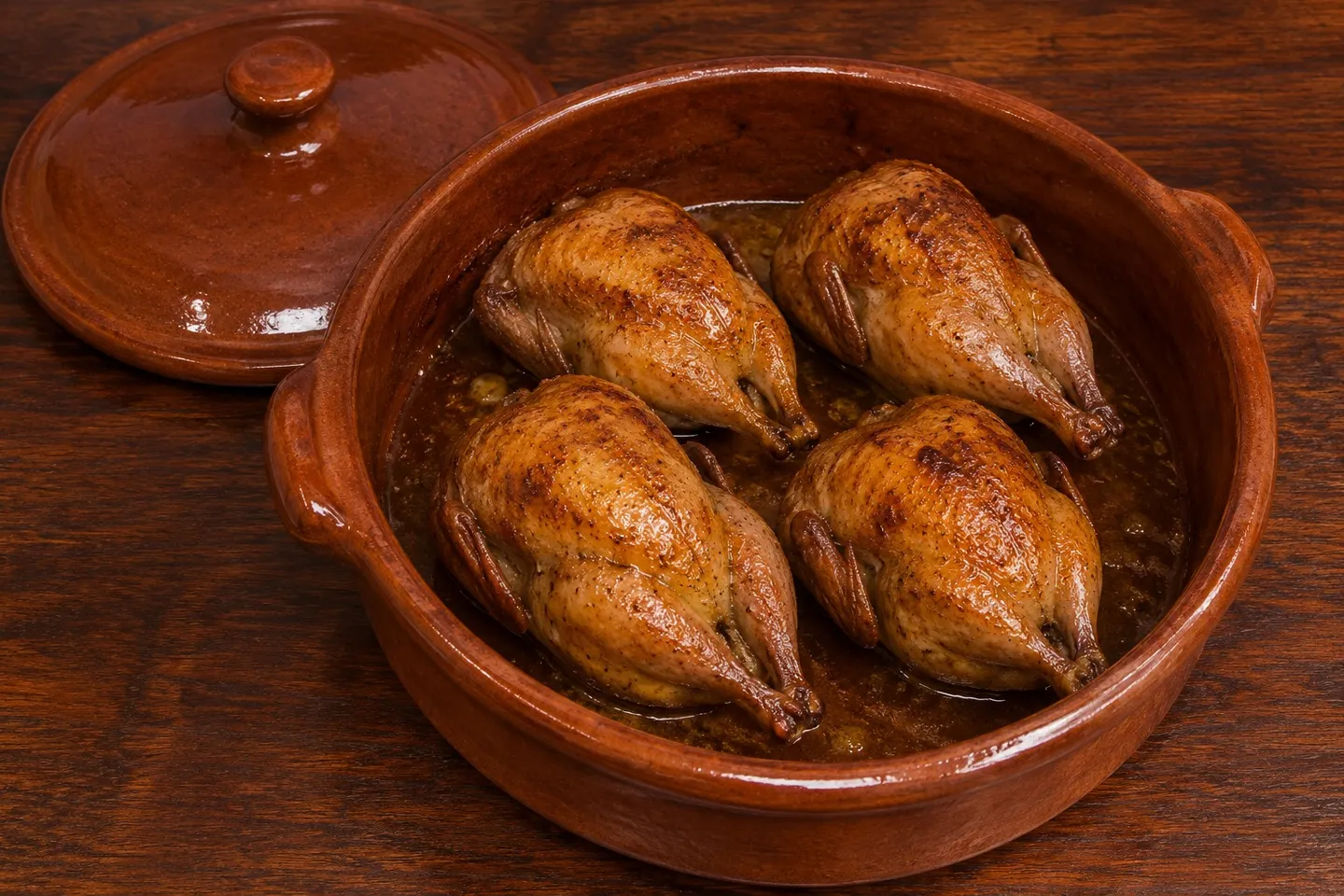
Partridge en Casserole (1907)
Reader ratingsYoung partridges pot-roasted in butter alone in a covered earthenware dish, finished with flamed brandy and game gravy and served in the dish: Escoffier’s en casserole method of 1907.
- Recipe makes
- 4 servings, 1 partridge each
- Prep
- Cook
- Total
Take the birds out of the refrigerator 30 minutes before cooking so they roast evenly. They need about 40 minutes in the oven and 10 minutes more for the brandy and gravy.
Four partridges pot-roasted in butter in an earthenware casserole, with its lid beside it.
The story behind the recipe
Perdreau en Casserole, the main course at Princess Elizabeth’s wedding breakfast in November 1947, is young partridge pot-roasted in butter and brought to the table in the dish it cooked in. Perdreau is the young bird, perdrix the grown one. Escoffier heads his section “Perdrix et Perdreaux,” and every partridge dish he names in it is a perdreau, while old partridges go into his game consommé and, browned, into the cabbage that a young roast partridge is served on.
What does “en casserole” mean?
In Escoffier’s 1907 Guide the phrase names a method, not a stew. The book was forty years old by the wedding, and it is read here for what the words on the card meant to a cook trained in the French kitchen. “En casserole” dishes are poêlings, which he describes as roasts cooked “entirely or almost entirely with butter,” made in earthenware and “served in the same.” Generally, he wrote, they are simply cooked in butter, “without the addition of vegetables”; add small onions, mushrooms or artichoke bottoms and the dish becomes “en cocotte” instead.
He gave no partridge en casserole of his own, and didn’t need to. “All the recipes given for pheasants may be applied to partridge,” he wrote at the head of his partridge recipes, and his pheasant en casserole is brief: truss the bird, cook it in butter only, swill the pan with a few drops of brandy and a tablespoonful of game gravy, cover it and send it to the table at once, as hot as it will go. Feathered game was his one exception to the rule that poêlings take no liquid while cooking: pheasants, partridges and quails may have a little “burnt brandy” added when nearly done.
Read more about this recipe
A dish for November
Partridge was a dish of the season. The bird is shot in autumn, and on 20 November 1947 it had a second merit: game was never rationed in Britain, which CBC News, looking back at royal wedding feasts, gives as the likely reason it was chosen.
Making it today
Our oven is moderate, as his was “not too fierce,” and the lid stays on until the last minutes so the birds cook in their own butter, then comes off to let them color. We flame the brandy in a small pan before pouring it over, which is what “burnt brandy” meant, and use a good stock where he had game gravy. The birds go back into the casserole and to the table in it.
What the wedding card leaves unsaid about each course is in What Was Served at Princess Elizabeth’s Wedding Breakfast in 1947? The ice that followed the partridge was a bombe named for the bride: Strawberry Bombe (1907).
Truss the pheasant as for an entrée, and poêle it in butter only. ...
Recipe makes: 4 servings, 1 partridge each
Ingredients
For 4 servings, 1 partridge each. Quantities are shown as written.
Quantities as written here, for 4 servings, 1 partridge each.
- Oven-ready young partridges (about 4 birds)1.6 kg
- Salt1 tsp
- Ground black pepper1/2 tsp
- Butter100 g
- Brandy3 tbsp
- Game stock or brown chicken stock60 ml
Measurement notes
Ingredients as written here
- 1.6 kg oven-ready young partridges (about 4 birds)
- 1 tsp salt
- 1/2 tsp ground black pepper
- 100 g butter
- 3 tbsp brandy
- 60 ml game stock or brown chicken stock
Equipment
- Earthenware or enameled cast-iron casserole with a lid, just large enough to hold the birds
 Kitchen string
- Small saucepan, for warming the brandy
- Long match or lighter
 Instant-read thermometer
Instructions
Heat the oven to 350°F (180°C). Pat the partridges dry, season them inside and out with the salt and pepper, and tie the legs together with kitchen string so the birds keep their shape.
Melt the butter in the casserole over medium heat. Turn the birds in it until they are coated all over, then set them breast up.
Cover the casserole and put it in the oven. Roast for 25 minutes, basting the birds with the butter in the dish every 10 minutes.
Take off the lid and roast for 10 to 15 minutes more, basting once or twice, until the birds are golden and the thickest part of the thigh reaches 165°F (74°C).
Warm the brandy in the small saucepan, take it off the heat, light it with a long match and pour it, still burning, over the birds. Let the flames die down.
Lift the birds onto a warm plate. Add the stock to the casserole and let it bubble on the stove for 2 minutes, scraping up the browned bits, then spoon off most of the butter.
Snip and remove the strings, return the birds to the casserole, cover it and bring it to the table at once.
Nutrition
560calories per serving
- Recipe makes
- 4 servings, 1 partridge each
- Servings
- 4
Estimated per serving (4) from USDA FoodData Central values for game birds with skin, butter, brandy and stock.
Recipe notes
When adjusting quantities
Allow one young partridge a person, and choose a casserole the birds fit snugly; a dish that is too large burns the butter.
Notes
Quantities mentioned in these notes don’t change when you adjust the servings.
Escoffier’s recipe is for pheasant, and we follow his own instruction to apply it to partridge. The oven temperature, the times and the basting interval are ours; he gives no times for this dish. His game gravy is replaced by game or chicken stock. We take off most of the butter before serving, as his general rule for poêlings directs. Flame the brandy away from anything that can catch, with the extractor fan off.
Scaling changes the ingredients only; pan sizes and cooking times need their own judgment. To adapt this recipe further, try the recipe tool at TuneMyRecipe (opens in a new tab), our sister site.
Sources and attribution
After A. Escoffier, A Guide to Modern Cookery (London, 1907), nos. 1832 and 250, applied to partridge as he directs
See the original pages (scan at Internet Archive) (opens in a new tab)
Recipe details
- Course
- Main course
- Dish family
- Meat & Poultry
- Region
- French
- Era
- Edwardian
- Source decade
- 1900s
- Event
- Royal wedding, 1947
- Main ingredient
- Poultry & game birds
- Difficulty
- Intermediate
- Occasion
- Wedding
- Season
- Autumn