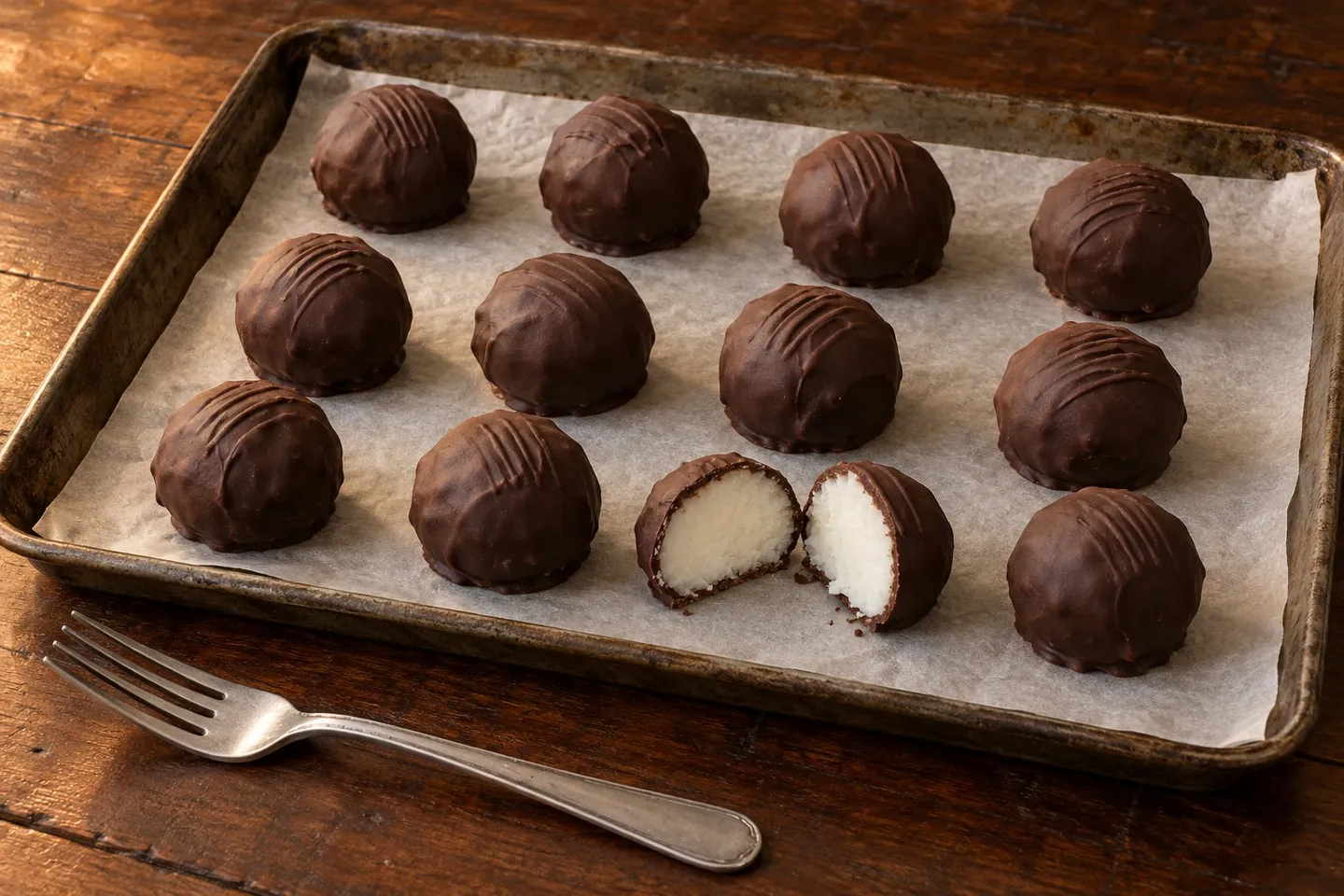
Chocolate Cream Drops (1884)
Reader ratingsBalls of soft white fondant dipped in sweet chocolate melted with a little ground cinnamon, after the chocolate cream drops in an 1884 Chicago candy maker’s trade manual.
- Recipe makes
- About 30 drops, each about 1 inch across
- Prep
- Cook
- Total
Cooking and working the fondant takes about an hour, mostly cooling time. It then rests overnight. The next day, rolling, drying and dipping take about 2 hours, and the chocolate needs about 30 minutes to set.
Chocolate cream drops on waxed paper, one cut to show the white center.
The story behind the recipe
Chocolate creams were on the list of sweets Milly Roseveldt swore off in Elizabeth W. Champney’s Witch Winnie of 1889, along with marshmallows and candied violets. A chocolate cream is a ball of soft white sugar cream in a thin coat of chocolate, and a trade manual of the time shows how a candy shop made one.
The cream comes first
G. V. Frye’s Practical Candy Maker, a Chicago book of 1884, calls his fondant “the basis of all Cream goods.” Twenty pounds of sugar, three quarts of water and a little cream of tartar are cooked to a soft ball, poured onto a wet marble slab and left until nearly cold. A long wooden spatula then works the syrup back and forth until it turns into a smooth white mass, which is kneaded by hand and kept in a crock under a damp cloth. Chocolate cream drops are among the first uses he names for it.
Read more about this recipe
Dipping by hand
For the drops, the cream is rolled into a strip, cut into equal pieces, rolled into balls and left in trays to dry a little. Sweet chocolate is melted in a warmer, a pan set inside a pan of hot water, with “a little ground cinnamon.” Frye pours a cup of it onto a small marble slab kept blood warm by gas jets underneath, rolls the balls through it and drops them by hand onto waxed paper. In summer, he adds, they go into an ice chest to harden.
Making it today
We make a small batch of Frye’s cream, cooked to 238°F (114°C) and worked once lukewarm, as modern fondant recipes do. The chocolate is tempered with a reserved quarter so it sets firm, and we dip with a fork in place of the warm slab. The cinnamon is his. Milly’s own cure, a cake of maple sugar a day, is closest to the Maple Cream Candy (1884). The pledge, and the cordial drops it gave up, are in What Did a Total Abstinence Candy Society Eat Instead?.
The first thing needed is a Chocolate warmer; this consists in a large tin or sheet-iron pan, ...
Recipe makes: About 30 drops, each about 1 inch across
Ingredients
For about 30 drops, each about 1 inch across. Quantities are shown as written.
Quantities as written here, for about 30 drops, each about 1 inch across.
- Sugar2 cups
- Water1/2 cup
- Cream of tartar1/8 tsp
- Semisweet chocolate, chopped8 oz
- Ground cinnamon1/4 tsp
Measurement notes
Ingredients as written here
- 2 cups sugar
- ½ cup water
- ⅛ tsp cream of tartar
- 8 oz semisweet chocolate, chopped
- ¼ tsp ground cinnamon
Equipment
- Small heavy saucepan, 1 to 1½ quarts
- Candy thermometer
- Pastry brush and a cup of water
- Marble slab, or a large rimmed baking sheet
- Bench scraper or wide metal spatula
 Instant-read thermometer
- Plastic wrap
- Baking sheets lined with waxed paper or parchment
- Heatproof bowl set over a pan of hot water
- Dipping fork, or an ordinary fork
Instructions
Wet the marble slab or baking sheet lightly with a little water.
Put the sugar, water and cream of tartar in the saucepan and stir over medium heat until the sugar dissolves. Brush down the sides of the pan with the wet pastry brush to wash away any crystals.
Clip on the candy thermometer (tilt the pan if the tip doesn’t reach the syrup) and boil without stirring until it reads 238°F (114°C), the soft ball stage.
Pour the syrup onto the wet slab at once, without scraping the pan. Leave it alone until it cools to lukewarm, about 105°F (40°C) on the instant-read thermometer, 30 to 45 minutes.
Work the syrup with the bench scraper, folding the edges in and pushing it back and forth across the slab. After 10 to 15 minutes it turns from clear to opaque white and stiffens into a crumbly mass.
Knead it with your hands until it is smooth and soft, like a firm dough. Wrap it tightly in plastic wrap and leave it at room temperature overnight.
Roll the fondant into a rope, cut it into equal pieces and roll each into a ball about 1 inch across. Set them on a lined baking sheet and let them dry for about 1 hour.
Finely chop or grate about a quarter of the semisweet chocolate and set it aside. Melt the rest in the bowl over hot, not boiling, water, stirring, until it is smooth and reads about 120°F (49°C). Take the bowl off the water and stir in the reserved chocolate a little at a time, then the ground cinnamon, until the chocolate is smooth and has cooled to 88°F to 90°F (31°C to 32°C). If it thickens while you dip, set it over the warm water for a few seconds.
Drop one ball at a time into the chocolate, turn it with the fork to coat, lift it out and tap off the extra. Slide it onto a clean lined baking sheet.
Leave the drops in a cool room for about 30 minutes, until the chocolate is firm. In a warm kitchen, chill them for 10 minutes.
Nutrition
75calories per serving
- Recipe makes
- About 30 drops, each about 1 inch across
- Servings
- 30
Estimated per drop from USDA FoodData Central values for sugar and semisweet chocolate, assuming about 5 oz of the chocolate ends up on the drops.
Recipe notes
When adjusting quantities
Fondant works best in small batches at home; for more drops, make a second batch. Some chocolate is always left over after dipping.
Notes
Quantities mentioned in these notes don’t change when you adjust the servings.
Hot sugar syrup causes serious burns, so pour it carefully and keep children away from the slab. If the fondant stays sticky after kneading, it was taken off the heat too soon; the next batch wants a degree or two more. If it is too stiff to roll the next day, knead in a few drops of water. Store the drops somewhere cool and dry, in an airtight box with waxed paper between the layers; warmth or damp leaves a white film on chocolate. Cooling the melted chocolate with the reserved quarter tempers it, so it sets firm and keeps its sheen; chocolate that is only melted sets dull and soft. Many semisweet chocolates contain milk, so check the label if that matters.
Scaling changes the ingredients only; pan sizes and cooking times need their own judgment. To adapt this recipe further, try the recipe tool at TuneMyRecipe (opens in a new tab), our sister site.

Sources and attribution
After G. V. Frye, Frye’s Practical Candy Maker (Chicago, copyright 1884), How to make Chocolate Cream Drops and Cream, or Fondant
Recipe details
- Course
- Dessert
- Dish family
- Desserts & Sweets
- Region
- American
- Era
- 19th century
- Source decade
- 1880s
- Main ingredient
- Chocolate
- Difficulty
- Advanced