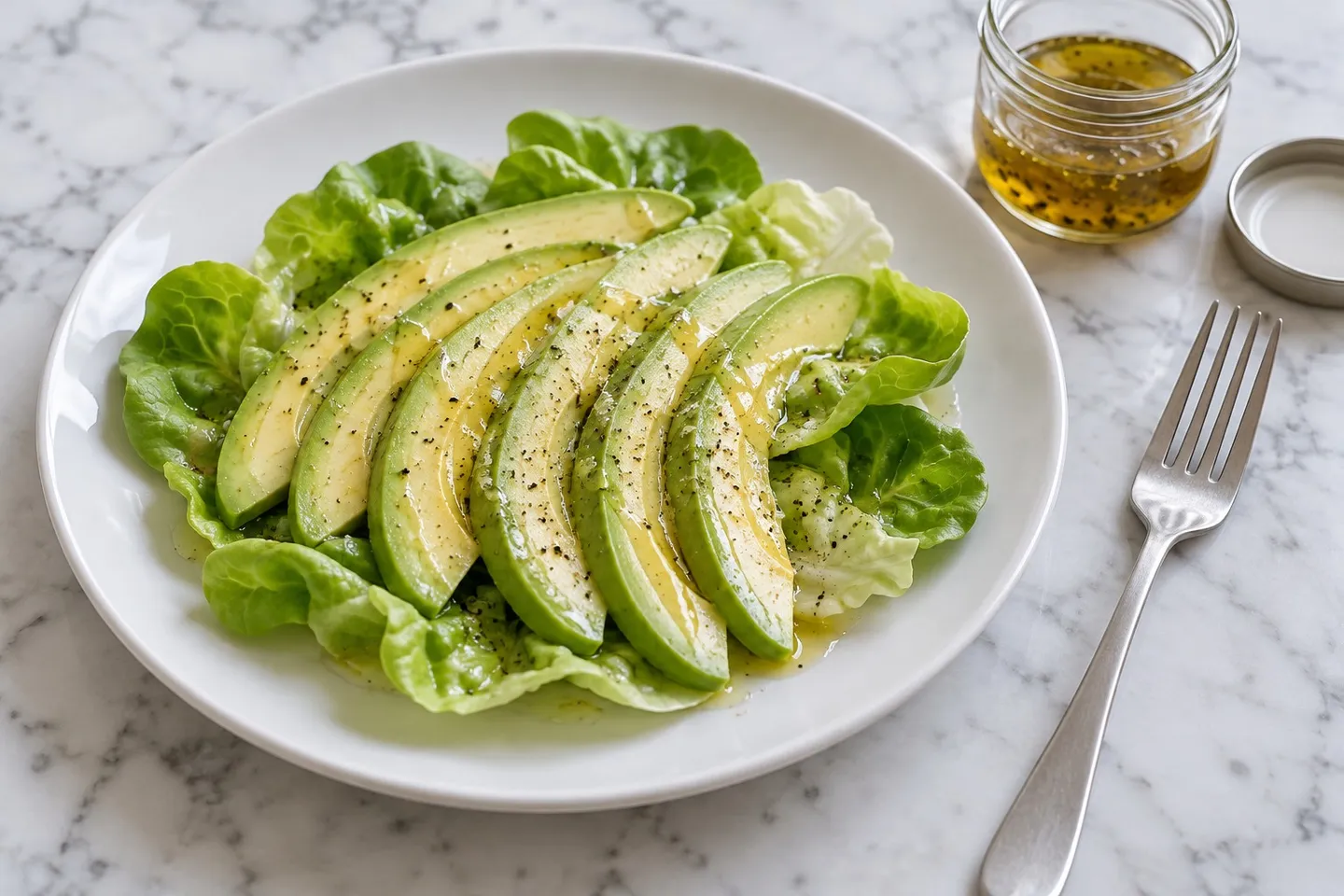
Alligator Pear Salad (1899)
Reader ratingsAlligator pear salad, the 1899 name for avocado: long thin strips served very cold with French dressing and a few drops of onion juice, after De Loup (1899) and Farmer (1910).
- Recipe makes
- 4 servings
- Prep
- Total
Chill the avocados and the plates for half an hour first; cut the fruit only at the last minute, since it darkens once cut.
Avocado strips with French dressing.
The story behind the recipe
The salad that New York served Latin America’s envoys on 27 May 1912 was a fruit from their own side of the world: “Alligator Pears, French Dressing,” just before the ices on the Pan American Society’s menu. The menu names nothing more, so this recipe comes from two American books, from 1899 and 1910: Maximilian De Loup’s American Salad Book of 1899 for the fruit, and Fannie Farmer’s cookbook of 1910 for the dressing.
A fruit with a “senseless name”
De Loup had no patience with what the fruit was called: it “has been given the senseless name of alligator pear by English speaking people,” he wrote, and he called it by its other names, avocado or aguacata. The tree was native to tropical America, and he expected it to reach more tables as the trees spread. The taste for it, “like that for tomatoes, is an acquired one.”
His plainest way was to halve the fruit, take out the large seed, season each half with salt, pepper and vinegar or lemon juice, and eat it with a spoon. That needed plenty of fruit, so “when the fruit is scarce or expensive” he peeled it, cut it into long thin strips and served it with French dressing, with a few drops of onion juice as “a great improvement.” Like all fruit salads, he added, “it should be as cold as possible when served.”
Farmer’s French dressing of 1910 is, she says, “more easily prepared and largely used than any other dressing”: half a teaspoon of salt, a quarter teaspoon of pepper, two tablespoons of vinegar and four of olive oil, shaken in a small cream jar. She also notes that “some prefer” a few drops of onion juice, just as De Loup did.
Read more about this recipe
Making it today
We follow De Loup’s second way, strips with dressing, because it matches the menu’s two words. Lettuce under the strips is our addition for the plate; De Loup serves the strips on their own. Grate a small piece of onion and press it through a fine sieve or a garlic press to get the few drops of juice. On the 1912 menu the salad followed Squab Chicken en Casserole (1910).
Alligator Pear Salad. The Avocado or aguacata which has been given the senseless name of alligator pear by English speaking people, ...
Recipe makes: 4 servings
Ingredients
For 4 servings. Quantities are shown as written.
Quantities as written here, for 4 servings.
- Large ripe avocados, chilled2
- Salt1/2 tsp
- Pepper1/4 tsp
- Vinegar2 tbsp
- Olive oil4 tbsp
- Small piece onion, for a few drops of juice1
- Small head butter lettuce (optional)1
Measurement notes
Ingredients as written here
- 2 large ripe avocados, chilled
- 1/2 tsp salt
- 1/4 tsp pepper
- 2 tbsp vinegar
- 4 tbsp olive oil
- 1 small piece onion, for a few drops of juice
- 1 small head butter lettuce (optional)
Equipment
- Small jar with a lid
- Grater, for the onion juice
- Sharp knife
Instructions
Chill the avocados and the salad plates in the refrigerator for 30 minutes.
Make the dressing. Put the salt, pepper, vinegar and olive oil in the jar, close it and shake until blended.
Grate the onion and press it through a fine sieve or garlic press over a saucer. Shake a few drops of the juice into the dressing and shake again.
If you are using the lettuce, lay a few leaves on each cold plate.
Rinse and dry the avocados. Halve them, remove the seeds and peel the halves. Cut each half lengthwise into long thin strips and arrange them on the plates.
Shake the dressing once more, spoon it over the strips, and serve at once, as cold as possible.
Nutrition
270calories per serving
- Recipe makes
- 4 servings
- Servings
- 4
Estimated per serving from USDA FoodData Central values for avocado, olive oil, vinegar and lettuce.
Recipe notes
When adjusting quantities
Farmer’s dressing keeps the proportion of one part vinegar to two of oil; scale it with the avocados.
Notes
Quantities mentioned in these notes don’t change when you adjust the servings.
De Loup’s other way needs no knife work at all: halve each avocado, take out the seed, and season the cut side with salt, pepper and a few drops of vinegar or lemon juice, to be eaten with a spoon. Farmer allows a tablespoon each of lemon juice and vinegar in place of the two of vinegar.
Scaling changes the ingredients only; pan sizes and cooking times need their own judgment. To adapt this recipe further, try the recipe tool at TuneMyRecipe (opens in a new tab), our sister site.
Sources and attribution
Maximilian De Loup, The American Salad Book (New York, 1899), Alligator Pear Salad; French Dressing from Fannie Merritt Farmer (Boston, 1910)
Recipe details
- Course
- Side dish
- Dish family
- Vegetables & Sides
- Region
- American
- Era
- 19th century
- Source decade
- 1890s
- Main ingredient
- Fruit
- Difficulty
- Easy