The last New Year’s Eve before Prohibition · United States
What Did You Eat on the Last New Year’s Eve Before Prohibition?
By New Year’s Eve 1919 a wartime law already barred selling alcoholic drinks. A 1900 bartender’s manual and a 1920 cookbook show the free lunch that went with the saloon, and a midnight supper.
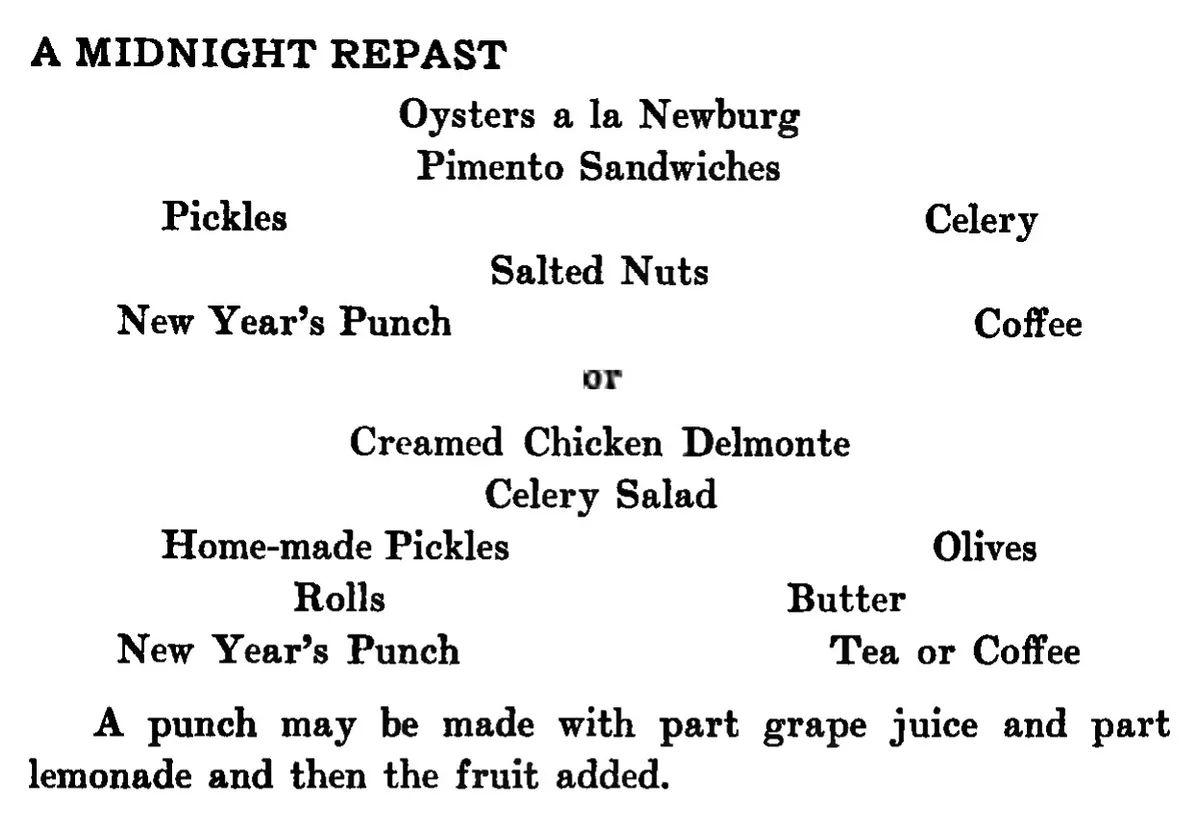
If you followed Mrs. Wilson’s Cook Book, published in Philadelphia in 1920, midnight on New Year’s meant oysters à la Newburg, pimento sandwiches, pickles, celery and salted nuts with a cider punch, or creamed chicken Delmonte in their place. We found no account of what anyone actually ate on December 31, 1919. What is certain is that a bar could no longer lawfully sell beer, wine or spirits for drinking: a wartime law, in force until demobilization ended, had barred those sales (except for export) since July 1, six and a half months before national Prohibition took effect on January 17, 1920, and from October 28 the Volstead Act drew the line at one-half of one percent alcohol. The saloon free lunch that a bartender’s manual of 1900 describes, cheese and crackers in bowls on the counter and sandwiches under a glass cover, belongs to the bar before that.
The saloon free lunch
Harry Johnson, a New York bartender, wrote a manual for his trade that came out in 1900, nineteen years before the night in question and well before the wartime law. One section, number 48, is headed “In Reference to Free Lunch.” It opens by admitting how common the habit had become: “it is now the general custom to serve more or less free lunch to patrons.” His advice is to give less, and give it clean. “Cheese and crackers, however, are always understood to be in separate bowls on the counter,” he writes, “as some people can not drink without a mouthful to eat.”
The rest is housekeeping. A little lunch should be cut at a time and more added “as soon as part of it has been consumed.” Sandwiches go under “a glass bowl, or napkin,” to keep them fresh. A busy house needs “a regular lunchman,” and the lunchman should see that patrons use a fork and not their fingers. The lunch should suit the customers: Germans may like “sauer-kraut” and bologna, Johnson says, and other patrons will not. He adds that “it is really a blessing where the proprietor can avoid giving the free lunch.”
It was not free to the owner. In the sample daily budget on page 51, a saloon pays a lunchman $15.00 a week and sets aside $5.00 a day for “the ‘free lunch’,” out of a day’s total of $86.59. In today’s money the lunchman is roughly $580 a week, the $5.00 roughly $190 and the daily total roughly $3,350.1 The budget does not say what the five dollars bought. His examples are cheese, crackers, sandwiches, sauerkraut and bologna, and that is the saloon food his book documents.
A midnight repast
Mary A. Wilson’s cookbook of 1920 has menus for parties, including one for New Year’s. It begins with an old custom: “In English communities it is the custom to sit up and watch the departing year out and to welcome in the new.” It then gives a “loving cup” of New Year’s punch for fifteen, made of cider, sliced bananas and cut cherries, and a “Midnight Repast” with two alternatives. The first is oysters à la Newburg, pimento sandwiches, pickles, celery, salted nuts, punch and coffee. The second is creamed chicken Delmonte, celery salad, home-made pickles, olives, rolls and butter, New Year’s punch, and tea or coffee.
Her New Year’s entry (p. 484) is headed “For eight couples,” yet the amounts for the punch and the Newburg are for fifteen persons. Her Newburg for the midnight table is one hundred stewing oysters, a quart of their liquor and a quart of milk thickened with flour, onions, pimentoes, eggs and parsley, served “on thick slices of toast.” Elsewhere in the book she gives a smaller Newburg of cream sauce, egg yolks and lemon for twenty-five oysters, which is the one we cook. The pimento sandwiches are rye bread with a seasoned butter and a filling of pimentos, celery, parsley, onion and cottage cheese, cut into triangles. The second menu’s creamed chicken is a stewing hen in a thick stock sauce with pimentos, celery, eggs and lemon, over toast with asparagus tips. Her pickles, celery and salted nuts, her celery salad and her olives, rolls and butter have no recipe on those pages.
What we don’t know
Johnson’s edition is of 1900, and he describes the saloon as a business, with no night in particular. Mrs. Wilson gives menus and amounts, and no account of a party. We have put them side by side because together they show the saloon counter before the dry years and the supper table at home. The dry years that followed are in What Did Americans Cook When the Bars Closed in 1920?, and an English drinks book of 1925 has its own idea of what goes with a cocktail, in What Did You Nibble With a Cocktail in the 1920s?
The recipes
All four come from Mrs. Wilson’s Cook Book. The punch, the sandwiches and the chicken are her own recipes for her midnight menus, on pages 484 to 487, cut down from party amounts. The Newburg is the one dish where we take her other recipe: her midnight menu names the dish and gives a Newburg for fifteen with pimentoes, onions and eggs, and we cook her smaller one from page 414, which has a lemony cream sauce. The modern amounts, times and temperatures are ours.
- Oysters à la Newburg (1920): oysters in a lemony cream and egg-yolk sauce on toast.
- Pimento Sandwiches (1920): rye bread, seasoned butter and a pimento and cottage cheese filling.
- Creamed Chicken Delmonte (1920): poached chicken in a thick stock sauce with pimentos and celery, on toast with asparagus tips.
- New Year’s Punch (1920): fresh cider with sliced bananas and cut cherries.
Cooking it
Of Wilson’s two menus, the chicken one is kinder to a host on the night: the creamed chicken Delmonte is poached and cooled the day before, which leaves only the sauce, the toast and three asparagus tips a plate for the last hour of the year. The punch goes with either menu, and more from the decade is among our 1920s recipes. For what a dry party poured once the bars had closed, Forgotten Drink, our sister site, mixes five alcohol-free drinks for a 1920s party (opens in a new tab).
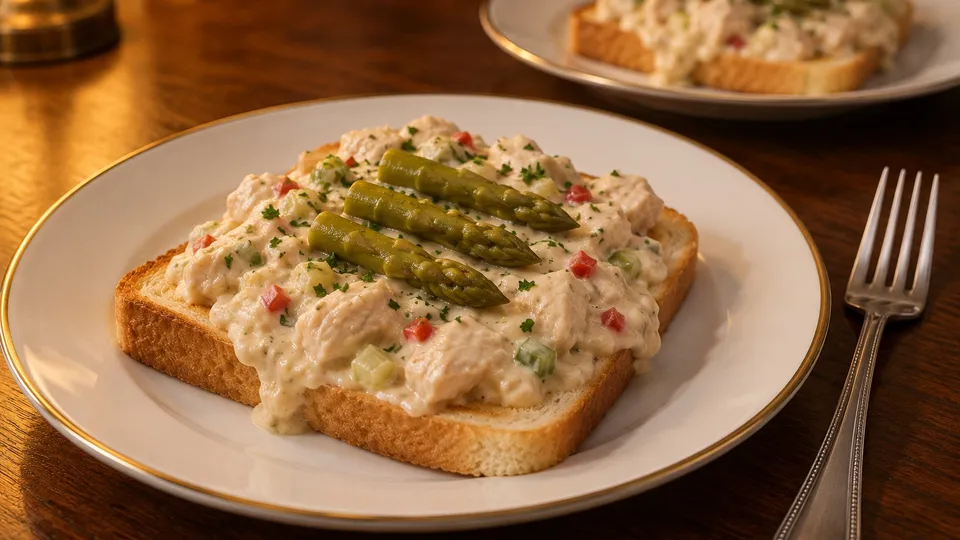 Cook it todayCreamed Chicken Delmonte (1920)
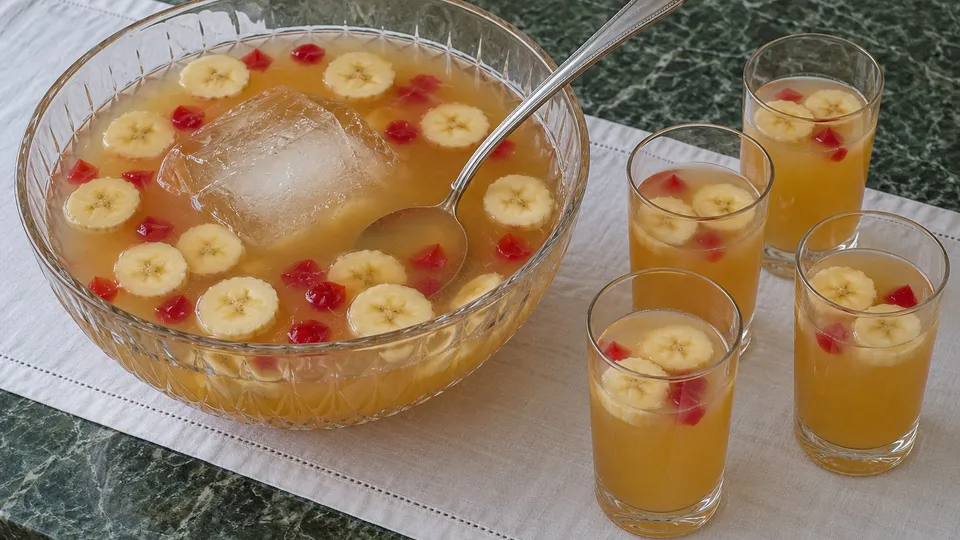 Cook it todayNew Year’s Punch (1920)
1 Equivalents use the Minneapolis Fed’s consumer price index table (1967 = 100), which gives 25 for 1900 and 967.5 for 2025, a factor of about 39. The figure for 1900 is an estimate.
Sources
- Harry Johnson, The New and Improved Illustrated Bartenders’ Manual (New York: Harry Johnson, 1900), pp. 51 and 135–137.
- Hamilton v. Kentucky Distilleries & Warehouse Co., 251 U.S. 146 (1919), on the text of the War-Time Prohibition Act of November 21, 1918 (sales barred after June 30, 1919).
- Ruppert v. Caffey, 251 U.S. 264 (1920), pp. 279–280 and 304, on the wording of the War-Time Prohibition Act, the date its sale ban began, and the Volstead Act’s one-half of one percent definition.
- Mary A. Wilson, Mrs. Wilson’s Cook Book (Philadelphia: J. B. Lippincott Company, 1920; Cornell copy, third printing, undated), pp. 414 and 484 to 487.